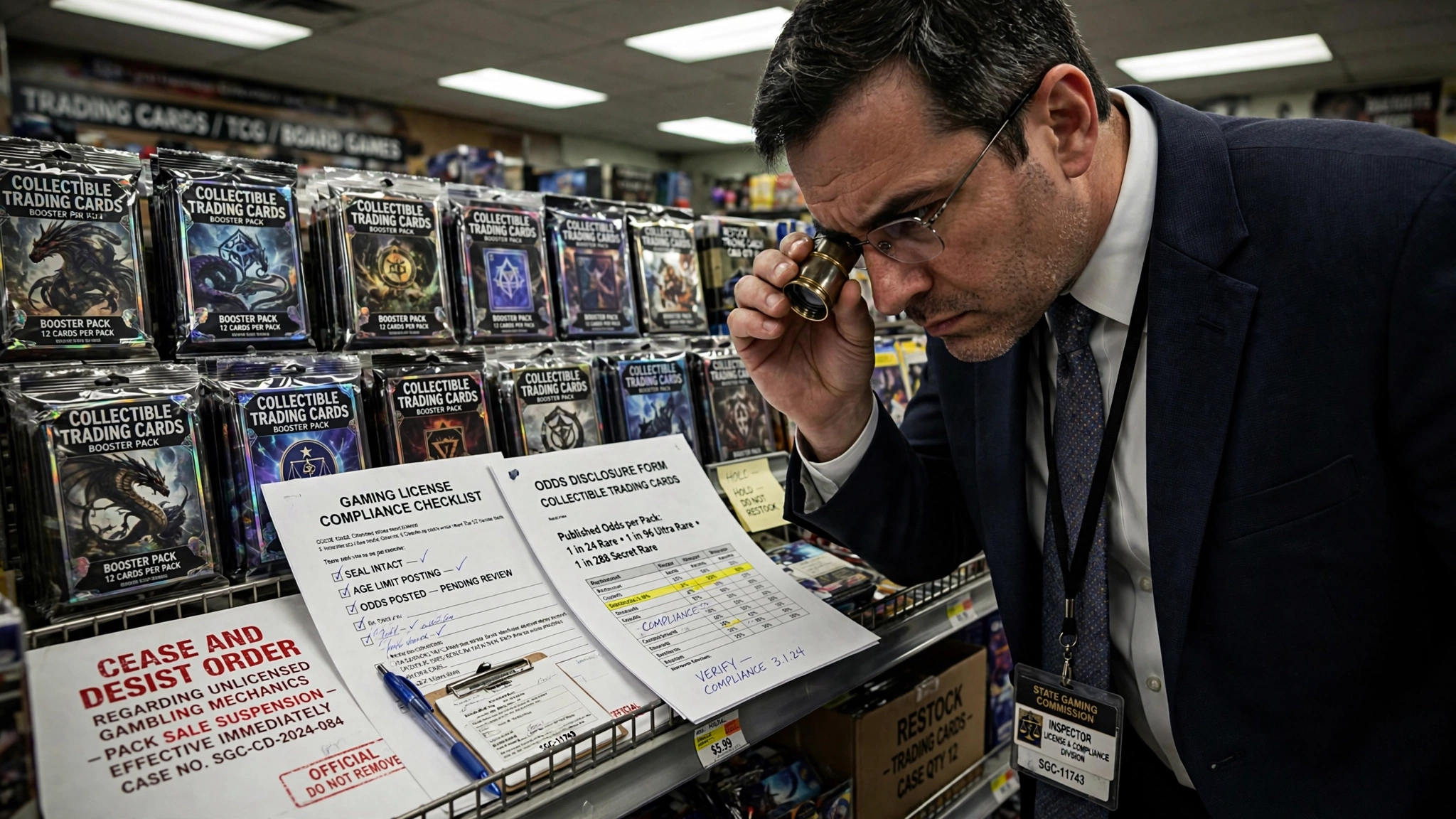
I. The Three-Element Test
The legal definition of a lottery in the United States has been stable for more than a century. In FCC v. American Broadcasting Co., Inc., 347 U.S. 284 (1954), the Supreme Court addressed whether television giveaway programs constituted lotteries within the meaning of 18 U.S.C. § 1304, which prohibits the broadcasting of “any lottery, gift enterprise, or similar scheme.” The Court held that the programs at issue were not lotteries because they lacked the element of consideration: the audience was not required to pay anything to participate. In so holding, the Court affirmed the longstanding three-element test that defines a lottery under federal law: prize, chance, and consideration.1
The test is not novel. It was not invented by the Court. It was inherited from English common law, codified in state constitutions, and applied by state courts for decades before the Supreme Court addressed it. As the court in Commonwealth v. Wall, 295 Mass. 70 (1936), stated: “The essence of a lottery is a chance for a prize for a price.” Three elements. Three words. Prize. Chance. Price.2
This test has been applied by the FCC to broadcast promotions, by the FTC to advertising sweepstakes, by state attorneys general to promotional giveaways, by state gaming commissions to amusement devices, and by the Department of Justice to internet gambling operations. It has been applied to scratch-off tickets, punch boards, bingo cards, raffles, and pull-tab games. It has been applied to digital loot boxes in Belgium, the Netherlands, and Australia. It has never been applied to a sealed pack of Pokémon cards sold at a Target.
We applied it. It fits.
II. Element One: Prize
A prize is anything of value offered to the participant. The element is satisfied whenever the outcome of the transaction yields something whose market value varies depending on which outcome occurs. The value need not be monetary. The value need not be large. The element is present if the thing received has value.
On February 16, 2026, a 1998 Japanese Promo Pikachu Illustrator card, graded PSA Gem Mint 10—the only copy in the world to receive that grade—sold at Goldin Auctions for $16,492,000. The card had been purchased in a private sale in 2021 for $5,275,000. It appreciated 213 percent in less than five years. CNN, Sports Illustrated, Hypebeast, and IGN covered the sale. Guinness World Records certified it as the most expensive trading card ever sold at auction.3
It is not alone at the top. In August 2025, a 2007–08 Upper Deck Exquisite Collection Dual Logoman Autograph card featuring Michael Jordan and Kobe Bryant sold at Heritage Auctions for $12,932,000. In March 2024, a CGC Pristine 10 Alpha Black Lotus from Magic: The Gathering’s 1993 inaugural print run sold in a private auction for $3,000,000. In 2025, a 1986–87 Fleer #57 Michael Jordan rookie card, PSA 9 with a PSA 10 autograph, sold at JOOPITER for $2,500,000.4
These are individual cards. Each was originally distributed inside a sealed pack. Each pack retailed for a price that would not cover a fast-food lunch. The 1998 Pikachu Illustrator was a promotional card distributed as a prize in a CoroCoro Comic illustration contest; only 39 copies were officially produced. The Alpha Black Lotus was one of approximately 1,100 copies printed in the Alpha edition of Magic: The Gathering in 1993, distributed randomly in $2.45 booster packs. The Michael Jordan Fleer rookie was one of an estimated 17,000 copies included in 36-card wax packs that retailed for approximately $0.45 each.5
The question is not whether trading cards have value. Heritage Auctions, Goldin, PWCC, and eBay process billions of dollars in trading card transactions annually. Professional Sports Authenticator, Beckett Grading Services, and Certified Guaranty Company operate industrial-scale authentication and grading facilities that evaluate the condition of individual cards and assign grades that directly determine their market price. The question has never been whether the contents of a sealed pack constitute a prize. The question is why no one has noticed that they do.
III. Element Two: Chance
Chance is the element that distinguishes a lottery from a sale. In a sale, the buyer knows what they are purchasing. In a lottery, the buyer does not. The outcome is determined by a process the buyer cannot control, predict, or observe.
A sealed pack of collectible trading cards is, by design, a transaction in which the buyer does not know what they are purchasing. The manufacturer determines the contents of each pack through a collation process—a mechanical sorting operation at the printing facility that distributes cards of varying rarity into sealed packaging according to a predetermined ratio. The manufacturer knows the ratio. The retailer does not. The consumer does not. The pack is sealed. The contents are hidden. The outcome is unknown until the pack is opened.
Modern trading card sets are organized into explicit rarity tiers. The Pokémon Trading Card Game, manufactured by The Pokémon Company, uses a rarity system that includes Common, Uncommon, Rare, Holo Rare, Ultra Rare, Secret Rare, Special Art Rare, and Hyper Rare designations. Each tier appears in sealed packs at a different frequency. The manufacturer controls the collation algorithm. The manufacturer does not disclose it.6
Magic: The Gathering, published by Wizards of the Coast (a subsidiary of Hasbro, Inc.), uses a parallel system of Common, Uncommon, Rare, and Mythic Rare. Wizards of the Coast has disclosed that Mythic Rare cards appear approximately once in every eight packs in standard booster products. This is the closest any major trading card manufacturer has come to disclosing odds. It is approximately the level of transparency one would expect from a carnival game operator who tells you the big prize exists somewhere on the wall.
Panini America, Upper Deck, Topps (now a division of Fanatics), and dozens of other manufacturers produce sports trading cards organized into rarity tiers that include numbered parallels, autographed inserts, and one-of-one “superfractor” cards. A “hobby box” of Panini Prizm basketball cards retails for $300 to $500 and contains a specified number of packs, each with a specified number of cards, with the manufacturer guaranteeing a certain number of autographed or numbered inserts per box. The buyer knows that the box contains at least one autographed card. The buyer does not know which player signed it, what the card is worth, or whether the autograph belongs to a future Hall of Famer or a player who will be out of the league in two seasons.
The randomization is not incidental to the product. It is the product. The entire business model of the collectible trading card industry is premised on the proposition that the consumer pays a fixed price for an unknown outcome. The industry does not dispute this. It celebrates it. The Pokémon Company’s advertising depicts the moment of opening a pack as an event—the “pull.” YouTube channels devoted to pack-opening content generate hundreds of millions of views. The emotional experience of discovering what is inside the sealed package is the reason people buy sealed packages instead of purchasing individual cards on the secondary market at their known market price.
This is not a purchase. It is a wager dressed in cardboard.
IV. Element Three: Consideration
Consideration is the element that separates a lottery from a sweepstakes. A sweepstakes offers prizes by chance, but it does not require the participant to pay. A lottery requires payment. The Supreme Court in FCC v. ABC held that the giveaway programs at issue were not lotteries precisely because the audience was not required to furnish consideration: listening to a broadcast did not constitute payment.7
A sealed pack of Pokémon cards retails for $4.49. A booster box containing 36 packs retails for approximately $143.64. A Panini Prizm hobby box retails for $300 to $500. An Upper Deck hockey hobby box retails for $150 to $400. A box of Topps Chrome baseball retails for $200 to $350. These are not free. They are not promotional. They are not distributed to listeners of a radio program. They are sold, at retail, for cash, in a store, from a shelf, next to the candy and the magazines.
The consumer furnishes consideration—United States dollars—in exchange for a sealed package whose contents are unknown and whose value is determined by a random process controlled by the manufacturer. The element of consideration is not ambiguous. It is printed on the price tag.
V. The Federal Prohibition
Title 18 of the United States Code, Section 1302, provides as follows:
“Whoever knowingly deposits in the mail, or sends or delivers by mail: Any letter, package, postal card, or circular concerning any lottery, gift enterprise, or similar scheme offering prizes dependent in whole or in part upon lot or chance… Shall be fined under this title or imprisoned not more than two years, or both; and for any subsequent offense shall be imprisoned not more than five years.”8
The statute was enacted in its original form as part of the Act of March 4, 1909. Its constitutionality was upheld by the Supreme Court in Ex parte Jackson, 96 U.S. 727 (1878), and again in In re Rapier, 143 U.S. 110 (1892). The related prohibition on interstate transportation of lottery tickets at 18 U.S.C. § 1301 was upheld in Champion v. Ames (The Lottery Case), 188 U.S. 321 (1903). The federal anti-lottery statutes are among the oldest and most consistently upheld federal criminal prohibitions in American law.9
The statute prohibits the mailing of “any package… concerning any lottery, gift enterprise, or similar scheme offering prizes dependent in whole or in part upon lot or chance.” A sealed pack of trading cards is a package. It contains prizes. The prizes are dependent upon chance. It is mailed. Amazon.com, TCGPlayer.com, eBay, Walmart.com, and every online trading card retailer in the United States ships sealed packs of randomized trading cards through the United States Postal Service, through United Parcel Service, and through FedEx. The USPS processed 7.3 billion packages in fiscal year 2024. An unknown but substantial fraction of those packages contained sealed randomized card products.10
Section 1301 of the same chapter provides: “Whoever brings into the United States for the purpose of disposing of the same, or knowingly deposits with any express company or other common carrier for carriage, or carries in interstate or foreign commerce any paper, certificate, or instrument purporting to be or to represent a ticket, chance, share, or interest in or dependent upon the event of a lottery, gift enterprise, or similar scheme offering prizes dependent in whole or in part upon lot or chance… Shall be fined under this title or imprisoned not more than two years, or both.” A sealed trading card pack is an instrument representing a chance in a scheme offering prizes dependent upon chance. It is carried in interstate commerce by common carriers. It is imported from Japan, Belgium, and other countries where the cards are printed.11
The statute does not contain an exception for packages that also contain cardboard. It does not contain an exception for packages sold in retail stores rather than at gambling establishments. It does not contain an exception for packages purchased by children. It does not contain an exception for packages that are “fun.” It contains a prohibition and a penalty. The prohibition has been enforced against private lottery operators for 148 years. It has not been enforced against the Pokémon Company for a single day.
VI. The Odds Disclosure Asymmetry
Every state that operates a lottery requires, by statute or regulation, that the odds of winning be disclosed to the consumer before the purchase is made.
The Washington State Lottery Commission requires under WAC 315-06-040 that “the estimated probability of purchasing a winning ticket shall be conspicuously displayed on” the tickets themselves, all printed promotional and advertising materials, television and radio commercials, and how-to-play brochures. The Minnesota State Lottery Act at § 349A.09 requires that “a prominent and clear statement of the approximate odds of winning each prize” be included on every brochure, pamphlet, or other material published to promote or explain any lottery game, and that each retailer “must post prominently at or near the point of ticket sale a notice… of the approximate odds of winning each prize in each game.” The Texas Lottery Commission requires under 16 TAC § 401.302 that “each scratch ticket shall state the overall estimated odds of winning a prize of any kind, including a break-even prize.” North Carolina General Statute § 18C-130 provides that “all advertising promoting the sale of lottery tickets or shares for a particular game shall include the actual or estimated overall odds of winning the game.”12
These requirements exist because the legislatures of these states understood that when a consumer pays money for a chance at a prize, the consumer is entitled to know the probability of receiving that prize. This is not a radical principle. It is the foundational consumer protection premise of every regulated gaming jurisdiction on Earth. It applies to casinos, racetracks, slot machines, bingo halls, sports betting platforms, daily fantasy sports contests, and state lottery scratch-off tickets. It applies to every game of chance in which a consumer furnishes consideration for an uncertain outcome.
It does not apply to a $4.49 pack of Pokémon cards.
The Pokémon Company does not disclose the probability of pulling a Special Art Rare card from a sealed pack. Topps does not disclose the probability of pulling a numbered parallel from a hobby box. Panini America does not disclose the probability that the guaranteed autographed card in a $400 hobby box will feature a specific player. Upper Deck does not disclose the probability of pulling a Young Guns rookie card from a specific position in a retail pack. No major trading card manufacturer in the United States publishes odds on its packaging, in its advertising, on its website, or in any disclosure document filed with any regulatory agency at any level of government.
A consumer who purchases a $30 scratch-off lottery ticket in the state of Texas will find, printed on the back of the ticket, the overall odds of winning any prize (typically around 1 in 3.33) and the complete prize structure showing the number of prizes at each denomination and the odds of winning each. A consumer who purchases a $400 hobby box of basketball cards will find, on the back of the box, a list of the total number of cards in the set, the number of packs in the box, and the manufacturer’s guarantee of a certain number of inserts. The consumer will not find the odds of pulling any specific card. The consumer will not find the probability that the autographed card will belong to a player whose signature is worth $5,000 rather than a player whose signature is worth $3. The manufacturer knows this probability. The manufacturer controls it. The manufacturer does not disclose it.
VII. The International Precedent
The United States is not the only country in which randomized consumer products raise questions under gambling law. It is merely the only major economy that has answered those questions by not asking them.
In April 2018, the Belgian Gaming Commission completed a five-month investigation into loot box mechanics in four video games: Star Wars Battlefront II, FIFA 18, Overwatch, and Counter-Strike: Global Offensive. The Commission applied the existing Belgian gambling law definition, which—like the American three-element test—requires a wager, an element of chance, and a prize. The Commission found that three of the four games (all except Battlefront II, which had already removed its loot box system) violated Belgian gambling legislation. Belgium’s Minister of Justice, Koen Geens, demanded immediate removal of the offending mechanics, citing potential fines of €800,000 and imprisonment. Blizzard Entertainment removed paid loot boxes from the Belgian editions of Overwatch and Heroes of the Storm. EA Sports removed FIFA Points from the Belgian version of FIFA.13
The Dutch Gaming Authority reached a similar conclusion in the same month, finding that loot boxes in four of ten investigated games constituted illegal gambling because items could be traded or sold outside the game, giving them independent economic value.14
A loot box is a digital sealed pack. The consumer pays real currency (or premium virtual currency purchased with real currency) to receive a randomized selection of virtual items of varying rarity and desirability. The mechanic is identical in structure to a physical trading card pack. The consumer pays a fixed price. The contents are determined by a random number generator controlled by the publisher. The outcome is unknown until the box is opened. The only difference between a loot box and a booster pack is the medium: one is digital, and the other is printed on cardboard and wrapped in foil.
The Belgian Gaming Commission understood this. It applied the same legal analysis to digital randomized rewards that the three-element lottery test applies to physical randomized rewards. It concluded that the mechanic is gambling. Belgium banned it. The United States did not ban the digital version. It did not notice the physical version. The physical version has been operating at scale since 1933, when Goudey Gum Company began inserting baseball cards into gum packages and consumers began buying the packages for the cards instead of the gum.
VIII. The FTC’s Own Workshop
The Federal Trade Commission is aware that randomized reward mechanics raise consumer protection concerns. It held a public workshop on the subject.
On August 7, 2019, the FTC convened “Inside the Game: Unlocking the Consumer Issues Surrounding Loot Boxes” at its offices in Washington, D.C. The workshop examined the consumer protection implications of video game loot boxes and microtransactions across three panels. Panelists discussed manipulative monetization mechanics, the psychological drivers of loot box spending, and the adequacy of industry self-regulation. The workshop generated a public comment docket and was attended by industry representatives, consumer advocates, and academic researchers.15
In August 2020, the FTC published a staff perspective paper summarizing the workshop’s findings. The paper identified concerns about confusing or manipulative disclosures, pressure to spend, impacts on children, and the lack of odds transparency. It noted that “some monetization schemes may obscure real transaction costs” and that “players may not understand their chances of winning a particular item.” It observed that emerging research was providing new insights. It encouraged industry self-regulation.16
The FTC did not recommend government regulation. It did not propose a rulemaking. It did not issue an enforcement action. It did not refer the matter to the Department of Justice for prosecution under 18 U.S.C. § 1302 or any other statute. It published a paper and moved on.
The paper addressed digital loot boxes. It did not address physical trading card packs. The distinction is notable because physical trading card packs are the original loot box. They predate digital loot boxes by eighty years. They satisfy the three-element lottery test more cleanly than digital loot boxes do, because the physical secondary market for trading cards is more liquid, more transparent, and more established than any secondary market for digital game items. A PSA-graded Pokémon card has a market price that can be verified on eBay in thirty seconds. Its value is denominated in United States dollars. It can be resold, gifted, insured, appraised, and included in a taxable estate. The “prize” element is not ambiguous. It is listed on a certificate of authenticity issued by a professionally staffed grading company.
The FTC held a workshop on the new version of the product. It has never held a workshop on the old version. The old version moves more money.
IX. The Scale of the Enterprise
The global trading card market was valued at approximately $13 billion in 2024. The U.S. trading card market was valued at $5.9 billion in 2025, with physical cards accounting for 88.6 percent of sales. Grand View Research projects the U.S. market will reach $10.2 billion by 2033 at a compound annual growth rate of 7.2 percent.17
The Pokémon Company reported net sales of ¥410.9 billion ($2.9 billion) for its fiscal year ending February 28, 2025—a 38 percent increase from the prior year and the company’s highest revenue in its history. The company has sold more than 64 billion individual trading cards over the life of the franchise. Its mobile app Pokémon TCG Pocket surpassed 100 million downloads in its first four months and generated over $1 billion in gross player spending in its first seven months. The app is a digital simulation of opening sealed packs of randomized cards. It charges real money. It discloses no odds.18
Fanatics, which acquired Topps in January 2022 for a reported $500 million, holds exclusive licensing agreements with Major League Baseball, the National Football League, the National Basketball Association, the National Hockey League, and Formula 1. The company produces sealed packs and boxes of randomized trading cards featuring the athletes of every major professional sports league in the United States. Panini America, until its licensing agreements expired, produced billions of individual trading cards distributed in sealed packs across more than forty countries.19
For comparison: in fiscal year 2024, the forty-eight U.S. state and territorial lottery commissions that operate state lotteries generated approximately $113 billion in total ticket sales, according to the North American Association of State and Provincial Lotteries. The lotteries returned approximately $28.5 billion in net revenue to their respective state treasuries. Every dollar of this revenue was generated by the sale of tickets to a game of chance in which the odds of winning are disclosed on the ticket, at the point of sale, in all advertising, and on the lottery commission’s website, as required by statute in every operating jurisdiction.20
The trading card industry generates $5.9 billion in annual U.S. revenue from the sale of sealed packages whose contents are determined by a random process and whose value varies by orders of magnitude depending on the outcome of that process. The state lottery industry generates $113 billion from the sale of tickets whose contents are determined by a random process and whose value varies by orders of magnitude depending on the outcome of that process. The lottery industry is regulated. The trading card industry is not. The lottery industry discloses its odds. The trading card industry does not. The lottery industry is operated by state governments. The trading card industry is operated by private corporations. The legal framework that governs both is the same three-element test. One of them has been applied.
X. The Regulatory Confession
The most instructive evidence that trading card packs satisfy the lottery definition comes, as it often does, from the regulators who have declined to act.
Section 1307(d) of Title 18 provides an exemption from the anti-lottery statutes for “an occasional and ancillary activity by a commercial organization” that is “not the primary business of that organization.” Congress enacted this exemption in 1975 to permit businesses to run promotional sweepstakes. The exemption presupposes that the underlying activity would otherwise fall within the prohibition. You do not write an exemption for something that does not fall within the requirement.21
The trading card industry cannot avail itself of the § 1307(d) exemption. The randomized distribution of collectible items is not an “occasional and ancillary activity” of the Pokémon Company. It is the primary business of the Pokémon Company. It is the primary business of Fanatics Trading Cards. It is the primary business of every company in the industry. The exemption exists. The industry does not qualify for it. The prohibition, therefore, applies.
Consider the regulatory posture of a single product: a $5 scratch-off lottery ticket sold by the Texas Lottery Commission and a $4.49 booster pack of Pokémon Scarlet & Violet sold at a Walmart in Dallas.
The scratch-off ticket is printed by a licensed vendor under contract with the state. Its prize structure has been reviewed and approved by the Texas Lottery Commission. The odds of winning each prize denomination are published on the back of every ticket. The overall odds of winning any prize are printed on the ticket and posted at every retail location. The retailer is licensed by the Commission. The retailer must verify the age of the purchaser. The Commission publishes monthly reports of prizes claimed and remaining. The Commission conducts audits. The Commission maintains a 24-hour problem gambling hotline. The revenue from the ticket sale is distributed to the Foundation School Fund and the Fund for Veterans’ Assistance.22
The Pokémon booster pack is manufactured by The Pokémon Company International, a subsidiary of The Pokémon Company, headquartered in Tokyo. Its prize structure is proprietary. The odds of pulling any specific card are not disclosed on the packaging, in advertising, on the company’s website, or in any regulatory filing. The retailer is not licensed by any gaming authority. The retailer does not verify the age of the purchaser. No state commission reviews or approves the odds. No audit is conducted. No monthly report is published. No problem gambling hotline number is printed on the package. The revenue from the sale is distributed to the shareholders of The Pokémon Company.
Both products cost approximately five dollars. Both products offer prizes dependent upon chance. Both products are sold from the same counter at the same store. One is regulated as a lottery. One is regulated as stationery.
XI. Conclusion
The evidence presented in these pages requires no interpretive leap and no novel legal theory. The three-element lottery test has been the law since before any trading card company existed. Prize, chance, and consideration. A sealed pack of randomized trading cards provides all three.
The prize element is documented by auction houses that have recorded individual card sales at $16.492 million, $12.932 million, $3 million, and $2.5 million. The chance element is intrinsic to the product design: the manufacturer controls the collation, determines the rarity tiers, and does not disclose the probabilities. The consideration element is printed on every price tag at every retailer in the country.
The federal anti-lottery statute at 18 U.S.C. § 1302 prohibits the mailing of “any package concerning any lottery, gift enterprise, or similar scheme offering prizes dependent in whole or in part upon lot or chance.” The USPS delivers billions of packages per year. Some of them contain sealed packs of randomized trading cards ordered from online retailers. No prosecution has been initiated. No investigation has been announced. No cease-and-desist letter has been sent.
Belgium applied its gambling law to digital loot boxes and declared them illegal. The FTC held a workshop and published a paper. State lottery commissions require odds disclosure on every scratch-off ticket sold at every gas station in the country. The Pokémon Company has sold 64 billion trading cards without disclosing the odds of anything, and its fiscal year 2025 revenue was $2.9 billion.
The three-element test is 148 years old. The trading card industry is 93 years old. One of them has noticed the other.
Ergo.
Sources
- Federal Communications Commission v. American Broadcasting Co., Inc., 347 U.S. 284 (1954). The Court held that the broadcast giveaway programs at issue did not constitute lotteries because the audience did not furnish consideration. The opinion affirmed the three-element test: prize, chance, and consideration. supreme.justia.com ↑
- Commonwealth v. Wall, 295 Mass. 70, 3 N.E.2d 28 (1936): “The essence of a lottery is a chance for a prize for a price.” See also NAB Legal Guide to Lotteries and Contests: “Three Elements of a Lottery: The traditional elements of a lottery are (1) prize, (2) chance and (3) consideration. All three elements must be present for there to be a lottery.” ↑
- Logan Paul’s 1998 Japanese Promo Pikachu Illustrator, PSA Gem Mint 10, sold at Goldin Auctions for $16,492,000 in February 2026. Only 39 copies of the card were officially distributed; this is the only copy graded PSA 10. Previously purchased in 2021 for $5,275,000. Guinness World Records certified the sale as the most expensive trading card ever sold at auction. cnn.com ↑
- 2007–08 Upper Deck Exquisite Collection Dual Logoman Autograph (Jordan/Bryant), sold Heritage Auctions, August 23, 2025, $12,932,000. CGC Pristine 10 Alpha Black Lotus (Magic: The Gathering), private auction, March 2024, $3,000,000. 1986–87 Fleer #57 Michael Jordan PSA 9/Auto PSA 10, sold JOOPITER, 2025, $2,500,000. mensjournal.com ↑
- The Pikachu Illustrator was produced as a prize for a CoroCoro Comic illustration contest in 1998; 39 copies distributed. Alpha Black Lotus: approximately 1,100 copies in the Alpha edition of Magic: The Gathering (1993), distributed in $2.45 booster packs. 1986–87 Fleer basketball wax packs retailed for approximately $0.45; estimated 17,000 copies of the #57 Jordan rookie printed. comicbook.com ↑
- The Pokémon Trading Card Game rarity system includes Common (•), Uncommon (♦), Rare (☆), Holo Rare, Ultra Rare, Secret Rare, Special Art Rare (SAR), and Hyper Rare (HR) designations. Pull rates for higher-rarity cards are not disclosed on packaging or in official documentation. See The Pokémon Company International product descriptions and set lists. ↑
- FCC v. American Broadcasting Co., 347 U.S. at 290–94. The Court held that the time spent listening to a broadcast “is not the consideration contemplated by the statute” and that “the consideration which is a prerequisite of a lottery is one which is given for the opportunity of winning a prize.” ↑
- 18 U.S.C. § 1302: “Whoever knowingly deposits in the mail, or sends or delivers by mail: Any letter, package, postal card, or circular concerning any lottery, gift enterprise, or similar scheme offering prizes dependent in whole or in part upon lot or chance… Shall be fined under this title or imprisoned not more than two years, or both; and for any subsequent offense shall be imprisoned not more than five years.” law.justia.com ↑
- Ex parte Jackson, 96 U.S. 727 (1878) (upholding constitutionality of postal anti-lottery statute); In re Rapier, 143 U.S. 110 (1892) (same); Champion v. Ames (The Lottery Case), 188 U.S. 321 (1903) (upholding prohibition on interstate transportation of lottery tickets under the Commerce Clause). justice.gov ↑
- United States Postal Service, Fiscal Year 2024 Annual Report. The USPS processed approximately 7.3 billion packages and shipping pieces in FY2024. Online trading card retailers including TCGPlayer, eBay, Amazon, and manufacturer direct-sales operations ship sealed product through USPS, UPS, and FedEx. ↑
- 18 U.S.C. § 1301: “Whoever brings into the United States for the purpose of disposing of the same, or knowingly deposits with any express company or other common carrier for carriage, or carries in interstate or foreign commerce any paper, certificate, or instrument purporting to be or to represent a ticket, chance, share, or interest in or dependent upon the event of a lottery, gift enterprise, or similar scheme offering prizes dependent in whole or in part upon lot or chance… Shall be fined under this title or imprisoned not more than two years, or both.” ↑
- Washington: WAC 315-06-040 (estimated probability of winning “shall be conspicuously displayed on” tickets, promotional materials, and commercials). Minnesota: § 349A.09 (“prominent and clear statement of the approximate odds of winning each prize”). Texas: 16 TAC § 401.302 (“each scratch ticket shall state the overall estimated odds of winning a prize of any kind”). North Carolina: G.S. § 18C-130 (“all advertising promoting the sale of lottery tickets… shall include the actual or estimated overall odds of winning”). law.cornell.edu ↑
- Belgian Gaming Commission, Loot Box Investigation Report, April 2018. The Commission investigated Star Wars Battlefront II, FIFA 18, Overwatch, and Counter-Strike: Global Offensive. Three of four titles found in violation of Belgian gambling legislation. Minister of Justice Koen Geens demanded removal of loot boxes, citing potential fines of €800,000 and imprisonment. Blizzard removed paid loot boxes from Belgian editions of Overwatch and Heroes of the Storm in August 2018. gamedeveloper.com ↑
- Dutch Gaming Authority (Kansspelautoriteit), investigation results April 2018. The Authority found that loot boxes in four of ten investigated games constituted illegal gambling because items could be traded outside the game, giving them independent economic value. ↑
- FTC, “Inside the Game: Unlocking the Consumer Issues Surrounding Loot Boxes,” public workshop held August 7, 2019, Washington, D.C. Three panels: “Treasure or Trifle? A Macro Look at Microtransactions,” “Head in the Game – What Drives Loot Box Spending,” and “A Level Playing Field – What’s Fair Game?” ftc.gov ↑
- FTC Staff Perspective Paper, “Inside the Game: Unlocking the Consumer Issues Surrounding Loot Boxes,” August 2020. The paper identified concerns about “confusing or manipulative disclosures,” “spending pressure,” “impacts on children,” and “lack of odds transparency.” The FTC did not recommend additional government regulation. ftc.gov ↑
- Grand View Research, “U.S. Trading Cards Market Size & Share Report, 2026–2033.” The U.S. trading card market was valued at $5.9 billion in 2025; physical cards accounted for 88.6% of sales. Projected to reach $10.2 billion by 2033 at a CAGR of 7.2%. Market Decipher estimates global trading card market at $13 billion in 2024. grandviewresearch.com ↑
- The Pokémon Company, fiscal year ending February 28, 2025: net sales ¥410.9 billion ($2.9 billion), up 38.1% YoY; operating profit ¥100.7 billion, first year exceeding ¥100 billion. Lifetime trading card sales exceed 64 billion cards. Pokémon TCG Pocket: 100 million downloads in first four months, $1 billion+ gross player spending in seven months. automaton-media.com ↑
- Fanatics acquired Topps in January 2022. Fanatics holds exclusive trading card licensing agreements with MLB, NFL, NBA, NHL, and Formula 1. Panini America previously held NBA and NFL licenses, producing billions of cards across 40+ countries before licensing transitions. ↑
- North American Association of State and Provincial Lotteries (NASPL), FY2024 data. U.S. state and territorial lotteries generated approximately $113 billion in total ticket sales and returned approximately $28.5 billion in net revenue to state treasuries. All operating jurisdictions require odds disclosure by statute or regulation. ↑
- 18 U.S.C. § 1307(d): Sections 1301–1304 do not apply to “an occasional and ancillary activity by a commercial organization” that is “not the primary business of that organization.” Enacted 1975, expanded by Charity Games Advertising Clarification Act of 1988. The exemption presupposes that the underlying activity falls within the prohibition. ↑
- Texas Lottery Commission: retailers are licensed; age verification is required for purchasers; odds are printed on each scratch ticket per 16 TAC § 401.302; monthly reports of prizes claimed and remaining are published; revenue is distributed to the Foundation School Fund and the Fund for Veterans’ Assistance. law.cornell.edu ↑