I. The Constitutional Framework
The Constitution of the State of Colorado, Article XVI, Section 5, provides:
“The water of every natural stream, not heretofore appropriated, within the state of Colorado, is hereby declared to be the property of the public, and the same is dedicated to the use of the people of the state, subject to appropriation as hereinafter provided.”1
Section 6 continues:
“The right to divert the unappropriated waters of any natural stream to beneficial uses shall never be denied. Priority of appropriation shall give the better right as between those using the water for the same purpose.”2
These provisions have been in force since August 1, 1876. They establish what water lawyers call the Colorado Doctrine, whose central operating principle is commonly summarized as “first in time, first in right”: those holding senior (older) rights receive water before junior (newer) rights in times of shortage.3 The territorial court recognized the principle in Yunker v. Nichols, 1 Colo. 552 (1872); the state supreme court adopted it outright and rejected the competing riparian doctrine in Coffin v. Left Hand Ditch Co., 6 Colo. 443 (1882).4 The United States Supreme Court later applied the doctrine to apportion an interstate stream against a sister state in Wyoming v. Colorado, 259 U.S. 419 (1922), holding that as between appropriations from the same stream, the one first in time is superior in right.5
The doctrine has a corollary that its proponents recite less often. If priority of appropriation gives the better right, then a diversion with no priority date has no right at all. A rain barrel has no priority date. It was manufactured in a factory, purchased at a garden center, and connected to a downspout on a Saturday. It has never appeared before a water court. It holds no decree. Under the plain text of the constitution, the water it intercepts is the property of the public, and the barrel’s operator is not among those to whom the public has granted its use.
II. The Century of Prohibition
For most of Colorado’s history as a state, the conduct described above was not a gray area. It was illegal.
Until 2016, Colorado was the only state in the country where it was illegal for a resident to capture rainwater from a roof for later use.6 The prohibition flowed directly from the constitutional framework: precipitation that falls on a roof would otherwise become runoff tributary to a natural stream, and that stream’s water had already been appropriated, in order of seniority, by parties holding decreed rights. To intercept it at the gutter was to take water belonging, in effect, to someone downstream holding a decree from 1874.
In 2016 the General Assembly passed House Bill 16-1005, signed by Governor John Hickenlooper, creating a narrow statutory exception codified at Section 37-96.5-103, C.R.S.7 The Colorado Division of Water Resources now states the terms of the exception plainly: any single-family residence, or multifamily residence of four or fewer units, may collect precipitation in rain barrels with a combined storage capacity of up to 110 gallons, using no more than two barrels, drawn from the roof of a building used primarily as a residence, for outdoor uses only, on the property where the water was collected.8 No permit is required within these limits. The barrels must have sealable lids.
Note what the statute grants. It grants no water right. It grants no priority date. It grants no decree. It grants a forbearance: the state will not prosecute the interception of up to 110 gallons at a time. A forbearance is not a property interest. It is the state looking the other way, in writing, up to a specified volume.
III. The Arithmetic of the Limit
The 110-gallon figure has the appearance of a strict quantitative ceiling. It is nothing of the sort. It is a ceiling on instantaneous storage, not on diversion, and the distinction swallows the ceiling whole.
The standard engineering estimate, published by sources including the Texas Water Development Board and the Surfrider Foundation, holds that one inch of rainfall on one square foot of impervious surface yields approximately 0.62 gallons of runoff.9 Applied to a modest 1,000-square-foot roof, a single inch of rain produces roughly 600 to 620 gallons of water.10 The two lawful barrels, filled to their combined legal capacity of 110 gallons, therefore capture less than one-fifth of one inch of rain from one modest roof. The remaining 500 gallons overtop the barrels and continue toward the stream, where the constitution says the water belongs.
But the statute permits the barrels to be emptied and refilled without limit. The Division of Water Resources provides that a household “can fill and refill two rain barrels with a combined storage capacity up to 110 gallons throughout the year.”11 The regulatory scheme goes further than permitting the cycle: Colorado requires each rain barrel to be emptied at least once a month.7 The law mandates the very emptying rhythm on which the multi-thousand-gallon seasonal total depends. Colorado State University Extension water specialist Blake Osborn, who conducts workshops instructing homeowners in rain collection, calculates that “a gardener can save about 2,500 gallons of water in a growing season” under the 110-gallon limit.12
Two thousand five hundred gallons. Through two barrels. Under a 110-gallon “limit.” The arithmetic is straightforward: the limit constrains the size of the bucket, not the number of trips to the well. A household that empties and refills its barrels twenty-three times per season diverts nearly twenty-three times the nominal limit, and the statute counts none of it, because the statute measures the container rather than the conduct. If a senior appropriator diverted twenty-three times the volume stated in their decree by the expedient of using a smaller headgate and opening it more often, the water court would not commend their choice of equipment.
IV. The Junior Appropriator Problem
During the 2016 legislative debate, the bill’s opponents stated the constitutional objection in plain language. State Senator Jerry Sonnenberg, representing a rural district on the eastern plains, said: “Anybody that does simple math knows that if you have 10 gallons and you hold up another gallon to use somewhere else where it normally wouldn’t have been used, that is a change to the math and how that goes down the river.”13 He added: “There is an impact. We know that there’s an impact.” He voted against the bill, warning that rain barrels would “steal water from rightful users further downstream.”14
The bill’s proponents answered with a study. Researchers at Colorado State University concluded that temporarily holding small amounts of rainwater would have no impact on the total runoff reaching the state’s streams and would not harm the prior appropriation system.15 The study is routinely cited as having settled the question.
Consider the structure of this settlement. A legislature proposes to exempt a popular practice from a constitutional water regime. A university within that state’s borders produces a study finding that the exemption will not harm the regime. The legislature cites the study. The question is declared settled. At no point does any rain barrel acquire a priority date, submit to adjudication, or receive a decree. The constitutional requirement that priority of appropriation give the better right is satisfied, in effect, by a finding that the violation is small. There is no de minimis exception in Article XVI. The constitution does not say that priority of appropriation shall give the better right except where the junior diversion is modest and the container is blue.
V. The Nevada Precedent
Colorado is not the only prior-appropriation state to have treated the rain barrel as a legal problem. In Nevada, the collection of rainwater was illegal until the 2017 legislative session, when Governor Brian Sandoval signed Assembly Bill 138, amending state law to allow what the statute terms “de minimis collection of precipitation,” codified at NRS 533.027.16 Before that amendment, the state’s position was unambiguous: as the Reno Gazette-Journal summarized it in a headline, using a rain barrel was a violation of Nevada water rights. Short answer: no. Full answer: no, with citations.17
Nevada’s statutory scheme is instructive because it reveals what the law does to unauthorized diverters when it is not in a forgiving mood. Under NRS 533.481, a person found in violation of the state’s water law faces an administrative fine of up to $10,000 per day per violation, replacement of up to 200 percent of the water unlawfully taken, and payment of the costs of the proceeding including investigative costs and attorney’s fees.18 The Division of Water Resources maintains a form titled “Request to Investigate an Alleged Violation” for citizens to report suspected unlawful diversions by their neighbors.19
Apply the penalty structure to the barrel. A 55-gallon barrel, filled and refilled across a 120-day growing season in violation of the appropriation statutes, represents 120 days of violation. At $10,000 per day per violation, the theoretical exposure is $1.2 million per barrel per season, plus 200 percent replacement water, which the barrel operator would presumably owe to the senior appropriator in the form of 110 gallons delivered downstream with interest. The legislature’s decision to instead call the conduct “de minimis” does not change the underlying physics. It changes the enforcement posture. The water still does not reach the stream.
VI. The Utah Registration Regime
Utah legalized rainwater harvesting in 2010 with Senate Bill 32, now codified at Utah Code Section 73-3-1.5.20 The statute permits collection without registration in no more than two covered containers, neither exceeding 100 gallons. Beyond that, a person must register with the State Engineer, providing name, address, location, and total storage capacity; registration then authorizes up to 2,500 gallons.21 Registration is free. It is not an application. It is not approved or denied. It is a notice filed with the state that a person is capturing precipitation within the legal limits.
The statute contains a provision of unusual candor. It states that beneficial use of captured precipitation “does not constitute a water right” and may not be changed, assigned, or consolidated with a water right.22 The State of Utah thus maintains a formal registry of precipitation-capture systems whose legal status the statute defines in the negative: the registrant holds a registered non-right to use water that is not theirs, recorded by the State Engineer, who is the official charged with administering the priority system from which the registrant is exempt. It is a list, kept by the government, of persons the government has decided not to prosecute, each of whom has helpfully supplied their name, address, and storage capacity to facilitate any future change in that decision.
VII. The Unpermitted Impoundment
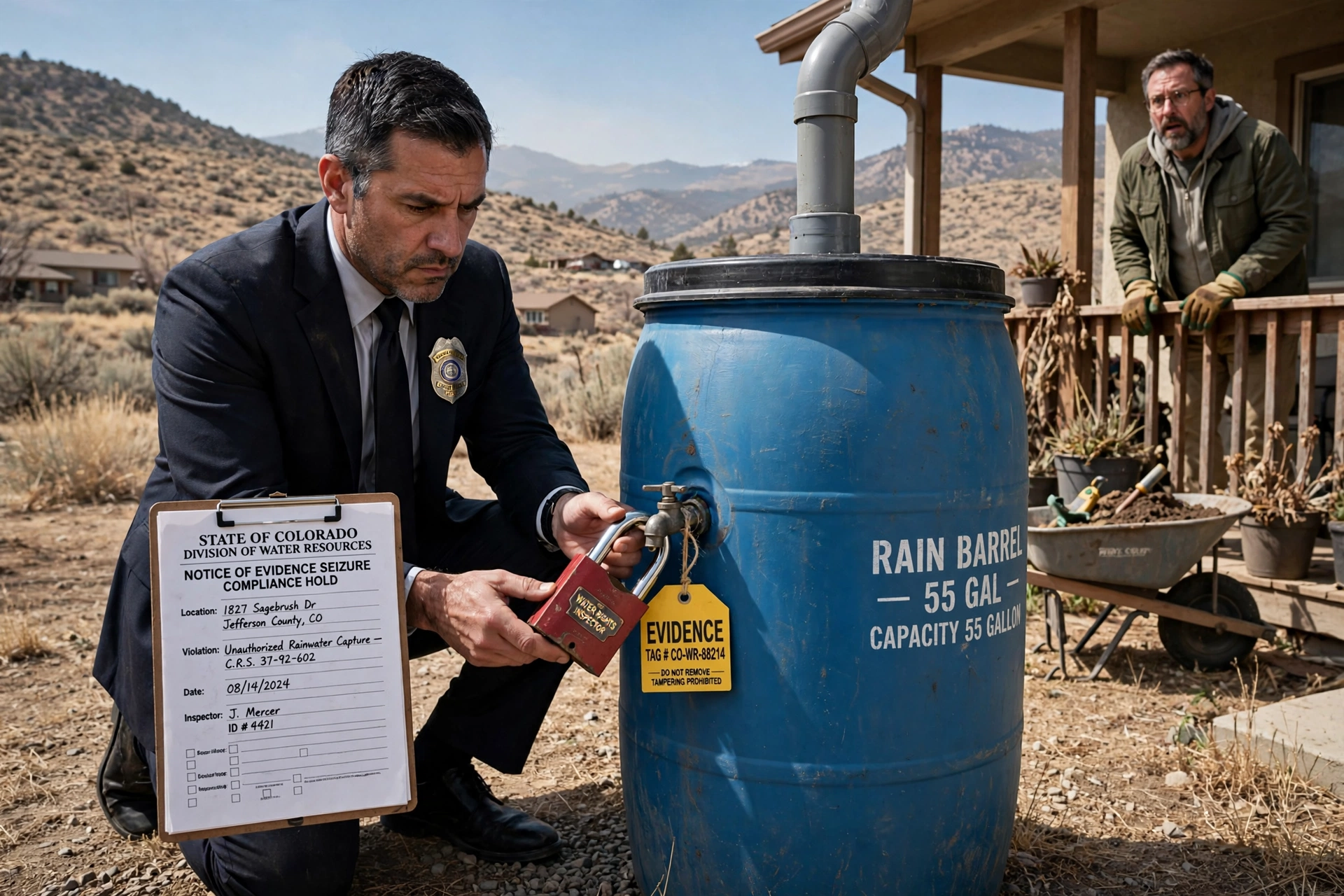
A rain barrel is, as a physical matter, a dam. It is a small dam, a 55-gallon dam, a dam approximately three feet tall, but it performs the defining function of a dam: it impounds water that would otherwise flow downhill and releases it at a time and place of the operator’s choosing. In Colorado, the storage of water has always been treated as an appropriation in its own right, requiring its own decreed storage right with its own priority date. Reservoirs do not operate on forbearance. They operate on decrees.
The Division of Water Resources requires that rain barrels have sealable lids.23 The stated purpose is to keep mosquitoes out. The functional effect is to create a sealed impoundment: a closed vessel, holding up to 55 gallons of the public’s water, fitted with a spigot for controlled release. The state mandates the engineering specification of the very impoundment it declines to adjudicate. It is as though the Division of Motor Vehicles required seatbelts in unregistered vehicles as a condition of continuing not to register them.
The barrel’s operator controls the timing of release with a precision no natural process affords. Water captured during a spring storm, which would have reached the stream during spring runoff when senior agricultural rights are being satisfied, is instead released in August onto petunias. The constitution’s priority system allocates water by seniority of right. The barrel allocates water by seniority of whoever owns the spigot.
VIII. The Vector Impoundment
The sealed lid is not merely a regulatory flourish. It is a public-health necessity, because an unsealed rain barrel is among the most efficient mosquito-breeding installations available to the suburban homeowner.
The Centers for Disease Control and Prevention directs the public to tightly cover water storage containers, specifically including rain barrels, so that mosquitoes cannot get inside to lay eggs.24 Mosquitoes require only one-quarter inch of standing water to complete their life cycle.25 A standard 55-gallon drum stands roughly three feet tall: approximately 140 quarter-inches of standing water stacked in a single column. Vector control inspectors in San Diego County have reported finding poorly sealed and homemade rain barrels without proper screening infested with mosquitoes, including Culex mosquitoes capable of transmitting West Nile virus and invasive Aedes mosquitoes capable of transmitting Zika virus.26
The legalization statutes thus authorize the mass deployment of backyard impoundments that must be individually sealed against disease vectors on pain of becoming, in the CDC’s framework, unpermitted mosquito habitat. The Division of Water Resources polices the lids. No agency polices the 2,500 gallons per season moving through the spigot. The state inspects the container for insects and declines to inspect it for water.
IX. The Water Nobody May Drink
There remains the question of what, exactly, the barrel operator is permitted to do with the intercepted water. The answer, in Colorado, is: almost nothing.
The captured rainwater must be used outdoors, on the same property, and may not be used for drinking water or indoor household purposes.27 The Colorado Department of Public Health and Environment discourages the use of rain barrel water on edible crops. The reason is water quality: untreated rooftop runoff carries microbial contamination from bird droppings and heavy metals from roofing materials, according to Colorado State University Extension.28
Assemble the full regulatory picture. The State of Colorado, having declared the water of every natural stream to be the property of the public, permits the public to intercept that water at the gutter in quantities up to 110 gallons at a time, on the condition that the water not be drunk, not be brought indoors, not be applied to food crops, and be kept sealed against mosquitoes. The state has legalized the collection of water it simultaneously declares unfit for the house. The senior appropriator downstream, holding a decree from the administration of President Grant, receives whatever the barrels overtop. The barrel operator receives 2,500 gallons per season of water suitable for petunias, a registered non-right in Utah, and, in Nevada until 2017, a theoretical fine exposure of $1.2 million per barrel.
X. Conclusion
The investigation is complete. The adjudication never began.
Article XVI, Section 5 of the Colorado Constitution declares the water of every natural stream to be the property of the public, subject to appropriation. Section 6 commands that priority of appropriation shall give the better right. The doctrine of prior appropriation, adopted in Coffin v. Left Hand Ditch Co. and enforced between sovereign states in Wyoming v. Colorado, means first in time, first in right. A rain barrel has no time. It was not first. It was not adjudicated. It holds no decree.
For a century, the law recognized this. Colorado was the only state in the nation where capturing rainwater was illegal, and Nevada agreed until 2017. Then the legislatures acted, and the prohibitions were replaced with allowances: 110 gallons in Colorado, two 100-gallon containers unregistered in Utah, de minimis collection in Nevada. None of these enactments granted a water right. Utah’s statute says so explicitly. They granted forbearance, measured in gallons, enforced against mosquitoes, revocable at the pleasure of the next legislature.
Meanwhile the arithmetic proceeds. Six-tenths of a gallon per square foot per inch of rain. Six hundred gallons per inch on a thousand-square-foot roof. One hundred ten gallons of lawful instantaneous storage, fillable and refillable without limit, yielding twenty-five hundred gallons per season by the extension service’s own calculation. Every gallon intercepted at the downspout is a gallon that does not reach the stream, where the constitution says it belongs and where a senior appropriator’s decree says it is owed.
The barrel sits beside the house, sealed against mosquitoes, padlocked against nothing, holding the public’s water for the petunias. It has no priority date. It needs none. The state has looked the other way, in writing, up to a specified volume, and the stream is short eleven gallons where the math changed.
Ergo.
Sources
- Colo. Const. art. XVI, § 5. leg.colorado.gov ↑
- Colo. Const. art. XVI, § 6. codes.findlaw.com ↑
- Water Education Colorado, “Prior Appropriation.” watereducationcolorado.org ↑
- Yunker v. Nichols, 1 Colo. 552 (1872); Coffin v. Left Hand Ditch Co., 6 Colo. 443 (1882) (opinion text via the Harvard Caselaw Access Project). static.case.law ↑
- Wyoming v. Colorado, 259 U.S. 419 (1922). supreme.justia.com ↑
- Colorado Public Radio, “The Colorado Legislature Takes Another Shot At Legalizing Rain Barrels” (Feb. 24, 2016): “Colorado is the only state in the country where it is illegal to capture rainwater for use at a later time.” cpr.org ↑
- Colo. HB 16-1005 (2016), codified at C.R.S. § 37-96.5-103; U.S. EPA summary of Colorado rainwater regulations. epa.gov ↑
- Colorado Division of Water Resources, “Rainwater Collection & Rain Barrels.” dwr.colorado.gov ↑
- Texas Water Development Board, “Rainwater Volumes from Roof Runoff” (approx. 1,000 gallons per inch on a 2,000 sq. ft. roof at 80% efficiency); Surfrider Foundation (0.62 gallons per sq. ft. per inch). twdb.texas.gov ↑
- County of San Diego Watershed Protection Program: one inch of rain on a 1,000 sq. ft. roof yields approximately 600 gallons. sandiegocounty.gov ↑
- Colorado Division of Water Resources, op. cit.: households “can fill and refill two rain barrels with a combined storage capacity up to 110 gallons throughout the year.” ↑
- Blake Osborn, Colorado State University Extension, quoted in North Denver Tribune: “a gardener can save about 2,500 gallons of water in a growing season” under the 110-gallon limit. northdenvertribune.com ↑
- State Sen. Jerry Sonnenberg, quoted in Marketplace, “Colorado’s rain barrel banditry is coming to an end” (June 3, 2016). marketplace.org ↑
- Ibid. ↑
- Colorado State University study, summarized in Boulder Weekly: temporarily holding small amounts of rainwater would have no impact on stream runoff and would not harm the prior appropriation system. boulderweekly.com ↑
- Nev. AB 138 (2017); NRS 533.027 (“de minimis collection of precipitation”). water-law.com ↑
- Mark Robison, Reno Gazette-Journal, via Lake Tahoe News: “Using rain barrels a violation of Nev. water rights”; short answer: no. laketahoenews.net ↑
- Nevada Division of Water Resources, Water Rights FAQs: penalties under NRS 533.481 (fine up to $10,000 per day per violation; replacement up to 200%). water.nv.gov ↑
- Ibid.: “Request to Investigate an Alleged Violation” form. ↑
- Utah SB 32 (2010); Utah Code § 73-3-1.5. law.justia.com ↑
- Utah Division of Water Rights / Conserve Water Utah FAQ: two covered containers of 100 gallons without registration; up to 2,500 gallons with free registration. conservewater.utah.gov ↑
- Utah Code § 73-3-1.5(6): beneficial use “does not constitute a water right and may not be: (a) changed … (b) assigned; or (c) consolidated with a water right.” law.justia.com ↑
- Colorado Division of Water Resources, op. cit.: “Water must be collected in rain barrels (up to 110 gallon total capacity) with sealable lids.” ↑
- CDC guidance via Moultrie County Health Department: “Tightly cover water storage containers (buckets, cisterns, rain barrels) so mosquitoes cannot get inside to lay eggs.” moultriehealth.org ↑
- Santa Clara County Vector Control District: mosquitoes need only a 1/4 inch depth of standing water to lay eggs. vector.santaclaracounty.gov ↑
- County of San Diego Communications Office / East County Magazine: vector control inspectors found poorly sealed and homemade rain barrels infested with mosquitoes, including Culex (West Nile) and invasive Aedes (Zika) species. eastcountymagazine.org ↑
- Colorado Division of Water Resources, op. cit.: “The water cannot be used for drinking water or indoor household purposes.” ↑
- Colorado State University Extension, via North Denver Tribune: untreated roof runoff may carry microbial contamination from bird droppings and heavy metals from roofing materials; CDPHE discourages use on edible crops. northdenvertribune.com ↑