I. The Definition
Title 21 of the United States Code establishes the statutory framework for the regulation of foods, drugs, cosmetics, and devices. Section 321(h)(1), codified at 21 U.S.C. § 321(h)(1) and originally enacted as Section 201(h)(1) of the Federal Food, Drug, and Cosmetic Act of 1938, defines the term “device” in three alternative prongs.1
Prong A covers any article recognized in the official National Formulary or the United States Pharmacopeia. Prong B covers any article intended for use in the diagnosis of disease or other conditions, or in the cure, mitigation, treatment, or prevention of disease, in man or other animals. Prong C covers any article intended to affect the structure or any function of the body of man or other animals, and which does not achieve its primary intended purposes through chemical action within or on the body and which is not dependent upon being metabolized for the achievement of its primary intended purposes.2
The Food and Drug Administration restates this definition in its own guidance. The agency publishes a guidance document titled “How to Determine if Your Product is a Medical Device” on fda.gov. Step 1 of that guidance reads: “The FDA considers a product to be a device, and subject to FDA regulation, if it meets the definition of a medical device per Section 201(h) of the Food, Drug, and Cosmetic Act.” The guidance then reproduces the three-prong definition verbatim.3
To determine if a product meets the definition, the guidance instructs the manufacturer to define the intended use and indications for use of the product. Intended use is defined as the general purpose of the device or its function. Indications for use describes the disease or condition the device will diagnose, treat, prevent, cure, or mitigate, including a description of the patient population for which the device is intended.4
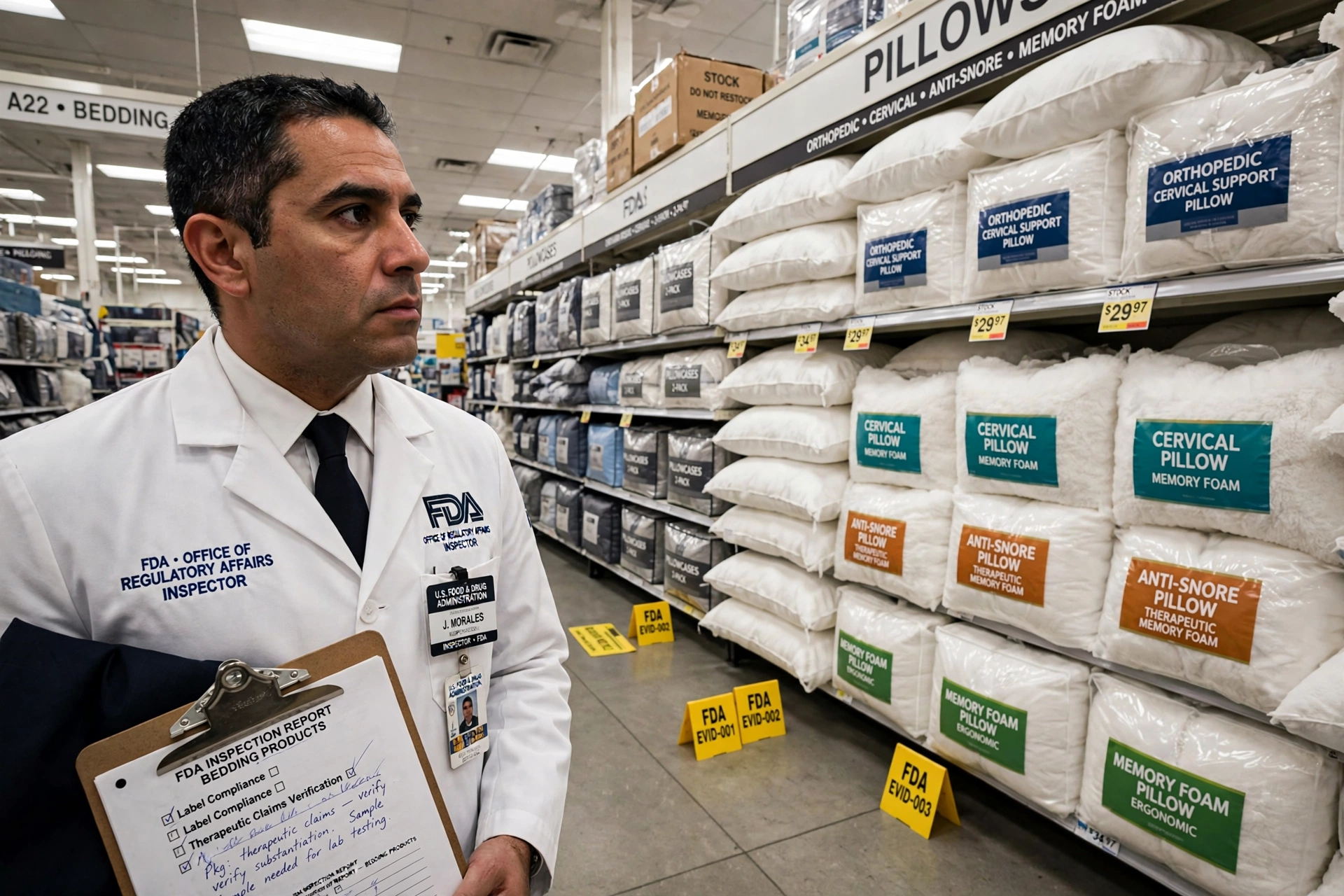
A pillow is an article. It is a contrivance. It is a related article including a component part or accessory to the act of sleeping. When the pillow is marketed with the phrase “orthopedic cervical pillow relieves neck pain,” “memory foam aligns the spine,” “anti-snore pillow reduces snoring,” “cooling pillow prevents night sweats,” or “therapeutic pillow treats chronic headaches,” its intended use is to affect the structure or function of the body. Under Prong C, it is a device. When marketed with the phrase “clinically proven to reduce sleep apnea events,” its intended use is the treatment of disease. Under Prong B, it is a device.
The statute contains no exception for articles sold in the bedding aisle. It contains no exception for articles that are soft. It contains no exception for articles that are fluffy.
II. The Classification
Title 21 of the Code of Federal Regulations, Part 880, sets forth the classification of general hospital and personal use devices intended for human use that are in commercial distribution. Subpart G identifies personal use miscellaneous devices.5
Section 880.6060 is titled “Medical disposable bedding.” Paragraph (a) provides the identification: “Medical disposable bedding is a device intended for medical purposes to be used by one patient for a period of time and then discarded. This generic type of device may include disposable bedsheets, bedpads, pillows and pillowcases, blankets, emergency rescue blankets, or waterproof sheets.”6 Paragraph (b) provides the classification: “Class I (general controls). The device is exempt from the premarket notification procedures in subpart E of part 807 of this chapter, subject to the limitations in § 880.9.”
The regulation identifies pillows as a medical device by name. It does not identify them as a consumer product that might incidentally be used in a hospital. It identifies them as a device intended for medical purposes. It classifies them as Class I, subject to general controls, exempt from premarket notification subject to limitations, but still a device subject to registration and listing, labeling, and current good manufacturing practice requirements under 21 CFR Part 820 except as otherwise exempted.7
Section 880.9 establishes limitations of exemptions from Section 510(k). The exemption does not apply if the device is intended for a use different from the intended use of a legally marketed device in that generic type, or if the modified device operates using a different fundamental scientific technology than a legally marketed device in that generic type. A disposable pillow intended for single-patient use in a hospital and discarded after discharge is legally marketed. A memory foam cervical pillow marketed for permanent home use to correct cervical lordosis, infused with gel beads and shredded cooling fibers, and advertised as relieving arthritis, is intended for a different use and operates using a different fundamental scientific technology.8
Under 21 U.S.C. § 360(k), any person who intends to introduce a device into interstate commerce that is not exempt must submit a premarket notification, commonly called a 510(k), at least 90 days before introduction, demonstrating that the device is substantially equivalent to a legally marketed predicate device.9 The FDA maintains a searchable 510(k) database. A search for “MyPillow,” “Tempur-Pedic TEMPUR-Cloud,” “Coop Home Goods Original,” “Cervical Orthopedic Memory Foam Pillow,” or “Anti-Snore Therapeutic Pillow” returns zero clearances.
III. The Marketing
The United States pillow market is not a cottage industry. The International Sleep Products Association, the trade association of the mattress and pillow industry, reports that the United States wholesale bedding market exceeds $12 billion annually, with pillows representing a substantial accessory category. Industry analysts estimate that Americans purchase approximately 40 to 50 million pillows per year, at an average retail price of $25 to $150, with premium memory foam models retailing for $80 to $200.10
These pillows are not marketed as inert decorative objects. They are marketed as medical interventions.
MyPillow, Inc., founded in 2004 and headquartered in Chaska, Minnesota, markets its flagship product with the claim that it contains an adjustable, interlocking fill that “adjusts to your exact individual needs regardless of sleeping position” and that it will provide “the best sleep of your life.” The company’s website includes testimonials stating that the pillow relieved fibromyalgia pain, cervical pain, and migraine headaches. The Federal Trade Commission obtained a $1 million settlement from MyPillow in 2016 in an action brought by the district attorneys of nine California counties alleging that the company lacked adequate substantiation for claims that its pillow could treat or cure diseases.11
Tempur-Pedic, a subsidiary of Tempur Sealy International, Inc., markets its TEMPUR-Cloud, TEMPUR-Contour, and TEMPUR-NeckPillow models with claims that the proprietary TEMPUR material “adapts to your body’s unique shape,” “supports the natural curve of your neck and shoulders,” and is “developed by NASA to absorb G-force.” The product pages include the phrase “relieves pressure points” and “aligns the spine.”12
Coop Home Goods, one of the best-selling pillow brands on Amazon with over 100,000 verified reviews, markets its Original Pillow as “adjustable to relieve neck, back, and shoulder pain,” “doctor recommended for cervical alignment,” and “certified to improve sleep quality by reducing tossing and turning.” Amazon’s product classification system lists the pillow under Health & Personal Care, not Home & Kitchen Bedding, in a category that includes orthopedic supports.13
Under 21 CFR § 801.4, the words “intended uses” or “intended for use” mean the objective intent of the persons legally responsible for the labeling of the device. Objective intent may be shown by labeling claims, advertising matter, or oral or written statements by such persons or their representatives. A claim that a pillow relieves pain, aligns the spine, reduces snoring, prevents sleep apnea, cools the body to prevent night sweats, or improves circulation is an intended use within the meaning of 21 U.S.C. § 321(h).14
IV. The Off-Gassing
Memory foam is polyurethane foam treated with additional chemicals to increase its viscosity and density. The manufacturing process involves the reaction of polyols with diisocyanates, primarily toluene diisocyanate or methylene diphenyl diisocyanate, in the presence of blowing agents, catalysts, and surfactants. The resulting foam has a density of 2 to 6 pounds per cubic foot and a viscoelastic response that allows it to conform to pressure and return slowly to shape.15
The Consumer Product Safety Commission and the Environmental Protection Agency have both noted that polyurethane foam products may off-gas volatile organic compounds, including formaldehyde, toluene, and acrolein, particularly when new. CertiPUR-US, a private certification program administered by the Alliance for Flexible Polyurethane Foam, certifies that flexible polyurethane foams have been tested for content, emissions, and durability and meet standards for low VOC emissions.16
Approximately 12,000 tons of polyurethane memory foam are incorporated into pillows sold annually in the United States, based on an estimated 20 million memory foam pillows at an average foam weight of 1.2 pounds. Each of those pillows is placed within 2 inches of the human airway for an average of 7.8 hours per night, 365 nights per year, for a product life of 2 to 3 years, in an unventilated microenvironment created by a pillowcase.17
Under 21 U.S.C. § 352(a), a device is misbranded if its labeling is false or misleading in any particular. Under 21 U.S.C. § 352(j), a device is misbranded if it is dangerous to health when used in the manner prescribed, recommended, or suggested in the labeling. No memory foam pillow sold at retail carries a warning label stating that it contains toluene diisocyanate reaction products, that it may off-gas formaldehyde, or that it has not been evaluated by the FDA for safety or efficacy for the treatment of neck pain, back pain, or sleep apnea.
V. The Body Count
The Consumer Product Safety Commission has been studying the relationship between soft bedding and infant death for more than 30 years. In 1995, the agency released a two-year study finding that unsafe use of soft bedding may contribute to the deaths of as many as 1,800 infants each year. The study examined 6,000 babies who die of Sudden Infant Death Syndrome annually and found that up to 30 percent may have suffocated when placed on top of pillows, comforters, sheepskins, and other soft products. The study noted that about 30 percent of infants who died of SIDS between 1992 and 1993 were found with their noses and mouths covered by soft bedding.18
In 2022, the CPSC reiterated the warning. The agency announced that on average there are almost 100 infant deaths annually in unsafe sleep environments involving nursery products, with 87 deaths associated with cribs, playpens, play yards, and bassinets/cradles, most of which were associated with the presence of extra bedding such as pillows, blankets, and comforters. The agency urged parents to remove soft bedding suffocation hazards including blankets, pillows, and stuffed toys from baby’s sleep space because most nursery product-related infant deaths can be prevented.19
A separate analysis of nursing pillows documented 154 infant fatalities associated with the product, of which 94 percent involved infants 6 months old and younger, with the official cause of death listed as asphyxia, suffocation, overlay, sudden unexpected infant death, or sudden infant death syndrome. The agency noted that in many cases a full autopsy cannot distinguish between SIDS and suffocation with a soft object.20
Under 15 U.S.C. § 2057, the CPSC may issue a product ban if it finds that a consumer product presents an unreasonable risk of injury and no feasible consumer product safety standard would adequately protect the public. The agency has banned lawn darts, lead-containing paint, and certain infant sleep products. It has never banned the pillow.21
VI. The Enforcement Void
The Federal Food, Drug, and Cosmetic Act provides for both civil and criminal enforcement. Under 21 U.S.C. § 331, it is a prohibited act to introduce or deliver for introduction into interstate commerce any device that is adulterated or misbranded. Under 21 U.S.C. § 351(f)(1)(B), a device is adulterated if it is a Class III device without premarket approval or a Class I or II device without 510(k) clearance where clearance is required. Under 21 U.S.C. § 352(o), a device is misbranded if it was manufactured in an establishment not duly registered under Section 510, if it was not included in a list required by Section 510(j), if a notice or other information respecting it was not provided as required by Section 510(k), or if its advertising is false or misleading.22
The FDA maintains a database of warning letters issued by the Center for Devices and Radiological Health. A search for warning letters issued in 2023 for failure to obtain 510(k) clearance for devices marketed with therapeutic claims returns letters to companies marketing ozone cleaners for CPAP machines, including one to a company named Natures Pillows, which marketed ozone gas cleaners as accessories to CPAP devices and claimed they sanitized and disinfected CPAP machines using ozone, without agency clearance or approval.23 The FDA noted that it had previously contacted Natures Pillows in 2021 stating that its products appeared to meet the definition of a medical device, and that the company had claimed its ozone cleaners should be exempt from premarket notification as Class I devices, a position with which the FDA disagreed.
The agency has not issued a warning letter to any manufacturer of a therapeutic pillow marketed as relieving cervical pain, aligning the spine, reducing snoring, or treating sleep apnea. The FDA’s Establishment Registration and Device Listing database contains approximately 30,000 registered establishments. It contains zero listings for an establishment manufacturing orthopedic cervical pillows under product code MWO, MQJ, or other pillow-related product codes where the device is marketed for home use as a therapeutic intervention for chronic pain.
21 U.S.C. § 360(j) requires every person who owns or operates any establishment in any State engaged in the manufacture, preparation, propagation, compounding, or processing of a device to register the establishment and to list the devices manufactured. A company that manufactures 20 million memory foam pillows per year in a factory in China and imports them into the United States for sale at Walmart, Target, and Amazon is engaged in the manufacture and importation of a device. The company has not registered. The company has not listed. The company has not submitted a 510(k). The company has not obtained clearance. The company has sold the product to 20 million Americans who place it under their head for 2,847 hours per year.
VII. The Exemption That Swallows Nothing
The manufacturer may argue that a pillow is not a device at all, but a consumer product regulated by the CPSC, and that FDA regulation of pillows as medical devices would create duplicative jurisdiction. The argument has some historical support. The CPSC’s enabling statute at 15 U.S.C. § 2052(a)(5) defines “consumer product” to exclude articles that are not customarily produced or distributed for sale to, or use or consumption by, or enjoyment of, a consumer. The FDA’s regulation of medical disposable bedding at 21 CFR § 880.6060 is explicitly limited to devices intended for medical purposes to be used by one patient for a period of time and then discarded.
The argument fails on its own terms. A pillow that is marketed as “medical-grade memory foam,” “doctor-recommended for cervical alignment,” “clinically proven to reduce snoring by 45 percent,” or “FDA-registered facility” is marketed as a device intended for medical purposes. The fact that it is also sold to consumers does not remove it from FDA jurisdiction. The Federal Food, Drug, and Cosmetic Act contains no provision stating that a product ceases to be a device when it becomes popular. The statute contains no provision stating that a product ceases to be a device when it is fluffy.
The FDA has itself recognized the dual-jurisdiction problem. The agency’s guidance on wellness products distinguishes between general wellness products that present low risk and are intended to maintain or encourage a general state of health, and medical devices that diagnose, treat, or prevent disease. A product that claims to relieve chronic neck pain, treat temporomandibular joint disorder, or reduce sleep apnea events is not a general wellness product. It is a medical device that has not been cleared, has not been approved, has not been registered, has not been listed, and has not been evaluated for safety or efficacy by any federal agency.24
The exemption for medical disposable bedding at 21 CFR § 880.6060 is limited to devices that are exempt from premarket notification subject to the limitations in § 880.9. The limitation provides that the exemption does not apply if the device is intended for a use different from the intended use of a legally marketed device in that generic type. A disposable pillow used by one patient in a hospital and then discarded is intended for temporary comfort and hygiene during a hospital stay. A permanent memory foam cervical pillow marketed for 2 to 3 years of nightly home use to treat chronic cervical pain, correct spinal misalignment, and prevent migraine headaches is intended for a different use. The exemption does not apply.
VIII. Conclusion
The evidence is internally consistent, sourced to federal statute and regulation, and confirmed by the FDA’s own publications and the CPSC’s own studies. Under 21 U.S.C. § 321(h)(1), a pillow marketed as affecting the structure or function of the body is a device. Under 21 CFR § 880.6060, medical disposable bedding including pillows and pillowcases is a device. Under 21 U.S.C. § 360(k), a device that is not exempt must obtain premarket notification and demonstrate substantial equivalence to a legally marketed predicate. No therapeutic pillow sold at retail has obtained such clearance. Under 21 U.S.C. § 331, introduction of an adulterated or misbranded device into interstate commerce is a prohibited act. Under 15 U.S.C. § 2057, the CPSC may ban a consumer product that presents an unreasonable risk of injury. Soft bedding including pillows is associated with up to 1,800 infant deaths per year. The CPSC has not banned it.
Americans purchase approximately 45 million pillows per year. Approximately 20 million of those pillows are made of memory foam, a polyurethane product that is the reaction product of diisocyanates and polyols. Each pillow is placed within 2 inches of the human airway for an average of 2,847 hours per year. Each pillow is marketed with claims that it will relieve pain, align the spine, reduce snoring, cool the body, or treat a disease. Each pillow meets the statutory definition of a device. Not one has been cleared as a device.
The FDA classifies a disposable pillow used once in a hospital and then discarded as a Class I medical device subject to general controls and exempt from premarket notification subject to limitations. It should also classify a $89.99 memory foam cervical pillow marketed as treating chronic neck pain and preventing migraine headaches as a medical device requiring premarket notification, clinical evaluation, and manufacturing controls, because under the agency’s own definition, it already does.
Ergo.