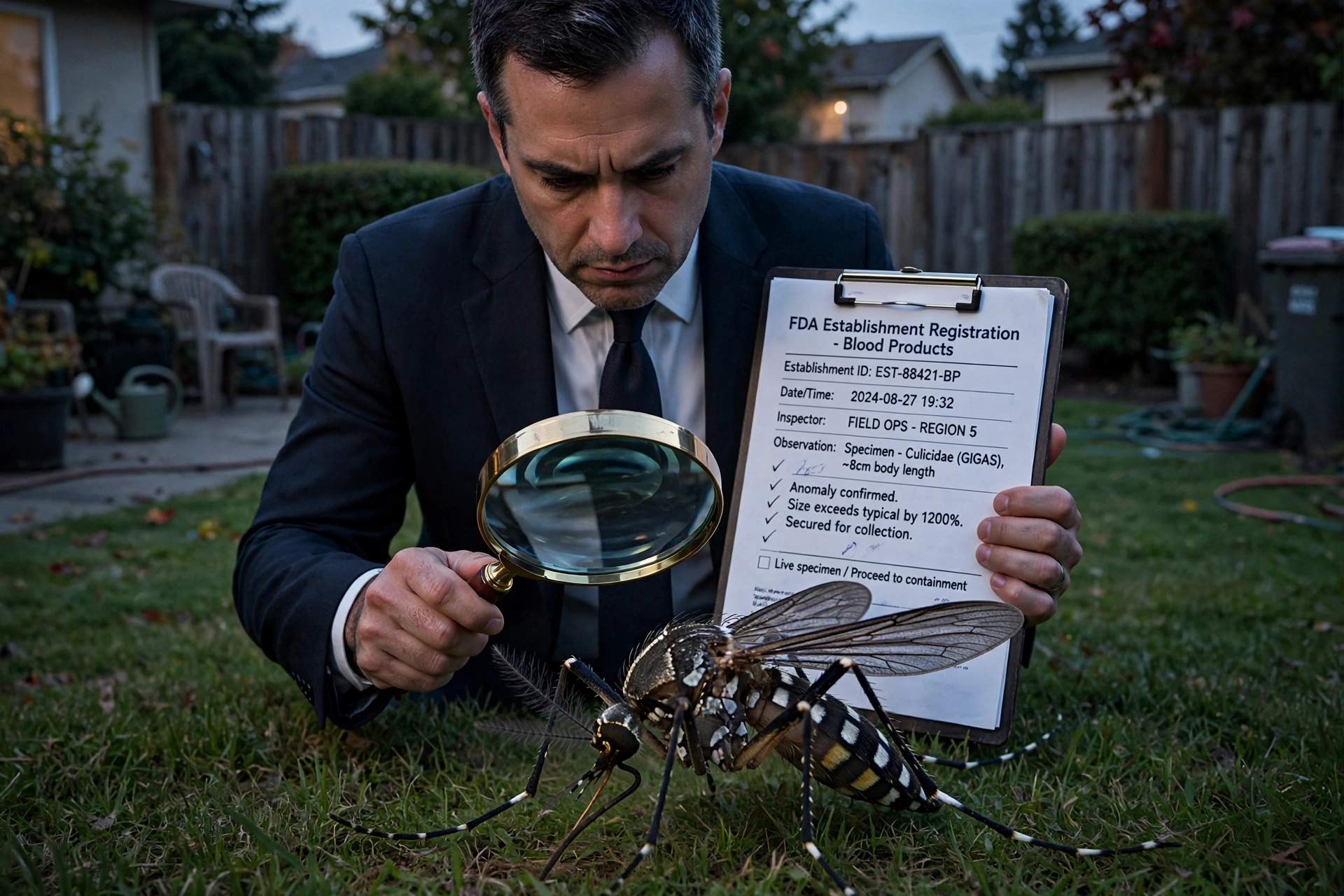
I. The Statute
Section 510 of the Federal Food, Drug, and Cosmetic Act, codified at 21 U.S.C. § 360, requires every establishment engaged in the manufacture of drugs to register with the Food and Drug Administration. Blood and blood components are regulated both as drugs under that Act and as biological products under Section 351 of the Public Health Service Act, 42 U.S.C. § 262. The registration framework for blood is codified at 21 CFR Part 607, titled “Establishment Registration and Product Listing for Manufacturers of Human Blood and Blood Products.” Section 607.7 provides, in the agency’s own words: “All owners or operators of establishments that engage in the manufacturing of blood products are required to register, pursuant to section 510 of the Federal Food, Drug, and Cosmetic Act.” The word is all.1
The registration is not a courtesy. The agency’s biologics establishment registration guidance provides that products must be registered and listed within five days of beginning operation, that registration must be renewed annually between November 15 and December 31, and that blood product listings must be updated every June and December. The registration dossier must include the name and street address of the establishment, all trade names, the kind of ownership, and the name of the owner or operator, including, in the case of a partnership, the name of each partner. Exemptions exist at 21 CFR 607.65. The mosquito has claimed none of them.2
Registration is the beginning, not the end. Part 606 of Title 21 imposes current good manufacturing practice for blood and blood components: the collection, processing, compatibility testing, storage, and distribution of every unit. Part 630 governs donor eligibility. Section 610.40 governs testing. The regime is among the most comprehensively documented manufacturing frameworks in federal law, and it applies to every establishment that manufactures blood products. Every one.3
II. The Operator
The operator is the female mosquito. Only the female feeds on blood; the males lack the necessary mouthparts and subsist on plant nectar. The female requires the protein of a blood meal for egg production. Her saliva contains proteins that stop host blood from clotting, keep blood vessels dilated and accessible, and suppress inflammatory reactions, including a salivary protein that blocks the binding of platelets to collagen, inhibiting clot formation after biting.4
The workforce is distributed across more than 3,000 mosquito species worldwide, of which 176 are established in the United States, operating in virtually every type of fresh, brackish, and saltwater habitat, across diurnal, crepuscular, and nocturnal shifts, effectively providing around-the-clock collection coverage. A female mosquito seeks a host’s blood to develop her eggs; during the bite, saliva containing an anticoagulant is injected into the host to facilitate feeding, and infected operators can pass pathogens in that same saliva directly into the host’s bloodstream.5
The unit volume is small but the throughput is not. A mosquito takes in anywhere from 0.001 to 0.01 milliliter of blood per meal. For its size, that is the equivalent of a person drinking as much as a bathtub holds. The collection network operates on every continent except Antarctica.6
III. The Collection Method
The collection apparatus is a fascicle of six stylets. The labium retracts to guide the bundle; the serrated maxillae and sharp mandibles grip and anchor; the labrum punctures the blood vessel and draws the fluid; the hypopharynx first releases a local anesthetic from the salivary gland and, upon completion of feeding, an anticoagulant to prevent clotting at the insertion site. The entire insertion is regulated by small vibrational motions to lower puncture forces. It is, by any engineering standard, a precision blood-collection device.7
The collections are pooled. Feeding attempts on defensive hosts lead to feeding disruption and partial blood meals; mosquitoes that fail to reach repletion try to feed again within the same gonotrophic cycle, producing multiple or mixed blood meals from multiple donors. Field collections have reported double human blood meals in up to 32 percent of engorged mosquitoes in Puerto Rico and 42 percent in Thailand, with triple blood meals in 2 to 5 percent. Each successive recipient therefore receives a pool: blood drawn from earlier donors, held in the operator’s midgut, and administered onward with the next collection.8
IV. Donor Eligibility
Before a registered establishment may collect a single unit, 21 CFR 630.10 requires a donor eligibility determination. The donor must review educational material regarding relevant transfusion-transmitted infections. The donor must agree not to donate if the donation could pose a risk to recipients. A sample of the donor’s blood will be tested. The donor must be informed of the risks and hazards of the donation procedure. The donor must be given the opportunity to ask questions and to withdraw from the donation procedure. And 21 CFR 630.10(h) is explicit: “You must not collect blood or blood components from a donor found to be ineligible.”9
The mosquito’s donor program works differently. No educational material is provided. No risk assessment is performed. No consent is obtained. No opportunity to ask questions is extended, and no opportunity to withdraw is offered, though donors are frequently asleep at the time of collection. Donors found to be ineligible are collected from anyway, including donors carrying Plasmodium parasites, dengue virus, Zika virus, yellow fever virus, and West Nile virus. The deferral rate is zero. The notification rate is zero.10
V. The Testing Regime
Every donation collected by a registered establishment must be tested. 21 CFR 610.40 requires that each donation of human blood and blood components be tested for evidence of infection due to relevant transfusion-transmitted infections: HIV, hepatitis B virus, and hepatitis C virus as a first tier, and HTLV, syphilis, West Nile virus, and Chagas disease as a second tier, with CJD, vCJD, and malaria subject to testing when licensed screening tests are available and testing is necessary to reduce the risk of transmission. Donations that test reactive must not be shipped or used. Donors who test reactive must be deferred and notified.11
Consider the second tier. West Nile virus is on the FDA’s mandatory donor-screening list: every unit of donated blood in America is tested for it. West Nile virus is transmitted predominantly by Culex mosquitoes. The regulation therefore screens the nation’s blood supply against a pathogen distributed by the very operator this investigation concerns. The screening regime treats West Nile as a transfusion-transmitted infection to be kept out of the blood supply, while the unregistered establishment outside injects it directly into donors’ bloodstreams, untested, unlabeled, and unreported.12
The mosquito performs no testing at any tier. It does not test for HIV. It does not test for hepatitis. It does not test for syphilis, Chagas disease, malaria, dengue, Zika, yellow fever, or West Nile virus. It does not defer reactive donors. It does not notify them. Under 21 CFR 630.30, an establishment must not release an unsuitable donation for transfusion or further manufacturing use. The mosquito’s entire output is unsuitable, and the entirety of it is released.13
VI. The Scale
The World Health Organization’s World Malaria Report 2023 estimates 249 million malaria cases and 608,000 malaria deaths globally in 2022, with the African region accounting for 94 percent of cases and 95 percent of deaths, and children under five making up approximately 80 percent of malaria deaths in Africa. Malaria is transmitted to humans by Anopheles mosquitoes. Every one of those 249 million cases represents a collection event: a blood draw performed by an unregistered operator, followed by administration of the operator’s own biological material into the donor.14
The broader ledger is worse. The diseases mosquitoes carry kill an estimated 725,000 people per year, making the mosquito the deadliest animal on earth: humans murder around 475,000 other people annually, snakes kill around 50,000, dogs claim 25,000, and sharks, the subject of an entire week of cable television, kill fewer than ten. The World Health Organization estimates 100 to 400 million dengue infections each year, transmitted through the bite of infected mosquitoes, with about half the world’s population now at risk.15
The operation is not confined to the tropics. The Centers for Disease Control and Prevention reports nearly 2,000 cases of malaria in the United States each year, mostly from international travel, but in 2023, for the first time in 20 years, the United States experienced locally acquired mosquito-transmitted malaria: ten cases across Florida, Texas, Maryland, and Arkansas. The unregistered establishments are operating domestically.16
VII. Labeling, Pooling Records, and Deviation Reporting
A registered establishment must label every unit. 21 CFR 606.121 requires the container label to bear the proper name of the product, the name, address, and registration number of each manufacturer, and the donor or lot number relating the unit to the donor. The regulation anticipates pooling explicitly: “If pooled, all donor numbers, all donation numbers, or a pool number that is traceable to each individual unit comprising the pool.” The mosquito pools donations from multiple donors per gonotrophic cycle and maintains no pool number, no donor numbers, and no donation numbers. No unit is traceable to any donor.17
The label must also carry a donor classification statement: “paid donor” or “volunteer donor,” in no less prominence than the proper name of the product. A paid donor is a person who receives monetary payment for a blood donation; a volunteer donor is a person who does not. The regulation provides no classification for the involuntary donor, the sleeping donor, or the donor who was never asked. There is one required statement the product arguably satisfies: “This product may transmit infectious agents.”18
And when something goes wrong, the establishment must say so. Biological product deviations must be reported to the FDA on Form FDA-3486 as soon as possible and no later than 45 calendar days from acquiring information reasonably suggesting that a reportable event occurred. A reportable event includes any deviation from current good manufacturing practice that may affect the safety, purity, or potency of a distributed product. The mosquito’s deviation from current good manufacturing practice is total, its distributed product numbering in the hundreds of millions of units, and it has never filed a single Form FDA-3486.19
VIII. The Penalty
The price of operating outside the framework is set by statute. Under 21 U.S.C. § 333(a), any person who violates a provision of 21 U.S.C. § 331, which prohibits the introduction of adulterated or misbranded drugs and devices into interstate commerce, the adulteration or misbranding of such articles, and the failure to register under Section 510, shall be imprisoned for not more than one year or fined not more than $1,000, or both. A violation committed after a prior conviction has become final, or committed with the intent to defraud or mislead, carries up to three years’ imprisonment or a $10,000 fine, or both.20
Registered establishments learn the cost of paperwork quickly: warning letters, consent decrees, and license suspensions follow CGMP deviations measured in single-digit percentages. The unregistered operator’s deviation rate is one hundred percent, across registration, donor eligibility, testing, labeling, pooling records, and deviation reporting, sustained across more than 3,000 species on every continent except Antarctica. The enforcement file contains no warning letter, no consent decree, and no inspection, because the establishment has never registered and therefore does not exist in the agency’s records.21
IX. Conclusion
Section 510 of the Federal Food, Drug, and Cosmetic Act, 21 U.S.C. § 360, requires every establishment that manufactures blood products to register with the Food and Drug Administration, and 21 CFR 607.7 provides that all owners or operators of establishments that engage in the manufacturing of blood products are required to register. Registration must occur within five days of beginning operation. Part 606 imposes current good manufacturing practice. Part 630 requires donor eligibility determination, educational material, informed consent, and the opportunity to withdraw. Section 610.40 requires testing of every donation for HIV, hepatitis B, hepatitis C, HTLV, syphilis, West Nile virus, and Chagas disease. Section 606.121 requires that pooled collections bear a pool number traceable to each individual unit. Biological product deviations must be reported within 45 days.
The female mosquito draws blood meals of up to 0.01 milliliter from multiple human donors within a single gonotrophic cycle, injecting anticoagulant saliva into each donor, pooling the collections in its midgut, and administering the pool to subsequent recipients. It screens no donors. It tests no donations. It labels no units. It maintains no pooling records. It files no deviation reports. The World Health Organization attributes 249 million malaria cases and 608,000 deaths in 2022 to mosquito-borne transmission. The diseases mosquitoes carry kill 725,000 people per year.
No mosquito holds a single FDA establishment registration number.
Ergo.
Sources
- 21 CFR § 607.7: “All owners or operators of establishments that engage in the manufacturing of blood products are required to register, pursuant to section 510 of the Federal Food, Drug, and Cosmetic Act.” govinfo.gov ↑
- FDA biologics establishment registration: “All owners or operators of establishments that manufacture blood products are required to register with the FDA, pursuant to section 510 of the Federal Food, Drug, and Cosmetic Act, unless they are exempt under 21 CFR 607.65.” Products must be registered and listed within 5 days of beginning operation, and annually between November 15 and December 31; blood product listings must be updated every June and December. fda.gov ↑
- 21 CFR Part 607, “Establishment Registration and Product Listing for Manufacturers of Human Blood and Blood Products”; 21 CFR Part 606, current good manufacturing practice for blood and blood components; 21 CFR § 607.25 (information required for establishment registration). govinfo.gov law.cornell.edu ↑
- “Only female mosquitos feed on blood, which provides a high level of nutrients for egg production. The saliva of biting insects contains proteins that stop host blood from clotting, keep blood vessels dilated and easily accessible, and prevent inflammatory reactions,” including a salivary protein that “blocks the binding of platelets to collagen, thus inhibiting clot formation after biting.” phys.org ↑
- “Worldwide there are over 3,000 mosquito species of which 176 are in the U.S.”; “A female mosquito seeks a host’s blood to help develop her eggs”; “During a mosquito bite, saliva containing an anticoagulant is injected into the host to facilitate feeding”; “Infected mosquitoes can pass pathogens in their saliva” directly into the host’s bloodstream. co.monmouth.nj.us ↑
- “Mosquitoes can take in anywhere from 0.001 to 0.01 milliliter of blood. For its size, that would be the equivalent of a person drinking as much as in a bathtub.” cvmosquito.org ↑
- The fascicle of six stylets: labium retracts to guide the bundle; serrated maxillae and sharp mandibles grip and anchor; the labrum punctures the blood vessel and draws the fluid; the hypopharynx releases a local anesthetic and, upon completion of feeding, an anticoagulant. wikipedia.org ↑
- “Feeding attempts on defensive hosts can lead to feeding disruption and acquisition of partial or minimal blood meals. Mosquitoes that are initially unsuccessful in reaching repletion may try to feed again within the same gonotrophic cycle, leading to multiple or mixed blood meals.” Field collections: 0–32% double human blood meals in Thailand; 32% in Puerto Rico and 42% in Thailand double, 2% and 5% triple. journals.plos.org ↑
- 21 CFR § 630.10: the donor must review educational material regarding relevant transfusion-transmitted infections, agree not to donate if the donation could pose a risk, consent to testing, be informed of the risks and hazards of the donation procedure, and be given the opportunity to ask questions and withdraw; “You must not collect blood or blood components from a donor found to be ineligible.” law.cornell.edu ↑
- Mosquito-borne diseases include malaria (Plasmodium parasites), dengue virus, Zika virus, yellow fever virus, and West Nile virus. who.int smithsonianmag.com ↑
- 21 CFR § 610.40: “you, an establishment that collects blood and blood components for transfusion or for use in manufacturing a product … must” test each donation for HIV, HBV, and HCV, and for HTLV, syphilis, West Nile virus, and Chagas disease, with CJD, vCJD, and malaria subject to testing when licensed tests are available and testing is necessary to reduce transmission risk. govinfo.gov ↑
- West Nile virus is transmitted predominantly by Culex mosquitoes. co.monmouth.nj.us govinfo.gov ↑
- 21 CFR § 630.30: “You must not release the donation for transfusion or further manufacturing use” when it is unsuitable; deferred donors must be notified under § 630.40. govinfo.gov ↑
- WHO World Malaria Report 2023: an estimated 249 million malaria cases and 608,000 malaria deaths globally in 2022; the African region accounted for 94% of cases and 95% of deaths; children under five make up approximately 80% of malaria deaths in Africa. Malaria is spread to humans by Anopheles mosquitoes. who.int cdc.gov ↑
- “The diseases that mosquitos carry and transmit to people they bite … kill 725,000” per year; “Humans murder around 475,000 other people each year. Snakes kill around 50,000”; sharks kill fewer than 10. WHO: “an estimated 100–400 million infections” of dengue occur each year, with about half the world’s population at risk. smithsonianmag.com who.int ↑
- CDC: nearly 2,000 cases of malaria reported in the United States each year, mostly from international travel; in 2023, for the first time in 20 years, the United States experienced locally acquired mosquito-transmitted malaria: 10 cases across Florida, Texas, Maryland, and Arkansas. cdc.gov ↑
- 21 CFR § 606.121(c)(3): “The donor or lot number relating the unit to the donor. If pooled, all donor numbers, all donation numbers, or a pool number that is traceable to each individual unit comprising the pool.” law.cornell.edu ↑
- 21 CFR § 606.121: the container label must bear the donor classification statement, “paid donor” or “volunteer donor,” and the statement “This product may transmit infectious agents.” law.cornell.edu ↑
- Biological product deviations must be reported on Form FDA-3486 “as soon as possible but … not to exceed 45 calendar days” from acquiring information reasonably suggesting a reportable event, including any deviation from current good manufacturing practice that may affect the safety, purity, or potency of a distributed product. govinfo.gov ↑
- 21 U.S.C. § 333(a): “Any person who violates a provision of section 331 of this title shall be imprisoned for not more than one year or fined not more than $1,000, or both”; a violation after a final conviction, or committed with intent to defraud or mislead, carries up to three years’ imprisonment or a $10,000 fine, or both. govinfo.gov ↑
- FDA biologics establishment registration applies to “All owners or operators of establishments that manufacture blood products,” 21 CFR § 607.7; over 3,000 mosquito species worldwide operate on every continent except Antarctica. govinfo.gov co.monmouth.nj.us ↑