I. The Gesture
The first Labor Day parade took place in New York City on September 5, 1882, when approximately 10,000 workers marched under the banner of the Central Labor Union. Oregon became the first state to recognize the holiday officially in 1887. By 1894, roughly 30 states had followed.1 The movement for a national holiday honoring labor had been growing for more than a decade, and it had done so peacefully, through parades.
Then came the Pullman Strike. During the depression that began in 1893, the Pullman Company cut its workers’ wages but did not reduce the rent it charged them in its company-owned town. Pullman employees walked off the job on May 11, 1894. The American Railway Union’s boycott of Pullman cars expanded into a nationwide stoppage involving an estimated 250,000 workers across 27 states, disrupting rail traffic across much of the country and impeding federal mail delivery.2
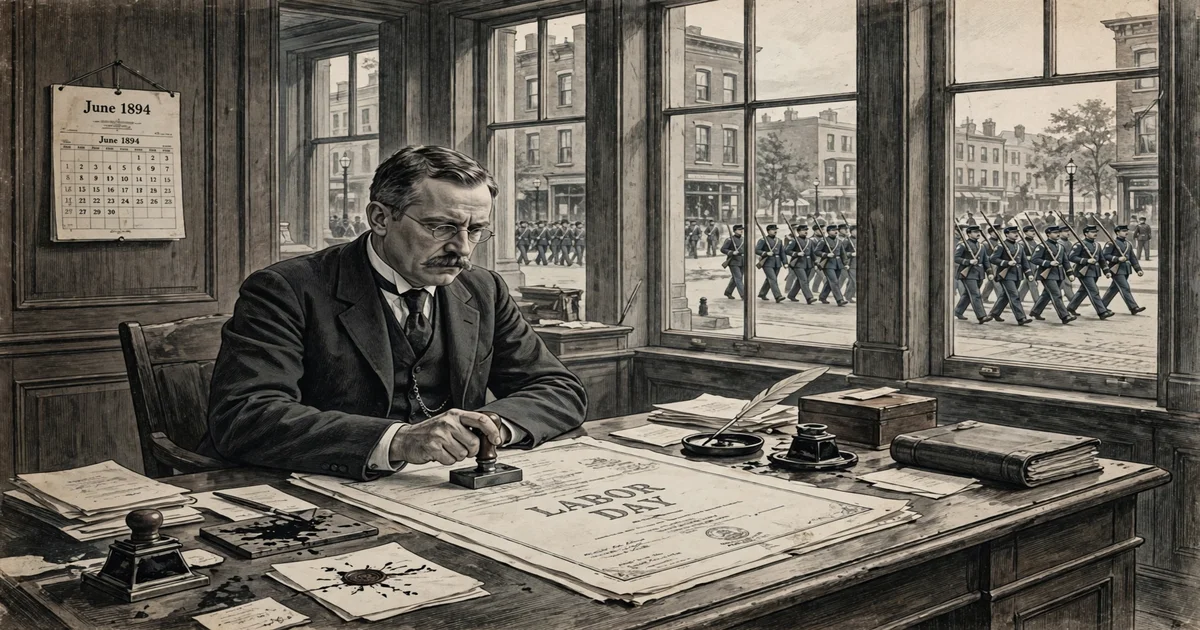
On June 27, 1894, with the strike still underway, Congress passed legislation designating the first Monday in September as a federal holiday honoring labor. President Grover Cleveland signed the bill the following day, June 28, 1894.3 The signing occurred just five days before Cleveland deployed federal troops to Chicago.2
The sequence that followed is a matter of public record. The federal government obtained a court injunction declaring the strike illegal. Cleveland sent the troops. On July 6, rioters destroyed hundreds of railroad cars in South Chicago. On July 7, National Guardsmen fired into a mob, killing as many as 30 people and wounding many others. Federal troops were recalled from Chicago on July 20, and the strike was declared over in early August. Eugene Debs, arrested at the height of the violence along with several other union leaders, was charged with violating the injunction and served six months in jail.2 The following year, in In re Debs, 158 U.S. 564 (1895), the Supreme Court upheld the federal government’s authority to enjoin the strike.4
The federal holiday honoring labor was therefore created by a president who, in the same month, obtained an injunction against labor, sent the Army against labor, and presided over the killing of as many as 30 laborers. The gesture was conciliatory. The troops were not. The holiday survived longer than the strike did.
II. The Holiday the Labor Law Does Not Know
Forty-four years after Cleveland signed the Labor Day Act, Congress enacted the Fair Labor Standards Act of 1938, the foundational statute of federal labor regulation in the United States. The FLSA established the federal minimum wage, overtime requirements, and child labor restrictions. It contains no provision requiring any employer to observe Labor Day, or any other holiday, or to pay any worker for any holiday, ever.
This is not an inference. It is the Department of Labor’s own published position, stated on the Department’s own website, in the Department’s own words: “The Fair Labor Standards Act (FLSA) does not require payment for time not worked, such as vacations or holidays (federal or otherwise). These benefits are generally a matter of agreement between an employer and an employee (or the employee’s representative).”5
The federal holiday statute itself is narrower than its name suggests. Federal holidays are established by law at 5 U.S.C. 6103, and the Office of Personnel Management states the scope plainly: “Federal law (5 U.S.C. 6103) establishes the public holidays listed in these pages for Federal employees.”6 The Congressional Research Service, in its analysis of the federal holiday framework, adds the qualification that is doing most of the work in that sentence: “these observances are only legally applicable to federal employees and the District of Columbia, as the states individually decide their own legal holidays.”7 There are 12 permanent federal holidays. Labor Day is one of them. For everyone who is not a federal employee, it is a federal holiday the way a restaurant’s dress code is a law: widely observed, legally void.
The Bureau of Labor Statistics measures the consequences. In its National Compensation Survey for March 2025, the Bureau reported that 81 percent of private industry workers had access to paid holidays.8 This means that 19 percent did not. Nineteen percent of the private nonfarm workforce is roughly 26 million people for whom Labor Day is not a paid holiday, not an unpaid holiday, but simply a Monday on which the federal government is closed.
The federal holiday honoring labor does not exist in federal labor law. It exists for federal employees by statute, and for everyone else by private agreement. The Department of Labor, the agency charged with protecting American workers, maintains a public page explaining that it requires nothing of their employers on the day honoring them. The holiday is a rumor the private sector voluntarily repeats.
III. The Unpermitted Stoppage
On September 4, 2026, two days before the publication of this article, the Bureau of Labor Statistics reported that total nonfarm payroll employment stood at 159,075,000 and that the unemployment rate was unchanged at 4.1 percent.9 On the first Monday in September, this productive apparatus, the largest in the history of the nation, halts. Federal offices close by law. The private sector follows by custom, because 81 percent of its workers have been granted the day and the remaining 19 percent have been granted the federal government’s example.
No strike authorization vote was held. No petition was filed with the National Labor Relations Board. No federal agency issued a permit for 159 million people to stop working at once, because no statute creates such a permit and no form exists on which to apply for one.
The National Labor Relations Act protects the right of employees to engage in concerted activity, including strikes. But the protected strike is a declared thing: authorized, noticed, negotiated, ended by agreement. Labor Day has none of these features. It has the scale of a general strike and the paperwork of a birthday. It is coordinated without a coordinator, declared without a declaration, and concluded without a settlement, because there was never a demand.
The United States therefore conducts the largest coordinated work stoppage in its history once a year, and the federal labor agencies maintain no file on it, because nobody called it a strike. The difference between a holiday and an unpermitted mass work stoppage turns out to be the name, and names are not permits.
IV. The Private Regulator
The one rule of Labor Day that every American knows is not a law. “No white after Labor Day” is a fashion regulation with no statute, no agency, and no enforcement mechanism beyond social sanction, and it governed American dress for the better part of a century.
The rule’s origins are in the Gilded Age. Wealthy American families summered in cooler retreats, Newport, the Hamptons, the Catskills, and white summer clothing in lightweight fabrics signaled the leisure class. Labor Day, the first Monday in September, became the symbolic end of the leisure season and the calendrical marker of the return to the city, where darker business attire resumed. Old-money etiquette books canonized the cutoff.10
The private regulator published its guidance in the fashion press. “White, while perfect for the country, it is, because it soils so easily, impossible for town wear,” Vogue declared in 1925.11 By the mid-20th century, fashion magazines reinforced the seasonal shift by featuring fall wardrobes in darker colors, and etiquette experts echoed the position that white was for summer and darker colors for fall and winter.12 Compliance was high. Defectors, notably Coco Chanel, who wore white year-round beginning in the 1920s, were treated as the exceptions that confirmed the rule’s jurisdiction.
The regulator has since deregulated unilaterally. The Emily Post Institute, the institutional descendant of the etiquette apparatus that codified the rule, now states that the rule no longer applies: “Today, seasonal fashion guidelines are based on the weight of the fabric, not the color.”12 There was no notice. There was no comment period. The century-long nationwide dress code was repealed by press release.
Consider the two regulators of Labor Day. The federal government, which possesses actual rulemaking authority, has never issued a single rule governing the observance of the holiday. The fashion industry, which possesses no statutory authority whatsoever, governed what 300 million people wore on and around the holiday for nearly a century, enforced its rule through social sanction alone, and then repealed it without procedure. Between the two regulators of the holiday, the one with legal authority did nothing and the one with no authority did everything.
V. The Casualty Count
The National Safety Council has published its forecast for this year’s observance. The Council estimates that 434 people will die in motor vehicle crashes during the Labor Day holiday period, which runs from 6 p.m. on Friday, September 4 through 11:59 p.m. on Monday, September 7. The 90 percent confidence interval for the estimate is 375 to 496 deaths. The holiday period is 3.25 days long. The Council notes that car travel “has the highest fatality rate of any major form of motorized transportation based on fatalities per passenger mile” and that holiday celebrations involving alcohol are a major contributing factor to motor vehicle crashes.13
The holiday established to honor the worker’s rest is therefore, by the National Safety Council’s own forecast, one of the deadliest travel periods of the year. The nation celebrates labor by placing its workforce onto the highways at the highest per-mile fatality rate of any major form of motorized transportation.
In 1894, the government killed as many as 30 strikers with troops. In 2026, it forecasts between 375 and 496 celebrants with sedans. No injunction will be filed.
VI. The Statistics That Cannot See It
The Bureau of Labor Statistics maintains continuous surveillance of American labor. It publishes the Employment Situation monthly, measuring employment, hours, and earnings through two national surveys. On September 4, 2026, it reported 159,075,000 nonfarm payroll jobs and an unemployment rate of 4.1 percent, in a release running thousands of words.9 The release does not contain the words “Labor Day.”
The Bureau has no statistical series for the one day dedicated to labor. It measures the labor force constantly and the holiday never. The nation’s labor statistics apparatus can tell you exactly how many people worked in August and cannot tell you that the first Monday in September is Labor Day.
By the measurement framework of the agency that exists to quantify American labor, the holiday honoring labor is not a data point. It is the one day of the year the statisticians themselves take off.
VII. Conclusion
The record is complete. The federal government broke the strike and signed the holiday in the same month. It declined, in the 44 years that followed and in the 88 years after that, to require any employer to observe it. It reserved legal observance for federal employees and left the rest of the country to private agreement. It counts the workers every month and does not count the day. It forecasts the deaths at a 90 percent confidence interval and files no injunction.
The largest unpermitted work stoppage in American history occurs once a year, by custom, without a vote, without a petition, and without the knowledge of the labor law. The government that enjoins strikes sponsors the stoppage. The agency that measures labor does not measure the holiday. The regulator that governed the dress code had no license. The celebration kills an estimated 434 people, between 375 and 496 at a 90 percent confidence interval.
Ergo.
Sources
- Flags Express, “Labor Day History: How the Holiday Began.” First parade: September 5, 1882, New York City, approximately 10,000 workers; Oregon first state to recognize the holiday, 1887; Congress passed the federal bill June 27, 1894, Cleveland signed June 28; federal troops later used to break the Pullman Strike. flagsexpress.com ↑
- HISTORY, “How a Deadly Railroad Strike Led to the Labor Day Holiday.” Cleveland signed the bill June 28, 1894, “a few days before sending federal troops to Chicago”; July 6: hundreds of railroad cars destroyed in South Chicago; July 7: National Guardsmen fired into a mob, killing as many as 30; troops recalled July 20; Debs served six months in jail for violating the injunction. history.com ↑
- White House archives, “On this date in White House History, June 28, 1894.” “President Grover Cleveland signs an act creating Labor Day, the first Monday in September, as a legal national holiday.” georgewbush-whitehouse.archives.gov ↑
- Wikipedia, “Pullman Strike.” Strike involved an estimated 250,000 workers in 27 states; Cleveland signed the Labor Day legislation June 28, 1894, “just five days before deploying federal troops to Chicago.” See also In re Debs, 158 U.S. 564 (1895), upholding the federal injunction against the strike. en.wikipedia.org ↑
- U.S. Department of Labor, “Holiday Pay.” “The Fair Labor Standards Act (FLSA) does not require payment for time not worked, such as vacations or holidays (federal or otherwise). These benefits are generally a matter of agreement between an employer and an employee (or the employee’s representative).” dol.gov ↑
- U.S. Office of Personnel Management, “Federal Holidays.” “Federal law (5 U.S.C. 6103) establishes the public holidays listed in these pages for Federal employees.” Labor Day: first Monday in September; 2026 observance: Monday, September 7. opm.gov ↑
- Congressional Research Service, IN11697, “Juneteenth National Independence Day: A New Federal Holiday.” “With the enactment of S. 475 and the creation of the Juneteenth National Independence Day, the United States now has 12 permanent federal holidays, codified at 5 U.S.C. §6103” and “these observances are only legally applicable to federal employees and the District of Columbia, as the states individually decide their own legal holidays.” everycrsreport.com ↑
- U.S. Bureau of Labor Statistics, Employee Benefits Survey, National Compensation Survey. “Latest Numbers,” private industry workers: “Access to paid holiday 81% in 2025.” Reference period: March 2025. bls.gov ↑
- U.S. Bureau of Labor Statistics, “The Employment Situation, August 2026,” USDL-26-1435, released September 4, 2026. “Total nonfarm payroll employment increased by 162,000 in August,” seasonally adjusted total 159,075,000; “the unemployment rate was unchanged at 4.1 percent.” bls.gov ↑ ↑
- Farmers’ Almanac, “Why You Cannot Wear White After Labor Day,” summarizing Smithsonian American fashion history. Gilded Age origins: white summer clothing signaled the leisure class at Newport, the Hamptons, and the Catskills; Labor Day became the symbolic end of the leisure season; old-money etiquette books canonized the cutoff. farmersalmanac.com ↑
- Cox Media Group, “Labor Day: Why can’t you wear white for the next few months.” Vogue, 1925: “White, while perfect for the country, it is, because it soils so easily, impossible for town wear.” Coco Chanel introduced white clothing lines in the 1920s in defiance of the rule. cmg-cmg-rd-20084-prod.cdn.arcpublishing.com ↑
- HISTORY, “What Are the Origins of the ‘No White After Labor Day’ Rule?” By the mid-20th century, fashion magazines such as Vogue and Harper’s Bazaar reinforced the seasonal shift and etiquette experts echoed the rule; the Emily Post Institute now states the rule no longer applies: “Today, seasonal fashion guidelines are based on the weight of the fabric, not the color.” history.com ↑ ↑
- National Safety Council, Injury Facts, “Labor Day 2026 Motor Vehicle Fatality Estimates.” NSC estimates 434 deaths on U.S. roads during the Labor Day holiday period, 6 p.m. Friday, September 4 through 11:59 p.m. Monday, September 7; 90% confidence interval 375 to 496; the holiday is “a 3.25-day weekend”; car travel “has the highest fatality rate of any major form of motorized transportation based on fatalities per passenger mile.” injuryfacts.nsc.org ↑