I. The Regulatory Architecture
The Resource Conservation and Recovery Act of 1976, codified at 42 U.S.C. §§ 6901–6992k, was enacted by Congress to address what the statute itself describes as “the rising tide of scrap, discarded, and waste materials” and “the inadequacy of current and past efforts to deal with this problem.” Subtitle C of RCRA establishes a federal “cradle-to-grave” system for tracking hazardous waste from the moment it is generated until its final disposal.1
The statute defines “hazardous waste” at 42 U.S.C. § 6903(5) as “a solid waste, or combination of solid wastes, which because of its quantity, concentration, or physical, chemical, or infectious characteristics may cause, or significantly contribute to an increase in mortality or an increase in serious irreversible, or incapacitating reversible, illness; or pose a substantial present or potential hazard to human health or the environment when improperly treated, stored, transported, or disposed of, or otherwise managed.”2
The EPA’s implementing regulations at 40 CFR Part 261 translate this definition into four testable characteristics. A solid waste is a hazardous waste if it exhibits any one of the following:
Ignitability (40 CFR § 261.21, waste code D001): a liquid with a flash point below 140 degrees Fahrenheit, a non-liquid capable of causing fire through friction or spontaneous chemical change, an ignitable compressed gas, or an oxidizer. The test method is EPA SW-846 Method 1010A or 1020B.3
Corrosivity (40 CFR § 261.22, waste code D002): an aqueous solution with a pH less than or equal to 2 or greater than or equal to 12.5, or a liquid that corrodes SAE 1020 steel at a rate greater than 6.35 millimeters per year at a test temperature of 55 degrees Celsius.4
Reactivity (40 CFR § 261.23, waste code D003): a waste that is normally unstable, reacts violently with water, forms potentially explosive mixtures with water, generates toxic gases when mixed with water or acid, is a cyanide- or sulfide-bearing waste, is capable of detonation if heated under confinement, or is a forbidden explosive under 49 CFR Part 173.5
Toxicity (40 CFR § 261.24, waste codes D004–D043): a waste whose extract, when subjected to the Toxicity Characteristic Leaching Procedure (TCLP, EPA Method 1311), contains any of 40 listed contaminants at or above specified concentrations. These contaminants include arsenic, barium, cadmium, chromium, lead, mercury, selenium, silver, and 32 organic compounds including benzene, carbon tetrachloride, and lindane.6
Any generator of hazardous waste in the United States must determine whether its waste meets any of these four characteristics. If it does, the generator must obtain an EPA identification number, comply with storage time limits and container management standards, use licensed hazardous waste transporters, prepare uniform hazardous waste manifests for every shipment, maintain records for at least three years, and ensure that the waste reaches a permitted treatment, storage, or disposal facility. The penalties for noncompliance are not trivial. Under 42 U.S.C. § 6928(d), any person who knowingly stores hazardous waste without a permit is subject to criminal fines of up to $50,000 per day of violation and imprisonment of up to five years. Knowing endangerment carries penalties of up to $250,000 and fifteen years.7
This is the regulatory framework. It is comprehensive, detailed, and aggressively enforced. It applies to every person, business, and facility in the United States that generates, stores, or disposes of hazardous waste.
With one exception.
II. The Chemistry of the American Garage
The National Fire Protection Association reports that U.S. fire departments respond to an average of 6,600 home structure fires per year that originate in garages. These fires cause an annual average of 30 civilian deaths, 400 civilian injuries, and $457 million in direct property damage.8
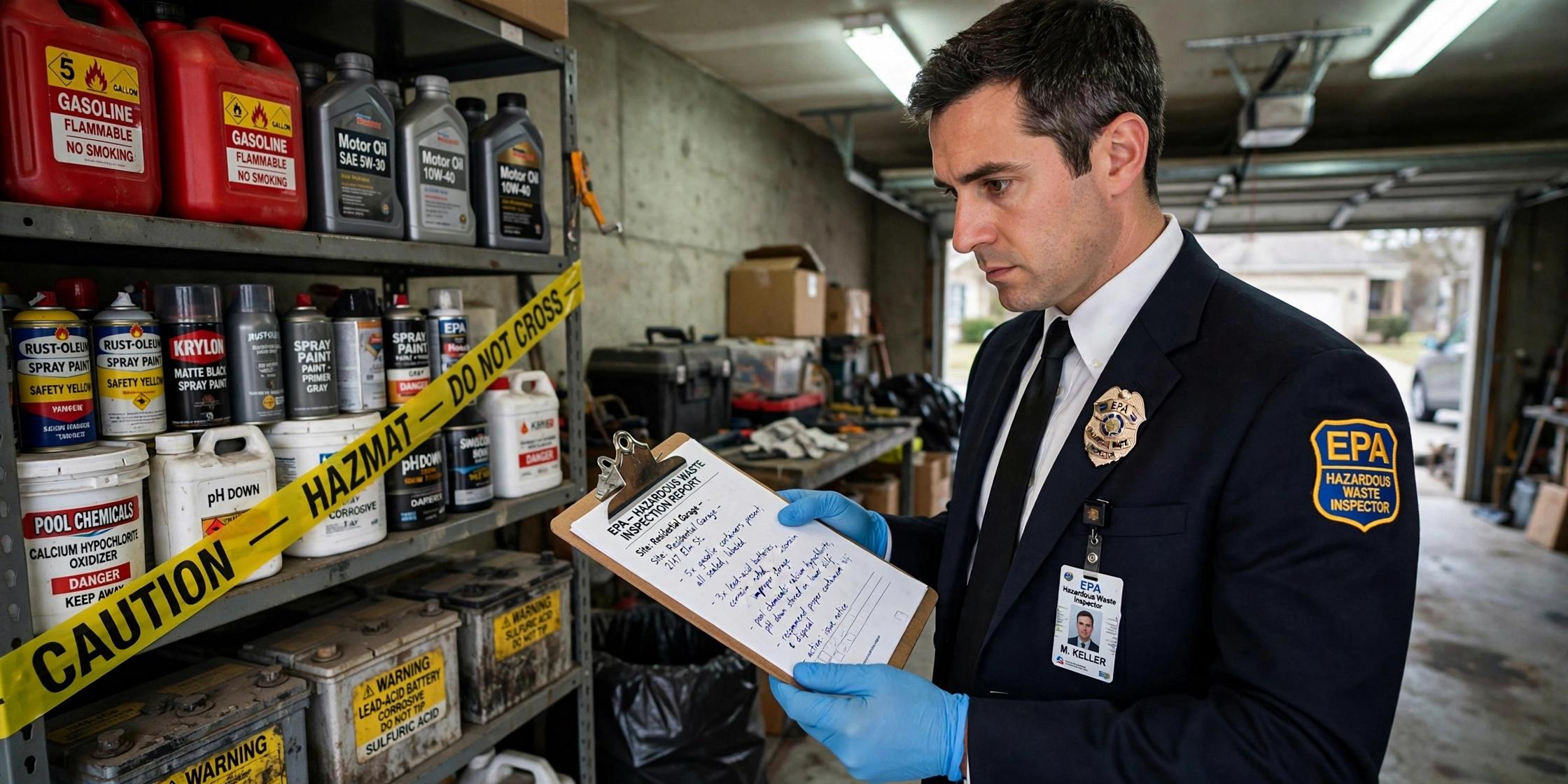
This is not mysterious. A residential garage is, in chemical terms, a poorly ventilated storage facility for substances that the EPA has spent four decades identifying, classifying, and regulating as hazardous waste when they appear anywhere else.
Gasoline. The flash point of gasoline is approximately negative 45 degrees Fahrenheit. The EPA’s ignitability threshold at 40 CFR § 261.21 is 140 degrees Fahrenheit. Gasoline exceeds this threshold by 185 degrees. It is a Class IB flammable liquid under NFPA 30. Its vapors are heavier than air and accumulate at floor level. The lower explosive limit is 1.4 percent concentration by volume in air. The American Petroleum Institute has documented that a single gallon of gasoline, fully vaporized, can produce approximately 20 cubic feet of explosive vapor-air mixture. The average American who operates a gas-powered lawn mower stores between one and five gallons of gasoline in a plastic container on a shelf in their garage.9
Motor oil. The average American household performs or commissions oil changes that generate approximately four to five quarts of used motor oil per vehicle, two to three times per year. Used motor oil contains lead, cadmium, chromium, arsenic, and benzene, all of which are listed contaminants under the TCLP at 40 CFR § 261.24. The EPA has published guidance confirming that used oil that has been mixed with hazardous waste is presumed to be hazardous waste. Many homeowners store used motor oil in milk jugs on their garage floor for months or years before disposing of it, if they dispose of it at all. The EPA has estimated that approximately 200 million gallons of used oil are improperly disposed of each year in the United States.10
Lead-acid batteries. A standard automotive lead-acid battery contains approximately 21 pounds of lead, three and a half pounds of sulfuric acid at a concentration of approximately 35 percent, and trace quantities of antimony and arsenic. Sulfuric acid at 35 percent concentration has a pH well below 2, satisfying the corrosivity characteristic at 40 CFR § 261.22. The lead content satisfies the toxicity characteristic at waste code D008. A spent lead-acid battery simultaneously exhibits two of the four RCRA hazardous waste characteristics. The average American garage contains at least one, often sitting on the concrete floor next to the battery that was removed six months ago and has not yet been taken to an auto parts store for recycling.11
Pesticides and herbicides. Many common household pesticides contain active ingredients that are listed hazardous wastes under 40 CFR § 261.33. Chlordane, formerly one of the most widely used residential termite treatments, is listed as hazardous waste U036. Lindane, used in some insecticidal shampoos and garden products, is listed as U129 and is also a toxicity characteristic contaminant at waste code D013. Diazinon, malathion, and carbaryl are organophosphate or carbamate insecticides whose containers, when discarded, may exhibit the toxicity characteristic. The average American household stores between two and four containers of pesticide or herbicide products in the garage.12
Pool and spa chemicals. Calcium hypochlorite, sold as “pool shock,” is a strong oxidizer that can react violently with organic materials, ammonia, acids, and other pool chemicals. It meets the reactivity characteristic at 40 CFR § 261.23. Muriatic acid (hydrochloric acid), used to lower pool pH, has a pH well below 2 and meets the corrosivity characteristic. These products are typically stored on the same shelf, sometimes in direct contact with each other, in a structure that has no chemical segregation protocol, no spill containment, and no Safety Data Sheet binder.13
Aerosol spray paint and solvents. Aerosol cans containing paint, lacquer, or solvent are ignitable compressed gases under 40 CFR § 261.21(a)(3). Paint thinner, mineral spirits, and turpentine are ignitable liquids with flash points well below 140 degrees Fahrenheit. Methylene chloride, found in some paint strippers, is a listed hazardous waste under 40 CFR § 261.33 (waste code U080). The average American garage contains between three and eight partially used aerosol cans.14
Antifreeze. Ethylene glycol, the primary component of most automotive antifreeze, is acutely toxic. A lethal dose for an adult human is approximately 100 milliliters. Used antifreeze may contain lead and other heavy metals leached from the engine cooling system, potentially satisfying the toxicity characteristic. The Consumer Product Safety Commission has identified antifreeze as one of the leading causes of accidental poisoning in children. It is sweet-tasting, brightly colored, and typically stored in an open or loosely capped jug on a garage floor at child-accessible height.15
III. The Aggregate Inventory
The U.S. Census Bureau’s American Housing Survey reports that approximately 63 percent of the nation’s roughly 130 million occupied housing units have a garage or carport. This translates to approximately 80 million structures.16
The Children’s Health Environmental Coalition, in data cited by the EPA’s own Tribal Waste Journal, estimates that the average American household stores between three and ten gallons of hazardous materials at all times.17
The arithmetic is not complicated. If the average household stores a conservative five gallons of materials meeting the RCRA hazardous waste definition, and 80 million households store those materials in garages, then the residential garage network of the United States contains approximately 400 million gallons of hazardous waste. At an average density of approximately 7 pounds per gallon, this represents approximately 2.8 billion pounds, or 1.27 million metric tons.
For context, the EPA’s Biennial Report data indicate that the United States generates approximately 35.2 million tons of RCRA-regulated hazardous waste per year from commercial and industrial sources. The residential garage inventory, at 1.27 million metric tons of unregulated hazardous materials stored at any given time, is not a negligible fraction. It is a standing reservoir of chemical hazard distributed across every residential neighborhood in the country, stored in structures that were designed to house automobiles and that meet no environmental engineering standard whatsoever.18
A commercial hazardous waste storage facility operating under 40 CFR Part 264 must maintain secondary containment capable of holding the entire volume of the largest container in the storage area plus ten percent. It must have an aisle space of at least two feet for inspection. It must have fire suppression. It must have spill response equipment. It must have trained personnel. It must have a closure plan and a post-closure plan. It must have financial assurance for cleanup. It must be inspected weekly by facility personnel and periodically by the EPA or authorized state agency.
The average American garage has a leaf blower in the aisle space.
IV. The Exemption
Section 261.4(b)(1) of Title 40 of the Code of Federal Regulations provides:
“The following solid wastes are not hazardous wastes: (1) Household waste, including household waste that has been collected, transported, stored, treated, disposed, recovered (e.g., refuse-derived fuel) or reused. ‘Household waste’ means any material (including garbage, trash and sanitary wastes in septic tanks) derived from households (including single and multiple residences, hotels and motels, bunkhouses, ranger stations, crew quarters, campgrounds, picnic grounds and day-use recreation areas).”19
The regulation was adopted as part of the original RCRA implementation on May 19, 1980, published at 45 Federal Register 33099. On November 13, 1984, the EPA expanded the definition of “household” to include bunkhouses, ranger stations, crew quarters, campgrounds, picnic grounds, and day-use recreation areas, published at 49 Federal Register 44978.20
The effect of the exemption is categorical and absolute. A material that meets every criterion for classification as a hazardous waste under 40 CFR Part 261 is not a hazardous waste if it was generated by an individual at a residence. The same gallon of gasoline, in the same plastic container, at the same temperature, with the same flash point and the same explosive potential, is a regulated hazardous waste when it sits in a commercial warehouse and is an unregulated household product when it sits in a suburban garage. The chemistry does not change. The vapor pressure does not change. The lower explosive limit does not change. The regulatory classification changes because of the address on the building.
The EPA has confirmed this interpretation repeatedly. In a 1990 Monthly Call Center Report clarifying the scope of the household exemption, the agency stated that “household waste” is identified by two criteria: the waste must be generated by individuals on the premises of a household, and the waste stream must be composed primarily of materials found in the waste generated by consumers in their homes. The guidance confirmed that there is no distinction between household hazardous waste generated by the homeowner and household hazardous waste generated by a contractor performing work at the residence.21
The exemption does not require the household to manage the waste safely. It does not require containment. It does not require ventilation. It does not require separation of incompatible chemicals. It does not require an emergency response plan. It does not require personnel training. It does not require disposal within any specified time frame. It does not require disposal at all. The homeowner who stores five gallons of gasoline next to a container of pool shock next to a jug of muriatic acid on a wooden shelf above a gas-fired water heater with an open pilot flame in an unventilated garage for the next thirty years is in full compliance with federal hazardous waste law, because 40 CFR § 261.4(b)(1) has removed the word “hazardous” from every container in the building.
V. What the Government Enforces
The EPA does not lack the institutional capacity to enforce RCRA. Its enforcement record demonstrates both the willingness and the ability to impose substantial penalties on entities that store hazardous waste improperly.
In January 2025, the Department of Justice and the EPA announced a settlement with Stericycle, Inc., a hazardous waste management company, for systemic nationwide violations of RCRA regulations. The settlement required Stericycle to pay a $9.5 million civil penalty, one of the largest civil penalties ever imposed for RCRA violations. The violations included failures to properly manage hazardous waste, inaccurate manifest records, and untimely submission of information to the EPA’s electronic manifest system.22
The EPA’s enforcement history includes actions against auto body shops for improper storage of paint waste. It includes actions against dry cleaners for improper storage of perchloroethylene. It includes actions against small manufacturing facilities for accumulating solvent waste beyond the 90-day limit. It includes actions against gas stations for failing to maintain proper records for used oil. In each case, the materials at issue were the same classes of chemicals that are stored in residential garages across America: ignitable solvents, corrosive acids, toxic metals, and reactive oxidizers.
The difference is not the chemistry. The difference is not the quantity. A very small quantity generator under 40 CFR Part 262 is a facility that generates 100 kilograms or less of hazardous waste per month. One hundred kilograms is 220 pounds. An auto body shop that generates 220 pounds of ignitable paint waste in a month must obtain an EPA identification number, comply with accumulation limits, and ensure delivery to a permitted facility. A homeowner who stores 220 pounds of ignitable gasoline, corrosive battery acid, reactive pool chemicals, and toxic pesticides in a garage indefinitely need not do anything at all.23
The difference is 40 CFR § 261.4(b)(1). The difference is an address.
VI. The Consequences of Non-Regulation
The practical consequences of the household exemption are documented by the agencies and organizations that respond when the stored materials do what their Safety Data Sheets predict they will do.
The NFPA’s report on home structure fires originating in garages identifies the leading causes as electrical malfunction, spontaneous combustion, and the ignition of flammable liquids. Garages contain the highest density of ignitable materials in any residential structure. They are also the most likely room in a house to lack a smoke detector, a fire sprinkler, and a fire-rated separation from the living space.8
The American Association of Poison Control Centers reports that household hazardous products account for approximately 30 percent of the substances most frequently involved in human poisonings. Sixty percent of all poisonings involve children under six years of age. Antifreeze, pesticides, and cleaning chemicals stored in garages are among the most common agents.24
The EPA itself has acknowledged the problem. Its household hazardous waste guidance program encourages communities to operate collection events at which residents can bring their accumulated hazardous materials for proper disposal. These events are necessary precisely because the household exemption has removed every other regulatory mechanism that would ensure proper management. The EPA’s guidance describes these events as addressing materials that are “potentially hazardous to human health and the environment.” The agency uses the word “hazardous” to describe the materials. It does not use the word “hazardous” to classify them, because it wrote a regulation in 1980 that prevents it from doing so.25
The cognitive dissonance is structural. The EPA maintains a web page titled “Household Hazardous Waste.” The page lists the materials. It describes the dangers. It recommends proper disposal. It links to local collection programs. It does not mention that the word “hazardous” in the page title is being used colloquially, because in the regulatory sense, the waste is not hazardous. The agency that defined these materials as hazardous, classified them by characteristic, assigned them waste codes, and built an entire regulatory infrastructure to track them from generation to disposal has exempted the largest single source of them from every element of that infrastructure.
VII. The Scale of the Exemption
The scope of the household hazardous waste exemption is not a rounding error in the national hazardous waste management system. It is the system’s largest structural feature.
The EPA’s RCRAInfo database tracks approximately 600,000 facilities that have obtained EPA identification numbers as hazardous waste generators, transporters, or treatment, storage, and disposal facilities. These 600,000 facilities are subject to the full weight of RCRA Subtitle C: identification, counting, manifesting, record-keeping, training, contingency planning, and the threat of criminal prosecution.26
There are 80 million garages. They outnumber the regulated universe by a factor of 133 to one. They contain, in aggregate, more than a million metric tons of materials that satisfy the regulatory definition of hazardous waste. They are not tracked. They are not inspected. They are not required to maintain records, train personnel, or develop emergency response plans. They are not required to do anything.
The regulatory architecture of RCRA Subtitle C is one of the most comprehensive environmental compliance frameworks ever enacted by any government. It imposes obligations on every person who generates a gram of hazardous waste in a commercial or industrial setting. It tracks that waste through manifests from the moment of generation to the moment of final disposal. It subjects violators to civil penalties of up to $70,117 per day (as adjusted for inflation under the Federal Civil Penalties Inflation Adjustment Act) and criminal penalties of up to $50,000 per day and five years’ imprisonment.
It then exempts the largest, most dispersed, least controlled, and most hazardous collection of hazardous waste storage facilities in the country, because the facilities are attached to houses.
VIII. Conclusion
The Resource Conservation and Recovery Act defines hazardous waste. The EPA’s regulations at 40 CFR Part 261 operationalize that definition through four testable characteristics: ignitability, corrosivity, reactivity, and toxicity. The average American garage contains materials that satisfy all four. Gasoline is ignitable. Battery acid is corrosive. Pool shock is reactive. Pesticides are toxic. These are not close calls. These are not borderline classifications requiring expert judgment. Gasoline has a flash point 185 degrees below the regulatory threshold. Battery acid has a pH that would corrode the test coupon specified in the regulation. Pool shock is a strong oxidizer that has caused structure fires, chemical burns, and toxic gas releases in documented residential incidents.
Congress was aware that American households store hazardous materials. It enacted RCRA in 1976. The EPA promulgated the household exemption in 1980. The exemption has been in continuous effect for 46 years. During those 46 years, the EPA has built one of the most rigorous hazardous waste compliance programs in the world. It has obtained multimillion-dollar penalties against companies that stored the same chemicals in the same quantities in the same types of containers. It has sent inspectors into auto body shops, dry cleaners, and gas stations. It has required contingency plans, personnel training, and financial assurance from facilities whose hazardous waste inventories are smaller than the inventory on the average garage shelf.
The agency that classified gasoline as a hazardous waste, assigned it waste code D001, and built an entire regulatory infrastructure to ensure that no one stores it improperly has simultaneously maintained, for nearly half a century, a regulation that permits 80 million Americans to store it in a plastic jug on a wooden shelf next to a water heater. The regulation does not require the jug to be closed. It does not require the shelf to be fireproof. It does not require the water heater to be separated. It does not require anything, because the waste is not hazardous, because the regulation says it is not hazardous, because the address is residential.
A gallon of gasoline does not know its address. Its flash point is negative 45 degrees Fahrenheit in a warehouse and negative 45 degrees Fahrenheit in a garage. Its vapors accumulate at floor level in a warehouse and at floor level in a garage. Its lower explosive limit is 1.4 percent in a warehouse and 1.4 percent in a garage. The chemistry is indifferent to the exemption. The fire is indifferent to the exemption. The 6,600 annual garage fires are indifferent to the exemption.
The EPA built a cradle-to-grave tracking system for hazardous waste. It tracks every gram from every generator to every disposal facility. It then carved a hole in the cradle large enough to hold 80 million garages, 400 million gallons of hazardous materials, and the quiet confidence of a regulatory agency that has decided, as a matter of administrative convenience, that chemistry changes at the property line.
Ergo.
Sources
- 42 U.S.C. §§ 6901–6992k, Resource Conservation and Recovery Act of 1976, as amended. law.cornell.edu ↑
- 42 U.S.C. § 6903(5), definition of “hazardous waste.” law.cornell.edu ↑
- 40 CFR § 261.21, Characteristic of ignitability. law.cornell.edu ↑
- 40 CFR § 261.22, Characteristic of corrosivity. Id. ↑
- 40 CFR § 261.23, Characteristic of reactivity. Id. ↑
- 40 CFR § 261.24, Toxicity characteristic, Table 1 (listing 40 contaminants and regulatory levels for the Toxicity Characteristic Leaching Procedure). Id. ↑
- 42 U.S.C. § 6928(d), criminal penalties for knowing violations of RCRA Subtitle C requirements; § 6928(e), knowing endangerment. law.cornell.edu ↑
- National Fire Protection Association, “Home Structure Fires Originating in Garages” (reporting annual averages of 6,600 fires, 30 deaths, 400 injuries, and $457 million in property damage). nfpa.org ↑
- American Petroleum Institute; NFPA 30, Flammable and Combustible Liquids Code (classifying gasoline as a Class IB flammable liquid with a flash point below 73°F and a boiling point at or above 100°F). OSHA Technical Manual, Section IV, Chapter 2 (gasoline flash point approximately −45°F). ↑
- EPA, “Managing Used Oil: Advice for Small Businesses” (estimating 200 million gallons of used oil improperly disposed of annually); 40 CFR Part 279, Standards for the Management of Used Oil. epa.gov ↑
- Battery Council International (reporting that the average lead-acid battery contains approximately 21 pounds of lead and 3.5 pounds of sulfuric acid at 35% concentration). ↑
- 40 CFR § 261.33, Discarded commercial chemical products, off-specification species, container residues, and spill residues (listing chlordane as U036 and lindane as U129). ↑
- CDC/NIOSH, “Chemical Safety: Pool Chemicals” (documenting incidents of toxic gas release from improper mixing of pool chemicals); 40 CFR § 261.23 (reactivity characteristic for oxidizers). ↑
- 40 CFR § 261.21(a)(3) (ignitability characteristic for ignitable compressed gases); § 261.33 (methylene chloride listed as hazardous waste U080). ↑
- Agency for Toxic Substances and Disease Registry, ToxFAQs for Ethylene Glycol (documenting acute toxicity, lethal dose, and sweet taste attracting children). atsdr.cdc.gov ↑
- U.S. Census Bureau, American Housing Survey (reporting approximately 63% of occupied housing units have a garage or carport; approximately 130 million occupied housing units yields approximately 80 million with garages). census.gov ↑
- Children’s Health Environmental Coalition, data cited in EPA Tribal Waste Journal, May 2014 (estimating average household stores 3–10 gallons of hazardous materials). archive.epa.gov ↑
- EPA, RCRAInfo Biennial Report data (reporting approximately 35.2 million tons of RCRA-regulated hazardous waste managed annually in the United States). rcrapublic.epa.gov ↑
- 40 CFR § 261.4(b)(1), Exclusions: Solid wastes which are not hazardous wastes (household waste exclusion). law.cornell.edu ↑
- 45 FR 33099 (May 19, 1980), final rule promulgating RCRA hazardous waste regulations including the household waste exclusion; 49 FR 44978 (November 13, 1984), expanding the definition of “household” to include additional residential categories. ↑
- EPA, Monthly Call Center Report Question, March 1990 (RCRA Online #13358), “Applicability of the Household Hazardous Waste Exclusion to Waste Generated by Contractors.” rcrapublic.epa.gov ↑
- EPA Press Release, “DOJ and EPA Announce $9.5M Settlement with Stericycle, Inc. for Violations of Hazardous Waste Management Regulations,” January 17, 2025. epa.gov ↑
- 40 CFR § 262.13, Table 1 (generator categories: VSQG ≤ 100 kg/month, SQG > 100 kg but < 1,000 kg/month, LQG ≥ 1,000 kg/month). epa.gov ↑
- American Association of Poison Control Centers, Annual Report data (reporting household hazardous products account for approximately 30% of substances most frequently involved in poisonings; 60% involve children under 6). ↑
- EPA, “Household Hazardous Waste (HHW)” web guidance (describing household hazardous waste collection programs and identifying leftover household products as “potentially hazardous to human health and the environment”). epa.gov ↑
- EPA, RCRAInfo database (tracking approximately 600,000 facilities with EPA identification numbers as hazardous waste handlers). ↑