I. The Statutory Framework
The Comprehensive Drug Abuse Prevention and Control Act of 1970, known as the Controlled Substances Act, established the federal regulatory framework for the manufacture, distribution, and possession of drugs and other substances in the United States. Title II of the Act, codified at 21 U.S.C. §§ 801–904, created a classification system of five schedules, designated substances into those schedules based on their potential for abuse, currently accepted medical use, and safety profile, and prescribed criminal penalties for conduct involving them.1
The operative criminal prohibition on possession is stated at 21 U.S.C. § 844(a): “It shall be unlawful for any person knowingly or intentionally to possess a controlled substance unless such substance was obtained directly, or pursuant to a valid prescription or order, from a practitioner, while acting in the course of his professional practice, or except as otherwise authorized by this subchapter or subchapter II.” The penalties for a first offense are imprisonment for not more than one year and a fine of not less than $1,000. For a second offense following a prior drug conviction, imprisonment for not less than fifteen days and not more than two years. For a third, not less than ninety days and not more than three years.2
The statute does not define “possess” by quantity. It does not establish a minimum weight. It does not specify a minimum concentration. It does not provide that a substance ceases to be a controlled substance when present in trace amounts. It does not exempt a person who did not know the substance was there from the obligation of knowledge, because the word “knowingly” modifies the act of possession, not the identity of the substance. A person who knowingly possesses a container that contains a controlled substance possesses that substance within the meaning of the statute, regardless of whether the person knew the substance was present in the container. The doctrine of constructive possession—that a person possesses contraband when they exercise dominion and control over the location in which it is found—has been applied by every federal circuit court of appeals.3
The statute says what it says. It does not say anything else.
II. The Substance
Cocaine is an alkaloid extracted from the leaves of the Erythroxylum coca plant, native to the western highlands of South America. It is a tropane ester with the molecular formula C₁₇H₂₁NO₄ and a molecular weight of 303.36 grams per mole. It acts as a potent central nervous system stimulant by inhibiting the reuptake of dopamine, norepinephrine, and serotonin at synaptic terminals. It is, simultaneously, a local anesthetic with legitimate medical applications in ophthalmologic and otolaryngologic procedures, which is why it is classified as Schedule II rather than Schedule I: it has a high potential for abuse and a currently accepted medical use in treatment in the United States.4
The scheduling is codified at 21 U.S.C. § 812(c), Schedule II(a)(4), which lists “coca leaves, except coca leaves and extracts of coca leaves from which cocaine, ecgonine, and derivatives of ecgonine or their salts have been removed; cocaine, its salts, optical and geometric isomers, and salts of isomers; ecgonine, its derivatives, their salts, isomers, and salts of isomers; or any compound, mixture, or preparation which contains any quantity of any of the substances referred to in this paragraph.” The implementing regulation at 21 CFR § 1308.12 assigns cocaine the DEA Controlled Substances Code Number 9041.5
The statutory language is notable for its breadth. It covers cocaine, its salts, its isomers, the salts of its isomers, the derivatives of its precursor, and—in the clause that matters here—“any compound, mixture, or preparation which contains any quantity of any of the substances referred to in this paragraph.” Any quantity. The statute does not say “a usable quantity.” It does not say “a detectable quantity.” It does not say “a pharmacologically active quantity.” It says “any quantity.”
III. The Currency
A Federal Reserve Note is a promissory note issued by one of the twelve Federal Reserve Banks, printed by the Bureau of Engraving and Printing at facilities in Washington, D.C. and Fort Worth, Texas, on a substrate composed of 75 percent cotton and 25 percent linen. The notes are produced in seven denominations: $1, $2, $5, $10, $20, $50, and $100. A new note enters circulation when a Federal Reserve Bank ships it to a depository institution in response to a currency order. It leaves circulation when a depository institution returns it to a Federal Reserve Bank for deposit, at which point it is either recirculated or destroyed based on its physical condition.6
As of December 31, 2024, the Federal Reserve reported approximately 55.4 billion notes in circulation with a total value of $2,322.9 billion. The breakdown by denomination: 14.9 billion $1 notes, 1.7 billion $2 notes, 3.7 billion $5 notes, 2.4 billion $10 notes, 11.1 billion $20 notes, 2.5 billion $50 notes, and 19.2 billion $100 notes. The $100 note is the most numerous by value and the second most numerous by volume. As much as one-half of the value of U.S. currency is estimated to circulate abroad.7
The cotton-linen substrate is relevant to the analysis that follows. Cotton and linen fibers are porous. They absorb oils, greases, and dissolved organic compounds from the surfaces they contact. They retain those compounds across hundreds of transactional exchanges. A bill printed in Fort Worth in 2022 that was used to purchase cocaine in Miami in 2023, deposited in a bank in Atlanta in 2024, run through a high-speed currency-counting machine alongside four hundred other bills, and dispensed from an ATM in Seattle in 2025 carries a chemical history that no chain-of-custody form will ever reconstruct. The substrate remembers what the banking system does not.
IV. The Contamination
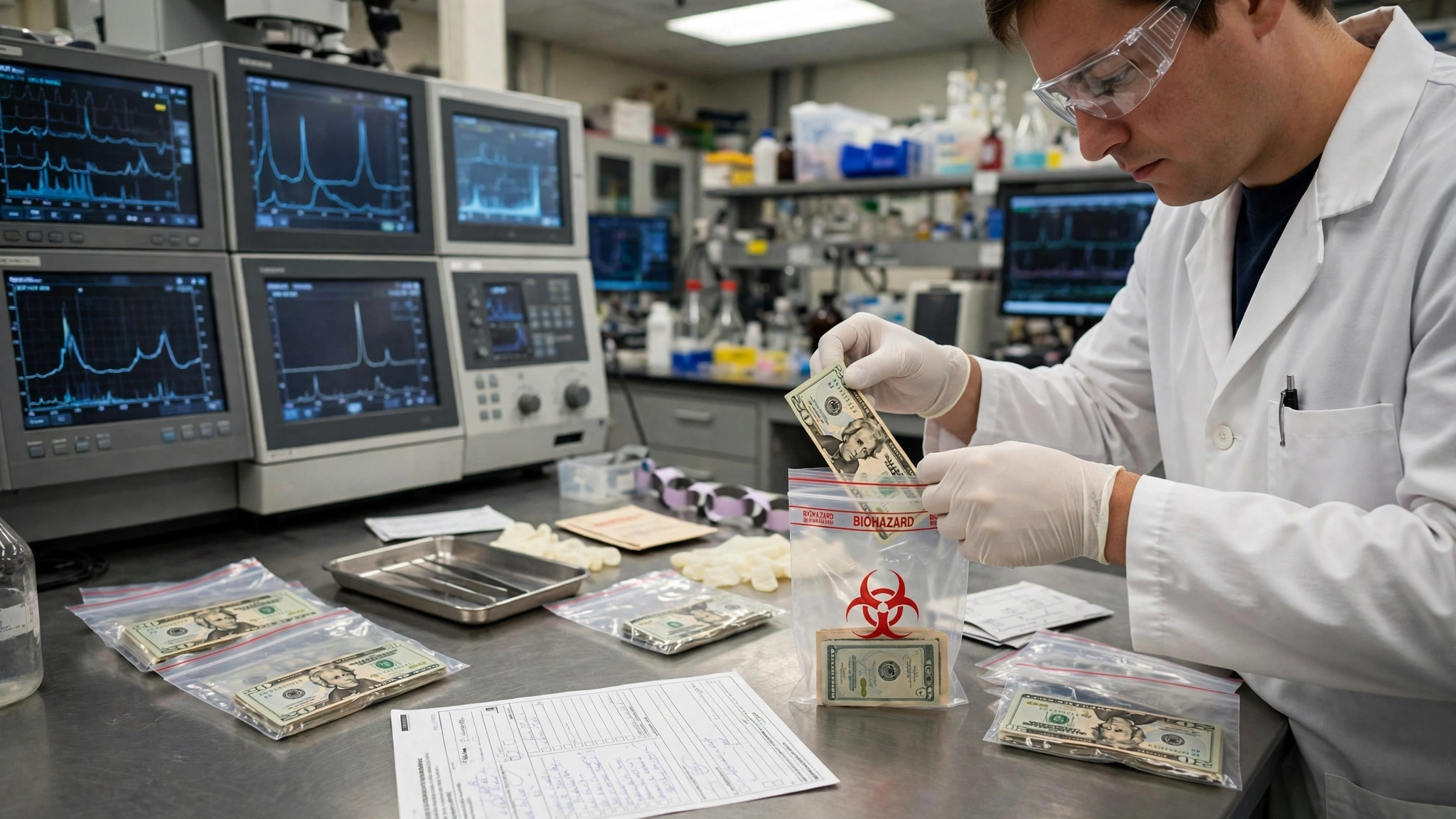
In 2009, Yuegang Zuo, a chemist at the University of Massachusetts Dartmouth, presented at the 238th National Meeting of the American Chemical Society the results of what he described as the largest and most comprehensive analysis of cocaine contamination on banknotes ever conducted. The study tested currency from more than 30 cities across five countries. In the United States, cocaine was detected on between 85 and 90 percent of all banknotes tested. In Washington, D.C., the contamination rate was 95 percent. The U.S. and Canadian rates were the highest observed, followed by Brazil, then China and Japan at 12 to 20 percent.8
The study was not an outlier. In 2001, Amy J. Jenkins of the Office of the Armed Forces Medical Examiner reported the presence of cocaine on 92 percent of U.S. $1 notes randomly collected from five cities, in amounts ranging from 0.01 to 922.72 micrograms per note, with a median of 1.37 micrograms. A 2022 study published in the Journal of the Brazilian Chemical Society, using high-performance liquid chromatography, detected cocaine on 100 percent of sampled U.S. banknotes in amounts ranging from 1.58 to 14.7 micrograms per note, with an average of 6.96 micrograms. A comprehensive survey conducted by the Federal Bureau of Investigation Laboratory over sixteen years, testing 4,174 bills collected from 90 locations between 1993 and 2009, determined an average cocaine contamination of 2.34 nanograms per bill across all denominations and estimated that approximately 83.5 percent of randomly drawn bills carry contamination below 20 nanograms, meaning that the remaining 16.5 percent carry contamination in excess of that threshold.9
A 2018 critical review published in the Journal of Forensic Sciences by the American Academy of Forensic Sciences synthesized the available literature and concluded that “67–100% of circulated U.S. currency is contaminated with cocaine ranging from a few nanograms to over one milligram per bill.” The upper bound—one milligram—is not a trace amount. It is a measurable quantity of a Schedule II controlled substance adhering to a piece of legal tender.10
V. The Mechanism
Cocaine reaches currency through three primary mechanisms, each of which has been documented in the peer-reviewed literature. The first is direct contact during drug transactions: bills are exchanged for cocaine, absorbing the substance from dealers’ hands, from surfaces on which the drug was prepared, and from the drug itself during counting. The second is direct use: bills, particularly denominations above $5, are rolled into tubes and used to insufflate powdered cocaine. Residue from the interior surface of the nostril transfers to the bill, and residue from the cocaine being inhaled deposits on the bill’s surface. The third mechanism is cross-contamination in currency-counting machines at financial institutions. A single contaminated bill processed through a high-speed counter transfers cocaine residue to the rollers, belts, and sensors of the machine, which in turn transfers that residue to every subsequent bill processed through the same equipment.11
The third mechanism is the one that produces the 90 percent contamination rate. A given bill need never have been within a mile of a drug transaction. It need only have been processed through a counting machine at a commercial bank alongside a bill that was. The Federal Reserve’s own payment data shows that approximately 29.8 billion notes were paid from circulation in 2025 and approximately 28.6 billion were received from circulation in the same period. Every note that passes through a Federal Reserve Bank’s high-speed processing equipment—equipment capable of counting 100,000 notes per hour—exits that equipment carrying whatever residue the previous 99,999 notes deposited on its rollers.12
The contamination is not hypothetical. It is not theoretical. It has been measured, quantified, and published in journals indexed by PubMed, the American Chemical Society, and the National Library of Medicine. It is a physical fact of the American monetary supply, as measurable as the ink on the bills themselves.
VI. The Dogs
The Drug Enforcement Administration, U.S. Customs and Border Protection, and state and local law enforcement agencies train canines to detect the odor of controlled substances including cocaine, heroin, methamphetamine, and marijuana. The training methodology, as described by the DEA, involves operant conditioning with positive reinforcement: the dog is rewarded for correctly identifying the target odor in controlled settings. The dog is certified when its accuracy in controlled detection exercises meets or exceeds an agency-defined threshold. DEA-trained canines undergo periodic recertification.13
A trained drug-detection canine alerts to the presence of cocaine on paper currency. This is not a deficiency in the canine’s training. It is the canine performing exactly as trained. The dog detects cocaine. Cocaine is present on the currency. The dog alerts. The alert is, by any measure of the word, accurate. The dog has correctly identified the presence of a controlled substance. The problem is not that the dog is wrong. The problem is that the dog is right about 90 percent of all currency in the United States.14
This fact has produced a substantial body of case law. The Third Circuit, in United States v. $10,700 in U.S. Currency, noted that “several of our sister circuits recently have called into question the evidentiary significance of a positive reaction to currency in determining whether there is probable cause to forfeit the money in light of studies indicating that a large percentage of United States currency is contaminated with sufficient traces of drug residue to cause a canine to ‘alert’ to it.” The Ninth Circuit, in United States v. $30,060, declined to find probable cause where the government “essentially based entire case on dog reaction.” The First Circuit wrote that “even though widespread contamination of currency plainly lessens the impact of dog sniff evidence, a trained dog’s alert still retains some probative value.”15
“Some probative value.” The courts did not say “no probative value.” They said “some.” A canine alert to cocaine on currency still counts for something in a forfeiture proceeding, even though the same alert would be triggered by the vast majority of all bills in the country.
VII. The Forfeiture
Section 881(a)(6) of the Controlled Substances Act, codified at 21 U.S.C. § 881(a)(6), provides that “all moneys, negotiable instruments, securities, or other things of value furnished or intended to be furnished by any person in exchange for a controlled substance or listed chemical in violation of this subchapter, all proceeds traceable to such an exchange, and all moneys, negotiable instruments, and securities used or intended to be used to facilitate any violation of this subchapter” are subject to forfeiture to the United States. The Civil Asset Forfeiture Reform Act of 2000, at 18 U.S.C. § 983(c), requires the government to establish by a preponderance of the evidence that the property is subject to forfeiture.16
The proceedings are brought against the property, not the person. The case caption reads United States v. $84,615 in U.S. Currency or United States v. One 2003 Dodge Ram Pickup. The owner of the property is the “claimant” who must come forward and assert an interest. The claimant need not have been charged with any crime. The claimant need not have been arrested. The claimant need not have been investigated. The government needs only to persuade a court, by a preponderance of the evidence, that the money has a “substantial connection” to drug trafficking.17
The evidence the government presents frequently includes a canine alert. The dog was brought to the currency. The dog alerted. The alert is presented as evidence of a nexus between the currency and drug activity. Courts weigh it alongside other factors—the amount of cash, the manner of packaging, the claimant’s travel patterns, the claimant’s criminal history, the claimant’s inability to document a legitimate source—to determine whether the government has met its burden. The Institute for Justice, a nonprofit legal organization, reported that the Department of Justice’s Assets Forfeiture Fund has taken in more than $36 billion since 2000. A substantial portion of that total consists of cash seizures in which the owner was never charged with a crime.18
The logical architecture of this system deserves careful examination. The government takes money from a person because a dog detected cocaine on the money. The person is not charged with possession of cocaine. The cocaine the dog detected is the government’s evidence that the money is connected to drugs. The government does not assert that the person possessed cocaine. It asserts that the money did. The distinction is not semantic. It is the distinction between a civil proceeding that takes a person’s property and a criminal proceeding that takes a person’s liberty. The evidentiary standard is lower. The burden of proof is on the claimant to prove a negative. And the cocaine that justifies the entire proceeding is, in the majority of cases, present on the currency for the same reason it is present on 90 percent of all currency everywhere: a counting machine at a bank.
VIII. The Arithmetic
The Federal Reserve reports 55.4 billion notes in circulation as of December 31, 2024. At a contamination rate of 90 percent—the rate documented by Zuo in the most comprehensive study to date—approximately 49.9 billion of those notes carry detectable quantities of cocaine. At the average contamination of 2.34 nanograms per bill documented in the FBI Laboratory’s sixteen-year survey, the aggregate quantity of cocaine adhering to the U.S. money supply is approximately 116.8 grams—roughly four ounces, or about the weight of a deck of playing cards.19
The number is small. It is, in pharmacological terms, negligible. Four ounces of cocaine distributed across 49.9 billion pieces of paper produces an average surface concentration so low that no human being could derive a pharmacological effect from handling any number of bills. A person would need to collect the cocaine from approximately 427,000 banknotes to accumulate a single milligram—roughly one-hundredth of a recreational dose.
But the statute does not contain a pharmacological-effect threshold. It says “any quantity.” The dog that alerts to the $20 bill in your wallet is detecting a real quantity of a real controlled substance on a real piece of your property. The statute that criminalizes possession of that substance applies to that quantity by its own terms. The arithmetic is uncomfortable because it produces a number that is legally meaningful and pharmacologically meaningless at the same time.
The U.S. Census Bureau estimates a resident population of approximately 336 million persons. The Pew Research Center, using Federal Reserve survey data, reports that approximately 71 percent of Americans use cash for at least some purchases. Seventy-one percent of 336 million is approximately 238 million persons who, at any given moment, carry at least one Federal Reserve Note that, with 90 percent probability, contains a detectable quantity of a Schedule II controlled substance.20
IX. The Minimum Quantity Problem
The Controlled Substances Act does not contain a minimum-quantity threshold for simple possession. Some states do. Under the “usable quantity” doctrine adopted by courts in California, Texas, and several other jurisdictions, a person cannot be convicted of possession unless the quantity of the substance is sufficient to be “used” in some way—typically, enough to be isolated, tested, and identified as a controlled substance by a forensic chemist. Trace residue that cannot be scraped from a surface, weighed, and analyzed does not constitute a “usable quantity.”21
But the usable-quantity doctrine is a judicial gloss on state statutes. It is not a feature of the federal Controlled Substances Act. The CSA says “any quantity.” Federal courts have not uniformly adopted a usable-quantity requirement for federal possession charges. The Eighth Circuit has held that “the mere presence of residue or trace amounts of a controlled substance is insufficient to support a conviction for possession,” but other circuits have not adopted bright-line minimums. The question of whether 2.34 nanograms of cocaine on a banknote constitutes “possession” within the meaning of 21 U.S.C. § 844(a) has never been litigated, because the government has never charged anyone with it.22
The government has, however, used the same 2.34 nanograms—or rather, the canine detection of it—as evidence in forfeiture proceedings. The dog detected cocaine. The detection supports a finding that the currency has a nexus to drug activity. The currency is forfeited. The distinction is that in the forfeiture proceeding, the cocaine on the bill is evidence that the money is dirty. In a possession proceeding, the cocaine on the bill would be evidence that the person is guilty. The substance is the same. The bill is the same. The amount is the same. The legal consequences are different because the government chooses to point the statute at the property rather than the person.
X. The Knowledge Problem
The word “knowingly” in 21 U.S.C. § 844(a) requires proof that the defendant knew they possessed the substance. This is the element that, in practice, makes prosecution of currency-borne cocaine impossible. A person who carries a $20 bill does not know that cocaine is adhering to its surface. They did not place it there. They did not observe anyone else place it there. They have no reason to believe it is there. The knowledge element is unsatisfied.23
Except that knowledge, in federal criminal law, is not limited to actual subjective awareness. The doctrine of willful blindness—also called deliberate ignorance or the ostrich instruction—provides that a person who takes deliberate steps to avoid learning a fact that they suspect to be true is treated as though they knew the fact. The Supreme Court, in Global-Tech Appliances, Inc. v. SEB S.A. (2011), held that willful blindness requires (1) the defendant must subjectively believe that there is a high probability that a fact exists and (2) the defendant must take deliberate actions to avoid learning of that fact. The doctrine has been applied in drug possession cases throughout the federal system.24
The first element is now common knowledge. The contamination of U.S. currency with cocaine has been reported by Scientific American, the American Chemical Society, National Public Radio, CNN, and every major news organization in the country. It appears in high-school chemistry textbooks. It is the subject of a trivia question that most educated Americans can answer correctly. A person who reads a newspaper, watches television news, or has attended a college-level chemistry or criminology course subjectively knows that there is a high probability that the bills in their wallet contain cocaine. The second element—deliberate avoidance—is satisfied every time a person declines to submit their currency for laboratory analysis. They do not test their money because they do not want to know what is on it.
The argument is absurd. It is also logically sound under the doctrine’s own terms. That is the point.
XI. Conclusion
The evidence assembled in these pages requires no interpretive creativity. The Controlled Substances Act designates cocaine as a Schedule II controlled substance. The Act criminalizes the knowing or intentional possession of any controlled substance. Peer-reviewed research published in the proceedings of the American Chemical Society, the Journal of Forensic Sciences, the Journal of the Brazilian Chemical Society, and the records of the FBI Laboratory has documented cocaine on 67 to 100 percent of U.S. currency in circulation, in quantities ranging from nanograms to milligrams per note. The Federal Reserve confirms 55.4 billion notes in circulation. The government trains dogs to detect the cocaine on those notes and uses the detections as evidence in civil forfeiture proceedings to take people’s money without charging them with a crime.
Every element of the analysis rests on publicly available data. The statutory text is in the United States Code. The scheduling is in the Code of Federal Regulations. The contamination rates are in the peer-reviewed literature. The circulation figures are on the Federal Reserve’s own website. The forfeiture statistics are in the Department of Justice’s annual reports. The case law is in the Federal Reporter.
If cocaine on a bill is evidence that the bill is connected to drug trafficking, then cocaine on a bill is evidence that the person carrying the bill possesses a controlled substance. If the first proposition supports a civil forfeiture, the second proposition supports a criminal charge. If the second proposition is absurd—and it is—then the first proposition is suspect. The same molecule of cocaine cannot be simultaneously probative and irrelevant depending on whether the government is pointing at the paper or the person.
Approximately 238 million Americans carry at least one Federal Reserve Note in their wallet, purse, or pocket at any given time. Approximately 90 percent of those notes contain cocaine. The statute makes possession unlawful. The dog confirms the possession. The government does not prosecute.
Ergo.
Sources
- Comprehensive Drug Abuse Prevention and Control Act of 1970, Pub. L. No. 91-513, 84 Stat. 1236, codified as amended at 21 U.S.C. §§ 801–904. Five-schedule classification system established at 21 U.S.C. § 812. law.cornell.edu ↑
- 21 U.S.C. § 844(a): “It shall be unlawful for any person knowingly or intentionally to possess a controlled substance unless such substance was obtained directly, or pursuant to a valid prescription or order, from a practitioner.” Penalties: first offense, up to 1 year imprisonment, minimum $1,000 fine; second offense, 15 days to 2 years, minimum $2,500; third offense, 90 days to 3 years, minimum $5,000. law.cornell.edu ↑
- Constructive possession doctrine: “a person has constructive possession of contraband when they have the power and intention to exercise dominion and control over the object.” United States v. Jenkins, 90 F.3d 814, 818 (3d Cir. 1996). Applied in all federal circuits. ↑
- Cocaine molecular formula: C₁₇H₂₁NO₄, MW 303.36 g/mol. Mechanism: inhibition of monoamine reuptake. Medical use: topical anesthetic in otolaryngology and ophthalmology. Schedule II criteria: high potential for abuse, currently accepted medical use, abuse may lead to severe dependence. 21 U.S.C. § 812(b)(2). ↑
- 21 U.S.C. § 812(c), Schedule II(a)(4): “coca leaves… cocaine, its salts, optical and geometric isomers, and salts of isomers… or any compound, mixture, or preparation which contains any quantity of any of the substances referred to in this paragraph.” 21 CFR § 1308.12: DEA Controlled Substances Code Number 9041. law.cornell.edu ↑
- Bureau of Engraving and Printing: substrate is 75% cotton, 25% linen. Notes printed at Washington, D.C. and Fort Worth, Texas facilities. Federal Reserve currency lifecycle: order, production, distribution, circulation, return, destruction. uscurrency.gov ↑
- Federal Reserve Board, Currency in Circulation: Volume. As of December 31, 2024: 55.4 billion notes, $2,322.9 billion in value. Denomination breakdown: $1 (14.9B), $2 (1.7B), $5 (3.7B), $10 (2.4B), $20 (11.1B), $50 (2.5B), $100 (19.2B). “As much as one-half of the value of U.S. currency is estimated to be circulating abroad.” federalreserve.gov ↑
- Zuo, Y. (2009). Presented at the 238th National Meeting of the American Chemical Society, Washington, D.C. Tested banknotes from 30+ cities across 5 countries. U.S. contamination rate: 85–90%. Washington, D.C.: 95%. Represents ~20% increase from prior study finding 67% contamination. sciencedaily.com ↑
- Jenkins, A.J. (2001). Forensic Science International. Cocaine on 92% of $1 notes from 5 cities, range 0.01–922.72 μg/note, median 1.37 μg. Lowe, E.R. et al. (2022). Journal of the Brazilian Chemical Society, Vol. 33, No. 10. Cocaine on 100% of sampled notes, 1.58–14.7 μg/note, avg 6.96 μg. FBI Laboratory survey (Eiceman et al., published 2015): 4,174 bills, 90 locations, 1993–2009, average 2.34 ng/bill, 83.5% below 20 ng. pmc.ncbi.nlm.nih.gov ↑
- Furton, K.G. & Harper, R.J. (2018). “Drug Contamination of U.S. Paper Currency and Forensic Relevance of Canine Alert to Paper Currency: A Critical Review of the Scientific Literature.” Journal of Forensic Sciences, 63(4). “67–100% of circulated U.S. currency is contaminated with cocaine ranging from a few nanograms to over one milligram/bill.” © 2018 American Academy of Forensic Sciences. pubmed.ncbi.nlm.nih.gov ↑
- Three mechanisms of contamination: (1) direct contact during drug transactions; (2) insufflation through rolled bills; (3) cross-contamination via currency-counting machines at financial institutions. Mechanism (3) produces the high background contamination rate. Documented in Jenkins (2001), Zuo (2009), and Lowe et al. (2022). ↑
- Federal Reserve Board, Payments of Currency to Circulation: Volume. 2025: 29.8 billion notes paid to circulation. Receipts from Circulation: 28.6 billion notes. High-speed processing equipment: up to 100,000 notes/hour. Cross-contamination during processing documented in Zuo (2009). federalreserve.gov ↑
- DEA canine training program: operant conditioning with positive reinforcement. Target odors include cocaine, heroin, methamphetamine, marijuana, and MDMA. Certification upon meeting accuracy threshold. Periodic recertification required. ↑
- Furton & Harper (2018): “Comprehensive review of the scientific literature establishes that… various biological and environmental parameters impact canine alert to drugs. It is concluded that canine alert to U.S. currency is not sufficiently reliable to determine that currency was directly used in an illicit drug transaction.” pubmed.ncbi.nlm.nih.gov ↑
- United States v. $10,700 in U.S. Currency, 258 F.3d 215, 230 (3d Cir. 2001): “several of our sister circuits recently have called into question the evidentiary significance of a positive reaction to currency.” United States v. $30,060, 39 F.3d 1039, 1042 (9th Cir. 1994): declining to find probable cause on dog reaction alone. United States v. Funds in the Amount of $30,670, 403 F.3d 448, 460–462 (7th Cir. 2005): factors for evaluating dog reliability. ↑
- 21 U.S.C. § 881(a)(6): forfeiture of moneys furnished in exchange for controlled substances, proceeds traceable to such exchange, and moneys used to facilitate violations. Civil Asset Forfeiture Reform Act of 2000, 18 U.S.C. § 983(c): preponderance-of-the-evidence standard; government must establish “substantial connection” between property and offense. ↑
- In rem forfeiture proceedings: case captioned against the property. Owner appears as “claimant.” No criminal charge required. United States v. $84,615, Eighth Circuit (2004): forfeiture sustained based on large cash amount, concealment, drug possession, and canine alert. ecf.ca8.uscourts.gov ↑
- Institute for Justice: Department of Justice Assets Forfeiture Fund receipts exceed $36 billion since 2000. Substantial portion from cash seizures where owner was not charged with any crime. ↑
- Author’s calculation. 55.4 billion notes × 90% contamination rate = 49.9 billion contaminated notes. 49.9 billion notes × 2.34 ng average contamination = 116.8 grams aggregate cocaine on U.S. currency supply. 116.8 grams ≈ 4.12 ounces. ↑
- U.S. Census Bureau: estimated resident population 336 million (2024). Pew Research Center (2024), using Federal Reserve Board’s 2023 Survey of Consumer Finances and Diary of Consumer Payment Choice: approximately 71% of Americans use cash for at least some transactions. 71% × 336 million ≈ 238 million persons carrying cash. ↑
- “Usable quantity” doctrine: state-law requirement that quantity be sufficient to be used or tested. People v. Leal, 64 Cal. 2d 504 (1966): California Supreme Court holding that “usable quantity” means quantity sufficient to be used as a narcotic. Bridges v. State, 389 S.W.2d 307 (Tex. Crim. App. 1965): Texas adopting usable-quantity requirement. ↑
- Federal usable-quantity requirement: not uniformly adopted. Eighth Circuit: “mere presence of residue or trace amounts” insufficient. Other circuits have not adopted bright-line minimum. The question of whether nanogram-level contamination on currency constitutes possession under 21 U.S.C. § 844(a) has never been litigated. ↑
- 21 U.S.C. § 844(a): “knowingly or intentionally.” Knowledge requirement: defendant must know they possess the substance. United States v. Jewell, 532 F.2d 697, 700 (9th Cir. 1976) (en banc): knowledge includes willful blindness. ↑
- Global-Tech Appliances, Inc. v. SEB S.A., 563 U.S. 754 (2011): willful blindness requires (1) subjective belief of high probability that a fact exists and (2) deliberate actions to avoid learning that fact. Applied in drug cases including United States v. Heredia, 483 F.3d 913 (9th Cir. 2007) (en banc). ↑