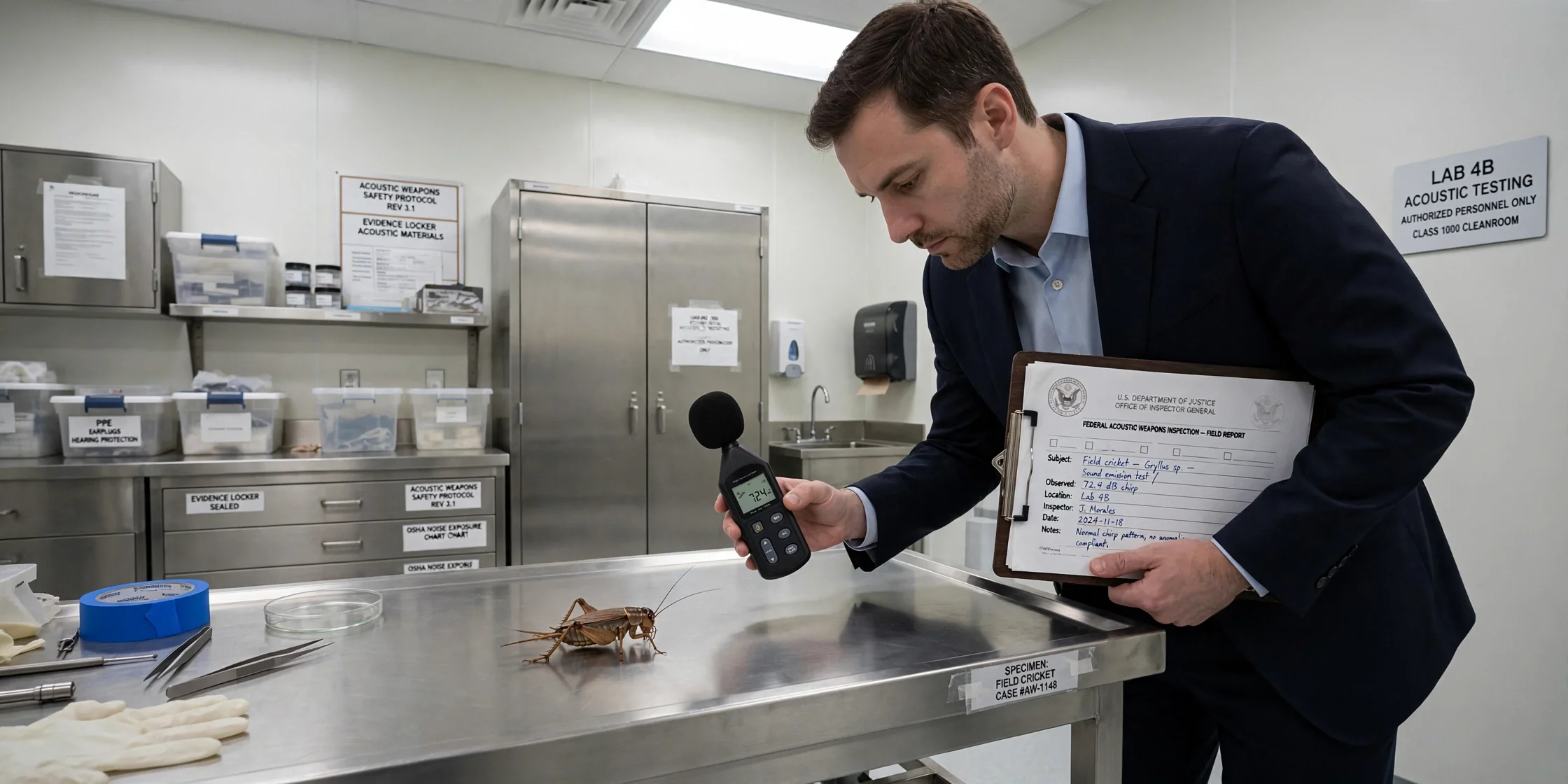
I. The Incident
Beginning in late 2016, diplomats posted to the United States embassy in Cuba began to experience unexplained health problems, including ear pain, tinnitus, vertigo, and cognitive difficulties, which reportedly began after they heard strange noises in their homes or hotel rooms. The sound linked to the incidents was described as a high-pitched beam of sound. It was recorded by United States personnel in Cuba, sent to the United States Navy for analysis, and later released by the Associated Press. Because the recording is the only available non-medical evidence of the incidents, much attention focused on identifying the origin of the acoustic signal.1
United States officials initially believed a sonic attack might be responsible. In response, the United States government dramatically reduced the number of diplomats posted at the embassy in Havana, withdrawing roughly half its staff, and expelled Cuban diplomats in retaliation. The working theory of the United States government was that an unidentified actor had deployed a covert sonic device against American personnel. The working theory of the crickets is not a matter of public record.2
The National Academies of Sciences, Engineering, and Medicine was commissioned by the State Department to review the cases. Its committee described the most distinctive clinical aspects as the sudden onset of a perceived loud sound, a sensation of intense pressure or vibration in the head, and pain in the ear or more diffusely in the head. No consistent picture of brain injury emerged from laboratory-based tests. The sound, however, was real, recorded, and released to the press. Somebody, or something, had produced it.3
II. The Panel
An elite advisory group of science consultants advising the United States government, known as JASON, was contracted to determine the cause and nature of the incidents. JASON produced its report in November 2018. The report was declassified in September 2021.4
The JASON team concluded that the sounds recorded in Havana were mechanical or biological in origin, rather than electronic. Its determination was specific: “The most likely source is the Indies short-tailed cricket, Anurogryllus celerinictus.” The panel further concluded that “the recorded audio signal is, with high confidence, not produced by the nonlinear detection of high-power radiofrequency or ultrasound pulses,” and judged as highly unlikely the notion that pulsed radiofrequency energy could mimic acoustic signals in the brain or in electronics. JASON attributed 8 of the original 21 cases of the syndrome to hearing cricket noises.5
Eight of twenty-one. More than one-third of the founding cases of the most famous suspected sonic attack in American diplomatic history were, in the judgment of the government’s own elite science panel, cricket concerts. The United States withdrew roughly half its embassy staff and expelled the diplomats of a foreign government over the mating call of an insect.6
III. The Match
In January 2019, biologists Alexander L. Stubbs of the University of California, Berkeley and Fernando Montealegre-Z of the University of Lincoln analyzed the Associated Press recording at the annual meeting of the Society for Integrative and Comparative Biology and posted a preprint to the bioRxiv repository. Their conclusion was that the sounds were the calling song of the Indies short-tailed cricket rather than those of a technological device.7
The match was not approximate. Stubbs and Montealegre-Z matched the song’s pulse repetition rate, power spectrum, pulse rate stability, and oscillations per pulse to the recording. The Associated Press recording exhibited frequency decay in individual pulses, which the researchers identified as a distinct acoustic signature of cricket sound production. When the cricket call was played on a loudspeaker and recorded indoors, the interaction of reflected sound pulses yielded a sound virtually indistinguishable from the Associated Press sample. The researchers’ assessment of the danger was direct: “While disconcerting, the mysterious sounds in Cuba are not physically dangerous and do not constitute a sonic attack.”8
The species at issue, Anurogryllus celerinictus, the Indies short-tailed cricket, was described in 1973 by Thomas J. Walker. Its Wikipedia entry now carries a permanent annotation: in January 2019, the noise from its song was proposed as the cause of the Havana syndrome. It is the only cricket species on earth with a counterintelligence file.9
Cuban scientists had reached a comparable conclusion two years earlier, in 2017, hypothesizing that the sound on the same recording was that of Jamaican field crickets. The Americans spent three years, convened an elite advisory panel, declassified the report, and arrived at the same place the Cubans had started: it was crickets.10
IV. The Instrument
A cricket produces its song by stridulation, the rapid and controlled rubbing of its forewings against each other. A hardened plectrum on the anal edge of one wing is drawn across a file, a series of cuticular teeth on the underside of a vein on the opposite wing. The stridulatory apparatus acts as a mechanical frequency-multiplying system, converting the slow wing-stroke rate of the insect, approximately 30 hertz, into a sound of much higher frequency, approximately 4.5 kilohertz in the field cricket Gryllus bimaculatus. The resulting oscillations are amplified by resonating wing regions. Only the male sings. The female, lacking the file and the plectrum, is acoustically disarmed.11
The output of this apparatus is not modest. Male field crickets sing for hours at over 100 decibels sound pressure level in order to attract females, according to research reported by the National Institute of Neurological Disorders and Stroke. Independent measurements place the highest reported cricket sound levels at approximately 100 decibels at a distance of 50 centimeters. For comparison, a car horn reaches about 110 decibels. The Italian mole cricket, Gryllotalpa vineae, a comparatively discreet model, manages approximately 88 decibels.12
Consider the specifications. A half-gram insect carries a mechanically frequency-multiplied acoustic emitter producing a pure-tone signal in the 2 to 8 kilohertz band at sound pressure levels exceeding 100 decibels, operates it continuously for hours, primarily at night, from concealed positions in residential areas, and does so on a sexually dimorphic basis, with only males equipped. The federal government’s own elite science panel examined such an emitter’s output and could not distinguish it, with high confidence, from a suspected hostile sonic weapon. The panel’s exact finding was that the recording was not a weapon. The panel’s implicit finding was that it could have been mistaken for one, because it was.13
V. The Thermometer
In 1897, physicist Amos Dolbear, a professor at Tufts College and a noted inventor, published an article titled “The Cricket as a Thermometer.” Dolbear had systematically studied the relationship between ambient temperature and the rate at which crickets chirp, and he expressed it as a formula now known as Dolbear’s law: the temperature in degrees Fahrenheit equals 50 plus the number of chirps per minute minus 40, divided by 4. The formula is accurate to within a degree or so. A popular shortcut counts the chirps in 14 seconds and adds 40. Thirty chirps in 14 seconds means 70 degrees.14
Dolbear’s observations had been preceded by an 1881 letter to the editor of Popular Science Monthly from Margarette W. Brooks of Salem, Massachusetts, who reported the correlation sixteen years before Dolbear’s article, though Dolbear appears to have known nothing of her letter until after his publication. Subsequent researchers determined that the species Dolbear most likely observed was the snowy tree cricket, Oecanthus fultoni, which early reports had misidentified as Oecanthus niveus. The thermometer had been mislabeled for decades. It continued to give the correct temperature.15
The cricket is therefore a measuring instrument. It reports ambient temperature to within approximately one degree Fahrenheit using an acoustic readout, requires no batteries, no calibration laboratory, and no power cord, and has been in continuous field service since at least 1881. No cricket has ever been submitted for calibration. No cricket bears a calibration sticker. No cricket’s thermometer function has ever been evaluated by any weights-and-measures authority in any jurisdiction, despite 129 years of documented metrological performance.16
VI. The Noise Standard
The Noise Control Act of 1972, codified at 42 U.S.C. § 4901 et seq., establishes as national policy an environment for all Americans free from noise that jeopardizes their health and welfare. Congress found that inadequately controlled noise presents a growing danger to the health and welfare of the Nation’s population, particularly in urban areas, and that the major sources of noise include transportation vehicles and equipment, machinery, appliances, and other products in commerce. The Act authorizes the establishment of federal noise emission standards for products distributed in commerce.17
In 1974, the Environmental Protection Agency’s Office of Noise Abatement and Control published “Information on Levels of Environmental Noise Requisite to Protect Public Health and Welfare with an Adequate Margin of Safety.” The document identified a 24-hour exposure level of 70 decibels as the level that would prevent any measurable hearing loss over a lifetime, and identified levels of 55 decibels outdoors and 45 decibels indoors as preventing activity interference and annoyance. These were the levels, in the agency’s judgment, that would permit spoken conversation, sleeping, working, and recreation. In 1982, the Office of Noise Abatement and Control was defunded, transferring primary responsibility for noise regulation to state and local governments. The crickets, which had never been subject to federal enforcement in the first place, noticed no change.18
The Occupational Safety and Health Administration sets the permissible exposure limit for occupational noise at 90 decibels on the A-weighted scale as an 8-hour time-weighted average, at 29 CFR § 1910.95. A field cricket producing over 100 decibels at 50 centimeters exceeds the permissible occupational exposure limit by more than 10 decibels, exceeds the EPA’s outdoor annoyance criterion by 45 decibels, and does so for hours, at night, in residential zones, without a permit, without engineering controls, without a hearing conservation program, and without ever having filed a single noise emission disclosure under the Act that Congress passed to control it.19
VII. The Registration Failure
No federal agency registers crickets as noise sources. No state issues a cricket a noise permit. No municipality has ever required a cricket to obtain a variance for nighttime operation above 45 decibels indoors, though the insect routinely sings from inside walls, attics, and ventilation ducts. The Noise Control Act authorizes federal emission standards for products distributed in commerce; crickets are not products, are not distributed in commerce, and are therefore outside the Act’s reach, which is precisely the loophole through which 100 decibels of nighttime acoustic energy passes every evening between dusk and dawn.20
The thermometer function is equally unregistered. Thermometers used in commerce are subject to state weights-and-measures inspection in every state. The cricket thermometer, accurate to within a degree, has evaded every such inspection for 129 years, on the technicality that no one has ever attempted to buy or sell anything with it, which has not stopped it from reporting the temperature correctly every night.21
The weapons question remains the most serious. The United States government, presented with a recording of cricket song, treated it as a suspected hostile sonic attack, withdrew roughly half its embassy staff, expelled foreign diplomats, convened the National Academies, and contracted its elite science advisory panel, which concluded with high confidence that the sound was a cricket. The government’s position is therefore that cricket song is acoustically indistinguishable from a suspected act of acoustic warfare, and that no registration, licensing, or control regime of any kind applies to the organism producing it. Every backyard in America is an unlicensed acoustic range. Every summer evening is an unpermitted exercise.22
VIII. Conclusion
Beginning in late 2016, the United States embassy in Havana was the target of what the United States government believed was a covert sonic attack. The high-pitched beam of sound at the center of the incidents was recorded, analyzed by the Navy, released by the Associated Press, examined by the government’s elite JASON advisory panel, and matched in pulse repetition rate, power spectrum, pulse rate stability, and oscillations per pulse to the calling song of the Indies short-tailed cricket, Anurogryllus celerinictus. Eight of the original 21 cases were attributed to cricket noise. The United States withdrew roughly half its embassy staff and expelled Cuban diplomats over the mating call of an insect described in 1973 by Thomas J. Walker.
The male field cricket, Gryllus bimaculatus, sings for hours at over 100 decibels sound pressure level, produced by a mechanical frequency-multiplying stridulatory apparatus that converts a 30-hertz wing stroke into a 4.5-kilohertz pure tone. The Environmental Protection Agency’s 1974 levels document identifies 55 decibels outdoors as requisite to protect public health and welfare. The Occupational Safety and Health Administration caps permissible exposure at 90 decibels over eight hours. The cricket exceeds both, nightly, without a permit. Amos Dolbear proved in 1897 that the cricket is a thermometer accurate to within a degree; the snowy tree cricket, Oecanthus fultoni, has reported the temperature correctly since at least 1881, when Margarette W. Brooks of Salem, Massachusetts first wrote it down. No cricket has ever been calibrated.
The Noise Control Act of 1972 directs the nation toward an environment free from noise that jeopardizes public health and welfare. The nation has not achieved it. The obstacle is not transportation equipment, machinery, or appliances. The obstacle is a half-gram insect with a file on its wing, a plectrum on the other, and a song the United States government once mistook for a weapon, then correctly identified as a cricket, and then declined to regulate in any respect whatsoever.
Ergo.
Sources
- Beginning in late 2016, diplomats posted to the U.S. embassy in Cuba experienced ear pain, tinnitus, vertigo, and cognitive difficulties after hearing strange noises; the AP recording was sent to the U.S. Navy for analysis. ouci.dntb.gov.ua ↑
- U.S. officials initially believed a sonic attack might be responsible; Washington withdrew roughly half its embassy staff and expelled Cuban diplomats in retaliation. phys.org ↑
- National Academies review: sudden onset of perceived loud sound, intense pressure or vibration in the head, ear pain; no consistent picture of brain injury in laboratory tests. ndupress.ndu.edu ↑
- JASON report, November 2018, declassified September 2021. wikipedia.org ↑
- JASON: sounds “mechanical or biological in origin, rather than electronic”; “most likely source is the Indies short-tailed cricket”; recorded signal “with high confidence” not produced by high-power RF or ultrasound pulses; 8 of the original 21 cases attributed to cricket noises. ndupress.ndu.edu ↑
- United States dramatically reduced diplomats posted in Havana and expelled Cuban diplomats. ouci.dntb.gov.ua ↑
- Alexander L. Stubbs (UC Berkeley) and Fernando Montealegre-Z (University of Lincoln), January 2019, Society for Integrative and Comparative Biology meeting, bioRxiv preprint: the sounds were the calling song of the Indies short-tailed cricket. news.berkeley.edu ↑
- Matched pulse repetition rate, power spectrum, pulse rate stability, and oscillations per pulse; frequency decay in individual pulses is a distinct acoustic signature of cricket sound production; loudspeaker playback recorded indoors yielded a sound virtually indistinguishable from the AP sample. ouci.dntb.gov.ua ↑
- Anurogryllus celerinictus, Indies short-tailed cricket, described 1973 by Thomas J. Walker; in January 2019 its song was proposed as the cause of Havana syndrome. wikipedia.org ↑
- 2017 hypothesis by Cuban scientists: the sound was that of Jamaican field crickets. wikipedia.org ↑
- Stridulation: plectrum drawn across serrated file; mechanical frequency multiplication converting ~30 Hz wing-stroke to ~4.5 kHz pure tone in Gryllus bimaculatus; crickets produce 2–8 kHz signals. frontiersin.org ↑
- Male Gryllus bimaculatus sings for hours at over 100 decibels SPL; only males sing. sciencedaily.com Highest reported ~100 dB at 50 cm; mole cricket ~88 dB; car horn ~110 dB. terminix.com noisyworld.org ↑
- Field cricket calling song carrier ~4.7 kHz; maximum hearing distances 10–15 m in some species. pmc.ncbi.nlm.nih.gov ↑
- Amos Dolbear, “The Cricket as a Thermometer,” 1897; TF = 50 + (N−40)/4; accurate to within a degree or so; shortcut: chirps in 14 seconds plus 40. wikipedia.org almanac.com ↑
- Preceded by 1881 letter from Margarette W. Brooks of Salem, Massachusetts to Popular Science Monthly; species likely the snowy tree cricket, Oecanthus fultoni, misidentified in early reports as O. niveus. wikipedia.org ↑
- Dolbear, Tufts College professor, physicist, and inventor; systematic study of chirp rate by temperature. thoughtco.com ↑
- Noise Control Act of 1972, 42 U.S.C. § 4901 et seq.; national policy of an environment free from noise jeopardizing health and welfare; authorizes federal noise emission standards for products in commerce. epa.gov law.cornell.edu ↑
- EPA, “Information on Levels of Environmental Noise Requisite to Protect Public Health and Welfare with an Adequate Margin of Safety,” March 1974: 70 dB over 24 hours prevents measurable hearing loss; 55 dB outdoors and 45 dB indoors prevent activity interference and annoyance. epa.gov ↑
- OSHA permissible exposure limit: 90 dBA as an 8-hour time-weighted average, 29 CFR § 1910.95. law.cornell.edu ONAC defunded 1982, primary responsibility transferred to state and local governments. pmc.ncbi.nlm.nih.gov ↑
- Noise Control Act provides for federal emission control with states retaining primary responsibility for permitted noise levels; 1982 ONAC defunding. govinfo.gov ↑
- Gizmodo/NYT reporting on the Stubbs and Montealegre-Z analysis via the University of Florida insect recording database match. gizmodo.com ↑
- JASON attributed 8 of the original 21 cases to hearing cricket noises; the explanation was not well received by some affected personnel. ndupress.ndu.edu ↑