I. The Statutory Framework
The Resource Conservation and Recovery Act of 1976 established the comprehensive federal framework for the management of solid waste and hazardous waste in the United States. Congress enacted the statute in response to what the legislative findings at 42 U.S.C. § 6901(a)(4) described as “the continuing technological progress and improvement in methods of manufacture, packaging, and marketing of consumer products” that resulted in “an ever-mounting increase” in the volume of solid waste requiring disposal. The statute’s stated objective, at § 6902(a), includes “regulating the treatment, storage, transportation, and disposal of hazardous wastes which have adverse effects on health and the environment” and “requiring that hazardous waste be properly managed in the first instance thereby reducing the need for corrective action at a future date.”1
The Act operates through a system of defined terms. Section 1004(27), codified at 42 U.S.C. § 6903(27), defines “solid waste” as “any garbage, refuse, sludge from a waste treatment plant, water supply treatment plant, or air pollution control facility and other discarded material, including solid, liquid, semisolid, or contained gaseous material resulting from industrial, commercial, mining, and agricultural operations, and from community activities.” The definition is not narrow. It encompasses garbage. It encompasses refuse. It encompasses “other discarded material.” It encompasses material from “community activities.” The preparation and consumption of food in an American household is a community activity. The material discarded after that activity is solid waste.2
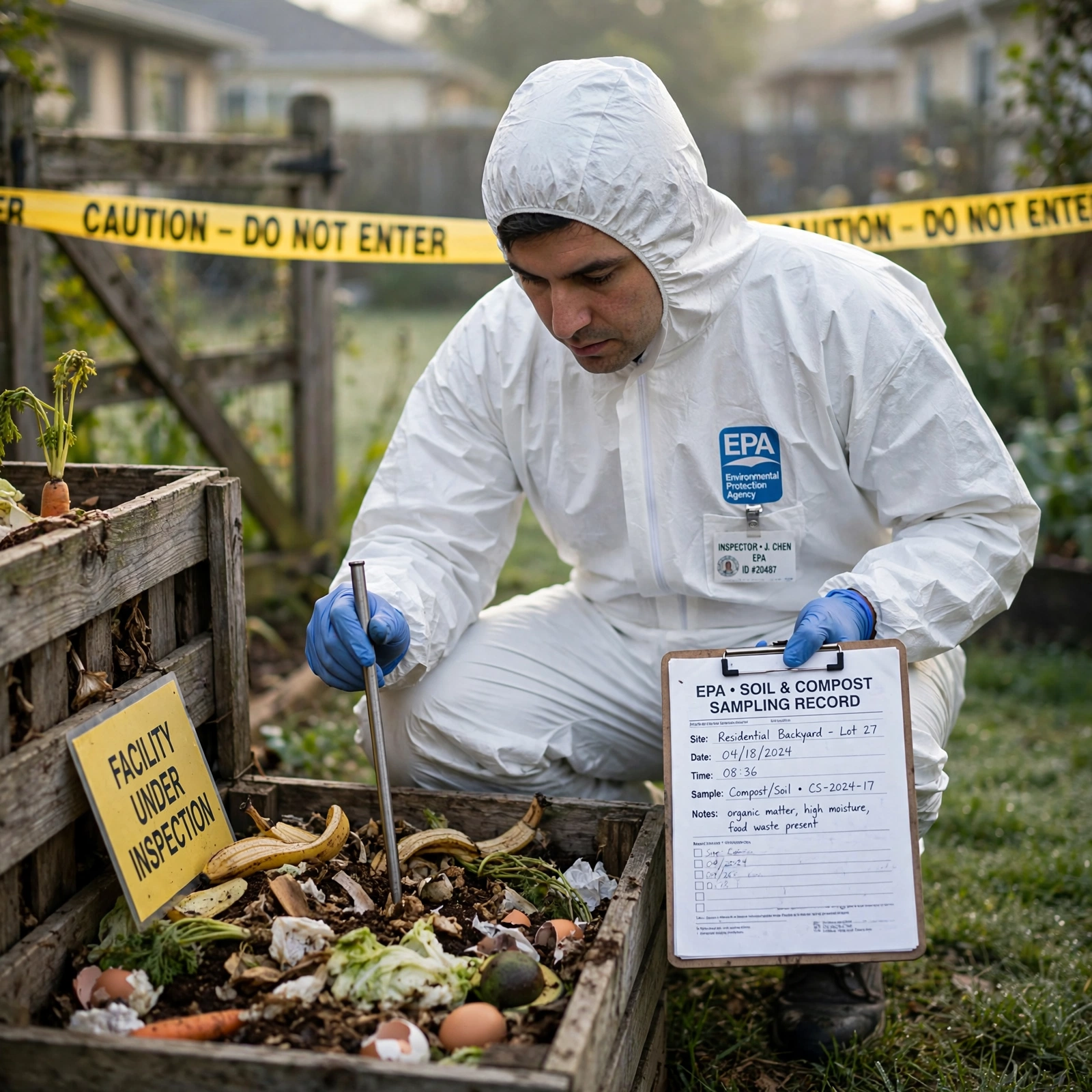
Section 1004(28), at 42 U.S.C. § 6903(28), defines “solid waste management” as “the systematic administration of activities which provide for the collection, source separation, storage, transportation, transfer, processing, treatment, and disposal of solid waste.” The definition does not limit “solid waste management” to industrial operations or municipal programs. It does not require a facility of any particular scale. It requires only the systematic administration of activities that provide for the treatment or disposal of solid waste. A person who maintains a compost bin, adds material on a regular schedule, turns the pile to aerate it, monitors moisture levels, and removes finished compost for application to garden beds is systematically administering an activity that provides for the treatment of solid waste.3
Section 1004(34), at 42 U.S.C. § 6903(34), defines “treatment,” when used in connection with hazardous waste, as “any method, technique, or process, including neutralization, designed to change the physical, chemical, or biological character or composition of any hazardous waste so as to neutralize such waste or so as to render such waste nonhazardous, safer for transport, amenable for recovery, amenable for storage, or reduced in volume.” The statute specifies that this definition applies to hazardous waste. But the concept it describes—a process designed to change the biological character of waste material so as to render it amenable for recovery and reduced in volume—is a perfect description of composting. The process is the same. The statutory vocabulary is the same. The regulated facility performs the activity at one scale. The backyard bin performs it at another.4
II. The Process Description
Composting is not gardening. Composting is biological waste treatment. The distinction matters because the regulatory consequences are determined by what the process does, not by what the operator calls it.
The EPA’s own guidance defines composting as “a form of organics recycling” in which “facilities collect and process organic materials (that would otherwise be landfilled or incinerated) into new products, such as soil amendments.” The agency’s description of the process acknowledges that the feedstock is waste material, that the process transforms it, and that the output is a different product. This is a textbook description of waste treatment. The agency uses the word “recycling” rather than “treatment” because “recycling” does not trigger the permitting consequences that “treatment” would.5
The biology of the process is unambiguous. During the active composting phase, thermophilic microorganisms—primarily bacteria of the genera Bacillus, Thermus, and Geobacillus, along with thermophilic fungi—colonize the organic substrate and metabolize carbon-based compounds through aerobic respiration. Internal pile temperatures rise to between 55°C and 70°C. At these temperatures, human pathogens including Salmonella, E. coli O157:H7, and helminth ova are destroyed. The physical structure of the waste is altered. The chemical composition changes as complex polymers are broken down into simpler organic acids, humic substances, and mineral nutrients. The biological community shifts from one dominated by mesophilic bacteria to one dominated by thermophilic organisms and, during the curing phase, by fungi and actinobacteria. The volume of the material is reduced by 30 to 60 percent. The mass is reduced by 40 to 80 percent.6
The input is garbage. The output is a soil amendment. Between input and output, the physical, chemical, and biological character of the waste has been changed by a controlled process designed to render it amenable for recovery and reduced in volume. The statute has a word for that.
III. The State Regulatory Acknowledgment
The clearest evidence that composting is solid waste management does not come from the federal government. It comes from the fifty states that regulate it as such.
RCRA Subtitle D, codified at 42 U.S.C. §§ 6941–6949a, establishes the framework for state solid waste management programs. Section 4003, at 42 U.S.C. § 6943, directs each state to develop a plan for the management of solid waste within its borders. The EPA sets minimum criteria; the states implement programs that meet or exceed those criteria. The result is a patchwork of state regulations that differ in their details but converge on a single principle: composting is a regulated solid waste management activity that requires government authorization.
Maine’s solid waste regulations at 06-096 C.M.R. ch. 410 require that “any person proposing to establish a new solid waste composting facility” must obtain a license. The regulations impose siting standards: the facility may not be located within 100 feet of a protected natural resource, within a 100-year flood plain, or within 300 feet of an off-site water supply well. Design standards require engineered surfaces, leachate collection systems, and stormwater management. Operations standards mandate temperature monitoring, pathogen reduction verification, and odor control measures.7
Washington State’s solid waste handling standards at WAC 173-350-220 provide that “these standards apply to all facilities that treat solid waste by composting.” The regulation uses the word “treat.” It does not say “recycle.” It does not say “manage.” It says “treat.” The state has classified composting as a form of solid waste treatment in its own regulatory text.8
Tennessee’s composting regulations at Tenn. Comp. R. & Regs. 0400-11-01-.11 provide that “no facility may compost solid waste without a permit.” Iowa’s regulations at Iowa Admin. Code r. 567-105.3 require composting facilities to be located at least 500 feet from any existing inhabited residence, 200 feet from public wells, 100 feet from private wells, and 50 feet from property lines. Maryland requires a composting facility permit under COMAR 26.04.11, plus a separate stormwater discharge permit, plus compliance with air quality regulations for odor emissions. Rhode Island’s regulations provide that “a mixed solid waste composting facility is not eligible for a registration”—it requires a full license, with radius plans, site plans, construction and engineering plans, operating plans, closure plans, and finished compost storage and marketing plans.9
The regulatory burden on a commercial composting facility is not trivial. It includes, across various state programs: environmental impact assessments, hydrogeological surveys, engineered pad construction, leachate collection and treatment, stormwater pollution prevention plans, odor management plans, vector control plans, fire prevention plans, noise mitigation measures, setback compliance, monitoring well installation, groundwater sampling, air emissions monitoring, pathogen testing of finished product, operational record-keeping, periodic compliance reporting, financial assurance for closure, and post-closure care obligations. The states impose these requirements because composting is solid waste treatment and solid waste treatment poses environmental risks that require regulatory oversight.
Every one of these states has made the same determination: composting is a solid waste management activity that requires a permit. Every one of them is correct.
IV. The Exemption Is a Confession
Every state that requires a permit for composting facilities also carves out an exemption for residential composting. This is the most instructive fact in the regulatory record.
Washington State’s regulation at WAC 173-350-220(2) provides a table of “Terms and Conditions for Solid Waste Permit Exemptions” specifying the materials and volumes that qualify for “conditionally exempt” status. West Virginia’s regulation at W. Va. Code R. § 33-3-3 states: “Residential and non-residential composting activities are exempt from obtaining a commercial solid waste facility permit.” Iowa exempts certain composting activities from permitting under Iowa Admin. Code r. 567-105.2. Tennessee exempts “backyard composting” from its permit requirement.10
The exemption is the confession. You do not exempt an activity from a permit unless the activity would otherwise require a permit. You do not write “residential composting is exempt from the solid waste facility permit” unless residential composting is, in the first instance, a solid waste facility activity. The exemption does not say “residential composting is not solid waste management.” It says “residential composting is solid waste management that we have chosen not to regulate.” The legal distinction is the difference between a substance that is not a pollutant and a substance that is a pollutant for which no standard has been set.
The pattern is identical to the one this publication has documented in other regulatory contexts. Kansas exempts playground swings and slides from its amusement ride safety act by name—because they meet the definition. The Nuclear Regulatory Commission exempts ionization smoke detectors from its radioactive materials licensing requirement at 10 CFR § 30.15(a)(7)—because they contain licensable radioactive material. California exempts residential composting from its solid waste facility permit requirement—because residential composting is a solid waste facility activity performed without a permit.
V. The Emissions Profile
The environmental justification for regulating commercial composting facilities is not theoretical. Composting emits greenhouse gases, air pollutants, and odorous compounds at concentrations that peer-reviewed research has documented and that state regulators have determined require management.
A critical review published in Environmental Science & Technology in 2023 analyzed 388 emission factors from 46 studies of composting operations. The review found that methane is the single largest contributor to 100-year global warming potential for yard waste composting, comprising approximately 80 percent of the total warming impact. For nitrogen-rich wastes including food scraps and mixed municipal organic waste, nitrous oxide is the largest contributor, accounting for 50 to 90 percent of the total global warming potential. Both gases are produced when anaerobic conditions develop within the composting mass—a condition that is routine in unmanaged residential compost piles where aeration is inconsistent.11
A 2023 review published in the International Journal of Environmental Research and Public Health documented that composting generates methane, nitrous oxide, ammonia, hydrogen sulfide, and volatile organic compounds. The review characterized these emissions as “practically unavoidable” and noted that they lead to “severe environmental problems.” Ammonia and hydrogen sulfide together account for over 95 percent of malodorous emissions from composting operations. Hydrogen sulfide is a toxic gas; the Occupational Safety and Health Administration sets a permissible exposure limit of 20 parts per million. Commercial composting facilities manage these emissions through forced aeration systems, biofilter installations, and enclosed vessel designs. Residential compost bins manage them by having no management system at all.12
Composting also generates leachate—liquid produced when water percolates through decomposing organic matter. Compost leachate contains elevated concentrations of nitrogen, phosphorus, potassium, biological oxygen demand, and dissolved organic carbon. Commercial composting regulations uniformly require leachate collection and treatment. A residential compost bin sitting on bare soil in a suburban backyard discharges its leachate directly into the ground, where it enters the shallow water table without treatment, without monitoring, and without any of the hydrogeological assessment that state regulations require of the facility across town that is performing the same biological process on the same category of material.
VI. The Scale of the Noncompliance
A 2024 national survey conducted by LawnStarter found that 47.18 percent of American adults reported that they currently compost food scraps or yard waste. Of those composters, 79.46 percent reported composting at home in their backyards or through indoor composting systems. The United States Census Bureau reports approximately 131.2 million occupied housing units. If the survey’s participation rate is representative, approximately 49 million American households operate backyard composting systems. Even if the true rate is substantially lower due to response bias—and composting participation surveys consistently produce higher self-reported rates than observational studies confirm—the number of households is conservatively in the range of 25 to 35 million.13
The EPA’s own data place the scale of the material in context. In 2019, 66.2 million tons of wasted food were generated across the food retail, food service, and residential sectors in the United States. Only 5 percent of that wasted food was composted. Food waste constitutes 24.1 percent of all municipal solid waste sent to landfills—the single largest material category. Twenty-six states have banned yard waste from landfills, creating a regulatory incentive for homeowners to compost yard trimmings rather than bag them for collection. The EPA’s most recent materials management data report 22.3 million tons of yard trimmings composted and 2.59 million tons of food composted through municipal and institutional programs. These figures do not include material composted in residential backyards, which no agency counts because no agency monitors the facilities that process it.14
The number of permitted commercial composting facilities in the United States is approximately 4,700, according to the Institute for Local Self-Reliance’s composting directory. Each of those facilities operates under a state-issued solid waste permit with enforceable conditions. The number of unpermitted residential composting operations is between seven and ten times larger. The permitted facilities process an estimated 100 million tons of organic material annually. The unpermitted facilities process an unknown quantity because no one has ever measured it.
VII. The Regulatory Asymmetry
Consider the regulatory treatment of two composting operations in the same American county.
On the east side of the county, a commercial composting facility accepts food scraps, yard trimmings, and agricultural waste from municipal collection programs and commercial generators. This facility operates under a state solid waste permit. It has submitted a permit application that includes site plans, engineering designs, a hydrogeological assessment, an odor management plan, a vector control plan, a fire prevention plan, a stormwater pollution prevention plan, a leachate collection and treatment plan, a closure plan, and a demonstration of financial assurance sufficient to fund closure and thirty years of post-closure care. The facility monitors groundwater quality through a network of monitoring wells sampled quarterly. It measures pile temperatures daily. It tests finished compost for fecal coliform, Salmonella, and heavy metals. It reports emissions to the state air quality agency. It submits annual compliance reports to the solid waste division. It is subject to unannounced inspections. Its permit is renewed every five years.
On the west side of the county, in a subdivision of 500 homes, approximately 235 households—47 percent, per the national survey rate—operate backyard compost bins. Each bin receives food scraps and yard waste. Each bin supports the same thermophilic microbial communities. Each bin produces the same metabolic byproducts: carbon dioxide, methane, ammonia, hydrogen sulfide, and volatile organic compounds. Each bin generates leachate that percolates into the soil. None of the 235 bins has submitted a permit application. None has installed a monitoring well. None has prepared a closure plan. None has demonstrated financial assurance. None has been inspected.15
The commercial facility and the 235 residential bins are performing the same biological process on the same category of waste material. The commercial facility is subject to comprehensive regulatory oversight because the state determined that composting poses environmental risks. The residential bins are subject to no oversight because the state determined that the same activity, performed at the same location where people live and children play, does not warrant a permit.
The commercial facility operates on an engineered pad designed to contain leachate. The residential bins operate on bare soil. The commercial facility employs forced aeration or mechanical turning to maintain aerobic conditions and minimize methane production. The residential bins rely on the operator’s memory to turn the pile, which peer-reviewed research has documented occurs far less frequently than required for optimal aerobic decomposition. The regulatory burden falls entirely on the facility that maintains professional management. The facility that maintains no management at all is exempt.
VIII. The EPA Encourages It
The most remarkable feature of the federal government’s posture toward residential composting is not its failure to regulate the activity. It is its active promotion of it.
The EPA publishes a page titled “Composting at Home” on its official website. The page provides instructions for selecting a composting method, building or purchasing a bin, choosing feedstocks, maintaining proper carbon-to-nitrogen ratios, and troubleshooting common problems. It describes the benefits of composting in terms that would satisfy any solid waste management plan: “When we send food and other organic materials to landfills or combustion facilities, we throw away the valuable nutrients and carbon contained in those materials. By composting our food scraps and yard trimmings instead, and using the compost produced, we can return those nutrients and carbon to the soil to improve soil quality, support plant growth and build resilience in our local ecosystems and communities.”16
The EPA’s own Wasted Food Scale places composting in the fourth tier of its preferred food waste management hierarchy—below source reduction, donation, and animal feed, but above anaerobic digestion, controlled combustion, and landfilling. The agency explicitly identifies composting as a superior waste management pathway compared to landfilling. It does not identify it as an activity that requires a solid waste permit. It identifies it as an activity you should do in your backyard on a Saturday.
The agency’s guidance does not mention RCRA. It does not mention solid waste permits. It does not mention that the activity it is encouraging millions of Americans to perform is classified by every state in the union as a regulated solid waste management activity for which a commercial operator would need a permit, an engineer, a groundwater assessment, a leachate management plan, an odor mitigation strategy, a closure and post-closure care plan, and a demonstration of financial assurance that the facility can be properly decommissioned if the operator abandons it.
The EPA encourages you to compost your food scraps because it is good for the environment. The EPA also administers the statute that classifies those food scraps as solid waste and the act of composting them as solid waste management. It has not reconciled the two positions. It does not appear to have tried.
IX. The Leachate in the Water Table
The environmental risks of unmanaged composting are not hypothetical. They are the same risks that state regulators identified when they required permits for commercial composting facilities, and they do not disappear because the facility is smaller.
Compost leachate is a documented source of nitrogen and phosphorus loading to shallow groundwater and surface water. A 2020 study published in Waste Management documented that composting facility runoff contained total nitrogen concentrations of 130 to 2,700 mg/L and chemical oxygen demand of 1,400 to 80,000 mg/L. For context, the EPA’s drinking water standard for nitrate is 10 mg/L. A residential compost bin does not produce leachate at industrial volumes, but it produces leachate at industrial concentrations, and it discharges that leachate into the same shallow aquifer that supplies the well or the municipal water system that delivers water to the kitchen faucet.17
Maine’s composting regulations require a 300-foot setback from off-site water supply wells. Iowa requires 200 feet from public wells and 100 feet from private wells. These distances exist because the states have determined that composting generates leachate that poses a contamination risk to groundwater. The average residential lot in the United States is approximately 8,200 square feet. On a lot of that size, the maximum distance from a compost bin to a property boundary is approximately 45 feet. The maximum distance to a neighbor’s well is determined by the neighbor’s lot size. In most suburban developments, compost bins operate well within the setback distances that states have determined are necessary to protect water supplies from the leachate generated by the same biological process.
The commercial facility must maintain those setbacks because the state determined that composting leachate is a water quality concern. The residential bin does not maintain them because the state determined that the same leachate, generated by the same process, from the same category of waste, at the same concentrations, is not a concern when it is produced thirty feet from a neighbor’s well instead of three hundred.
X. Conclusion
The evidence does not require a novel legal theory. RCRA defines solid waste. Food scraps are solid waste. RCRA defines solid waste management. Composting is solid waste management. Every state that regulates composting facilities has made this determination. Every state that exempts residential composting from the solid waste permit requirement has confirmed the determination by carving an exemption from it. The exemption is not a denial that composting is solid waste management. It is an acknowledgment that composting is solid waste management that the state has elected not to regulate at the residential scale.
The EPA encourages it. The states exempt it. The same agencies that require commercial composting facilities to install monitoring wells, collect leachate, test for pathogens, measure greenhouse gas emissions, and demonstrate financial assurance for closure have determined that approximately 35 million American households should perform the same activity in their backyards with a wooden box and a kitchen bucket.
The biological process does not know the difference between a permitted facility and a backyard bin. The same thermophilic bacteria colonize both. The same metabolic reactions proceed in both. The same emissions are generated by both. The same leachate percolates through both. The commercial facility has a permit, an engineer, a monitoring program, and quarterly compliance reports. The residential bin has a pitchfork.
Section 1004(27) of RCRA defines “solid waste” as any garbage or discarded material from community activities. Section 1004(28) defines “solid waste management” as activities that provide for the treatment and disposal of solid waste. The banana peel in the compost bin is solid waste. The composting of it is solid waste management. The bin is an unpermitted solid waste treatment facility operating without environmental monitoring, without leachate controls, without a closure plan, and without any of the regulatory infrastructure that every state in the union requires of the facility down the road that is doing the same thing to the same waste for the same reason.
The EPA’s own website tells you how to do it. It provides illustrated instructions.
Ergo.
Sources
- 42 U.S.C. § 6901(a)(4) (Congressional findings on solid waste); 42 U.S.C. § 6902(a) (objectives of RCRA). law.cornell.edu ↑
- 42 U.S.C. § 6903(27): “The term ‘solid waste’ means any garbage, refuse, sludge from a waste treatment plant, water supply treatment plant, or air pollution control facility and other discarded material, including solid, liquid, semisolid, or contained gaseous material resulting from industrial, commercial, mining, and agricultural operations, and from community activities.” law.cornell.edu ↑
- 42 U.S.C. § 6903(28): “The term ‘solid waste management’ means the systematic administration of activities which provide for the collection, source separation, storage, transportation, transfer, processing, treatment, and disposal of solid waste.” law.cornell.edu ↑
- 42 U.S.C. § 6903(34): “The term ‘treatment’, when used in connection with hazardous waste, means any method, technique, or process, including neutralization, designed to change the physical, chemical, or biological character or composition of any hazardous waste so as to neutralize such waste or so as to render such waste nonhazardous, safer for transport, amenable for recovery, amenable for storage, or reduced in volume.” law.cornell.edu ↑
- U.S. EPA, “Composting,” under Reducing the Impact of Wasted Food by Feeding the Soil and Composting. “Composting is a form of organics recycling. Organics recycling is when facilities collect and process organic materials (that would otherwise be landfilled or incinerated) into new products, such as soil amendments.” epa.gov ↑
- Composting microbiology and thermophilic phase temperatures are well-documented in F.C. Michel Jr. et al., “Effects of Turning Frequency, Leaves to Grass Mix Ratio and Windrow vs. Pile Configuration on the Composting of Yard Trimmings,” Compost Science & Utilization, vol. 4, no. 1, 1996. Mass and volume reduction ranges from Rynk et al., “On-Farm Composting Handbook,” NRAES-54, Northeast Regional Agricultural Engineering Service, 1992. Temperature ranges for pathogen destruction documented in EPA’s 40 CFR Part 503 (Standards for the Use or Disposal of Sewage Sludge): 55°C for 3 consecutive days. ↑
- Maine solid waste composting regulations, 06-096 C.M.R. ch. 410, § 2: General Licensing Requirements for composting facilities, including siting, design, and operational standards. law.cornell.edu ↑
- Washington Administrative Code 173-350-220(1)(a): “These standards apply to all facilities that treat solid waste by composting.” apps.leg.wa.gov ↑
- Tennessee composting regulations: Tenn. Comp. R. & Regs. 0400-11-01-.11: “no facility may compost solid waste without a permit.” Iowa: Iowa Admin. Code r. 567-105.3 (setback requirements). Maryland: COMAR 26.04.11 (composting facility permit). Rhode Island: 250 RICR 140-05-8.9: “A mixed solid waste composting facility is not eligible for a registration.” law.cornell.edu ↑
- Washington: WAC 173-350-220(2), Table 220-A, “Terms and Conditions for Solid Waste Permit Exemptions.” West Virginia: W. Va. Code R. § 33-3-3(3.5.b): “Residential and non-residential composting activities are exempt from obtaining a commercial solid waste facility permit.” Iowa: Iowa Admin. Code r. 567-105.2 (exemptions). Tennessee: exemption for backyard composting from Tenn. Comp. R. & Regs. 0400-11-01-.11(1)(b). law.cornell.edu ↑
- K. Muñoz-Arboleda et al., “Greenhouse Gas and Air Pollutant Emissions from Composting,” Environmental Science & Technology, vol. 57, no. 22, 2023, pp. 8483–8496. Review of 388 emission factors from 46 studies. CH4 is the largest contributor to GWP100 for yard waste composting (~80%); N2O is the largest for nitrogen-rich wastes (50–90%). pmc.ncbi.nlm.nih.gov ↑
- Li M. et al., “Measures for Controlling Gaseous Emissions during Composting: A Review,” International Journal of Environmental Research and Public Health, vol. 20, no. 4, 2023, 3587. Greenhouse gases (CH4 and N2O) and odor emissions (NH3, H2S) “practically unavoidable.” NH3 and H2S comprise >95% of malodorous emissions. OSHA PEL for H2S: 20 ppm (29 CFR § 1910.1000, Table Z-2). mdpi.com ↑
- LawnStarter, “U.S. Composting Survey,” 2024: 47.18% of respondents currently compost; 79.46% compost at home. U.S. Census Bureau, 2023 American Housing Survey: approximately 131.2 million occupied housing units. Survey calculation: 131.2M × 47.18% × 79.46% ≈ 49.2 million households with backyard composting. lawnstarter.com ↑
- U.S. EPA, “Food: Material-Specific Data.” In 2019, 66.2 million tons of wasted food generated; 5% composted. Food is 24.1% of municipal solid waste in landfills. EPA, “National Overview: Facts and Figures on Materials, Wastes and Recycling”: 22.3 million tons of yard trimmings composted; 2.59 million tons of food composted (2018 data). 26 states ban yard waste from landfills. epa.gov ↑
- Comparative analysis based on state permitting requirements documented in sources 7–10 and the LawnStarter survey participation rate in source 13. The 47% participation rate applied to a 500-home subdivision yields approximately 235 composting households. ↑
- U.S. EPA, “Composting at Home,” under Reducing the Impact of Wasted Food by Feeding the Soil and Composting. Full quote: “When we send food and other organic materials to landfills or combustion facilities, we throw away the valuable nutrients and carbon contained in those materials. By composting our food scraps and yard trimmings instead, and using the compost produced, we can return those nutrients and carbon to the soil to improve soil quality, support plant growth and build resilience in our local ecosystems and communities.” Composting is in the fourth tier of EPA’s Wasted Food Scale. epa.gov ↑
- Compost leachate composition: total nitrogen 130–2,700 mg/L and COD 1,400–80,000 mg/L documented in facility runoff studies. EPA drinking water standard for nitrate: 10 mg/L (40 CFR § 141.62). Average residential lot size approximately 8,177 square feet per U.S. Census American Housing Survey (median lot size for single-family detached homes). State setback requirements from Maine (300 feet from water supply wells) and Iowa (200 feet from public wells, 100 feet from private wells). ↑