I. The Statute
The Noise Control Act of 1972 was enacted as Public Law 92–574, 86 Stat. 1234, and codified at 42 U.S.C. §§ 4901–4918, with a congressional declaration of findings and policy that reads like a description of the exact event it would never regulate.1
Congress found that noise is a constant source of torment to the citizens of the United States; that nearly twenty million citizens are exposed to noise levels that can lead to psychological and physiological damage; and that another forty million are exposed to noise levels that cause sleep or work disruption. Congress further found that federal action is essential to deal with major noise sources, the control of which “require[s] national uniformity of treatment.”2 Chronic exposure, the legislative record notes, has been linked to increased risk of cardiovascular problems, strokes, and nervous disorders, and to diminished worker productivity measured in untold costs to society.3
The Act directed the Environmental Protection Agency to protect the health and welfare of Americans from unregulated noise and established the Office of Noise Abatement and Control to carry out the mandate. In 1974, the Office published its Levels Document, Information on Levels of Environmental Noise Requisite to Protect Public Health and Welfare with an Adequate Margin of Safety, recommending an equivalent sound exposure of 70 decibels over a twenty-four-hour period to protect the public from hearing loss, and levels of 55 and 45 decibels for outdoor and indoor activities, respectively, to protect against interference and annoyance.4
Congress strengthened the regime in 1978 with the Quiet Communities Act, 42 U.S.C. § 4913, directing the EPA to provide extensive informational, technical, and financial assistance to state and local governments to facilitate their noise control efforts.5 Then, in 1982, the funding for the Office of Noise Abatement and Control was terminated, and no funds have been provided since. The Noise Control Act of 1972 and the Quiet Communities Act of 1978 were never rescinded by Congress. They remain in effect today, in the EPA’s own words, “essentially unfunded.”6
This is not a dispute about the law. The law is on the books. The office is gone. The Administrator of the EPA remains legally responsible for enforcing the Act’s regulations, and in June 2023, litigants filed suit in federal court (No. 1:23-cv-01649) seeking to compel the agency to resume the noise duties Congress assigned it, observing that noise abatement programs across the country “lie dormant” because the money stopped even as the legal obligation continued.7 A complaint is not an office, but it is the only sign of life the statute has shown in forty-four years.
II. The Mechanism
The emitter is the periodical cicada, genus Magicicada. Only the males sing, and they sing for one reason: to find a mate. On each side of the male’s thorax sit thin, ridged plates of exoskeleton called tymbals, made of a rubbery substance called resilin. The cicada vibrates these tymbals with dedicated muscles, and with every vibration a sound wave is released; the insects can send out 300 to 400 sound waves per second. The male’s abdomen is almost completely hollow, and the sound waves enter the cavity, bounce around, and emerge louder. This is, structurally, an amplifier with legs.8
The operators, in a substantial number of cases, are not in full command of their faculties. Periodical cicadas are infected by Massospora cicadina, a fungal parasite that floods the insect with cathinone, a stimulant also found in the khat plant, and that causes infected males to flick their wings in the manner of receptive females, so that healthy males attempting to mate with the impostors become infected in turn. “It’s sex, drugs and zombies,” an evolutionary biologist at the University of Connecticut told Scientific American.9 Cathinone is classified by the Drug Enforcement Administration as a Schedule I controlled substance.10
Consider what this means. The largest unregulated noise emission event of the decade was produced by billions of insects, a meaningful fraction of them under the influence of a mind-altering fungus that manufactures a federally controlled substance, vibrating rubbery plates on their thoraxes hundreds of times per second through hollow resonating abdomens. No manufacturer has registered the tymbal design. No label discloses the cathinone content. The Noise Control Act’s product noise labeling provisions were written for emitters exactly like this one, and the office that wrote them was defunded before the brood’s previous emergence had even occurred.
III. The Scale
In the spring of 2025, Brood XIV, the second-largest of the fifteen periodical cicada broods, emerged for the first time since 2008, appearing by the billions across thirteen states: Georgia, Kentucky, Maryland, Massachusetts, New Jersey, New York, North Carolina, Ohio, Pennsylvania, South Carolina, Tennessee, Virginia, and West Virginia, with localized appearances in nine southern counties of Indiana.1112 The entomologist Gene Kritsky of Mount St. Joseph University, who has tracked these broods for decades through his Cicada Safari project, notes that Brood XIV is the ancestral brood from which all other seventeen-year broods branched off, and that it is the same brood first recorded by the pilgrims of the Plymouth colony in 1634.13 The operator has been running unpermitted noise events on this continent for nearly four hundred years, and the colonists documented it before there was a Congress to defund the office that would ignore it.
The previous year set the modern record. In the spring of 2024, Brood XIII, the seventeen-year brood of northern Illinois, emerged simultaneously with Brood XIX, the thirteen-year Great Southern Brood. Illinois was the only state to host both. The dual emergence had not occurred since 1803, when Thomas Jefferson was president, and will not occur again until 2245.14 In the densest stands, Kritsky documented as many as 1.5 million cicadas per tree-covered acre, which is nearly a billion per square mile.15 Chasers, researchers, and entomology tourists fanned out across eighteen states.15
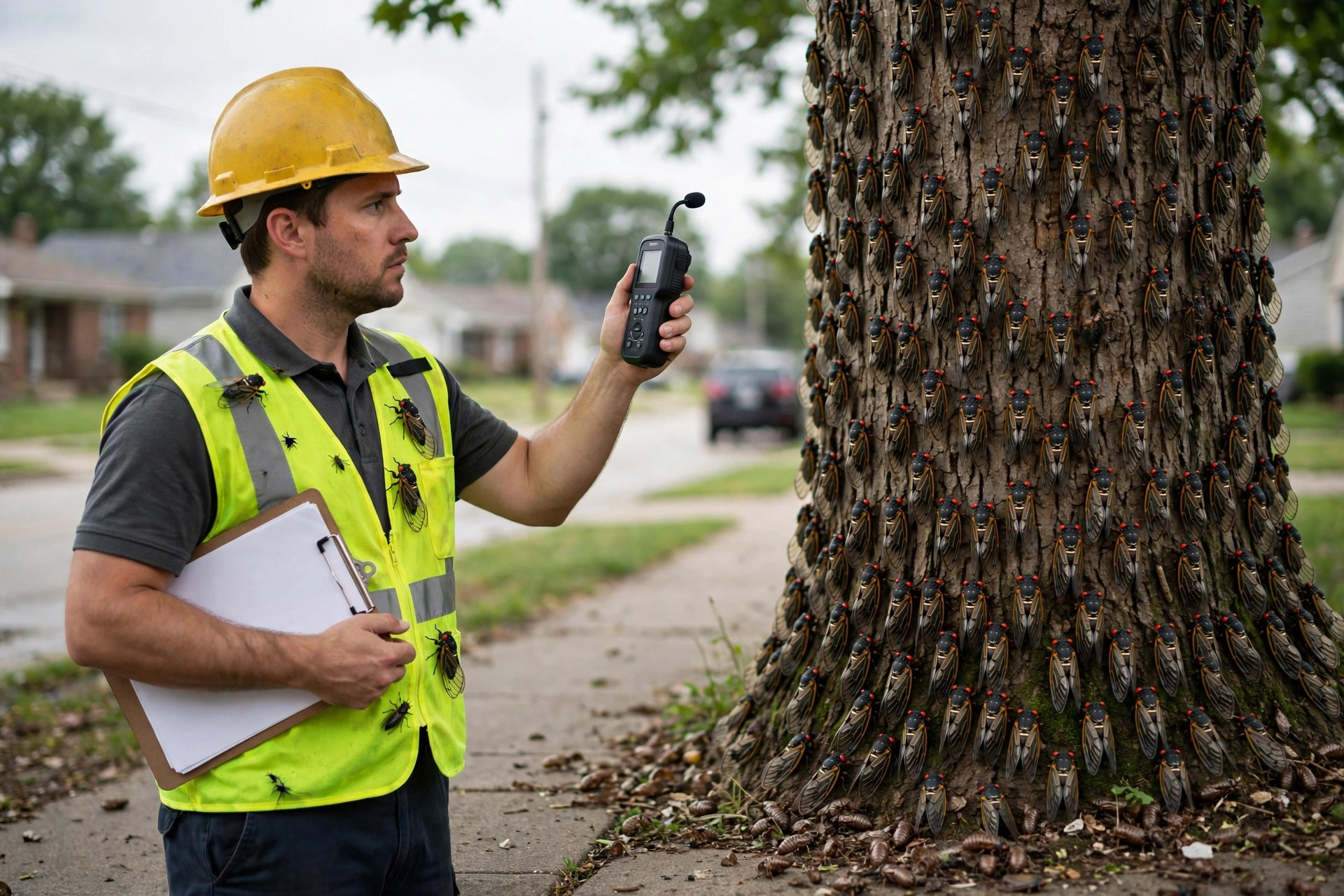
The sound was measured. A professional engineer with Civiltech, an Illinois engineering firm, took readings during the 2024 emergence and found the sustained combined chorus at 88.5 decibels on the A-weighted scale, fluctuating between 82 and 89 dBA in waves. The loudest traffic noise the same engineer had ever measured on a highway project was approximately 75 dBA along I-90 near the I-290 interchange. The fourteen-decibel difference, he noted, made the cicadas subjectively more than twice as loud as the interstate. The insects exceeded the Federal Highway Administration’s noise abatement thresholds, 67 dBA for residential areas and 72 dBA for commercial, by a margin that would require a highway agency to consider building a noise wall.16 No wall was considered. The emitters were not a highway.
Other measurements were higher. In parts of Illinois the chorus hit 101 decibels, louder than a lawnmower, arriving in waves like, in the Associated Press’s phrase, aliens descending in a science fiction movie.15 The National Institutes of Health, cited by the University of Illinois Extension, puts male cicada calls at over 90 decibels, as loud as a lawnmower, motorcycle, or tractor.14 At the Morton Arboretum near Chicago, a visitor’s Apple Watch buzzed with a loud-environment warning at 90 decibels; the watch issues such warnings because sustained exposure at that level can damage hearing.17 Some entomological sources put the peak chorus at 100 decibels.18
The EPA’s own 1974 Levels Document set 70 decibels over twenty-four hours as the ceiling for hearing protection.4 The cicadas ran at 88.5, day after day, for six weeks of daylight hours. That is 18.5 decibels above the federal hearing-protection guideline, sustained day after day for six weeks of daylight hours, and the agency that published the guideline no longer has an office, a budget, or a single employee whose job description includes reading a decibel meter.
IV. The Precedent
The jurisdictions that hosted the emergences have noise laws. They enforce them against people.
Chicago’s municipal code, Chapter 11-4, limits sound to 65 decibels during the day and 55 decibels at night, with quiet hours from 10 p.m. to 8 a.m., and separately provides that no electronically amplified sound may exceed 55 dB(A) when measured inside a dwelling unit.1920 Evanston sets 55 decibels by day and 45 by night. Springfield sets 60 and 50. A published compendium of Illinois noise ordinances reports that fines for violations typically range from $200 to $1,000, with the offending equipment subject to seizure for repeat offenders.19
The measured cicada chorus of 88.5 dBA exceeded Chicago’s daytime limit by 23.5 decibels and its nighttime limit by 33.5 decibels. On the logarithmic decibel scale, a ten-decibel increase is perceived as roughly a doubling of loudness. The insects were operating at more than three doublings above the legal nighttime limit. A human being generating 88.5 decibels in a Chicago residential neighborhood at night would be cited, fined, and, on repetition, relieved of the equipment. The cicadas were not cited. They were not fined. They have no equipment that can be seized, unless the city is prepared to impound the trees.
The federal government has its own precedent for treating 67 decibels as an actionable threshold. Under the Federal Highway Administration’s noise regulations, when traffic noise reaches 67 dBA at residences, the agency must consider abatement, which in practice means noise walls.16 The 2024 cicada chorus in the Chicago suburbs exceeded that threshold by 21.5 decibels, at one DuPage County shopping plaza drowning out an automated car wash, and in Oak Brook flowing in waves as an ever-present buzzing drone.15 The regulation that would compel a wall against a highway at 67 dBA has nothing to say about a biological chorus at 88.5. The wall was never considered. There is no form for it.
Occupational law comes closest to touching the event and still misses. The Occupational Safety and Health Administration’s noise standard, 29 CFR § 1910.95, requires employers to administer a hearing conservation program when workers are exposed at or above 85 decibels as an eight-hour time-weighted average, and sets the permissible exposure limit at 90 dBA for a full workday.21 The 2024 chorus ran at 88.5 dBA, one and a half decibels below the federal limit for a full workday, and landscapers, arborists, tree crews, and road workers across northern Illinois spent full shifts inside it for six weeks. No employer’s hearing conservation program lists the cicada as the exposure source. The standard assumes the noise comes from machinery. The machinery assumption is forty-four years out of date.
V. The Enforcement Void
The structural problem is definitional. The Noise Control Act regulates “persons” and “products.” The Act defines “person” at 42 U.S.C. § 4902 to mean any individual, corporation, partnership, association, State, municipality, or Federal agency.22 The cicada is none of these. It cannot be served with process. It cannot be named as a respondent. It cannot retain counsel, attend a hearing, or pay a civil penalty. This is the most complete regulatory evasion strategy in American administrative law, and it was developed over millions of years by an insect with no legal department.
The enforcement office that might have tried anyway was defunded in 1982, before the current emergence cycle’s grandparents hatched. Consider the timeline: the Office of Noise Abatement and Control lost its funding in 1982. Brood XIV has emerged in 1991, 2008, and 2025 without a single federal noise inspection. Brood XIII emerged in 1990, 2007, and 2024. Every seventeen-year emergence since the office died has proceeded without federal noise oversight. The cicadas have outlasted the regulator by two full generations, and the regulator is not coming back: the 2023 lawsuit seeking to compel the EPA to resume its Noise Control Act duties remains the only sign of life in the statute, and a complaint is not an office.7
The compliance rate is zero. No noise permit has been issued to a cicada. No inspection has been conducted. No decibel reading has been filed with any agency by any regulator in either the 2024 or the 2025 emergence. The only professional decibel measurements on the record were taken by a private engineering firm, for a blog post, because the engineers found the numbers interesting.16 That is the entire enforcement history of the largest unregulated noise emission events in modern American history: a blog post.
VI. The Declining Operator
The operation is, in one sense, winding down. The adults that sang in 2025 are dead. Their offspring hatched, fell to the soil, and burrowed underground to feed on tree root sap for the next seventeen years. Brood XIV will not emerge again until 2042.12 Brood XIX, the thirteen-year brood, returns in 2037. Brood XIII returns in 2041. The 221-year dual emergence will not recur until 2245.14
But “declining” is the wrong word for a schedule measured in prime numbers. The broods do not negotiate. They do not apply for permits during the sixteen years they spend underground, because there is no office to apply to, and they would not recognize the jurisdiction in any case. The 2037 emergence is eleven years away. The 2041 emergence is fifteen. The federal government has forty-four years of experience not regulating this event, and the insects have millions of years of experience not noticing.
There is a final irony in the enforcement record, and it belongs to the fungus. The cicadas that sang the loudest were, in many cases, being puppeteered by Massospora cicadina, which floods its host with cathinone, a compound the Drug Enforcement Administration lists in Schedule I of the Controlled Substances Act.910 So the federal government does, in a sense, regulate one input to the noise event: it prohibits the manufacture of the drug. It simply does not prohibit the noise. The fungus manufactures a controlled substance inside an unregulable insect to compel it to produce unregulated sound at volumes that exceed federal guidelines by eighteen decibels, and the only federal agency with a documented interest in any part of this chain is the one that classifies the drug. The EPA’s Office of Noise Abatement and Control was defunded in 1982. The DEA was not.
The permit application is not pending. It will not be filed. The operator does not recognize federal jurisdiction, does not retain counsel, and does not experience regulatory anxiety. It sings. It mates. It dies. It returns in 2042. The Noise Control Act is still the law. The office is still defunded. The cicadas are still louder than the statute.
Ergo.
Sources
- Noise Control Act of 1972, Pub. L. 92–574, 86 Stat. 1234, codified as amended at 42 U.S.C. §§ 4901–4918. law.cornell.edu ↑
- 42 U.S.C. § 4901(a)(1)–(3), congressional findings and statement of policy. Noise as “a constant source of torment”; nearly 20 million citizens exposed to psychologically and physiologically damaging levels; another 40 million exposed to sleep- and work-disrupting levels; federal action essential because control of major noise sources “require[s] national uniformity of treatment.” law.cornell.edu ↑
- Findings accompanying S. 3385 (115th Congress), reciting the Noise Control Act’s legislative history: chronic noise exposure linked to increased risk of cardiovascular problems, strokes, and nervous disorders; sleep deprivation and task interruption imposing untold costs in diminished worker productivity. govinfo.gov ↑
- John Eichwald, Padmaja Vempaty, and Yulia Carroll, “Review of Sixty U.S. Environmental Community Noise Ordinances,” Hearing Journal (2022), PMCID: PMC9347828. The Noise Control Act directed EPA to protect Americans from unregulated noise and formed the Office of Noise Abatement and Control; the Office’s 1974 Levels Document recommended an equivalent exposure of 70 decibels over twenty-four hours to protect against hearing loss, and 55 and 45 decibels for outdoor and indoor activities, respectively, against interference and annoyance. pmc.ncbi.nlm.nih.gov ↑
- Quiet Communities Act of 1978, Pub. L. 95–609, 92 Stat. 3079, codified at 42 U.S.C. § 4913, amending the Noise Control Act to direct EPA to provide extensive informational, technical, and financial assistance to state and local noise control efforts. govinfo.gov ↑
- U.S. Environmental Protection Agency, “EPA History: Noise and the Noise Control Act.” EPA coordinated all federal noise control activities through the Office of Noise Abatement and Control; the office’s funding was phased out in 1982, transferring primary responsibility to state and local governments; the Noise Control Act and the Quiet Communities Act were never rescinded and remain in effect, “although they are essentially unfunded.” epa.gov ↑
- Complaint, Noise Pollution Clearinghouse et al. v. U.S. Environmental Protection Agency, No. 1:23-cv-01649 (D.D.C. filed June 7, 2023). The complaint alleges EPA abandoned its nondiscretionary duties under the Noise Control Act, that the Administrator “remains legally responsible” for enforcement though funding was terminated, and that noise abatement programs across the United States “lie dormant.” epa.gov ↑
- Arizona State University, Ask a Biologist, on cicada sound production: tymbals are thin, ridged areas of exoskeleton on both sides of the thorax, made of the rubbery substance resilin; the cicada vibrates its tymbals very fast using body muscles, releasing 300–400 sound waves per second; the male’s abdomen is almost completely hollow, and the sound waves bounce around inside, emerging louder. Quoted in WGN-TV reporting on the 2024 emergence. wcia.com ↑
- Mindy Weisberger, “The Brood XIV Zombie Cicadas Are Coming,” Scientific American, May 2025. Massospora cicadina infects periodical cicadas, floods them with the stimulant cathinone (also found in khat), and causes infected males to flick their wings like receptive females, spreading the infection to healthy males that attempt to mate with them. Evolutionary biologist John Cooley (University of Connecticut): “It’s sex, drugs and zombies.” scientificamerican.com ↑
- 21 CFR § 1308.11, Schedules of controlled substances: cathinone is listed in Schedule I. ↑
- USA Today Network, “Brood XIV: See the 2025 cicada map,” April 2025. Brood XIV emerging spring 2025 for the first time since 2008, by the billions, in Georgia, Kentucky, Maryland, Massachusetts, New Jersey, New York, North Carolina, Ohio, Pennsylvania, South Carolina, Tennessee, Virginia, and West Virginia. beaconjournal.com ↑
- The Weather Company, “Cicada Brood XIV to Emerge in Eastern US,” March 2025. Brood XIV, the second-largest of the fifteen periodical cicada broods, in thirteen eastern states; “Catch them in 2025, or wait until 2042.” weather.com ↑
- Sara Hashemi, “Watch for Cicadas: Billions From Brood XIV Will Soon Emerge After 17 Years Underground,” Smithsonian Magazine, May 8, 2025. Brood XIV is the ancestral brood from which all other seventeen-year broods branched off; it is the same brood first recorded in 1634 by the pilgrims of the Plymouth colony, per entomologist Gene Kritsky (Mount St. Joseph University). smithsonianmag.com ↑
- University of Illinois Extension, via AgriMarketing, “Enjoy the Silence… Cicadas Are Coming,” 2024. Broods XIII (seventeen-year) and XIX (thirteen-year) emerging simultaneously across Illinois; the first simultaneous emergence since 1803, not to recur until 2245; Illinois the only state with the double emergence; male cicada calls over 90 decibels per the National Institutes of Health; emergence triggered when soil temperatures reach 64°F at seven to eight inches deep. agrimarketing.com ↑
- Associated Press, “Illinois is hit with cicada chaos,” June 14, 2024. Decibel levels hit 101 in parts of Illinois, louder than a lawnmower; Brood XIII at up to 1.5 million cicadas per tree-covered acre, nearly a billion per square mile, per Gene Kritsky; chasers across eighteen Midwestern and Southern states; in a DuPage County shopping plaza, cicadas mobbing the only tree drowned out an automated car wash. arcpublishing.com ↑
- Civiltech Engineering, Inc., “How Loud Were They? Measuring the Noise of the Cicadas,” 2024. Professional engineer’s measurements during the 2024 emergence: sustained combined chorus of 88.5 dBA, fluctuating 82–89 dBA; loudest traffic noise the engineer had measured on a highway project was approximately 75 dBA on I-90; the fourteen-dBA difference made the cicadas subjectively more than twice as loud as the interstate; federal thresholds of 67 dBA (residential) and 72 dBA (commercial), above which noise abatement walls must be considered on highway projects. civiltechinc.com ↑
- Phys.org, “To hear the cicadas sing, enthusiasts travel from near and far,” June 2024. At the Morton Arboretum near Chicago, a visitor’s Apple Watch issued a “loud environment” warning at 90 decibels during the cicada chorus; the watch warns because sustained exposure at such levels can cause permanent hearing damage. phys.org ↑
- DTN/Progressive Farmer, “Countdown to Cicada Cacophony,” May 9, 2024. The sound male cicadas make looking for a mate can reach 100 decibels. dtnpf.com ↑
- Noise Ordinance by City, “Noise Ordinance in Illinois.” Chicago Municipal Code Chapter 11-4: 65 dB daytime, 55 dB nighttime (10:00 p.m.–8:00 a.m.); Evanston 55/45; Springfield 60/50; typical Illinois noise fines $200–$1,000, with equipment subject to seizure for repeat offenders. noiseordinancebycity.com ↑
- City of Chicago, “Sound Rules and Regulations,” Municipal Code § 11-4-2805: no establishment shall operate electronically amplified sound exceeding 55 dB(A) when measured from within any dwelling unit; Riverwalk guideline 50 dB(A). wttw.com ↑
- 29 CFR § 1910.95, “Occupational noise exposure.” Employers must administer a hearing conservation program when employee noise exposure equals or exceeds 85 decibels as an eight-hour time-weighted average; permissible exposure limit of 90 dBA for an eight-hour day. ↑
- 42 U.S.C. § 4902, definitions under the Noise Control Act: “person” means any individual, corporation, partnership, association, State, municipality, or Federal agency. ↑