I. The Code
Section 105.1 of the International Building Code, adopted at the state or local level in all fifty states and Washington, D.C., states the rule without qualification: “Any owner or owner’s authorized agent who intends to construct, enlarge, alter, repair, move, demolish or change the occupancy of a building or structure, or to erect, install, enlarge, alter, repair, remove, convert or replace any electrical, gas, mechanical or plumbing system, the installation of which is regulated by this code, or to cause any such work to be performed, shall first make application to the building official and obtain the required permit.”117
Section 111.1 is equally direct: “No building or structure, in whole or in part, shall be used or occupied until the building official has issued an approval in the form of a certificate of occupancy or certificate of completion.”2 The sequence the code contemplates is application, review, permit, inspection, certificate, occupancy. Every year in the United States, human builders follow it. Every year, the birds do not.
The code does contain an exemption, and the birds appear to have read it. Section 105.2 exempts from the permit requirement one-story detached accessory structures, such as tool and storage sheds and playhouses, provided the floor area does not exceed 120 square feet.3 A 9.5-foot-diameter eagle nest has a footprint of approximately 71 square feet. It qualifies for the garden shed exemption on floor area, and on no other basis whatsoever. The exemption was written for garden sheds. The largest bird nest in recorded history would qualify for it on floor area while weighing nearly three tons, rising twenty feet deep, and housing occupants that arrived by air. The exemption is the only section of the building code that the birds comply with, and they comply with it by accident.
II. The Structures
The bald eagle builds the largest nest of any North American bird. A typical nest, or eyrie, is four to five feet in diameter and two to four feet deep, and the pair adds one to two feet of new material each breeding season.4 The nests are occupied for decades. One nest in Vermilion, Ohio, was used by bald eagles for thirty-four years; it measured 2.7 meters across, 3.6 meters deep, and weighed an estimated two metric tons, until the tree blew down.5 Thirty-four years of continuous occupancy. No certificate of occupancy was ever issued, because no application was ever filed, because the building official has no form for a tree.
The record is larger still. The largest bald eagle nest ever recorded, near St. Petersburg, Florida, measured 9.5 feet in diameter and 20 feet deep, and weighed almost three tons.4 Three tons of sticks, moss, grass, and seaweed, assembled beak by beak, with no structural engineer, no load calculation, and no stamped drawing. The exterior walls are stacked in a cone of strong sticks to carry the weight; the interior is lined with soft material for the eggs.4 It is, by every engineering measure that matters, a structure. It is, by every permitting measure that matters, invisible.
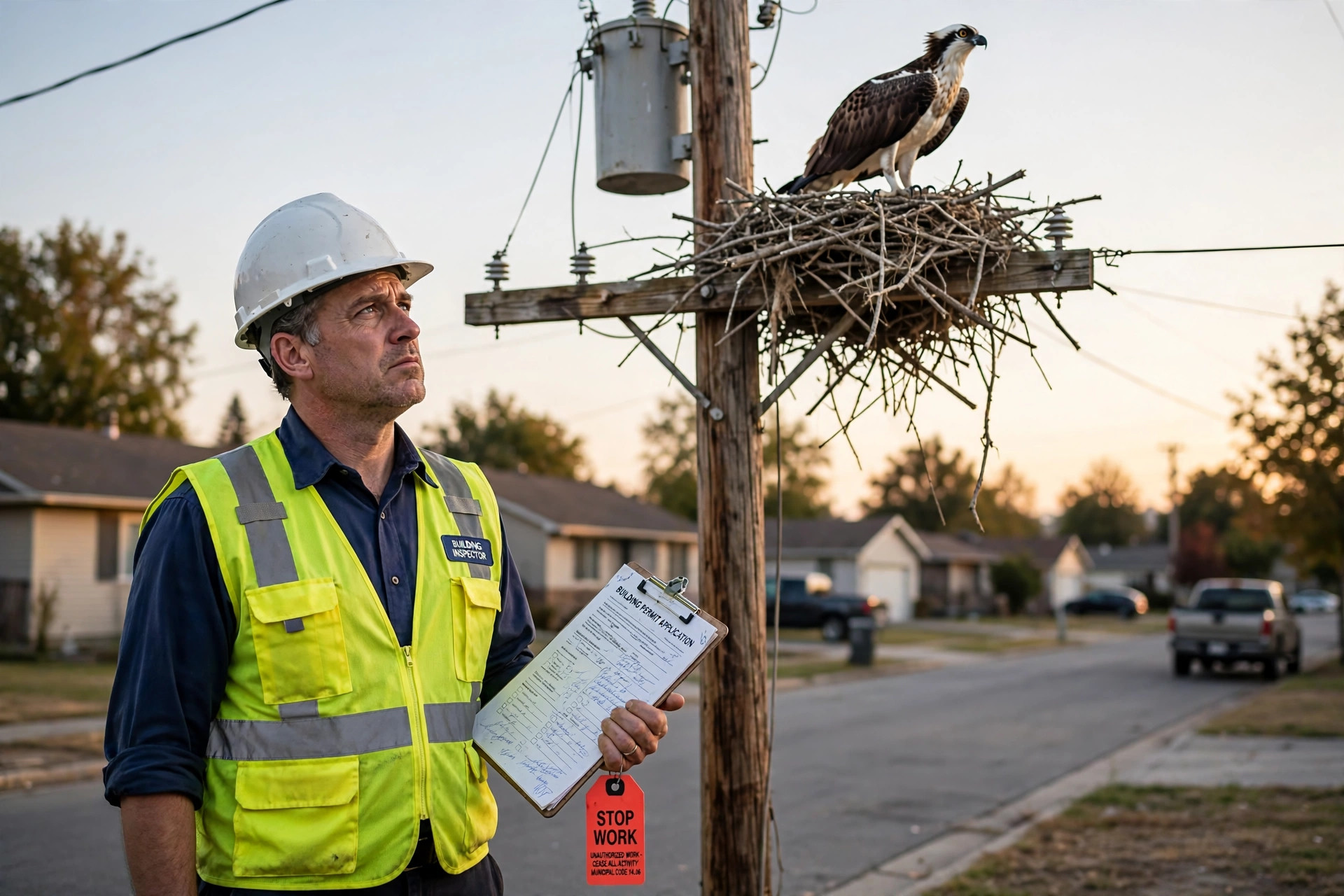
The ospreys build smaller and more dangerously. Their nests measure up to three feet in width and are frequently constructed on the crossarms of utility poles, directly adjacent to energized electrical equipment.6 The birds prefer the tallest available structures, which in developed areas are the structures that carry the power grid.
The monk parakeet builds the most ambitious structures of all. It is the only parrot species that constructs large nests from sticks, and a single communal nest can weigh more than 300 pounds, according to the National Audubon Society.7 An entire flock participates in the construction. The executive director of the largest avian rescue organization in the Northeast describes them as “multi-chambered, multi-family ‘condominiums.’”7 A multi-family condominium, built without a permit, on infrastructure the builders do not own, occupied year-round. In any human jurisdiction this would be a zoning violation, a building code violation, and a trespass. In Florida it is a Tuesday.
III. The Grid
The structures do not merely stand. They interact with the electrical grid, usually by shorting it out.
Baltimore Gas and Electric runs a program called Osprey Watch, through which customers report nests sighted on or near power lines and poles. When the company is alerted and no birds or eggs are present, a trained crew removes the nest and places deterrents; when birds or eggs are present, the equipment is shielded until the birds leave for the fall, and only then is the nest removed.8 The company reports an average of about twelve outages caused by ospreys each year. In the program’s debut year, customers filed twenty-three alerts across four counties and Baltimore City, and the company installed four dedicated nesting platforms as alternative housing.8 Consider the position of the utility: it is constructing alternative housing for the unpermitted builders, at its own expense, to protect its own infrastructure from their construction.
In central Ohio, an osprey nest built on an AEP Ohio power pole fell where the circuits come together, and approximately five thousand customers lost power.9 The nest burned. Afterward, the utility installed a sixty-foot pole nearby with a dedicated nesting platform and relocated the remains of the nest to it; the osprey returned to the safer location. Last year, the company reported installing more than 18,000 animal protection units across its service area, including nesting platforms. “This isn’t a one-time fix,” the company said. “Our crews handle this every year.”9 Every year, the birds build. Every year, the utility builds around them.
The monk parakeets are worse. In Florida, their nests caused 198 power outages in a single five-month period, leaving 10,000 people without power.10 In 2001, a similar five-month span produced 198 outages costing $585,000.7 Florida utilities removed 3,000 parakeet nests in a five-year period at an estimated cost of $4.7 million, and the nests, when big enough to bridge the gap between live electrical lines, short the lines out, sometimes blowing transformers and darkening whole neighborhoods.10 In New Jersey, a PSE&G crew’s annual spring removal of parakeet nests from transformers and wires began, as it does every year, in Edgewater; one earlier nest-caused outage left more than 3,000 people without power for four hours.11 In Connecticut, United Illuminating spent $125,000 removing dozens of nests from utility poles across several towns, capturing and euthanizing more than 200 birds in the process, and was promptly sued by the Connecticut chapter of Friends of Animals.12
The United States Department of Agriculture, which maintains a fact sheet on the species, reports that electric utility companies remove parakeet nests from their structures to maintain service reliability; that nest removal is the most common management method; and that it provides only short-term relief, because the parakeets tend to rebuild their nests immediately.13 The federal government’s official position is that the structures are removed, and that the removal does not work, because the builders return. This is stated in a government publication without irony, because irony is not a listed management method.
IV. The Demolition Permit
Here the law performs its most remarkable maneuver: it regulates the demolition of the structures it never permitted anyone to build.
Under the Migratory Bird Treaty Act, a nest that contains viable eggs or nestlings, an “in-use” nest from the laying of the first egg until the nestlings fledge and are no longer dependent on the nest, may not be purposefully taken without a permit or other federal authorization.14 An inactive nest, one without viable eggs or nestlings, may be destroyed without a permit, provided no person retains possession of it; but relocation of an inactive nest requires authorization, because relocation requires a person to collect and possess the nest.14 To summarize: the bird may build without authorization; the human may demolish the empty structure without authorization; but the human may not move the empty structure without authorization, and may not touch the occupied structure at all without authorization. The regulatory burden falls entirely on the party that did not build the thing.
Eagles receive their own separate federal regime. The Bald and Golden Eagle Protection Act’s implementing regulations at 50 CFR Part 22 provide for permits to take eagle nests, applied for on Form 3-200-72, with a report of the permitted take due to the Fish and Wildlife Service within thirty days; possession of an eagle nest for any purpose other than the permitted removal or relocation is prohibited without a separate permit.15 A thirty-four-year, two-ton structure may be removed only with a federal permit, a federal form, and a federal report. It was built with a beak.
The utilities operate inside this framework. Eversource, the New England utility, holds a Special Purpose Utility Permit under which a nest with eggs or chicks present may be removed only if the life or viability of a chick or the eggs is immediately threatened by the nest’s continued presence on the utility structure; when removal is necessary, the company notifies the U.S. Fish and Wildlife Service to ensure regulatory compliance.16 If the nest is not in immediate danger, the energized equipment is insulated to protect against fire and outage, and the nest is removed only after the chicks have fledged and the birds have migrated, at which point a deterrent is installed.16 The utility must therefore maintain, at its own cost, an energized hazard it did not create, around occupants it did not invite, until the occupants voluntarily vacate, and then it must file paperwork about the vacancy.
This is the only construction industry in the United States in which the demolition permit is subject to federal authorization, the building permit was never applied for, and the certificate of occupancy was never issued, and in which the structure nevertheless stands, occupied, for thirty-four years.
V. The Enforcement Void
The compliance rate is zero. No building permit has ever been issued to a bird. No certificate of occupancy has ever been granted to a nest. No building official has ever conducted a framing inspection on a tree crotch, a final inspection on a crossarm, or a reinspection after the parakeets rebuilt overnight. The International Building Code’s enforcement machinery, which in 2024 and 2025 processed millions of permit applications from human builders, has processed none from the avian sector, which has been building since before there were building officials.
The structural problem is definitional, as it always is. Section 105.1 addresses itself to “any owner or owner’s authorized agent” who intends to construct.1 The bird is not an owner. The bird is not an authorized agent. The bird does not intend, in the sense the code means; it builds. The code assumes a builder who can be identified, served, fined, and made to stop. The bird can be none of these, and has never been asked to be. This is the most complete permitting evasion strategy in American land use law, and it was developed over millions of years by animals with no legal department and no awareness that departments exist.
The private sector has responded the only way it can: by building around the builders. Utilities install nesting platforms, insulate energized equipment, relocate nests beak-built on crossarms to poles built for the purpose, and dispatch trained crews every spring to demolish structures that will be rebuilt by fall. The Department of Agriculture concedes that the demolition provides only short-term relief.13 The utilities keep demolishing. The birds keep building. The platforms multiply. Somewhere in the middle of this, the building official’s jurisdiction ends at the property line, and the tree crotch is beyond it.
VI. Conclusion
The record, taken as a whole, describes the largest unpermitted construction program in the United States. Its structures weigh up to three tons. They are occupied for decades without certificates of occupancy. They are built on critical electrical infrastructure without authorization from the infrastructure’s owner, and they cause hundreds of power outages, cost utilities millions of dollars, and darken whole neighborhoods. When the structures are demolished, the demolition requires federal authorization; when they are rebuilt, the rebuilding requires nothing.
The birds do not recognize the jurisdiction. They do not retain counsel. They do not experience regulatory anxiety. They build, they occupy, they fledge, and they return next spring to the same crossarm, where the utility has thoughtfully installed a platform. The permit application is not pending. It will not be filed. The building official is still responsible for every structure in the jurisdiction, and the jurisdiction’s largest structures are in the trees.
Ergo.
Sources
- International Building Code, Section 105.1, Permits Required: “Any owner or owner’s authorized agent who intends to construct, enlarge, alter, repair, move, demolish or change the occupancy of a building or structure . . . shall first make application to the building official and obtain the required permit.” codes.iccsafe.org ↑
- 2017 Ohio Building Code (based on the International Building Code), Section 111.1, Approval required to occupy: “No building or structure, in whole or in part, shall be used or occupied until the building official has issued an approval in the form of a certificate of occupancy or certificate of completion in compliance with this Section.” codes.iccsafe.org ↑
- International Building Code, Section 105.2, Work exempt from permit: one-story detached accessory structures used as tool and storage sheds, playhouses, and similar uses, provided the floor area does not exceed 120 square feet. bainbridgewa.gov ↑
- Stewards of the Upper Mississippi River Refuge, “Bald Eagle FAQ.” The average bald eagle nest is 4 to 5 feet in diameter and 2 to 4 feet deep; each year the adult pair adds 1 to 2 feet of new material. The largest recorded bald eagle nest, located in St. Petersburg, Florida, was 9.5 feet in diameter, 20 feet deep, and weighed almost 3 tons. stewardsumrr.org ↑
- Oakland Zoo, “Bald Eagle.” A nest in Vermilion, Ohio, shaped like a wine glass, was used by bald eagles for 34 years until the tree blew down; it measured 2.7 meters across, 3.6 meters deep, and weighed almost two metric tons. oaklandzoo.org ↑
- Beacon Journal, “Osprey in dangerous Lake Redman nest aided by Met-Ed & Game Commission,” June 10, 2025. Ospreys prefer tall structures including electric transmission towers and poles; their nests can measure up to three feet in width, placing the birds near energized electrical equipment and risking outages. beaconjournal.com ↑
- ND Insider, “Feral monk parakeets in New England: History, nests and more,” May 5, 2022. Monk parakeets are the only parrot species that construct large nests from sticks; the nests can weigh more than 300 pounds, per the National Audubon Society; Karen Windsor of Foster Parrots calls them “multi-chambered, multi-family ‘condominiums’”; in 2001, Florida saw 198 power outages over a five-month period caused by monk parakeet nests, costing $585,000. ndinsider.com ↑
- Maryland Department of Natural Resources, “Osprey Watch: Protecting raptors and preventing outages,” March 20, 2017. Baltimore Gas and Electric’s Osprey Watch program: customers report nests on or near power lines; crews remove nests when no birds or eggs are present and shield equipment when they are; an average of about 12 outages per year are caused by ospreys; in the debut year, 23 alerts were filed and four nesting platforms were installed. news.maryland.gov ↑
- The Columbus Dispatch, “Osprey nest blamed for recent AEP power outage relocated to new pole,” April 20, 2026. An osprey nest on an AEP Ohio pole in the Pickerington area fell where the circuits come together, leaving about 5,000 customers without power; crews installed a 60-foot pole with a nesting platform nearby and relocated the nest; the company installed more than 18,000 animal protection units across its service area last year. dispatch.com ↑
- UConn Today, “Beating Monk Parakeets at Their Own Game,” September 2014. Monk parakeet nests in Florida caused 198 power outages in one five-month period, leaving 10,000 people without power; when nests grow large enough to bridge live electrical lines, they short the lines out, sometimes blowing transformers; Florida utilities removed 3,000 nests in a five-year period at an estimated cost of $4.7 million. today.uconn.edu ↑
- Beacon Journal, “A spring ritual: Monk parakeet nests are removed,” March 29, 2017. PSE&G’s annual spring removal of monk parakeet nests from poles in Bergen County, New Jersey; the nests around transformers and wires are a fire hazard; one earlier outage left more than 3,000 people without power for four hours. beaconjournal.com ↑
- WCMU Public Radio, “A Skirmish Over Wild Monk Parakeets,” January 4, 2006. United Illuminating spent $125,000 removing dozens of monk parakeet nests from utility poles in several Connecticut towns; more than 200 birds in West Haven, Milford, Stratford, and Bridgeport were captured and euthanized; Friends of Animals filed suit to stop the program. radio.wcmu.org ↑
- U.S. Department of Agriculture, APHIS Wildlife Services, “Monk Parakeets.” Electric utility companies remove parakeet nests from their structures to maintain service reliability; nest removal is the most common method used to manage parakeet problems on utility structures, but it provides only short-term relief because parakeets tend to rebuild their nests immediately. aphis.usda.gov ↑
- U.S. Fish and Wildlife Service, Migratory Bird Permit Memorandum MBPM-2, “Destruction and Relocation of Migratory Bird Nests” (2025). An “in-use” nest contains viable eggs or nestlings, from the first egg laid until nestlings fledge and are no longer dependent on the nest; purposeful take of an in-use nest requires a permit or other MBTA authorization; an inactive nest may be destroyed without a permit provided no person retains possession of it; relocation of an inactive nest requires authorization because relocation requires collection and possession. fws.gov ↑
- 50 CFR § 22.27 (2011 edition), permits to take eagle nests. Applications on Form 3-200-72; when an active nest must be removed, nestlings and eggs must be handled by a Service-approved agent and transported to foster nests or a rehabilitation facility; a summary report is due within 30 days of the permitted take; possession of the nest for any other purpose requires a separate permit. govinfo.gov ↑
- Eversource, “Osprey Management Program.” A nest with eggs or chicks present may be removed only if the life or viability of a chick or the eggs is immediately threatened by the nest’s continued presence on the utility structure; the company operates under a Special Purpose Utility Permit and notifies the U.S. Fish and Wildlife Service; otherwise equipment is insulated until chicks fledge and the birds migrate, then the nest is removed and a deterrent installed. eversource.com ↑
- International Code Council, “Safety guidelines for skyscrapers strengthened in 2009 International Building Code.” The IBC “is adopted at the state or local level in all 50 states and Washington, D.C.” iccsafe.org ↑