I. The Statutory Framework
The Fair Labor Standards Act of 1938, codified at 29 U.S.C. §§ 201–219, establishes minimum wage, overtime, and recordkeeping requirements for employers engaged in interstate commerce. The statute is among the most consequential pieces of labor legislation in American history. It was enacted, as its preamble declares, to eliminate “labor conditions detrimental to the maintenance of the minimum standard of living necessary for health, efficiency, and general well-being of workers.”1
The Act accomplishes this through four principal mechanisms. First, at 29 U.S.C. § 206(a)(1), it requires that every employer pay each employee not less than $7.25 per hour.2 Second, at 29 U.S.C. § 207(a)(1), it requires overtime compensation at one and one-half times the regular rate for each hour worked in excess of forty hours per workweek. Third, at 29 U.S.C. § 211(c), it requires employers to maintain records of the wages, hours, and conditions of employment of each worker. Fourth, at 29 U.S.C. § 212, it restricts the employment of children under the age of eighteen.
These obligations depend on the existence of an employment relationship. The FLSA does not define “employment relationship” as such. Instead, it defines the word “employ.” The definition appears at Section 203(g). It is seven words long:
“‘Employ’ includes to suffer or permit to work.”3
The word “includes” is significant. It signals that the definition is illustrative, not exhaustive. The concept of employment under the FLSA is at least as broad as “to suffer or permit to work,” and may be broader still. The Supreme Court has repeatedly confirmed this interpretation. The seven-word definition is the widest door in American statutory law. Anything that walks through it is employment.
II. The Broadest Definition in American Law
In United States v. Rosenwasser, 323 U.S. 360 (1945), the Supreme Court considered whether pressers who ironed garments in a laundry were “employees” within the meaning of the FLSA. The Court observed that the Act’s definition of “employ” is “the broadest definition that has ever been included in any one act.”4 The Court noted that “a broader or more comprehensive coverage of employees within the stated categories would be difficult to frame.”
Four decades later, in Tony and Susan Alamo Foundation v. Secretary of Labor, 471 U.S. 290 (1985), the Court confronted a more unusual set of facts. The Alamo Foundation was a nonprofit religious organization that operated commercial businesses, including gas stations, retail clothing and grocery outlets, hog farms, and construction and electrical companies. Individuals who described themselves as “associates” of the Foundation worked in these businesses. They received no cash wages. They testified that they considered their work voluntary and performed it out of religious conviction, not economic need. The Foundation argued that these individuals were not “employees” because they expected no compensation and did not want any.
The Supreme Court unanimously disagreed. Justice White, writing for the Court, held that the associates were employees under the FLSA regardless of their professed voluntariness. The critical inquiry was not whether the workers desired wages but whether the employer “suffered or permitted” them to work. “The Act,” Justice White wrote, “defines the verb ‘employ’ expansively.”5 The fact that the Foundation provided the associates with food, shelter, transportation, and other benefits in lieu of wages did not change the analysis. These benefits were compensation. The associates were employees. The Foundation owed them the minimum wage.
The Alamo Foundation holding establishes a principle of considerable reach: if you direct another person to perform work, and you provide something of value in return, the law presumes an employment relationship regardless of what either party calls it. The label is immaterial. The economic substance governs.
III. The Economic Reality
In Rutherford Food Corp. v. McComb, 331 U.S. 722 (1947), the Supreme Court articulated what has become known as the “economic reality test” for determining whether an employment relationship exists under the FLSA. The case involved meat boners who worked in a slaughterhouse operated by the Kaiser Packing Company. The boners owned their own tools. They were paid collectively based on production, which pay they divided among themselves. They worked under a contract that characterized them as independent contractors, not employees.6
The Court held that they were employees. Justice Reed, writing for the majority, explained that “where the work done, in its essence, follows the usual path of an employee, putting an ‘independent contractor’ label on the worker does not deprive him of the protection of the Fair Labor Standards Act.” The determination, the Court held, “does not depend on isolated factors but rather upon the circumstances of the whole activity.”7
The economic reality test, as refined by subsequent circuit court decisions, examines several factors: (1) the extent to which the work performed is an integral part of the employer’s business; (2) the worker’s opportunity for profit or loss depending on managerial skill; (3) the extent of the relative investments of the employer and the worker; (4) whether the work requires special skills and initiative; (5) the permanence of the relationship; and (6) the degree of control exercised by the employer.8
Consider these factors as applied to the household chore arrangement. The work performed by a child who vacuums floors, washes dishes, takes out trash, cleans bathrooms, and folds laundry is integral to the operation of the household. The child has no opportunity for profit or loss: the allowance is fixed at whatever the parent determines, regardless of the quality or efficiency of the work. The parent provides all equipment, supplies, and facilities: the vacuum, the cleaning products, the trash bags, the washer and dryer, the kitchen itself. The child requires no special skills or initiative that would suggest an independent business. The relationship is permanent for the duration of childhood. And the degree of control exercised by the parent is absolute: the parent determines what work is done, when it is done, how it is done, and what standards must be met before payment is released.
By every factor of the economic reality test, a child doing chores for an allowance is an employee of the household.
IV. The Compensation
The federal minimum wage, established at 29 U.S.C. § 206(a)(1)(C), is $7.25 per hour. This rate has not been adjusted since July 24, 2009. It applies to every employee covered by the FLSA, with limited exceptions for tipped workers, certain students, and workers with disabilities, none of which describe a child loading a dishwasher after dinner.9
The T. Rowe Price Parents, Kids & Money Survey, a nationally representative survey of parents with children ages 8 to 14, reported in its most recent published results that the average American child who receives an allowance receives approximately $19.39 per week. The survey further found that approximately 66 percent of American parents give their children an allowance, and that three-quarters of those parents require their children to perform household chores to earn it.10
The Bureau of Labor Statistics’ American Time Use Survey documents that children between the ages of six and seventeen spend an average of 24 to 36 minutes per day on household activities on days when they engage in such activities. For a child who performs chores five to six days per week, this yields approximately three to four hours of labor per week.11 Parenting surveys corroborate this range. A 2025 study conducted by Wells Fargo and published in July of that year reported that the average weekly allowance had risen to $37, and separately noted that the most common chore assignments include cleaning rooms, doing dishes, taking out trash, feeding pets, and yard work.12
The arithmetic is straightforward. A child who performs four hours of household labor per week for $19.39 is being compensated at an effective hourly rate of $4.85. This is 33 percent below the federal minimum wage of $7.25. A child who performs three hours of labor per week for the same amount earns $6.46 per hour, still 11 percent below the federal minimum. Even at the higher Wells Fargo average of $37 per week, a child performing five hours of chores earns $7.40 per hour, a rate that, while technically exceeding the federal floor by fifteen cents, falls below the minimum wage in thirty states and the District of Columbia, including California ($16.50), New York ($16.50), Washington ($16.66), Connecticut ($16.35), Massachusetts ($15.00), New Jersey ($15.49), and Illinois ($15.00).13
The T. Rowe Price survey further disaggregated its allowance data by amount. Among children who receive an allowance, 55 percent receive $10 or less per week.14 A child who receives $10 per week for four hours of chores earns $2.50 per hour. This is less than half the federal minimum wage. It is also less than the federal minimum wage for workers with disabilities under a Section 14(c) certificate, which must be commensurate with the wages paid to experienced workers performing the same work, and which requires individual prevailing wage surveys. The Department of Labor maintains a rigorous certification program for subminimum wage payments to workers with disabilities. It maintains no certification program for subminimum wage payments to eight-year-olds who set the dinner table.
V. The Chore Chart as Employment Record
Section 211(c) of the FLSA requires every employer to “make, keep, and preserve such records of the persons employed by him and of the wages, hours, and other conditions and terms of the employment maintained by him.” The implementing regulations at 29 CFR § 516.2 specify the records that must be maintained for each employee. The list includes, among other items: the employee’s full name; home address, including zip code; date of birth if under nineteen years of age; sex and occupation; time and day of week when the employee’s workweek begins; hours worked each day and total hours worked each workweek; basis on which employee’s wages are paid; regular hourly pay rate; total daily or weekly straight-time earnings; total overtime excess compensation; total additions to or deductions from wages paid each pay period; total wages paid each pay period; and date of payment and the pay period covered by the payment.15
These records must be preserved for at least three years. They must be made available for inspection and transcription by the Division’s authorized representatives at any time.
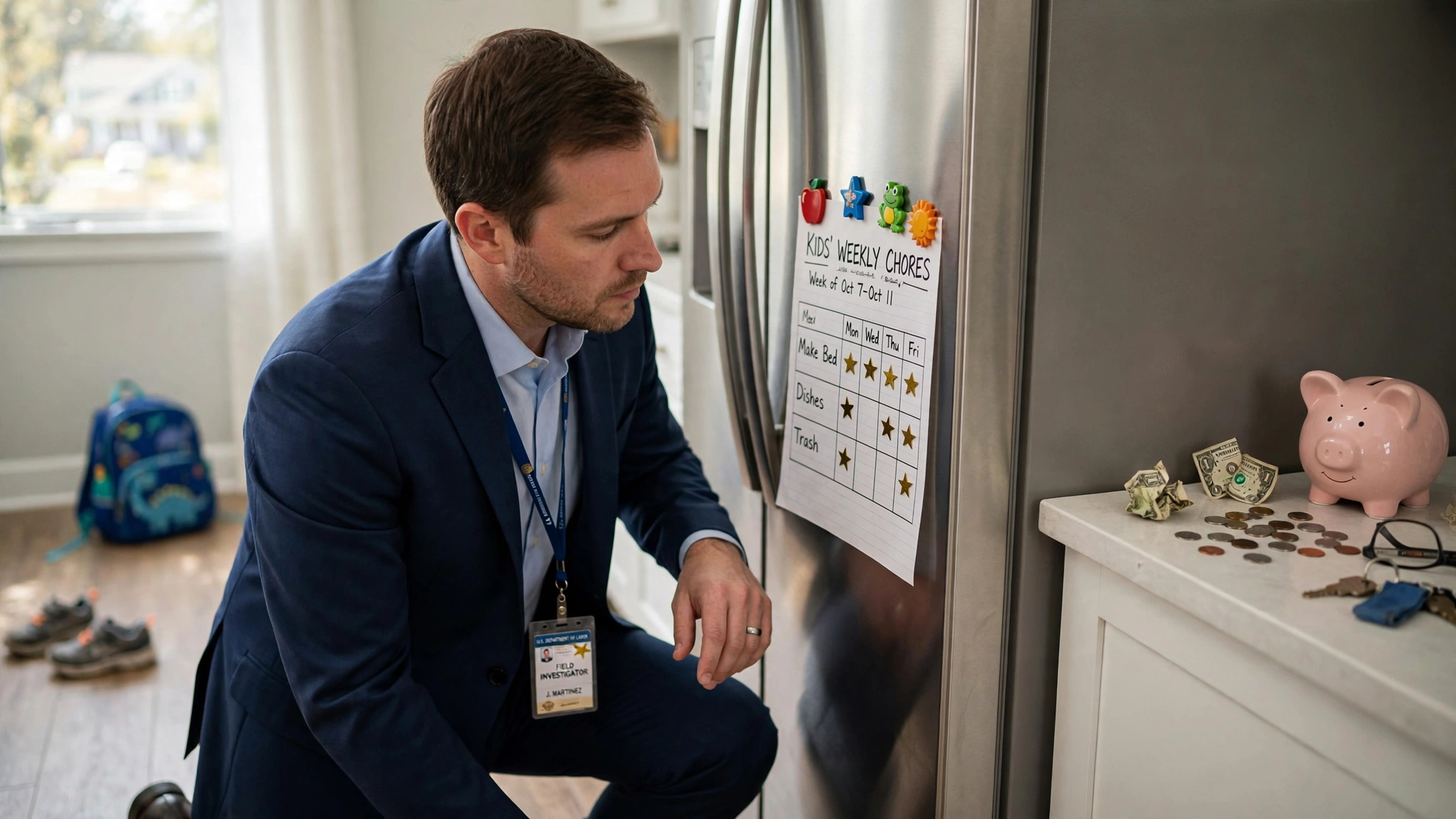
The typical American household maintains its employment records on a sheet of construction paper affixed to the refrigerator with a magnet shaped like a watermelon. The document contains a grid of chore names in the left column and days of the week across the top row. Compliance is indicated by the placement of a gold star sticker. The document does not record the employee’s Social Security number, the hours worked each day, the regular hourly pay rate, or the basis on which wages are computed. It does not separate straight-time earnings from overtime earnings. It does not record deductions. It records the name of the employee, usually in crayon, and occasionally misspelled.
Under 29 CFR § 516.34, employers who fail to maintain the required records are in violation of the Act. The Department of Labor may seek injunctive relief under 29 U.S.C. § 217 to compel compliance. The Department of Labor has sought such relief against restaurants, construction firms, garment manufacturers, janitorial services, agricultural operations, and home health care agencies. It has never sought injunctive relief against a household that tracks chore completion with stickers.
VI. The Exemption That Proves the Rule
Section 213 of the FLSA contains a catalogue of exemptions from the Act’s minimum wage and overtime provisions. These exemptions are numerous and specific. Section 213(a)(1) exempts employees employed in a bona fide executive, administrative, or professional capacity. Section 213(a)(5) exempts employees of small newspapers. Section 213(a)(6) exempts certain agricultural employees. Section 213(a)(15) exempts domestic service workers employed on a casual basis to provide babysitting services or companionship services.
Section 213(c) addresses child labor specifically. It provides, at subsection (1)(A), that the child labor provisions of Section 212 “shall not apply to any child employed in agriculture outside of school hours for the school district where such child is living while he is so employed, if such child is employed by his parent, or by a person standing in the place of his parent, on a farm owned or operated by such parent or person.”16
Additionally, Section 203(l) defines “oppressive child labor” to exclude employment by a parent of a child under sixteen “other than in manufacturing or mining or in an occupation found by the Secretary of Labor to be particularly hazardous.” This provision is the FLSA’s explicit acknowledgment that parents employ their children. The statute does not exempt this employment from its minimum wage requirements. It exempts it only from the child labor restrictions that would otherwise prohibit it.
The distinction is critical. Section 213(c) and the parental exception in Section 203(l) address whether a child may be employed, not how much a child must be paid once employed. The minimum wage provision at Section 206 contains no parental exemption. A parent who employs a child in an occupation that is neither manufacturing, mining, nor hazardous, as permitted by Section 203(l), is still required to pay the child at least $7.25 per hour, unless another exemption in Section 213 applies. No other exemption applies to a child emptying a trash can in a suburban kitchen.
Congress, in other words, created an exemption for parents to employ their children. It did not create an exemption for parents to underpay them.
VII. The Scale
The Bureau of Labor Statistics, in its Employment Characteristics of Families report for 2025, documents that there are approximately 32.9 million families with own children under the age of eighteen in the United States.17 If 66 percent of these families provide an allowance, as the T. Rowe Price survey indicates, then approximately 21.7 million families pay their children for something. If three-quarters of those families require chores in exchange, as the same survey reports, then approximately 16.3 million American families maintain chore-for-allowance arrangements that satisfy every element of an employment relationship under Section 203(g).
The minimum wage shortfall per child is calculable. At the survey-reported average of $19.39 per week for four hours of chores, the effective hourly rate of $4.85 falls $2.40 below the federal minimum wage. Over fifty-two weeks, the annual underpayment per child is $499.20. Across 16.3 million households, the aggregate annual minimum wage shortfall is approximately $8.1 billion.
Section 216(b) of the FLSA provides that an employer who violates the minimum wage provisions “shall be liable to the employee or employees affected in the amount of their unpaid minimum wages” and “in an additional equal amount as liquidated damages.”18 The liquidated damages provision is mandatory absent a showing of good faith. The total annual liability, including liquidated damages, is therefore approximately $16.2 billion. This exceeds the combined annual revenue of the twenty largest law firms in the United States.
The statute of limitations for an FLSA minimum wage claim is two years, or three years in the case of a willful violation. 29 U.S.C. § 255(a). A parent who has knowingly paid an allowance of $10 per week for four hours of chores for three years has committed a willful violation: the parent knows the work is being performed, determines the compensation, and has made no inquiry into whether the rate complies with federal law. The three-year lookback applies. At $499.20 per year, the cumulative underpayment per child over three years is $1,497.60, doubled to $2,995.20 with liquidated damages.
The Department of Labor’s Wage and Hour Division employs approximately 700 investigators nationwide across its district and area offices.19 In fiscal year 2023, these investigators opened approximately 21,000 compliance actions and recovered $274 million in back wages for more than 163,000 workers. The Division’s investigations have reached nail salons, car washes, restaurants, poultry plants, gas stations, and residential homes where domestic workers were paid below the minimum wage.
To investigate the 16.3 million households that maintain chore-for-allowance arrangements, at the Division’s current throughput of 21,000 cases per year, would require approximately 776 years. By the time the Division completed its investigation of the 2026 violators, it would be the year 2802, and every child in the original cohort would have aged out of the workforce, raised children of their own, and presumably established chore-for-allowance arrangements with the next generation, compounding the backlog.
The $8.1 billion in annual underpayments represents approximately thirty times the total amount the Division recovers in back wages each year. If every dollar of the Division’s annual recovery were redirected exclusively to the chore-chart enforcement initiative, it would take thirty years to make the nation’s eight-year-olds whole for a single year of undercompensated dishwashing.
VIII. Conclusion
The elements are not in dispute. The statute defines employment as suffering or permitting another person to work. A parent who assigns chores suffers the child to work. A parent who provides an allowance in exchange has established the compensation term of the employment relationship. The Supreme Court has held that the FLSA’s definition of employment is the broadest ever enacted by Congress, that it reaches workers who consider themselves volunteers, and that it governs based on economic reality rather than the labels the parties assign to the arrangement.
The economic reality of the chore-for-allowance arrangement is that a child performs labor under the complete control of the parent, using equipment owned by the parent, in facilities maintained by the parent, on a schedule determined by the parent, to standards set by the parent, in exchange for compensation determined unilaterally by the parent. The child has no bargaining power, no right to negotiate, no alternative source of income, no union representation, and no knowledge that a federal statute enacted in 1938 entitles the child to more money for cleaning the bathroom than the parent has offered.
The average child who earns $19.39 per week for four hours of chores is underpaid by $2.40 per hour. Across America, 16.3 million children are performing household labor at below-minimum-wage rates. The aggregate shortfall exceeds $8 billion per year. With liquidated damages, it exceeds $16 billion. With accrued interest and a three-year lookback, the figure grows larger still. It is, by any measure, the largest systematic minimum wage violation in the history of the American labor market.
And it is committed in kitchens. On Saturday mornings. By people who keep the overtime regulations on a refrigerator magnet shaped like a banana and enforce the attendance policy by threatening to cancel screen time. The employer posts no OSHA workplace safety poster because the employer does not know that 29 CFR § 1903.2 requires one. The employee does not file a complaint because the employee does not know what the Department of Labor is and would not care if told.
The Wage and Hour Division has 700 investigators. It investigates restaurants that pay dishwashers below minimum wage. It has not investigated a single household that pays a child below minimum wage for washing the same dishes in the same kind of sink. The statute does not distinguish between sinks. The statute does not distinguish between dishwashers. The statute says “to suffer or permit to work.” It does not say “unless the work is assigned by a person who also reads you a bedtime story.”
There are gold star stickers on 16.3 million refrigerators in the United States. Each one documents a completed shift. None of them document the hourly rate.
Ergo.
Sources
- 29 U.S.C. § 202(a), Congressional Finding and Declaration of Policy. law.cornell.edu ↑
- 29 U.S.C. § 206(a)(1)(C), Minimum Wage. The current rate of $7.25 per hour became effective July 24, 2009, pursuant to the Fair Minimum Wage Act of 2007 (Pub. L. 110–28, § 8102). law.cornell.edu ↑
- 29 U.S.C. § 203(g). law.cornell.edu ↑
- United States v. Rosenwasser, 323 U.S. 360, 363 n.3 (1945). supreme.justia.com ↑
- Tony and Susan Alamo Foundation v. Secretary of Labor, 471 U.S. 290, 295 (1985). supreme.justia.com ↑
- Rutherford Food Corp. v. McComb, 331 U.S. 722 (1947). supreme.justia.com ↑
- Rutherford, 331 U.S. at 729–730. ↑
- The multi-factor test is derived from Rutherford and refined in decisions including Zheng v. Liberty Apparel Co., 355 F.3d 61 (2d Cir. 2003), and the Department of Labor’s Fact Sheet #13 on the employment relationship under the FLSA. dol.gov ↑
- 29 U.S.C. § 206(a)(1)(C). The subminimum wage provisions for tipped employees, full-time students, student learners, and workers with disabilities are set forth in 29 U.S.C. §§ 206(a)(5) and 214. ↑
- T. Rowe Price, Parents, Kids & Money Survey, conducted by NMG Consulting, published 2023. Survey data cited in SNB Online, “Allowance For Kids: How Much Are Parents Giving These Days?,” April 15, 2024. snbonline.com ↑
- Bureau of Labor Statistics, American Time Use Survey, Table A-1: Time spent in detailed primary activities, by age and sex, annual averages. bls.gov ↑
- Wells Fargo, “New Wells Fargo Study Shows Parents Give Their Kids an Average Weekly Allowance of $37,” July 2, 2025. newsroom.wf.com ↑
- State minimum wage rates effective January 1, 2026. U.S. Department of Labor, Wage and Hour Division, “Minimum Wage Laws in the States.” dol.gov ↑
- T. Rowe Price, Parents, Kids & Money Survey (2017). Slide 69: “Amount of Allowance” — 55% of parents who give an allowance give $10 or less per week. slideshare.net ↑
- 29 CFR § 516.2, Records to be preserved. law.cornell.edu ↑
- 29 U.S.C. § 213(c)(1)(A); see also 29 U.S.C. § 203(l), which exempts employment by a parent from the definition of “oppressive child labor” for occupations other than manufacturing, mining, or those determined hazardous by the Secretary. law.cornell.edu ↑
- Bureau of Labor Statistics, “Employment Characteristics of Families — 2025,” Table 4: Families with own children, 2024–2025 annual averages. Total families with own children under 18: 32,895 thousand (2025). bls.gov ↑
- 29 U.S.C. § 216(b). law.cornell.edu ↑
- U.S. Department of Labor, Wage and Hour Division, “Fiscal Year Data,” FY 2023. dol.gov ↑