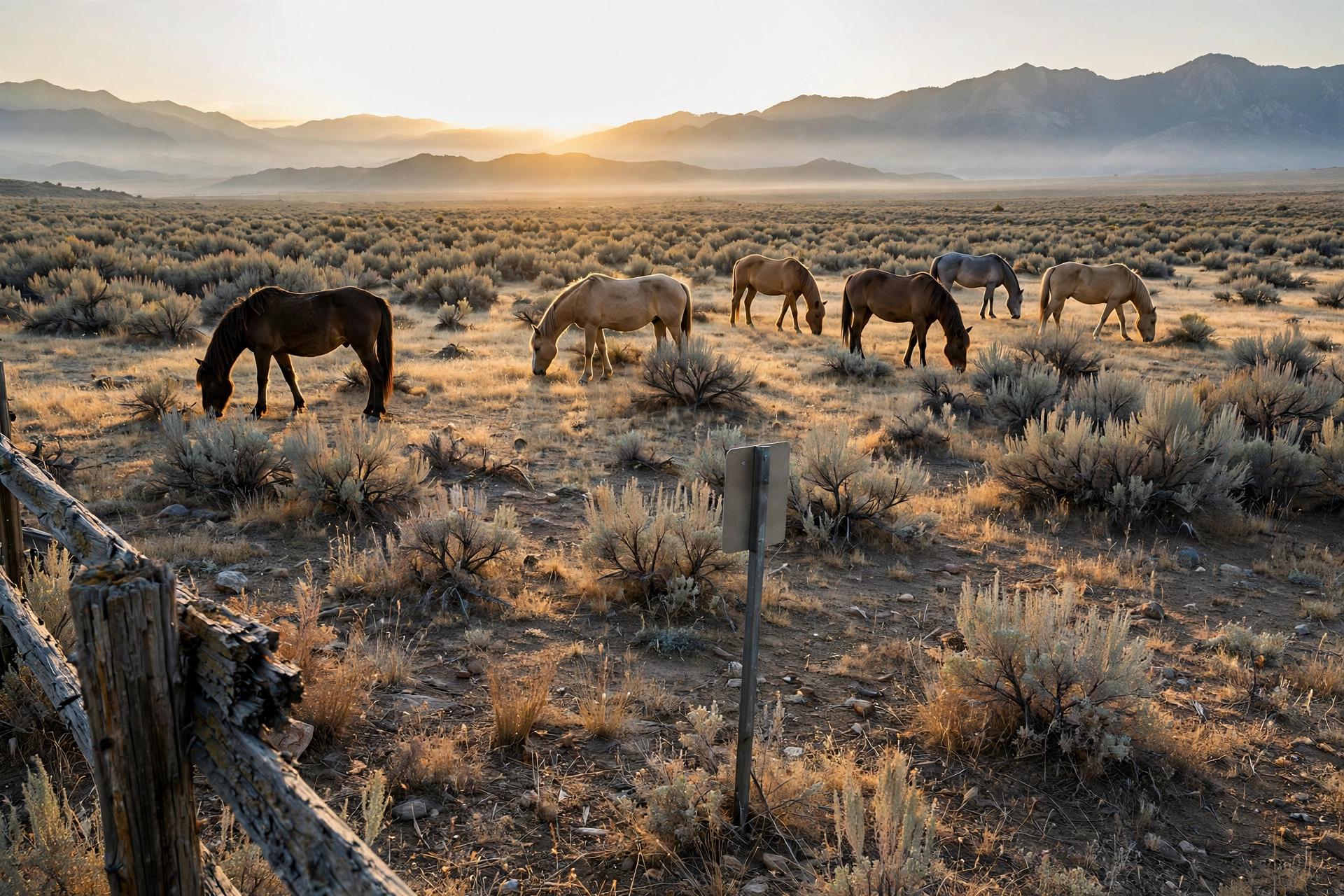
I. The Animal
The mustang is not a wild horse. It is the feral descendant of domestic horses, brought to the Americas by Spanish explorers in the sixteenth century, and the American Museum of Natural History classifies it as feral, not wild, because it descends from a domesticated population. The word itself gives the game away. Mustang comes from the Spanish mestengo, meaning stray, or ownerless. The animal the law calls wild is, by ancestry, a stray.115
A mustang eats like a horse, because it is one. A 1,000-pound horse eats about 20 pounds of forage a day, about 2 percent of its body weight, and drinks about 10 gallons of water, about a gallon for every 100 pounds of animal. It eats grasses and forbs and shrubs, and it eats them where it finds them, which is wherever the range grows them.23
Mustangs live in bands, small groups of mares and foals kept by a stallion, with young males pushed out to bachelor bands of their own. The bands move constantly, following water and forage across country that has almost no fences and almost no people, and they share the range with permitted livestock and with the wildlife whose habitat the Bureau counts when it sets the level.17
The horse has virtually no natural predators on the range, and the Bureau states plainly that herd sizes can double about every four years. A population with no predators and a growth rate of about 20 percent a year does not need a permit to expand. It needs only grass.6
II. The Range
The Bureau of Land Management manages wild horses and burros in 175 herd management areas across 10 western states, covering 26.9 million acres of Bureau land. The areas are the ground where the animals were found when the 1971 Act passed, and the Bureau has managed them there ever since.1718
Nevada holds nearly half of it. Eighty-three of the 175 areas are in Nevada, and the state holds 42,572 of the 85,466 animals, against an appropriate management level of 12,811, more than three times the number the land is supposed to hold.613
The local numbers are sharper. In Churchill County, Nevada, the East Pershing Herd Management Area held 2,875 horses at the end of 2024, against an appropriate management level of 345 to 555, roughly five to eight times the target. The Lahontan Herd Management Area, 35 miles east of Carson City, held an estimated 518 horses against a level of 7 to 10.7
The Bureau sets each area's level by weighing available water and forage, rangeland health, soil stability, wildlife habitat needs, authorized livestock grazing, and drought. The level is the number of animals that can thrive in balance with other public land resources and uses. The count is 85,466. The level is 25,592. The difference is 59,874 animals.76
The range itself has shrunk. Wild horse habitat has decreased by 41 percent since 1971, while the population has grown to five times its 1971 level. The same ground holds more horses than ever, and less of it than ever.161
III. The History
The horse is a returning native and a foreign import at the same time. Horses evolved in North America, spread across the world, and died out on this continent about 10,000 years ago. They returned in 1519, when Cortes brought them to the mainland, and spread north until, by the 1600s, Plains tribes had made them central to their cultures.1
By 1900, perhaps two million mustangs roamed the western half of the country. Then came the market for horse meat in Europe, glue, pet food, and pony fur coats, and the airplanes that herded them for slaughter. By 1971, about 17,000 were left. The decline from two million to 17,000 is a loss of more than 99 percent in seventy years.151
The rescue began with a truck. In 1950, Velma Johnston, a secretary driving to work in Reno, followed a livestock truck leaking blood to a rendering plant and watched wounded mustangs unloaded for slaughter. She spent the next twenty years fighting for the horses, and in 1959 Congress passed the Wild Horse Annie Act, which banned the use of motorized vehicles to capture them.5
The campaign that followed drew more letters to Congress than any issue except the Vietnam War. In 1971, Congress passed the Wild Free-Roaming Horses and Burros Act unanimously, and President Nixon signed it on December 15, 1971. The law declared that wild horses and burros are living symbols of the historic and pioneer spirit of the West, and that they are fast disappearing from the American scene.204
The disappearance stopped. The protection worked so well that the population the law was written to save from extinction now stands at five times its 1971 level, and the Bureau spends $142 million a year managing the animals the law protects.613
IV. The Law
The grazing law is older than the horse law by thirty-seven years. The Taylor Grazing Act of 1934 created grazing districts and required permits for livestock grazing on federal land, and the Federal Land Policy and Management Act of 1976 made the Bureau the manager of those lands for multiple use and sustained yield. A permit is a privilege, not a property right, and it conveys no right, title, or interest in the land.12
The price is set every year. The 1978 Public Rangelands Improvement Act established the formula, from a 1966 base value of $1.23 per animal unit month, adjusted by private lease rates, beef prices, and production costs, and a 1986 executive order set a floor of $1.35. For 2026, the fee is $1.69 per animal unit month, effective March 1, 2026, and it applies to nearly 18,000 Bureau permits and leases and about 5,550 Forest Service permits across 16 western states.8
The regulation defines the unit in terms that include the horse by name. Under 43 CFR 4130.8-1, an animal unit month is a month's use and occupancy of range by one cow, bull, steer, heifer, horse, burro, mule, five sheep, or five goats. The fee schedule prices a horse's month of grazing at $1.69, and the horse has never been billed.9
The penalty schedule is steeper than the fee schedule. Under 43 CFR 4150.3, settlement for unauthorized grazing is the value of the forage consumed, measured by the average private grazing land lease rate per animal unit month in the state where the grazing occurs. For willful violations, twice that value. For repeated willful violations, three times. Settlement for willful violations also includes the full value of all damage to public lands and all reasonable expenses of detection, investigation, and impoundment, and no violator may graze again until the amount due is paid.10
The permit itself has qualifications. Under 43 CFR 4110.1, an applicant must own livestock and base property, private land or water capable of serving as a base of operations. The wild horse owns no livestock. It owns no base property. It cannot complete the application, and the Bureau has never asked it to.19
The horse law runs parallel. The 1971 Act, at 16 U.S.C. 1331, declares the animals living symbols and orders the Secretary to manage them to achieve a thriving natural ecological balance, and it authorizes the removal of excess animals. The Bureau removed 7,853 animals in fiscal year 2025, and it holds 64,205 more off the range, most of them in long-term pastures for the rest of their lives.4613
V. The Forage
The forage is the whole dispute. A horse eats about 20 pounds a day and drinks about 10 gallons, and it does so every day of the year, in every season, because no permit tells it when to stop. Permitted livestock graze only in the season their permit authorizes, in the numbers their permit authorizes, on the allotment their permit names.2314
The competition is the reason the appropriate management level exists. The Bureau weighs authorized livestock grazing against wildlife habitat, water, and forage when it sets the level, and the level is the number that can thrive in balance with other uses. At 85,466 animals against a level of 25,592, the balance the Bureau describes does not exist.76
The damage is measured in the same units as the forage. The Bureau counts soil stability among the factors that set the level, which is the agency's way of saying the ground itself is part of the ledger, and that a range grazed past its level is a range whose soil pays for the excess.7
The burros deserve a line of their own. Of the 23,943 burros on the range, 13,546 live in Arizona, in desert country where water is the scarcest resource on the ledger. A burro eats less than a horse and drinks less, and it still eats and drinks from the same account.6
VI. The Scale
Do the arithmetic the record permits. One animal unit month is 790 pounds of oven-dried forage. Multiply by 85,466 animals and the herd consumes about 67.5 million pounds of forage a month, about 33,800 tons, or about 405,000 tons a year.14
The horses alone, at 20 pounds a day, eat about 1.23 million pounds a day, about 615 tons, or about 225,000 tons a year. They drink about 615,000 gallons of water a day, about 225 million gallons a year. The burros eat and drink on top of that.23
The bill follows the same arithmetic. Eighty-five thousand four hundred sixty-six animals, at twelve months each, is 1,025,592 animal unit months a year. At the 2026 permit rate of $1.69, the annual grazing bill is about $1.7 million. At the average private lease rate of about $23.40 per animal unit month, the value of the forage consumed is about $24.0 million, which is the settlement figure the unauthorized grazing rule prescribes for a nonwillful violation. For a willful violation, twice that, about $48.0 million. For a repeated willful violation, three times, about $72.0 million.891011
The growth follows the count. The herd stood at 73,130 on March 1, 2025, and at 85,466 on March 1, 2026, an increase of 12,336 animals, about 17 percent, in a single year. The Bureau removed 7,853 animals in fiscal year 2025, and the herd grew anyway, by more animals than the Bureau removed. At the Bureau's stated growth rate of about 20 percent a year, the herd doubles in about four to five years.6
The enforcement follows the growth. Congress appropriated $142.0 million for the wild horse program in fiscal year 2025, and $101.4 million of the program's fiscal year 2024 obligations went to holding animals off the range. The government spends about eighty-two dollars managing the herd for every dollar of grazing fees the herd does not pay.13
The figures are arithmetic, not measurement, and the assumptions are stated with them. The arithmetic is correct anyway, and the horses are real, and the permits do not exist.6
VII. The Defense
The defense is noted. It concedes every number in this investigation and disputes only the prescription.
Its first exhibit is the statute. Congress passed the 1971 Act unanimously, and the Act declares the horses protected living symbols and orders the Secretary to manage them. The permit system was never meant to reach them, because Congress created a separate regime for them in the same body of law. The exemption is not a loophole. It is the law.4
Its second is the applicant. A grazing permit requires a person who owns livestock and base property, and the wild horse owns neither and cannot sign the form, pay the fee, or receive the notice the unauthorized grazing rule requires. The regulations govern persons. The horse is not one.1910
Its third is the definition. The animal unit month lists the horse because ranchers graze domestic horses under permits, and the regulation prices a domestic horse's forage. It says nothing about a wild one, and no court has ever held that a feral animal owes a grazing fee.9
Its fourth is the management level. The appropriate management level is a target, not a permit cap, and exceeding it triggers removal, not billing. The Bureau removed 7,853 animals in fiscal year 2025, placed 8,080 into private care, treated 921 with fertility control, and holds 64,205 off the range. The enforcement system exists. It costs $142 million a year.613
Its fifth is the habitat. Wild horse habitat has decreased 41 percent since 1971, while the population grew fivefold. The overpopulation is partly a ledger of lost ground, not only of unfiled forms, and the horses did not sell the ground.16
Its sixth is the arithmetic. The forage math assumes every horse is a paying customer at full animal unit months, but range horses eat less in winter and lose weight, and much of the forage would go uneaten if the horses vanished. The unpaid bill prices forage no rancher would buy, at that scale, in that country, at any price.
The defense rests. It is overruled.
VIII. The Prescription
The ledger is now complete, and it admits of only one reading.
Every horse should hold a grazing permit under the Taylor Grazing Act, applied for on Form 4130-1, supported by base property, billed at $1.69 per animal unit month before grazing use begins, and issued for a ten-year term. Every burro should hold the same. Every band should graze only in its authorized season, on its named allotment, in its authorized numbers. The 59,874 animals above the appropriate management level should be impounded under 43 CFR 4150.4, and the impoundment expense should be charged to the herd, as the settlement rule provides. The adopted animals should be offered at $25 a head, the agency's own price for an untrained horse, and the $142 million program budget should be reclassified as the cost of collecting a $1.7 million debt.891011131921
The queue should be cleared in order. The Bureau should process the applications before any further horse is grazed, and the bands should be assigned allotments, and the seasons should be set, and the excess should be impounded, and the fees should be collected, and the forage should be billed at the private rate for willful violations, since the herd has now exceeded its level for decades in the open, on the public record, one animal unit month at a time.610
The test case is the next March 1. The count will be published, the fee will be announced, the herd will stand at more than three times its level, the bands will graze in every season, the forage will be consumed at about 405,000 tons a year, and the applications will not exist, and the largest unpermitted grazing operation in the United States will operate for another year, in the open, on federal land, one animal unit month at a time.68
Ergo.
Sources
- Mustangs are descendants of escaped, domestic Spanish horses brought to the Americas in the sixteenth century, and are considered feral rather than truly wild because they descend from a domesticated population. The genus Equus evolved in North America, and the last truly wild horses of America died out about 10,000 years ago. About two million mustangs roamed North America in 1900, and by 1971 the population had been reduced to about 17,300. livescience.com ↑↑↑↑↑
- Horses should receive 1.5 to 2 percent of body weight in forage per day on a dry matter basis. For a 1,000-pound horse, that is roughly 15 to 20 pounds of hay or pasture equivalent every day. app.equidiary.com ↑↑↑
- A mature horse drinks at least one gallon of water per 100 pounds of body weight per day, or about 10 gallons a day for a 1,000-pound horse. extension.purdue.edu ↑↑↑
- Congress unanimously passed the 1971 Wild Free-Roaming Horses and Burros Act, which declared that wild horses and burros are living symbols of the historic and pioneer spirit of the West, that they contribute to the diversity of life forms within the nation, and that they are fast disappearing from the American scene. returntofreedom.org ↑↑↑
- In 1950, Velma Johnston followed a livestock truck leaking blood to a rendering plant. Her campaign led to the 1959 Wild Horse Annie Act (P.L. 86-234), which prohibited the use of motorized vehicles to capture free-roaming horses, and to the unanimously passed Wild Free-Roaming Horses and Burros Act of 1971. nevadawomen.org ↑
- As of March 1, 2026, the Bureau of Land Management estimated 85,466 wild horses and burros on the range, 61,523 horses and 23,943 burros, against a high-end appropriate management level of 25,592. As of March 1, 2025, the estimate was 73,130. Nevada held 42,572 animals against a level of 12,811. The Bureau states that herd sizes can double about every four years, that it removed 7,853 animals in fiscal year 2025, placed 8,080 into private care, applied 921 fertility control treatments, and has adopted out more than 290,000 wild horses and burros since 1971. Arizona held 13,546 of the burros. blm.gov ↑↑↑↑↑↑↑↑↑↑↑↑
- The East Pershing Herd Management Area held 2,875 horses at the end of 2024 against an appropriate management level of 345 to 555, and the Lahontan Herd Management Area held an estimated 518 horses against a level of 7 to 10. The Bureau sets the level by weighing available water and forage, rangeland health, soil stability, wildlife habitat needs, authorized livestock grazing, and drought. lovelockreviewminer.com ↑↑↑↑↑
- The federal grazing fee for 2026 is $1.69 per animal unit month for lands administered by the Bureau of Land Management and the Forest Service, effective March 1, 2026. The fee applies to nearly 18,000 grazing permits and leases administered by the Bureau and nearly 5,550 permits administered by the Forest Service. The formula was established by Congress in the 1978 Public Rangelands Improvement Act, from a 1966 base value of $1.23, under a 1986 executive order. blm.gov ↑↑↑↑
- Under 43 CFR 4130.8-1, an animal unit month is defined as a month's use and occupancy of range by 1 cow, bull, steer, heifer, horse, burro, mule, 5 sheep, or 5 goats, and the grazing fee for any year shall not be less than $1.35 per animal unit month. law.cornell.edu ↑↑↑↑
- Under 43 CFR 4150.3, the amount due for unauthorized grazing includes the value of forage consumed, measured for nonwillful violations by the average monthly rate per animal unit month for pasturing livestock on privately owned land in the state, twice that value for willful violations, and three times that value for repeated willful violations, plus the full value of damages to public lands and all reasonable expenses of detection, investigation, and impoundment. Violators shall not be authorized to graze again until the amount due is paid. Section 4150.4 provides for impoundment and disposal of unauthorized livestock, including notice of public sale. codes.findlaw.com govinfo.gov ↑↑↑↑↑
- The average private grazing land lease rate for non-irrigated land in the West is about $23.40 per animal unit month, and federal grazing permits typically run for ten-year terms. legalclarity.org ↑↑
- The Taylor Grazing Act of 1934 established grazing districts and regulated use to prevent overgrazing, and the Federal Land Policy and Management Act of 1976 established the Bureau's mandate to manage public lands for multiple use and sustained yield. A grazing permit grants a privilege to use federal rangeland, and livestock on Bureau land without one constitutes unauthorized grazing. animalofthings.com ↑
- The Congressional Research Service reports that the Bureau manages wild horses and burros in 175 herd management areas in 10 western states, that nearly half, 83, are in Nevada, that 64,205 animals were held off range as of August 2025, that the fiscal year 2025 appropriation for the program was $142.0 million, and that off-range holding accounted for $101.4 million of fiscal year 2024 obligations. The Bureau typically charges a minimum of $25 to adopt an untrained animal and $125 per trained animal. congress.gov ↑↑↑↑↑↑
- One animal unit month is 790 pounds of oven-dried forage, and term grazing permits describe the season of use, the number of animal unit months authorized, and the kind and class of livestock. animalofthings.com ↑↑
- Mustangs are the feral descendants of sixteenth-century Spanish horses, and the name comes from the Spanish mestengo, meaning stray. Perhaps as many as two million mustangs roamed the western half of the country by the end of the nineteenth century, and by the early twentieth century they were sold for horse meat, turned into glue and pet food, and herded by airplanes. There were then about 17,000 wild mustangs left. smithsonianmag.com ↑↑
- Wild horse habitat has decreased by 41 percent since 1971. returntofreedom.org ↑↑
- Wild horses and burros are defined by federal law as unbranded, unclaimed, free-roaming horses or burros found on public lands, and the Bureau protects and manages them in 175 herd management areas across 10 western states. blm.gov ↑
- Herd management areas comprised 26,907,632 acres of Bureau of Land Management land as of March 1, 2018. blm.gov ↑
- Applicants for grazing permits must meet the qualifications in 43 CFR 4110.1, including ownership of livestock and base property, private land or water rights capable of serving as a base of operations. animalofthings.com ↑↑↑
- Congress received more letters on the plight of wild horses than on any other issue in American history to that date, save the Vietnam War. americanlegendmustang.org ↑
- The grazing fee must be paid before grazing use begins, except where after-season billing occurs under an approved allotment management plan. animalofthings.com ↑