I. The Catch
A sea otter's meal is a commercial landing. The animal dives to the seafloor, takes shellfish, brings the catch to the surface, and eats it, which is the taking the statute regulates, performed at a scale no licensed fisherman in the state matches. A sea otter eats 25 to 30 percent of its body weight every day. A large male may consume as much as 11 kilograms, 25 pounds, of food in a single day. The otter spends about eight hours a day feeding, which is a full working day, and it works every day of the year, including the days the fishery is closed, which is every day, because the abalone fishery has been closed to commercial take since 1997 and to everyone since 2018.1
The menu is long, and the otter eats all of it. The diet consists mainly of slow moving fishes and marine invertebrates, including crabs, sea urchins, abalones, clams, mussels, and snails, and it extends to octopus, shrimp, sea cucumbers, sea stars, and marine worms, more than 40 different animals in all. The otter eats the species the state has spent decades trying to save, and it eats them in the waters where the state has forbidden everyone else to take them. The prize of the menu is the abalone, and the otter removes an abalone from its rock by repeatedly hitting it with a stone, which is a technique no licensed diver is permitted to use, because no licensed diver is permitted to take abalone at all.17
The catch is taken without any of the apparatus the law imagines around a fishery. There is no season, no size limit, no bag limit, no gear restriction, and no closed area the otter respects. The otter fishes in January and in July, at dawn and at noon, in water less than 60 feet deep and in water 300 feet deep, and it takes the small abalone and the large abalone with the same indifference. The state sets a minimum size for abalone, a daily bag limit, an annual limit, and a season, and it enforces all of them against human divers with wardens, citations, and fines. It enforces none of them against the otter, because the otter has never been cited, and no warden has ever written a citation to an animal that cannot hold a license.17
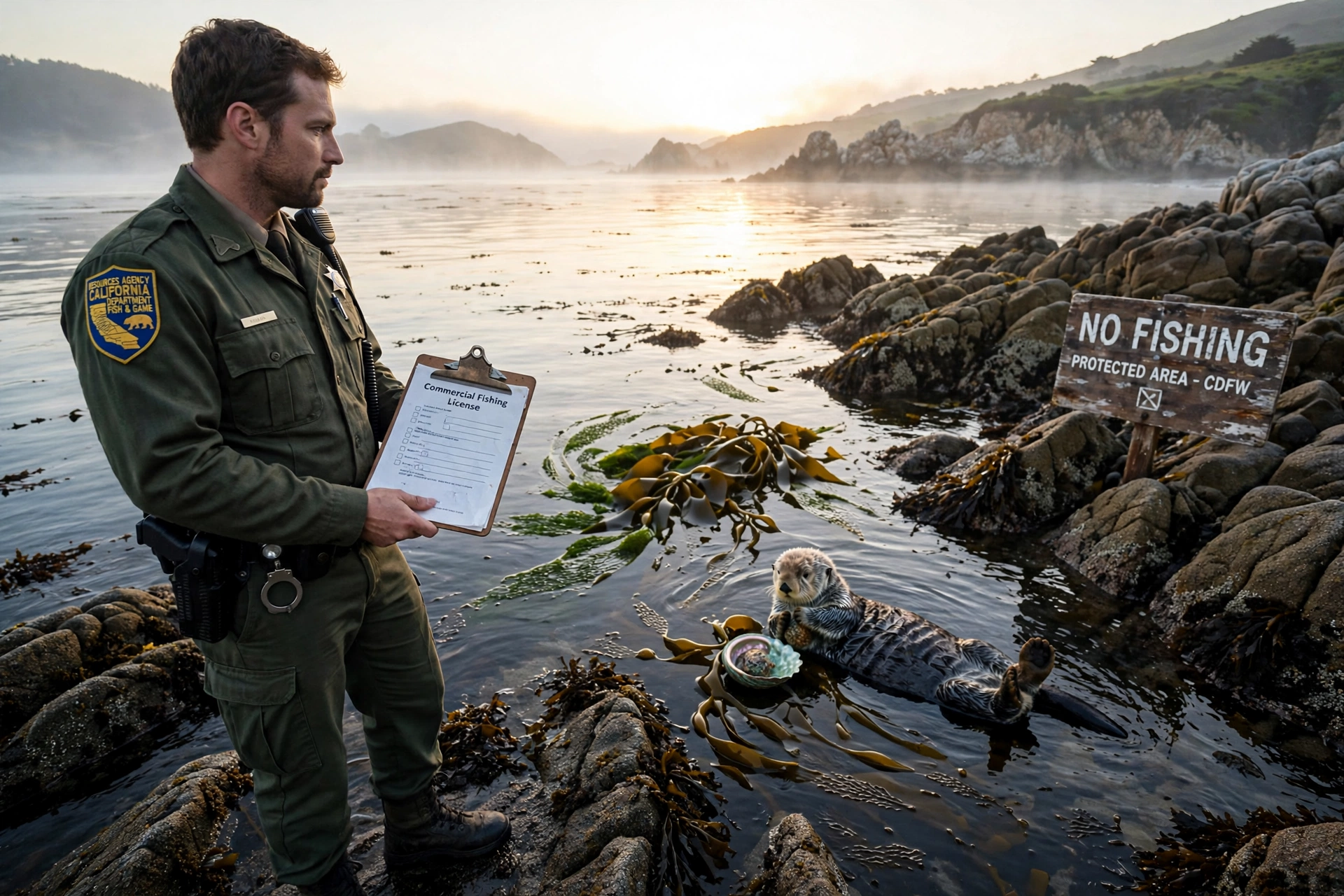
The eating is public and unhurried. The otter floats on its back, places the food on its chest, and eats with its forepaws, in full view of the shore, the pier, and the wildlife viewing platform. It does not hide the catch. It does not hurry. It does not look over its shoulder for the warden, because the warden is standing on the rocks holding a clipboard, and the otter has never once been asked to produce a license. The catch is consumed at the surface, on the otter's own chest, before any fish ticket could be written, which is convenient, because no fish ticket has ever been filed for any of it.116
II. The Gear
The gear is a rock. The sea otter is the only tool using marine mammal, and its tool of choice is a rock, used as a hammer or an anvil to break open hard shelled prey. The otter places the rock on its chest and bashes the mollusk against it repeatedly, or it places the mollusk on the rock and strikes it, until the shell breaks and the meat is exposed. The otter also uses stationary rocks on the beach as anvils to crack open mussels. The gear is unregistered, uninspected, and unnumbered, and it is carried in a loose flap of skin under each foreleg, which the otter uses as a pocket to store both the food it has gathered and the rock it will use to open it.4
The vessel is the otter. The statute lists the appliances it regulates as any boat, aircraft, net, trap, line, or other appliance, and the otter is the other appliance. It uses no boat, no net, no trap, and no line. It swims on its back at the surface, propelled by its rear flippers, steering with its tail, and it dives to the bottom to retrieve food, where it uses its sensitive whiskers to locate small prey inside crevices and its strong forepaws to dig for clams. The vessel requires no registration, no inspection, and no safety equipment, and it has never been documented, because the Coast Guard documents vessels, and the otter is not a vessel, except when it is fishing, which is always.45
The wetsuit is the fur. The sea otter has the densest fur of any animal on earth, between 600,000 and 1,000,000 hair follicles per square inch, and it is the only marine mammal without a layer of blubber. It stays warm in cold ocean water by wearing the densest fur of any mammal and by eating a quarter of its body weight every day, and the fur is the reason for the appetite, and the appetite is the reason for the catch. The insulation is unlicensed, the appetite is unlicensed, and the catch that feeds the appetite is unlicensed, which is the whole of the case in three facts.4
The depth finder is the whisker, and the dredge is the forepaw. Most dives are within 60 feet of the surface, and the otter may occasionally dive as deep as 250 feet, and some accounts put the maximum at 300 feet. A feeding dive usually lasts from less than a minute to as long as five minutes. The gear works at depths no wader reaches, in weather no boat fishes, and on ground no trawl touches, and it works there every day, because the otter does not check the forecast, the tide table, or the regulation digest before it goes to work.4
III. The Fleet
The fleet is small in California and large in Alaska. The world population of sea otters is around 129,000, with about three quarters in Alaska. The southern sea otter, the subspecies that lives in California, numbers about 3,000 animals along the central coast. In Southeast Alaska, the population was estimated at 25,000 animals in 2012, and it has grown since. The California fleet is the remnant of a fleet, and the Alaska fleet is the fleet.3
The fleet was once much larger, and the state knows exactly how much larger, because the state helped make it smaller. The animals once boasted a population of more than 300,000 along the North Pacific rim, from Japan to Baja California, and they were prized for their fur and hunted down to about 2,000 by the time the United States, Russia, Japan, and Britain signed the North Pacific Fur Seal Convention in 1911. In March 1938, a group of about 50 otters was publicly reported near the Bixby Creek Bridge on the Big Sur coast, and every southern sea otter alive today descends from that remnant colony. The population grew steadily for decades, then levelled off at just under 3,000, and the United States Fish and Wildlife Service has set a population above 3,090 for three consecutive years as one benchmark for considering delisting. The fleet is listed as threatened under the Endangered Species Act since 1977, and it occupies roughly 13 percent of the coastline it historically occupied in California.313
The fleet has a famous operator, and she does not fish. Otter 841, a female southern sea otter born about 2018 at the Coastal Science Campus of the University of California, Santa Cruz, was released into the wild in June 2020. In the summer of 2023, she began climbing onto surfboards at Steamer Lane in Santa Cruz, gnawing on the foam and fiberglass, and in some cases swimming off with the board. A Santa Cruz photographer documented her on about a dozen different surfboards over the course of a few months. On July 14, 2023, the California Department of Fish and Wildlife issued a bulletin titled, Wildlife officials attempt safe capture of unusually aggressive sea otter in Santa Cruz. A team from the department, the United States Fish and Wildlife Service, and the Monterey Bay Aquarium tried to capture her, and she outmaneuvered them. In October 2023, it was confirmed that she had given birth to a pup, and the capture plans were dropped. She reappeared in the Santa Cruz area in May 2024, and in October 2025, incidents involving otters seizing surfboards surfaced again in Santa Cruz, though it was never established whether 841 was involved or whether other otters had learned the behavior from her. The fleet's most famous operator takes property, not fish, and the state could not catch her either.1214
The fleet is the smallest marine mammal in North America and the heaviest member of the weasel family, and it is four to four and a half feet long and weighs 30 to 100 pounds. The fleet works in groups, and it works in the open, and it works without ever having filed a single form. The smallest operator in the fleet is the one that takes the most, per pound of its own body, of any commercial fisherman on the coast.3
IV. The Grounds
The grounds are the kelp forests and estuaries of the central California coast, and the otter fishes all of them, including the parts where fishing is banned. California's marine protected area network consists of 124 areas with varying levels of protection, covering 16 percent of state waters, the largest marine protected area network in the United States. State marine reserves do not allow any type of extractive activity, including fishing or kelp harvesting, with the exception of scientific collecting under a permit. State marine parks do not allow any commercial extraction. The otter fishes in both, because the otter does not read the boundary signs. The reserve protects the fish from the fisherman. It does not protect the fish from the otter.10
The grounds include Elkhorn Slough, a California estuary on Monterey Bay, where the fleet runs a second business the state has never licensed either. The otters there are crab specialists, and researchers estimate they can remove 400,000 crabs per year in an area the size of seven football fields. With fewer crabs, more small grazing invertebrates survive, and these keep algae from smothering the eelgrass, and the eelgrass meadows now cover a seven fold greater area than they did when the otters returned after a hundred year absence. In a study published in Nature in January 2024, researchers reported that where otters were abundant they reduced crab numbers and bank erosion slowed by as much as 80 to 90 percent. The otter's fishing restores the estuary. The state's own science says so. The state still has not issued the otter a permit for any of it.1517
The grounds include the abalone beds, where the catch is a protected species and the fishery is a closed one. The red abalone population dropped roughly 85 percent following the collapse of North Coast kelp forests that began with a marine heatwave in 2014. The recreational red abalone fishery in northern California, once valued at an estimated 24 to 44 million dollars a year and enjoyed by about 31,000 fishers, has been closed since 2018, and the closure has been extended repeatedly, most recently through April 1, 2036. The commercial abalone fishery was closed by the state in 1997. The red abalone was extirpated in central California owing to a combination of fishing and sea otter predation, which is the literature's own account of who took the abalone and where it went. The otter takes the abalone the state closed the fishery to save, and it takes it in the waters where the state closed the fishery.78
The grounds are also the kelp forests, where the fleet's fishing is the only thing standing between the forest and the urchin. Sea urchins can graze faster than kelp grows if nothing keeps them in check, and otters do. Where otters are present, urchins hide in crevices and feed on drifting kelp. Where otters are absent, urchins come out into the open and mow down living kelp, and the seafloor becomes an urchin barren, bare rock covered with crusting coralline algae. As otters were reintroduced to Southeast Alaska and British Columbia, kelp returned where they spread. The fleet's unlicensed fishing is the conservation program. The conservation program has no license.17
V. The Law
The law the otter breaks is the California Fish and Game Code, and the law is specific about what it covers. Section 7850 provides that, excepting persons expressly exempted under this code, no person shall use or operate, or assist in using or operating, any boat, aircraft, net, trap, line, or other appliance to take fish or amphibia for commercial purposes, unless the person holds a commercial fishing license issued by the department. The otter uses an appliance, its body and its rock, to take fish, and it takes them every day. The department shall issue a commercial fishing license to any resident who is 16 years of age or older, upon payment of a base fee of ninety-five dollars. No otter has ever paid the ninety-five dollars. No otter has ever been issued the license. The license year runs from April 1 through March 31, and the otter fishes through all twelve months of it.516
The law is specific about what a fish is, and the specificity is the whole of the case. Section 45 of the code provides that fish means a wild fish, mollusk, crustacean, invertebrate, amphibian, or part, spawn, or ovum of any of those animals. A crab is a fish. A clam is a fish. An abalone is a fish. A sea urchin is a fish. The definition is so broad that a California Court of Appeal held in 2022 that bumblebees are fish under the California Endangered Species Act, because the same definition applies there. If a bumblebee is a fish, an abalone is a fish, and if an abalone is a fish, the otter that takes it is taking fish, and the taking requires a license.6
The law has a second requirement, and it is the one the otter has most completely ignored. Every commercial landing in California must be recorded on a fish ticket, and the state's commercial fishing regulations digest devotes a section to fish ticket requirements. The otter files no fish ticket. The otter's landings are never recorded, because the otter eats the landing at the surface, on its back, before any ticket could be written, and because the otter has no name to put on the ticket, no license number to enter, and no address at which the department could audit the books.16
The law has a third requirement, and it is the one the abalone makes unavoidable. Fish and Game Code section 5521.5 makes it unlawful to take abalone for commercial purposes, and the commercial abalone fishery has been closed since 1997. The recreational red abalone fishery was closed in 2018, and the closure has been extended through April 1, 2036, and no recreational abalone report cards, tags, or permits are being issued during the closure. The otter holds no abalone report card. No otter has ever been issued one, because none are being issued, to anyone, and the otter takes abalone anyway.7
The law has a fourth requirement, and it is the one the reserves make unavoidable. Title 14, section 632 of the California Code of Regulations provides that in a state marine reserve it is unlawful to injure, damage, take, or possess any living, geological, or cultural marine resource, and take may be authorized only for research, restoration, and monitoring purposes under a scientific collecting permit. The otter holds no scientific collecting permit. The otter takes, daily, inside the reserve, and it takes the living marine resource the reserve was established to protect.10
The law has a federal requirement, and it is the one that protects the otter instead of regulating it. The Marine Mammal Protection Act, at 16 U.S.C. 1372, provides that it is unlawful for any person to take any marine mammal in waters or on lands under the jurisdiction of the United States. The otter is a marine mammal, and the Act names sea otters expressly in its definition of the term. In federal waters, the Magnuson-Stevens Fishery Conservation and Management Act governs commercial fishing through fishery management plans, permits, and catch limits. The otter fishes mostly within a kilometer of shore, in state waters, which is why the state case is the strong one, and the federal case is the backup, and the federal law that would punish the taking of the otter is the same law that cannot reach the taking by the otter.11
VI. The Scale
Do the arithmetic the record permits. California holds about 3,000 southern sea otters. At the Alaska Legislature's figure of 65 pounds average body weight, each otter eats 25 percent of its weight a day, which is about 16 pounds of shellfish a day per otter, which is about 48,750 pounds a day for the California fleet, which is about 17.8 million pounds of shellfish a year, taken from the seafloor of a single state, by 3,000 animals, none of which holds a license. The arithmetic is an estimate, and the estimate is the best the record offers, because the operator files no fish tickets.123
The scale is larger in Alaska, and the Alaska Legislature has done the same arithmetic. In Southeast Alaska, the growing sea otter population is devastating the shellfish biomass, according to the sponsor statement for Senate Bill 60, and the statement calculates that a population of 25,000 sea otters, at an average body weight of 65 pounds and a daily food intake of 25 percent of body weight, will consume over 148 million pounds of shellfish per year. The legislature's own arithmetic puts the unlicensed catch at 148 million pounds a year in one region of one state. The licensed fleet files tickets for its catch. The unlicensed fleet files nothing, and its catch is larger than the tickets account for.2
The scale is best measured against the licensed fishery the state closed. The recreational red abalone fishery in northern California was once enjoyed by about 31,000 fishers and valued at an estimated 24 to 44 million dollars a year, and it is closed, and it will remain closed through April 1, 2036. The licensed fishery is closed. The unlicensed fleet of 3,000 otters fishes on, taking the same species, in the same waters, every day, and its catch is never counted, because no ticket is filed, and its value is never recorded, because no landing is reported.8
The scale is also counted in the species the fleet takes that the law has already listed as endangered. The white abalone was listed as endangered under the Endangered Species Act in 2001, and it was the first marine invertebrate to be listed. The black abalone is also listed as endangered. The otter eats abalone, and the abalone it eats includes the species the federal government has determined to be in danger of extinction, and the otter eats them without a permit, without an incidental take statement, and without ever having consulted the listing.9
The scale is growing where the fleet grows and stalled where the fleet stalls. The California population has levelled off at just under 3,000, and the delisting benchmark of 3,090 has not been met for three consecutive years. The Alaska population is growing, and its range is expanding, and its catch grows with it. The 17.8 million pounds a year in California is the current figure. The 148 million pounds a year in Southeast Alaska is the current figure. The fleet is not shrinking. The license file is not growing. The two numbers move in opposite directions, and they have moved in opposite directions for as long as anyone has counted.3
VII. The Defense
The defense is noted. It concedes every number in this investigation and disputes only the prescription.
Its first exhibit is the personhood of the defendant. Section 7850 defines person as a natural person 16 years of age or greater. A sea otter is not a natural person. It is a natural otter. The department shall issue a commercial fishing license to any resident who is 16 years of age or older, upon payment of a base fee of ninety-five dollars, and the otter cannot pay the fee, because it has no wallet, and it cannot present identification, because the department requires a valid driver's license or identification card, and the otter has neither.
Its second is the sale, or rather the absence of one. The otter does not sell its catch. It eats it. The statute requires a license to take fish for commercial purposes, and the otter takes fish for the purpose of eating them, on its back, on its chest, in full view of the shore. The catch is subsistence, not commerce. The 17.8 million pounds a year is eaten, not sold, and the defense submits that a fishery with no sales is not a commercial fishery, no matter how large the catch.
Its third is the protection. The otter is itself a protected species, listed as threatened under the Endangered Species Act since 1977, and the Marine Mammal Protection Act makes it unlawful for any person to take any marine mammal. The law forbids taking the otter, and the license the prescription demands is a license to take, and the defense submits that the state cannot license the taking of a species it has forbidden anyone to take, and cannot license an animal it has forbidden anyone to touch.
Its fourth is the keystone. The otter is a keystone species, an animal whose effect on its community is large, and disproportionately large relative to its abundance. By eating urchins, the otter protects the kelp forests. By eating crabs, the otter protects the eelgrass. By eating crabs, the otter slows the erosion of the marsh banks by as much as 80 to 90 percent. The fishing the prescription would license is the conservation the state spends millions to achieve by other means, and the defense submits that the state should not require a license for the work it cannot do itself.
Its fifth is the antiquity. The otter fished these waters before California, before the Fish and Game Code, before the license, and before the 1911 treaty that saved it from the fur trade. The fur trade reduced more than 300,000 animals to about 2,000, and the treaty was written to save the otter, not to license it, and the defense submits that a practitioner that predates the regulator by millennia cannot be held to the regulator's paperwork, and that the catch predates the statute by an interval the statute cannot reach.
Its sixth is the surfboard. Otter 841 took surfboards, not fish, and the state's capture team failed to catch her, and the state gave up, and the defense submits that a state that cannot catch one otter cannot license 3,000 of them, and that the fleet's most famous operator remains at large, with a pup, in Santa Cruz, where she was last seen.
The defense rests. It is overruled.
VIII. The Prescription
The ledger is now complete, and it admits of only one reading.
Every otter should hold a commercial fishing license, one per otter, issued upon payment of the base fee of ninety-five dollars, with a commercial boat registration for the body, a gear registration for the rock, and an abalone endorsement it cannot use. Every landing should be recorded on a fish ticket, filed daily, naming the species, the weight, and the location. Every otter should observe the season, the size limit, and the bag limit. Every otter should hold a scientific collecting permit for every state marine reserve it fishes, and an incidental take statement for every white abalone it eats. The license should expire March 31, like every license, and the otter should renew it in the spring, before it fishes.571016
The test case is the next tide. An estimated 17.8 million pounds of shellfish a year in California, and 148 million pounds a year in Southeast Alaska, none of it licensed, none of it ticketed, none of it reported, each pound taken by an animal with the densest fur on earth, at a depth of 300 feet, with a rock it keeps in its armpit, from a reserve where all fishing is banned, of a species the state closed the fishery to save. The patients will be fed, the kelp will be saved, and the season will be measured, as it has been every year, since the first otter, under the first Fish and Game Code, waiting for a license that does not exist.
Ergo.
Sources
- Sea otters eat about 25 to 30 percent of their weight every day, and a large male may consume as much as 11 kg (25 lb.) of food daily. Their diet consists mainly of slow moving fishes and marine invertebrates including crabs, sea urchins, abalones, clams, mussels, and snails. They eat more than 40 different animals, and spend about eight hours a day feeding. SeaWorld, All About Otters, Diet and Eating Habits. seaworld.org ↑↑↑↑↑
- In Southeast Alaska, the growing sea otter population is devastating the shellfish biomass. Using an average body weight of 65 lbs. and a daily food intake of 25 percent of body weight, a sea otter population of 25,000 animals will consume over 148 million pounds of shellfish per year. Alaska Senate Bill 60 Sponsor Statement. akleg.gov ↑↑
- Recent estimates put the world population at around 129,000, with about three quarters in Alaska. Central California holds about 3,000 southern sea otters. The animals once boasted a population of more than 300,000 along the North Pacific Rim and were hunted down to about 2,000. In March 1938 a group of about 50 otters was publicly reported near the Bixby Creek Bridge on the Big Sur coast, and every southern sea otter alive today descends from that remnant colony. The U.S. Fish and Wildlife Service has set a population above 3,090 for three consecutive years as one benchmark for considering delisting. thesea.org ↑↑↑↑↑
- Sea otters have the thickest fur of any animal, between 600,000 to 1,000,000 hair follicles per square inch, and unlike most other marine mammals they lack a blubber layer. They may occasionally dive as deep as 250 feet and use their sensitive whiskers to locate small prey inside crevices or their strong forepaws to dig for clams. The otter is one of the few mammals that use tools, typically a rock used as a hammer or anvil, stored in a loose patch of skin under its armpit. U.S. Department of the Interior, 12 Facts About Otters for Sea Otter Awareness Week. doi.gov ↑↑↑↑
- Excepting persons expressly exempted under this code, no person shall use or operate, or assist in using or operating, any boat, aircraft, net, trap, line, or other appliance to take fish or amphibia for commercial purposes, unless the person holds a commercial fishing license issued by the department. As used in this section, person means a natural person 16 years of age or greater. The department shall issue a commercial fishing license to any resident who is 16 years of age or older, upon payment of a base fee of ninety-five dollars. California Fish and Game Code sections 7850 and 7852. law.justia.com ↑↑↑
- Fish means a wild fish, mollusk, crustacean, invertebrate, amphibian, or part, spawn, or ovum of any of those animals. California Fish and Game Code section 45. The Court of Appeal held in Almond Alliance of California v. Fish and Game Commission (2022) that bumblebees fall within the definition of fish under the California Endangered Species Act. leginfo.legislature.ca.gov ↑
- The commercial abalone fishery was closed by the state in 1997. The recreational red abalone fishery was closed by the Commission in late 2017, effective for the 2018 season, and the closure has been extended repeatedly, most recently through April 1, 2036. Fish and Game Code section 5521.5 makes it unlawful to take abalone for commercial purposes, and no recreational abalone report cards, tags, or permits are being issued during the closure. California Fish and Game Commission, Marine Resources Committee Staff Summary, March 13, 2025. nrm.dfg.ca.gov ↑↑↑↑↑
- The red abalone population dropped roughly 85 percent following the collapse of North Coast kelp forests that began in 2014. The recreational red abalone fishery was once enjoyed by about 31,000 fishers and valued at an estimated 24 to 44 million dollars a year. The red abalone was extirpated in central California owing to a combination of fishing and sea otter predation. Reid et al., The economic value of the recreational red abalone fishery in northern California. researchgate.net ↑↑
- White abalone were listed as endangered under the Endangered Species Act in 2001, and were the first marine invertebrate to be listed. The black abalone is also listed as endangered under the ESA. NOAA Fisheries, White Abalone: Science. fisheries.noaa.gov ↑
- The marine protected area network consists of 124 areas with varying levels of protection, covering 16 percent of state waters, the largest marine protected area network in the United States. State marine reserves do not allow any type of extractive activities, including fishing or kelp harvesting, with the exception of scientific collecting under a permit. In a state marine reserve it is unlawful to injure, damage, take, or possess any living, geological, or cultural marine resource. California Code of Regulations, Title 14, Section 632. scienceforconservation.org ↑↑↑
- Except as provided in sections 1371, 1373, 1374, 1379, 1381, 1383, 1383a, and 1387, it is unlawful for any person or vessel to take any marine mammal in waters or on lands under the jurisdiction of the United States. The term marine mammal means any mammal morphologically adapted to the marine environment, including sea otters. Marine Mammal Protection Act, 16 U.S.C. 1372. govinfo.gov ↑
- Otter 841, born circa 2018, is a female southern sea otter who began attracting awareness for her aggressive interactions with surfers and kayakers off the coast of Santa Cruz, California, in mid-2023. In October 2023, it was confirmed that she had given birth to a pup. In October 2025, incidents involving otters seizing surfboards resurfaced in Santa Cruz, and it is unknown whether 841 was the perpetrator or whether other otters had learned the behavior. en.wikipedia.org ↑
- The southern sea otter was listed as threatened under the federal Endangered Species Act in 1977. The animals once ranged along the Pacific coast from Oregon down through Baja California, and they now inhabit roughly 13 percent of their historical range in California. sharkstewards.org ↑
- On July 11, 2023, a video of a five-year-old female sea otter, better known as Otter 841, in Santa Cruz went viral after onlookers caught her stealing a surfboard. On July 14, 2023, the California Department of Fish and Wildlife issued a bulletin titled Wildlife officials attempt safe capture of unusually aggressive sea otter in Santa Cruz. Photographer Mark Woodward documented her on about a dozen different surfboards over a few months in 2023. khsu.org ↑
- In Elkhorn Slough, returning otters turned out to be good for eelgrass. Researchers estimate the otters can remove 400,000 crabs per year in an area the size of seven football fields, and the eelgrass meadows now cover a seven fold greater area than when the otters returned after a hundred year absence. National Geographic, Sea Otters: Your Defence Against The Algal Apocalypse. nationalgeographic.com ↑
- The 2026 California Commercial Fishing Regulations Digest, effective April 1, 2026 through March 2027, sets out commercial license, permit and stamp fees and fish ticket requirements for all commercial fishing in California. California Department of Fish and Wildlife. nrm.dfg.ca.gov ↑↑↑↑
- Sea otters protect kelp forests through a trophic cascade: otters eat urchins, urchins eat kelp, so more otters means more kelp. Where otters are absent, urchins come out into the open and mow down living kelp, leaving urchin barrens. In Elkhorn Slough, where otters were abundant, bank erosion slowed by as much as 80 to 90 percent. thesea.org ↑↑