I. The Procedure
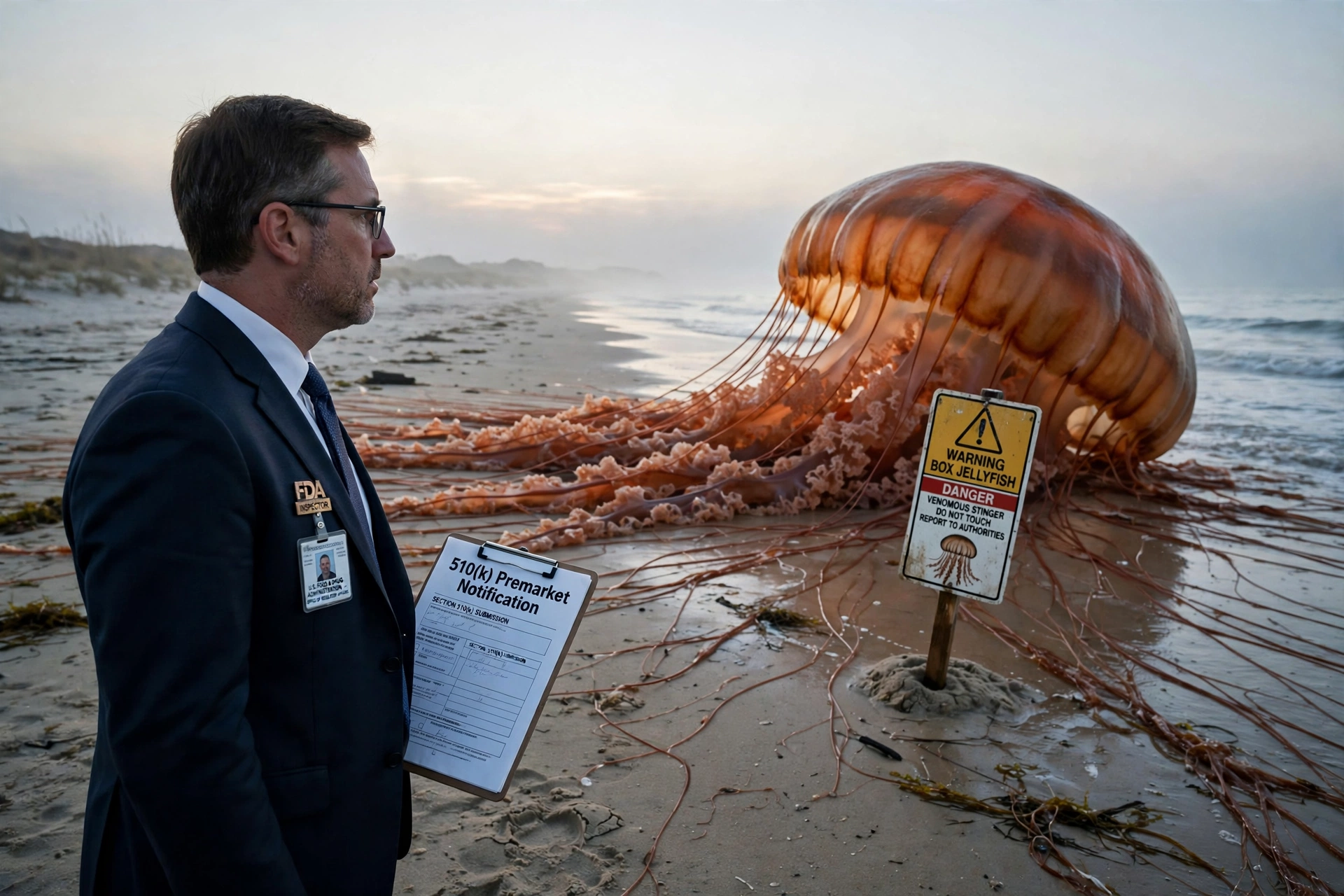
A jellyfish sting is an injection. It punctures the skin and delivers a fluid below the surface of the skin, which is the definition of the procedure in every jurisdiction that regulates it. The operation performs this procedure an estimated 150 million times a year, worldwide. The number is an estimate, and the estimate is the best the literature offers, because the operator keeps no records. The patients do not consent. The practitioner does not ask. The procedure is performed on swimmers, surfers, fishermen, and children wading at the edge of the water, and it is performed without a waiting room, without a chart, and without a single entry in any medical record system on earth.1
The procedure is not evenly distributed. About 200,000 jellyfish stings occur in Florida every year. About 500,000 occur in Chesapeake Bay every year. The numbers are large enough to be counted by the state, and small enough, against the global total, to show how much of the operation runs uncounted. Most stings are painful but not dangerous. The exception is the box jellyfish, and the exception is the whole of the case. Approximately 50 to 100 people die each year from stings by the many species of box jellyfish. The Philippines alone suffers 20 to 40 box jellyfish deaths a year. Australia has recorded at least 69 box jellyfish deaths since record keeping began in 1883. The dead are not counted in any single registry, because no country keeps one, and the estimate of 50 to 100 a year is itself an admission that the true number is unknown.23
The procedure is fast, and the fastness is part of the harm. A sting from a deadly box jellyfish can kill a person within minutes. The National Science Foundation, in its report on jellyfish blooms, states the interval plainly: three minutes after a person is stung by a deadly box jellyfish, he or she may be dead. The venom causes paralysis, cardiac arrest, and death, all within a few minutes of the sting. A single box jellyfish carries enough venom to kill more than 60 humans. The dose is not measured, the patient is not weighed, and the practitioner does not wait to see whether the patient survives. The practitioner drifts away.23
The procedure is performed without informed consent, which is the first requirement of every medical procedure the law recognizes. No patient is told what will be injected, in what dose, or with what risks. No patient signs a form. No patient is offered an alternative. The jellyfish does not carry a consent form, because it has no hands, and it does not offer an alternative, because it has no other treatment. The injection is the treatment, the injection is the injury, and the patient learns of both at the same instant.1
II. The Device
The device is the nematocyst, and it is the most sophisticated injection device in the animal kingdom. It is a pressurized capsule containing a coiled, harpoon-like thread. When triggered by contact, the capsule explosively discharges, ejecting the thread, which punctures the target and elongates by turning inside out, delivering a cocktail of neurotoxins. The thread is a needle. The capsule is a syringe. The venom is the drug. The whole device is a single cell.45
The device is also the fastest. Researchers at the University of Heidelberg, using an electronic framing-streak camera at 1,430,000 frames per second, measured the discharge of the stinging cell at as short as 700 nanoseconds, creating an acceleration of up to 5,410,000 times the force of gravity. The impact pressure at the site of penetration exceeds 7 gigapascals, which is in the range of the pressure generated by some bullets, and sufficient to penetrate the cuticle of crustacean prey. The discharge is among the fastest mechanical processes in nature, and it is completed, in the initial phase, in less time than a human nerve impulse takes to cross a single synapse. No manufactured needle moves this fast. No manufactured needle needs to, because no manufactured needle is trying to pierce a crab.4
The device is deployed in numbers no manufacturer could match. A single lion's mane jellyfish carries around 1,200 tentacles, each lined with stinging cells. The tentacles of a large specimen trail 100 feet or more. The device keeps working after the operator is dead. A detached tentacle retains the ability to sting for up to 25 days, which means the device outlives the practitioner by nearly a month and continues to inject patients who never met the animal that stung them.9
The record of the device at work is a single incident on a single beach. In July 2010, around 150 beachgoers were stung by the remains of a broken-up lion's mane jellyfish along Wallis Sands State Beach in Rye, New Hampshire. The animal was dead. It weighed about 50 pounds. It had broken apart in the surf, and its fragments fanned out through the water, stinging everyone they touched. Five people were hospitalized. The incident is believed to have been caused by a single specimen. One animal, dead, in pieces, performed 150 injections in a single afternoon, and no one in the water had consented to any of them.910
III. The Fleet
The fleet is large, and the largest member of it is the largest animal of its kind ever measured. The lion's mane jellyfish, Cyanea capillata, is the largest known species of jellyfish. The largest recorded specimen was measured off the coast of Massachusetts in 1865, and it had a bell 210 centimeters, seven feet, across and tentacles around 36.6 meters, 120 feet, long. The tentacles are longer than a blue whale. The animal is the longest known animal in the world, and it is also, by the Guinness Book of World Records, the heaviest jellyfish in the sea, weighing up to 2,200 pounds. It has no brain, no heart, and no bones, and it is the longest animal on the planet.911
The most dangerous member of the fleet is the box jellyfish, and it is dangerous in a way the others are not. The box jellyfish has 24 eyes, bundled into four structures called rhopalia around the bottom of its bell. It can see, and it can swim, and it can steer toward what it sees, which makes it the only member of the fleet that aims. Chironex fleckeri, the Australian box jellyfish, is the largest of the box jellyfish, with a body up to one foot across and about 60 tentacles that grow up to ten feet long. It is widely considered the most venomous marine animal. Its venom can kill a person in under five minutes.12
The smallest member of the fleet is the most venomous by volume. The Irukandji jellyfish is about one cubic centimeter as an adult, smaller than the nail on a little finger, and it is among the most venomous jellyfish in the world. Its sting can cause Irukandji syndrome, a condition that can produce fatal brain hemorrhages, and it sends 50 to 100 people to the hospital in Australia every year. The smallest practitioner in the operation carries the most concentrated drug, and the drug is delivered by an animal the patient cannot see.13
The fleet has a member that is not a member at all, and it is the most famous stinger in the water. The Portuguese man o' war is not a jellyfish. It is a hydrozoan, a siphonophore, a colony of specialized animals living as one organism, and it is classified apart from the true jellyfish, which are scyphozoans. The most famous defendant in the case is not the species on the chart. It is a different class of animal entirely, performing the same procedure, with the same device, under a different name.1
The fleet has one more member, and it is the one the law cannot reach at all. Turritopsis dohrnii, the immortal jellyfish, is about 4.5 millimeters wide, smaller than the nail on a little finger, and it can reverse its life cycle. When it is injured, starving, or stressed, the adult returns to its polyp stage and grows up again. The process can repeat indefinitely, which renders the animal biologically immortal in theory, though in practice most individuals are eaten or killed by disease before they revert. The fleet includes an operator that does not die of old age. It simply becomes young again.17
IV. The Route
The route is the current, and the current files no flight plan. The jellyfish does not swim to its patients. It drifts, and the drift carries it to beaches, to bays, to harbors, and to the cooling water intakes of nuclear power plants. The operation has no territory, because the ocean is its territory, and it has no schedule, because the bloom is its schedule. A bloom is a convergence of jellyfish on a beach or an intake, and it arrives without notice, without a manifest, and without ever stopping at a border.2
The route has a second line of business, and it is the one the energy industry knows best. Jellyfish blooms clog the cooling water intake pipes of nuclear power plants, preventing reactors from getting the water they need to cool their cores. When enough jellyfish are pulled in, they block the screens, reduce the volume of water coming in, and force the reactor to shut down. The shutdowns have occurred all over the globe. In 2011, two reactors at Scotland's Torness power station shut down in a single week when the seawater they used as coolant was inundated with jellyfish. In 2013, Sweden's Oskarshamn plant, home to the world's largest boiling water reactor at 1,400 megawatts, was closed for three days because moon jellyfish clogged its intake filters. The operators reported tonnes of them. The same plant had been shut down by jellyfish in 2005. Florida's St. Lucie plant was shut down by jellyfish in 1984, and again in 2011, this time for two days. Japan's Shimane plant shut down in 2011. California's Diablo Canyon plant has fought jellyfish for decades. In August 2025, four reactors at France's Gravelines nuclear plant, one of the largest in Europe, shut down automatically when a swarm of Asian moon jellyfish clogged the cooling system filters.141516
The route is unmapped because the operator keeps no log, and the cost of the route is counted in the losses of others. The National Science Foundation reports that since the 1980s, worldwide jellyfish blooms have caused hundreds of millions, or perhaps even billions, of dollars in losses, clogging power station intakes, stinging people, and killing fish in farms. Researchers have reported that blooms may be increasing as a result of climate change and overfishing. The fleet grows larger while the permit file stays empty, and the same animals that inject swimmers in the morning shut down reactors in the afternoon.2
V. The Law
The law the jellyfish breaks is the Federal Food, Drug, and Cosmetic Act, and the law is specific about what it covers. A hypodermic single lumen needle is a device intended to inject fluids into, or withdraw fluids from, parts of the body below the surface of the skin. That is the definition in 21 CFR 880.5570, and the device is classified Class II, which means it may not be marketed until the manufacturer has submitted a 510(k) premarket notification and the Food and Drug Administration has found the device substantially equivalent to a device already on the market. The nematocyst meets the definition word for word. It injects fluid below the surface of the skin. It has never submitted a 510(k). It has never been found substantially equivalent to anything, because there is nothing on the market equivalent to a harpoon that fires in 700 nanoseconds.6
The drug the device delivers is regulated separately, and it is regulated more strictly. Section 505 of the Act, codified at 21 U.S.C. 355(a), provides that no person shall introduce or deliver for introduction into interstate commerce any new drug, unless an approval of an application filed pursuant to the statute is effective with respect to such drug. The venom is a new drug. It has never been the subject of an approved application. No new drug application has been filed for it, no abbreviated new drug application has been filed for it, and no approval of any kind is effective with respect to it. The venom is introduced into interstate commerce, into the bodies of citizens of many states, every day of the summer, without an approval, without an application, and without a single page of clinical data.7
The administration of the drug is the practice of medicine, and the practice of medicine requires a license. California Business and Professions Code section 2052 provides that any person who diagnoses, treats, operates for, or prescribes for any ailment, blemish, deformity, disease, disfigurement, disorder, injury, or other physical or mental condition of any person, without having a valid, unrevoked, or unsuspended certificate, is guilty of a public offense, punishable by a fine not exceeding ten thousand dollars, by imprisonment in a county jail not exceeding one year, or by both. Section 2053 elevates the same conduct to a felony where it is committed under circumstances that cause or create a risk of great bodily harm, serious physical or mental illness, or death. A box jellyfish sting creates exactly that risk, and it creates it in under five minutes.8
The law has a third requirement, and it is the one the jellyfish has most completely ignored. A device manufacturer must register its establishment with the Food and Drug Administration and list the devices it manufactures, under 21 CFR Part 807. No jellyfish has registered an establishment. No jellyfish has listed a device. The drug is administered without a label, without directions for use, without contraindications, without a boxed warning, and without a prescription. The patient is not told the name of the drug, the dose of the drug, or the identity of the practitioner, because the practitioner has no name on file, no license on file, and no address at which service of process could be effected.6
VI. The Scale
Do the arithmetic the record permits. There are roughly 10,000 known species of jellyfish, and approximately 100 of them pose a danger to humans. The dangerous minority is one percent of the fleet, and it performs 150 million injections a year. The safe majority does nothing at all, which is the usual distribution of labor in an unregulated industry: one percent of the operators do all of the work, and the other 99 percent drift.1
The scale is best measured against the animals the public actually fears. Box jellyfish cause more death and serious injury than sharks, sea snakes, and stingrays combined. The shark, the subject of a century of films, legislation, and beach closures, kills a handful of people a year. The jellyfish, the subject of no film, no legislation, and no beach closure that lasts past noon, kills 50 to 100. The animal the public fears is regulated, tagged, tracked, and filmed. The animal the public ignores is unregistered, untracked, and unfilmed, and it kills more people than all three of the feared animals put together.3
The scale is also counted in the losses of the industries the fleet touches. The blooms that sting swimmers also clog power station intakes, kill farmed fish, and close beaches, and the National Science Foundation puts the losses since the 1980s in the hundreds of millions, perhaps billions, of dollars. The operator pays none of it. The swimmer pays for the treatment, the plant pays for the shutdown, the farmer pays for the dead fish, and the jellyfish pays nothing, because the jellyfish has never been billed.2
The scale is growing. Researchers have reported that jellyfish blooms may be increasing as a result of climate change and overfishing, as warming waters extend the season and the removal of predators leaves the fleet unchecked. The 150 million injections a year are the current figure. The fleet is not shrinking. The permit file is not growing. The two numbers move in opposite directions, and they have moved in opposite directions for as long as anyone has counted.2
VII. The Defense
The defense is noted. It concedes every number in this investigation and disputes only the prescription.
Its first exhibit is the personhood of the defendant. A jellyfish is not a person. It cannot file a 510(k) premarket notification, sign a new drug application, or hold a medical license. The Federal Food, Drug, and Cosmetic Act regulates persons, and a jellyfish is 95 percent water. The 510(k) attaches to the manufacturer, not to the manufactured, and the jellyfish is both, which is the problem, and neither, which is the defense.
Its second is the anatomy. A jellyfish has no brain, no heart, no bones, and no blood. It has only a basic network of neurons that allow it to sense its environment. It cannot read the Code of Federal Regulations. It cannot measure a dose, cannot hire a regulatory consultant, cannot retain counsel, and cannot renew a clearance, because it has no brain with which to do any of these things. The law does not demand the impossible, and the prescription demands exactly that.
Its third is the antiquity. Jellyfish have been in the oceans for more than 500 million years, which means they appeared more than 250 million years before the first dinosaurs. The Food and Drug Administration was established in 1906. The defense submits that a practitioner that predates the regulator by half a billion years cannot be held to the regulator's paperwork, and that the sting predates the statute by an interval the statute cannot reach.
Its fourth is the mistaken identity. The Portuguese man o' war, the most famous stinger in the American imagination, is not a jellyfish. It is a colony of animals, not a single animal, and it belongs to a different class. The prosecution has charged the jellyfish with the injections of an animal that is not a jellyfish, and the defense submits that the most famous defendant in the case is not a defendant at all.
Its fifth is the immortal. Turritopsis dohrnii reverses its life cycle when it is injured, starving, or stressed, returning to its polyp stage and growing up again. A defendant that can become a juvenile again cannot be served with process, cannot be sentenced as an adult, and cannot be made to age into compliance. The law has no procedure for a defendant that is never the same age twice.
The defense rests. It is overruled.
VIII. The Prescription
The ledger is now complete, and it admits of only one reading.
Every jellyfish should hold a 510(k) clearance for each nematocyst, filed in advance, one clearance per stinging cell, each naming the species, the waters, and the expected venom. Every venom should hold an approved new drug application, with labeling, indications, contraindications, and a boxed warning stating that the drug may cause paralysis, cardiac arrest, and death within minutes. Every jellyfish should register its establishment and list its device. Every sting should be preceded by informed consent, a prescription, and a record in the patient's chart. The clearance should expire, like every clearance, and the jellyfish should reapply, in the spring, before it blooms.678
The test case is the next summer. An estimated 150 million injections, none of them cleared, none of them approved, none of them licensed, each delivered in 700 nanoseconds by an animal with no brain, at an acceleration of more than five million times the force of gravity, with an impact pressure in the range of a bullet, from a device that keeps stinging for 25 days after the animal is dead. The patients will be treated, the reactors will be shut down, and the season will be measured, as it has been every year, since the first jellyfish, under the first Food, Drug, and Cosmetic Act, waiting for a clearance that does not exist.
Ergo.
Sources
- Jellyfish stings occur an estimated 150 million times annually worldwide. There are roughly 10,000 known species of jellyfish, with approximately 100 of them posing danger to humans. The Portuguese man-of-war is classified under Hydrozoa, while true jellyfish are Scyphozoa. Cutis, Aquatic Antagonists: Jellyfish Stings, 109(1), January 2022. mdedge.com ↑↑↑↑
- About 200,000 jellyfish stings occur in Florida annually, and 500,000 people are stung by jellyfish in Chesapeake Bay annually. Twenty to 40 people are killed annually from box jellyfish stings in the Philippines alone. Three minutes after a person is stung by a deadly box jellyfish, he or she may be dead. Since the 1980s, worldwide jellyfish blooms have caused hundreds of millions, or perhaps even billions, of dollars in losses. National Science Foundation, Jellyfish Gone Wild. docslib.org ↑↑↑↑↑↑
- Approximately 50 to 100 people die each year due to stings from the many species of box jellyfish. Each box jellyfish carries enough venom to kill more than 60 humans. Box jellyfish cause more death and serious injuries than sharks, sea snakes, and stingrays combined. Box jellyfish are believed to have caused at least 69 deaths in Australia since record keeping began in 1883. reptileknowledge.com ↑↑↑
- Discharge kinetics of nematocysts in Hydra were measured as short as 700 nanoseconds, creating an acceleration of up to 5,410,000 g, with an impact pressure of more than 7 GPa, in the range of that generated by some bullets. Nüchter et al., Nanosecond-scale kinetics of nematocyst discharge, Current Biology 16, R316-R318, May 9, 2006. cell.com ↑↑
- Nematocysts consist of a pressurized capsule containing a coiled harpoon-like thread. When triggered, the capsule explosively discharges, ejecting the thread which punctures the target and delivers a cocktail of neurotoxins. Nematocyst discharge is among the fastest mechanical processes in nature, completed within 3 milliseconds in Hydra. Nature Communications 13:3494, June 17, 2022. pmc.ncbi.nlm.nih.gov ↑
- A hypodermic single lumen needle is a device intended to inject fluids into, or withdraw fluids from, parts of the body below the surface of the skin. Classification: Class II (performance standards). 21 CFR § 880.5570. Device manufacturers must register their establishments and list their devices under 21 CFR Part 807. law.cornell.edu ↑↑↑
- No person shall introduce or deliver for introduction into interstate commerce any new drug, unless an approval of an application filed pursuant to subsection (b) or (j) is effective with respect to such drug. 21 U.S.C. § 355(a). govinfo.gov ↑↑
- Business and Professions Code section 2052 states that any person who diagnoses, treats, operates for, or prescribes for any ailment, blemish, deformity, disease, disfigurement, disorder, injury, or other physical or mental condition without a valid, unrevoked, or unsuspended certificate is guilty of a public offense, punishable by a fine not exceeding ten thousand dollars, by imprisonment in a county jail not exceeding one year, or by both. Section 2053 elevates the conduct to a felony where it causes or creates a risk of great bodily harm, serious physical or mental illness, or death. Medical Board of California. mbc.ca.gov ↑↑
- The largest recorded lion's mane specimen was measured off the coast of Massachusetts in 1865 and had a bell 210 centimeters (7 feet) across and tentacles around 36.6 meters (120 feet) long. Each lobe contains about 70 to 150 tentacles, with around 1,200 tentacles in total. Tentacles may retain the ability to sting for up to 25 days after detaching. In July 2010, around 150 beachgoers were stung by the remains of a broken-up lion's mane jellyfish along Wallis Sands State Beach in Rye, New Hampshire, believed to have been caused by a single specimen. en.wikipedia.org ↑↑↑
- A large, dead jellyfish caused mayhem at Wallis Sands beach when it stung about 150 people in the water. Five people were hospitalized. The jellyfish weighed about 50 pounds. Keene Sentinel, July 2010. keenesentinel.com ↑
- The lion's mane jellyfish has a bell diameter of 7 to 8 feet and tentacles around 60 feet in length, with the largest specimens observed at 120 feet. The Guinness Book of World Records lists it as the heaviest jelly in the sea, weighing up to 2,200 pounds. animals.howstuffworks.com ↑
- Chironex fleckeri is the largest of the box jellyfish, with body sizes reaching up to one foot in diameter and tentacles up to 10 feet long, about 60 tentacles in total. Box jellyfish have 24 eyes, bundled into four structures called rhopalia. Their venom can kill a person in under five minutes. reptileknowledge.com ↑
- The Irukandji jellyfish are about one cubic centimeter as adults and are among the most venomous jellyfish in the world. Their stings can cause fatal brain hemorrhages and send 50 to 100 people to the hospital in Australia annually. reptileknowledge.com ↑
- Two reactors at Scotland's Torness power station shut down in a single week in 2011 when jellyfish inundated the cooling seawater. Sweden's Oskarshamn nuclear power plant was forced to shut down by a bloom of moon jellyfish in 2005, and stopped generating again for three days in 2013. Jellyfish caused Florida's St. Lucie plant to shut down in 1984 and again in 2011, and shut down Japan's Shimane plant in 2011. Jellyfish have been a problem for decades at California's Diablo Canyon plant. Bulletin of the Atomic Scientists. lucian.uchicago.edu ↑
- The Oskarshamn-3 reactor, the largest boiling water reactor in the world at 1,400 megawatts, had its start-up aborted in 2013 after moon jellyfish clogged the cooling water filters. The operators reported enormous amounts of jellyfish, tonnes of them. Energy Voice, October 1, 2013. energyvoice.com ↑
- On the night of August 10, 2025, four reactors at France's Gravelines nuclear power plant shut down automatically when a swarm of Asian moon jellyfish clogged the cooling system filters. news.worldgrowthforums.com ↑
- Turritopsis dohrnii, about 4.5 millimeters wide, can reverse its life cycle and has been called biologically immortal. Jellyfish have no brain, heart, bones, or blood, are around 95 percent water, and have been living in the oceans for at least 500 million years, more than 250 million years before the first dinosaurs. reptileknowledge.com ↑