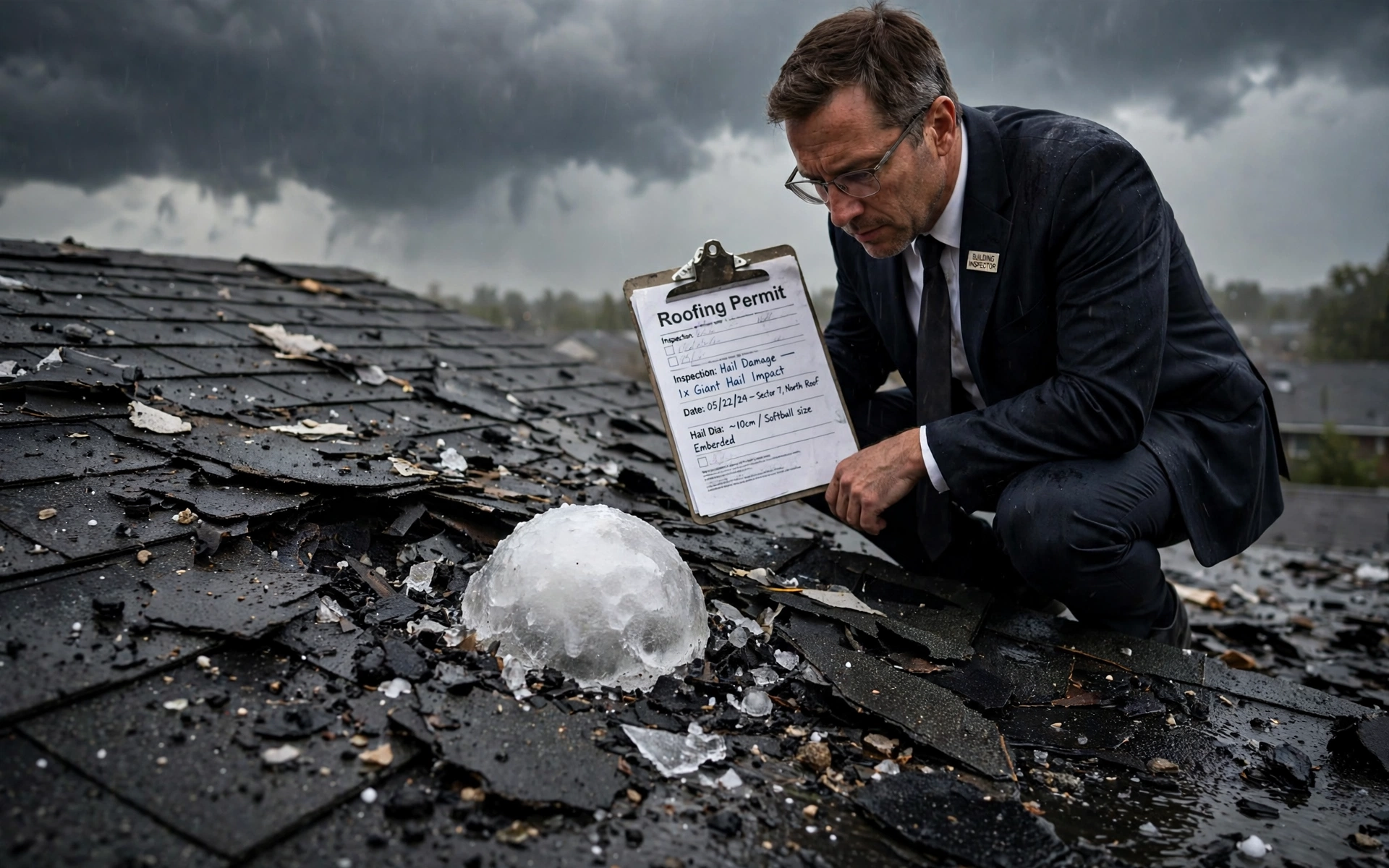
I. The Trade
Hail is frozen precipitation in the form of balls or irregular lumps of ice, defined by the National Oceanic and Atmospheric Administration as a particle five millimeters, about a quarter of an inch, or larger. It is manufactured in the thunderstorm, and the manufacturing process is violent. A strong updraft carries a raindrop above the freezing level, where supercooled water freezes onto it on contact. The stone is carried up and down through the cloud, collecting a new layer of ice on each pass, growing heavier with every cycle, until gravity finally overcomes the updraft and the stone falls. The stronger the updraft, the larger the stone it can hold.1
The National Weather Service measures the trade in familiar objects. A hailstone the size of a pea is a quarter of an inch across. A dime is three quarters of an inch. A quarter is one inch, and one inch is the threshold at which the National Weather Service calls a thunderstorm severe. A golf ball is one and three quarter inches. A tennis ball is two and a half. A baseball is two and three quarters. A softball is four inches or more. The updraft required to suspend each is measured, too: about 24 miles an hour to hold up a pea-sized stone, 49 miles an hour for a quarter-sized stone, and 103 miles an hour for a softball-sized stone. The updraft that builds a softball-sized hailstone is itself a hurricane-force wind, blowing straight up.12
The threshold for severity was itself raised by the record. Until January 5, 2010, the National Weather Service called a thunderstorm severe when it produced hail three quarters of an inch across, the size of a penny. On that date the service raised the minimum to one inch, quarter size, because research showed that significant damage does not occur from hail smaller than an inch. Quarter-sized hail and larger are the stones that damage cars, homes, buildings, and crops. The service did not raise the threshold because the hail got smaller. It raised it because the hail below an inch was not doing enough damage to count.2
The fall speeds are measured by the National Severe Storms Laboratory. Stones under one inch fall at 9 to 25 miles an hour. Stones of one to one and three quarter inches fall at 25 to 40 miles an hour. Stones of two to four inches fall at 44 to 72 miles an hour. Stones larger than four inches fall at more than 100 miles an hour. A hailstone does not drift down. It arrives.1
II. The Record
The largest hailstone ever recovered in the United States fell near Vivian, South Dakota, on July 23, 2010. It measured 8.0 inches in diameter, 18.625 inches in circumference, and weighed 1.9375 pounds. It was found by Vivian resident Les Scott, who collected several enormous stones after the storm and put the largest in his freezer. He had originally planned to make daiquiris out of the hail. A storm-related power outage melted part of the stone before personnel from the National Weather Service in Aberdeen could measure it, and the committee that certified the record noted that the stone had almost certainly been larger at impact. The National Climate Extremes Committee certified it as the United States record for both diameter and weight. The stone now rests at the National Center for Atmospheric Research.34
The Vivian stone displaced two records at once. The previous record for diameter was 7 inches, set at Aurora, Nebraska, on June 22, 2003. The previous record for weight was 1.67 pounds, set at Coffeyville, Kansas, on September 3, 1970. Aurora retains one record: its stone still holds the record for circumference, at 18.75 inches, a fraction of an inch more than Vivian’s 18.625. The record book keeps the categories separate, and the stones keep competing across them.34
The world record is heavier, and it killed people. The heaviest hailstones on record, according to the World Meteorological Organization, weighed up to 1.02 kilograms, 2.25 pounds, and fell in the Gopalganj district of Bangladesh on April 14, 1986, killing 92 people. The American record stone has never killed anyone. The world record stone killed 92. The difference is not the stone. It is where the stone fell.4
The American record for injury belongs to a festival. On May 5, 1995, softball-sized hail fell on the Mayfest festival in Fort Worth, Texas, injuring more than 400 people and causing $1.1 billion in insured losses. The crowd had gathered outdoors, under an open sky, on a spring afternoon. The stones arrived at more than 100 miles an hour, each carrying the energy of a small-caliber round, and no one in the crowd held a permit for any of them.5
III. The Scale
The operation runs every year, in every hail season, across the whole of the country. The National Oceanic and Atmospheric Administration counts an average of around 7,000 severe hail events in the United States each year. In 2025, the Insurance Information Institute counted 5,432 hail events of one inch or larger, and the Storm Prediction Center’s own file counted 7,982 severe hail reports, including 1,058 reports of hail two inches or larger. Texas had the most events in 2025, with 902, followed by Kansas with 375. The hardest-hit states are Colorado, Nebraska, and Wyoming, a region the industry calls Hail Alley.678
The bill is the largest in the weather business. Hail causes more than $10 billion in damage in the United States each year, more than tornadoes. Severe convective storms, the category that includes hail, tornadoes, and damaging wind, caused at least $66 billion in insured losses in 2023, $59 billion in 2024, and at least $51 billion in 2025, according to Gallagher Re. Hail accounts for between 60 and 80 percent of severe convective storm losses, according to Aon. Wind and hail together caused 42.5 percent of all homeowners insurance losses in 2023, more than any other cause, and the average wind or hail claim was $14,747.678
The single storms are measured in billions. The costliest hail event in American history, by the billion-dollar disaster database, was the Midwest and Ohio Valley hail and tornado outbreak of April 6 to 11, 2001, which included the Tri-State hailstorm along Interstate 70 from Kansas City to St. Louis: $5.85 billion in 2026 dollars. The Rockies hailstorms of June 2023 cost $5.77 billion. The May 2017 Denver hailstorm cost $4.56 billion, the most expensive hailstorm in Colorado history, with insured losses exceeding $2.2 billion at the time. The March 12 to 14, 2024 storms cost $6.51 billion. From 1980 to 2024, severe storms caused 203 of the 403 billion-dollar weather disasters in the United States, at a total cost of $514.4 billion.59
Do the arithmetic the record permits. Severe convective storms caused at least $51 billion in insured losses in 2025. Hail accounts for 60 to 80 percent of severe convective storm losses. The hail share of the 2025 total is therefore roughly $31 billion to $41 billion. The average residential roof replacement in 2025 cost $17,631, according to Verisk. At that price, the hail share of a single year’s losses would pay for re-roofing roughly 1.8 million to 2.3 million homes. Every one of those roofs was worked on by an unlicensed contractor, and none of the work was inspected.
IV. The Work
The work hail performs on a roof is the demolition phase of a re-roof, executed from above at highway speed. It strips shingles from the deck. It fractures underlayment. It dents metal roofing, cracks tile, and bruises asphalt shingles, knocking the protective granules from the surface and exposing the mat beneath to sun and water. A roof that has been hailed on does not look destroyed. It looks tired, pitted, and thinned, and it leaks in the next rain. The tear-off crew that follows does the same work more slowly, with pry bars, and charges for it.10
The force of the work is a matter of arithmetic. Computed from the National Severe Storms Laboratory’s fall speeds and the density of ice, a quarter-sized stone falling at 40 miles an hour carries about one joule of energy. A golf-ball-sized stone at the same speed carries about seven. A baseball-sized stone falling at 72 miles an hour carries about 85. A softball-sized stone falling at more than 100 miles an hour carries about 500 joules, roughly the muzzle energy of a standard 9mm pistol round. The Vivian stone, at 1.94 pounds and more than 100 miles an hour, carried about 880 joules, roughly twice the muzzle energy of a 9mm. The roof is not struck by weather. It is struck by a volley of small-caliber rounds made of ice, fired from a cloud, with no one holding the weapon.1
The price of the lawful version of the same work is published every year. The 2025 Cost vs. Value report puts a full tear-off and 3,000 square feet of fiberglass asphalt shingles at $31,871 on average nationally, including underlayment, drip edge, flashing, and two skylights. Verisk’s 2026 U.S. Roof Report puts the average residential roof replacement in 2025 at $17,631 across all materials, about 33 percent above the 2021 to 2024 average. The roof is the most expensive single component of the house to replace, and the hail replaces it for free, without asking, and without a permit.15
The permit is the part the law actually requires. The International Residential Code, which most local governments adopt as the foundation for their building rules, requires a permit for any work that alters, repairs, or replaces a building’s structural components. For roofing, that includes tearing off old materials and installing a new roof, replacing damaged decking or rafters, and adding or modifying structural supports. A full roof replacement requires a building permit in virtually all jurisdictions in the United States. When a licensed contractor does the work, the contractor pulls the permit, and the license number goes on the application. When a homeowner does the work, the homeowner pulls the permit as an owner-builder. When hail does the work, no one pulls anything.1011
The code does contain an exemption, and the investigation reports it. The International Residential Code exempts ordinary repairs from permit requirements, and the standard example of an ordinary repair is replacing a few damaged shingles, patching a small leak, or re-sealing flashing. A few shingles. The exemption is written for the homeowner with a tube of sealant and a Saturday afternoon. Hail does not replace a few shingles. It replaces the roof. The exemption does not cover the work, because the work is not minor, and the worker is not a homeowner.
V. The License
The license the hail lacks is a specific instrument with a specific number. In California, roofing is Class C-39 work, licensed by the Contractors State License Board. A C-39 roofing contractor installs products and repairs surfaces that seal, waterproof, and weatherproof structures, to prevent water or its derivatives, compounds, or solids from penetrating such protection and gaining access to material or space beyond. The classification covers asphaltum, pitch, tar, felt, glass fabric, urethane foam, metal roofing systems, shakes, shingles, roof tile, slate, and any other roofing, waterproofing, or membrane material. California law requires a C-39 license for any roofing work valued at more than $500. Working without one is a misdemeanor under California Business and Professions Code Section 7028.12
The license is not handed out. The applicant must show at least four years of journey-level experience in the roofing classification within the ten years before applying, pass the Law and Business examination and the C-39 trade examination, carry a $25,000 contractor’s bond, and maintain workers’ compensation insurance even if the business has no employees. The bond exists to protect the homeowner. The insurance exists to protect the worker. The examinations exist to prove the contractor knows the code. Hail holds no bond, carries no insurance, and has never sat for an examination.12
The pattern repeats in every state that licenses the trade. In Louisiana, roof work on a residential dwelling valued at more than $7,500 requires a residential roofing license, effective January 1, 2026, and Jefferson Parish requires a re-roofing permit before the replacement of 50 percent or more of the roof covering on any one- or two-family dwelling, with the contractor’s license on file. In Maryland, it is illegal to perform home improvement work over $500 without a valid Maryland Home Improvement Commission license, and working without a permit is a misdemeanor punishable by up to one year in jail or criminal fines. Maryland licensees must demonstrate at least two years of experience, pass written examinations, and carry a minimum of $50,000 in liability insurance. In Florida, the licensed roofing contractor is legally required to pull the permit, and a contractor who asks the homeowner to pull it instead is a red flag for an unlicensed operator.131411
The system is thorough, and it is universal. Forty-two specialty classifications in California alone. A license number on every permit application. A bond on file for every licensee. An inspection at the end of every job. The building departments of the country have built a complete regulatory apparatus for the removal and replacement of roofs, and the largest roofing contractor in the country operates entirely outside it, in every state, in every season, at highway speed, from the sky.
VI. The Defense
The defense is noted. It concedes every number in this investigation and disputes only the prescription.
Its first exhibit is the personhood of the defendant. Hail is not a person. It cannot hold a license, sign a contract, post a bond, or appear before a licensing board. The licensing statutes regulate persons who perform work for compensation, and a hailstone performs no work for anyone and is compensated by no one. The permit requirement attaches to the owner of the building or the contractor the owner hires, not to the weather.
Its second is the contract. Roofing work, as the statutes define it, is work performed under a contract for a price. Hail enters into no contract, names no price, and issues no invoice. The $31 billion to $41 billion figure is a measure of damage, not a measure of work performed, and damage is not a service. The homeowner does not hire the hail. The hail hires itself, and pays itself nothing.
Its third is the exemption. The International Residential Code exempts ordinary repairs from permit requirements, and the hail that falls on most roofs on most days is pea-sized, dime-sized, or smaller, the kind of hail that does no damage at all. The code’s exemption for minor work covers exactly the hail that does nothing. The hail that does something is the exception, and the law is written for the rule.
Its fourth is the doctrine. Insurance law calls hail an act of God, a loss arising from natural causes without human intervention, and the entire edifice of contractor licensing is built on human intervention. The state licenses the human. It does not license the sky. The sky is not a contractor, and the storm is not a job site.
Its fifth is the impossibility. A hailstone cannot read the code. It cannot sit for an examination, cannot carry a $25,000 bond, cannot maintain workers’ compensation insurance, and cannot pull a permit, because it melts. The law does not demand the impossible, and the prescription demands exactly that.
The defense rests. It is overruled.
VII. The Prescription
The ledger is now complete, and it admits of only one reading.
Every stone that strikes a roof should be covered by a permit, filed in advance, one application per stone, each naming the stone, the diameter, the roof, and the hour. Stones of one inch or more, the size at which the National Weather Service calls a thunderstorm severe, should hold a C-39 license or its local equivalent, with four years of journey-level experience, two examinations passed, a $25,000 bond on file, and workers’ compensation insurance in force. The building department should inspect the work before the storm and after it. The permit should expire 180 days after issuance if no work has started, which, for a stone that melts in minutes, is a generous window.1012
The test case is the next storm. About 7,000 severe hail events a year, thousands of unlicensed contractors arriving at highway speed, each carrying a permit application it will never file, each performing a roof replacement it will never be paid for, each melting before the inspector arrives. The roof will be stripped, the underlayment punctured, the decking cracked, and the granules knocked from the shingles, and the building department will record the damage, issue the permit for the repair, and license the contractor who fixes what the unlicensed contractor did, as it has done every year, since the first roof, under the first storm, waiting for a form that does not exist.
Ergo.
Sources
- NOAA defines hail as ice 5 millimeters, about a quarter of an inch, or larger. Updraft speeds of about 24 miles an hour hold up pea-sized hail, 49 miles an hour hold up quarter-sized hail, and 103 miles an hour hold up softball-sized hail. Fall speeds estimated by the National Severe Storms Laboratory: 9 to 25 miles an hour for stones under one inch, 25 to 40 for stones of one to one and three quarter inches, 44 to 72 for stones of two to four inches, and more than 100 for stones larger than four inches. NOAA National Severe Storms Laboratory, Severe Weather 101: Hail Basics, via Magma Tribune. magmatribune.com ↑↑↑↑
- The National Weather Service uses everyday objects to describe hailstone diameter: pea at a quarter inch, dime at three quarters, quarter at one inch, golf ball at one and three quarter inches, tennis ball at two and a half, baseball at two and three quarters, softball at four inches or more. One inch is the threshold for a severe thunderstorm. On January 5, 2010, the National Weather Service raised the minimum hail size for a severe thunderstorm from three quarters of an inch to one inch, because research showed significant damage does not occur from hail smaller than an inch. weather.gov headlines.ametsoc.org ↑↑
- A record-setting hailstone was discovered in Vivian, South Dakota, measuring 8.0 inches in diameter, 18.625 inches in circumference, and weighing 1.9375 pounds. It broke the previous United States records for diameter, 7.0 inches on June 22, 2003 in Aurora, Nebraska, and weight, 1.67 pounds on September 3, 1970 in Coffeyville, Kansas. The Aurora hailstone retains the record for circumference at 18.75 inches. The stone had shrunk considerably between impact and measurement, in part because of a power outage at the residence of the individual who found it. National Weather Service, Aberdeen, South Dakota. weather.gov ↑↑
- The heaviest hailstones on record weighed up to 1.02 kilograms, 2 pounds 3.9 ounces, and are reported to have killed 92 people in the Gopalganj area of Bangladesh on April 14, 1986. The heaviest hailstone in the Western Hemisphere fell at approximately 23:00 UTC on July 23, 2010 in Vivian, South Dakota; it weighed 0.88 kilograms, 1 pound 15 ounces, and had a diameter of 8 inches and a circumference of 1 foot 6.2 inches. Guinness World Records, citing the World Meteorological Organization. guinnessworldrecords.com ↑↑↑
- The costliest hail storms in United States history, by the billion-dollar disaster database: the Midwest and Ohio Valley hail and tornadoes of April 6 to 11, 2001, including the Tri-State hailstorm, $5.85 billion in 2026 dollars; the Rockies hailstorms of June 21 to 26, 2023, $5.77 billion; the May 2017 Denver hailstorm, $4.56 billion; the Central and Southern severe weather of March 12 to 14, 2024, $6.51 billion. The Mayfest storm of May 5, 1995 in Fort Worth: softball-sized hail fell on a festival crowd, more than 400 injured, $1.1 billion in insured losses. disasteraware.com ↑↑
- Hail causes over $10 billion in damage annually in the United States, more than tornadoes. According to the National Oceanic and Atmospheric Administration, the United States averages around 7,000 severe hail events each year. Climate Central. climatecentral.org ↑↑
- Severe thunderstorms and hail cost United States insurers at least $51 billion in 2025, after $66 billion in 2023 and $59 billion in 2024, per Gallagher Re. NOAA data compiled by the Insurance Information Institute shows 5,432 hail events, hail one inch or larger, in 2025, up from 5,373 in 2024, with Texas the most at 902. The Storm Prediction Center’s 2025 hail file counted 7,982 severe hail reports, including 1,058 reports of hail two inches or larger. Wind and hail caused 42.5 percent of all homeowners insurance losses in 2023, and the average wind or hail claim was $14,747, per the Insurance Information Institute. medium.com ↑↑
- Severe convective storms generated $57 billion in losses in 2024, according to Aon, and around $60 billion in annual losses in recent years, with hail generally accounting for somewhere between 60 and 80 percent of that. The hardest-hit states are Colorado, Nebraska, and Wyoming, according to the National Severe Storms Laboratory. finance-commerce.com ↑↑
- From 1980 to 2024, there were 403 confirmed weather and climate disaster events with losses exceeding $1 billion each in the United States, including 203 severe storm events at a total cost of $514.4 billion. NOAA National Centers for Environmental Information, Billion-Dollar Weather and Climate Disasters. ncei.noaa.gov ↑
- Most roof replacements and major repairs require a building permit from the local government before work begins. The International Residential Code requires a permit for any work that alters, repairs, or replaces a building’s structural components, including tearing off old materials and installing a new roof. Small fixes like patching a leak or replacing a handful of damaged shingles generally do not require a permit, as ordinary repairs exempt under IRC R105.2. A permit typically expires 180 days after issuance if no work has started. legalclarity.org ↑↑↑
- Full roof replacement, tearing off the old roof and installing new roofing material, requires a permit in virtually all United States jurisdictions. Re-roofing over one existing layer still requires a permit. Minor repairs like replacing a few damaged shingles are typically exempt. In Florida, the licensed roofing contractor is legally required to pull the permit. permitmint.com ↑↑
- Class C-39 Roofing: a roofing contractor installs products and repairs surfaces that seal, waterproof and weatherproof structures, to prevent water or its derivatives, compounds or solids from penetrating such protection and gaining access to material or space beyond. California Contractors State License Board, Description of Classifications, 16 CCR 832.39. California law requires a C-39 license for any roofing work valued at more than $500, and working without one is a misdemeanor under Business and Professions Code Section 7028. Applicants must show four years of journey-level experience, pass the Law and Business and C-39 trade examinations, carry a $25,000 bond, and maintain workers’ compensation insurance even with no employees. web.cslb.ca.gov getjobber.com ↑↑↑
- In Maryland, it is illegal to perform home improvement work over $500 without a valid Maryland Home Improvement Commission license. Working without permits is a misdemeanor, punishable by up to one year in jail or criminal fines. Licensed contractors must demonstrate at least two years of experience and pass written examinations, and are required to carry a minimum of $50,000 in liability insurance. bayareaexteriorsmd.com ↑
- A re-roofing permit must be obtained from the Jefferson Parish Department of Building Permits prior to replacement of roof covering, 50 percent or more, on all one- and two-family dwellings in unincorporated Jefferson Parish. The contractor must possess a valid Louisiana Residential Contractor License with a residential roofing classification. Effective January 1, 2026, roof work on a residential dwelling where the value of the work is greater than $7,500 requires a Louisiana Residential Roofing or Residential Construction license. jeffparish.gov ↑
- A new shingle roof averages $31,871 in the 2025 Cost vs. Value report, for a full tear-off and 30 squares, 3,000 square feet, of fiberglass asphalt shingles. Verisk’s 2026 U.S. Roof Report puts the average residential roof replacement in 2025 at $17,631, about 33 percent above the 2021 to 2024 average. Zonda and Journal of Light Construction, 2025 Cost vs. Value Report; Verisk, 2026 U.S. Roof Report. smartamericanliving.com ↑