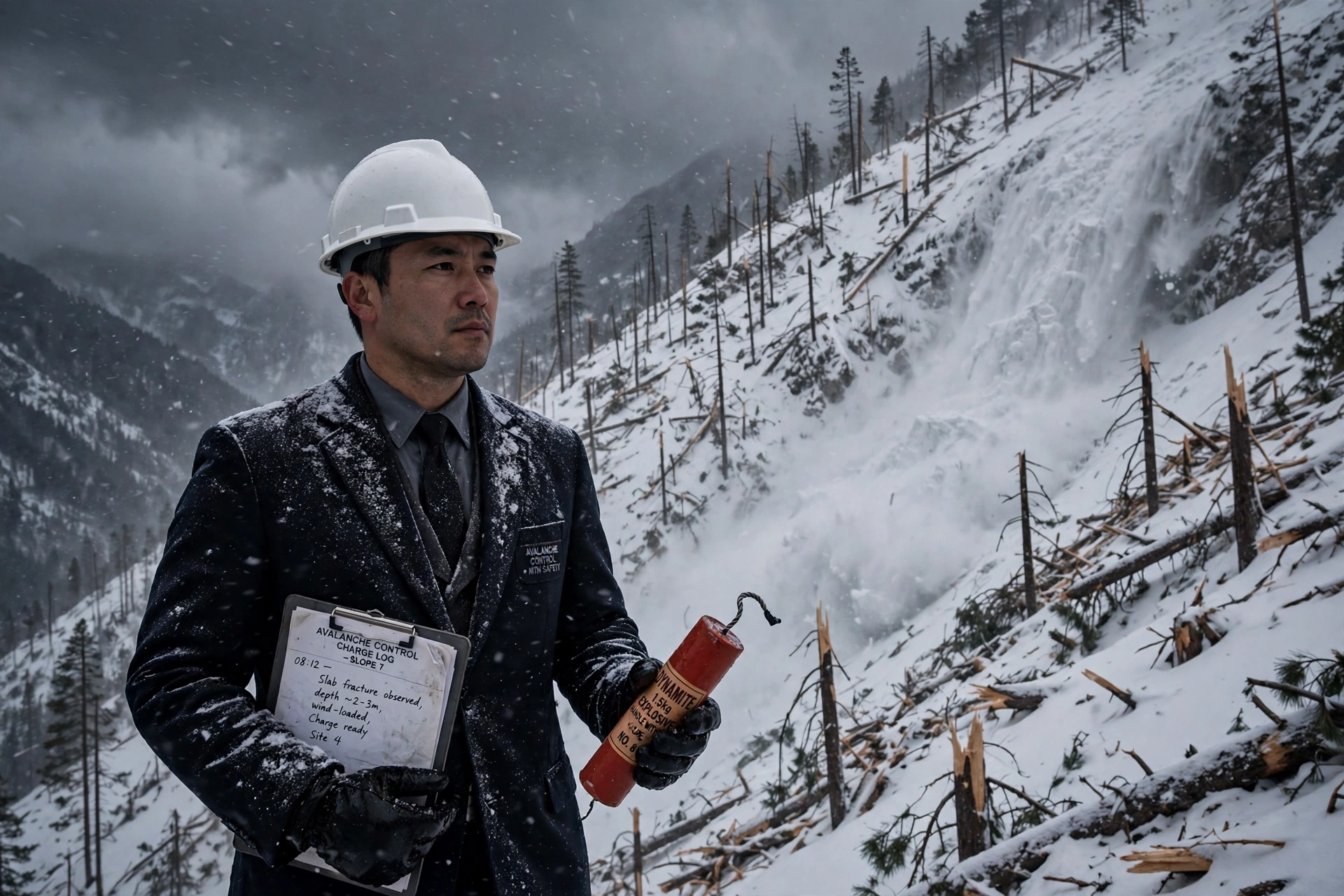
I. The Operation
Explosives are among the most licensed substances in American law. Federal law makes it unlawful to engage in the business of importing, manufacturing, or dealing in explosive materials without a federal explosives license issued by the Bureau of Alcohol, Tobacco, Firearms and Explosives. The states layer their own licenses on top. Washington requires a license to manufacture, purchase, sell, use, possess, transport, or store explosives, and its explosives chapter expressly addresses avalanche control, providing that the transportation, storage, and use of explosives in normal and emergency avalanche control procedures conducted by trained and licensed ski area operator personnel must meet the requirements of regulations adopted by the director of labor and industries.1
Colorado operates a dedicated Explosives Program that regulates individuals and businesses that use, manufacture, possess, sell, store, transport, and dispose of explosives or blasting agents, and it names avalanche control explicitly among the uses it regulates, alongside highway and building construction and demolition and oil and gas exploration. The program issues Type I permits to individuals, Type II permits to companies and local government agencies that use explosives, and Type III permits to companies that store explosives in magazines. An applicant for a Type I permit must pass an examination covering the regulations for the classification of work the applicant will be performing.2
California regulates the act itself, slope by slope. Title 8, Section 5357 of the California Code of Regulations, under the heading Snow Avalanche Blasting, provides that all avalanche blasting shall be conducted under the attended supervision of the blaster in charge, who is a licensed avalanche blaster certified by the Division to perform such blasting activities. Slopes and trails in the potential avalanche path and ski lifts must be closed to the public until the work is completed. Blasting is to be conducted during daylight hours except during emergency operations. Hand charges shall not exceed 4.5 pounds of TNT equivalent. The employer shall prepare a written safety plan before each blasting activity commences, covering the procedures to be followed, the handcharge arming and handling procedures, the type of explosives to be used, and the emergency rescue plans, and shall provide a copy of the safety plan to the Division's Mining and Tunneling Unit before blasting can commence.3
Washington's administrative code is more detailed still. Every avalanche control blasting crew must consist of a qualified and licensed blaster and at least one trained assistant. Blasting from aircraft requires a written program approved by the Federal Aviation Administration and the director of labor and industries, and the blaster in charge must hold a license with an endorsement for aerial blasting. The avalauncher, a device like a cannon that uses compressed gas to propel a projectile containing an explosive charge, may be operated only by trained and authorized personnel under the direct supervision of a licensed avalanche blaster, and its operators must have a current state blasting license.4
Consider what an avalanche is, in regulatory terms. It is the release of a mass of snow down a steep slope with destructive force due to its mass. It does the work of a blast, moving tons of material, snapping trees, burying roads, and demolishing structures, and it does it without a license, without a blaster in charge, without a written safety plan, and without ever closing the slope to the public. The difference between the licensed operation and the unlicensed one is not the force. It is the paperwork.
II. The Scale of Production
The throughput of the unlicensed blaster is established by the federal government itself. Every year about 100,000 avalanches sweep down mountains across the United States, damaging everything in their path and killing 28 people on average, according to a national avalanche specialist for the United States Forest Service. The Forest Service operates 14 avalanche forecasting centers, and the Colorado Avalanche Information Center keeps the central archive of avalanche accidents for the United States, with detailed records going back to 1950 and sparse records back to the 1860s.5
One hundred thousand avalanches a year is about 274 a day, every day, for the full calendar year, and the season is compressed into roughly five months, from late fall through early spring. The count is an estimate because most slides are never seen by anyone, and the reporting captures only a fraction of the fleet. The Colorado Avalanche Information Center typically documents about 2,700 avalanches in Colorado in a single avalanche year, and practitioners estimate that the true number in the state is roughly ten times the reported count. In the 2023-24 season alone the Center recorded 5,555 avalanches in Colorado, of which 938 were triggered by backcountry users, and 117 people were caught, 44 partially buried, and 6 fully buried.67
The licensed operation, for comparison, is small and counted to the shot. The Colorado Department of Transportation has been firing 54 remotely controlled blasters about 200 times a year to pre-empt natural avalanches above its highways, and it is seeking federal approval to install 50 more. The department still operates 7 howitzers statewide, M101 A1 105 millimeter guns with a range of up to 7 miles, which it is phasing out in favor of the remote systems. Two hundred licensed shots a year against one hundred thousand unlicensed releases. The permitted fleet fires once for every five hundred slides the unpermitted fleet delivers.89
The death toll is counted with more certainty than the slides, because almost every fatal accident is investigated and reported. Over the last ten winters, an average of 23 people died in avalanches each winter in the United States. The 2020-21 season was the deadliest of the decade, with 37 fatalities. Colorado, the deadliest state, has recorded 328 avalanche deaths since the 1950-51 season and averages six a year. The last time the state recorded zero avalanche deaths was more than fifty years ago, in the winter of 1968-69.6
III. The Process
An avalanche begins as a failure of a structure. A snowpack fails when the load exceeds the strength, and the strength is heterogeneous, varying with the properties of the snow grains, their density and shape and temperature, the water content, and the bonds between them. The most dangerous form is the slab avalanche, in which a thick, cohesive top layer of snow slips off an underlying weak layer, often a layer of loosely bonded crystals known as sugar snow, and slides down as a sheet. A slab can be a few feet deep and hundreds of feet wide. The Tunnel Creek slide of 2012 was a slab 32 inches deep and 200 feet wide, released onto a surface hoar layer above an early February crust, on a 42 degree slope.1011
The speed of the release is the first measure of the blast. An average avalanche travels at speeds around 80 miles per hour. Powder snow avalanches, in which the snow mixes with the air to form a turbulent suspension current, can exceed 300 kilometers per hour, or about 190 miles per hour, and can travel long distances along flat valley bottoms and even uphill for short distances. A large avalanche at Montroc, France, in 1999 moved 300,000 cubic meters of snow down a 30 degree slope at about 100 kilometers per hour. The largest avalanches attain masses of a million tons.10
The force is the second measure, and it is measured against buildings. Avalanches can reach speeds of 200 miles per hour, attain a mass of more than a million tons, and attain forces 48 times stronger than those needed to demolish a frame house. They can snap trees like toothpicks, dump snow in 30-foot-high heaps, and leave behind acres of destroyed buildings. The debris itself is a weapon of a second kind: a person buried in avalanche debris is buried in snow that sets up like concrete, and a review of 178 Colorado avalanche fatalities between 1995 and 2026 found asphyxiation to be the primary cause of death in 65 percent of cases, with trauma accounting for 22 percent.1213
Put the lawful limit against the unlicensed delivery. California caps a hand charge at 4.5 pounds of TNT equivalent. A million-ton avalanche moving at 80 miles per hour carries kinetic energy on the order of 150 tons of TNT, or about 300,000 pounds, which is roughly sixty-seven thousand times the lawful hand-charge limit. The licensed blaster files a written safety plan before firing four and a half pounds. The unlicensed operator fires the equivalent of 150 tons, on 274 slopes a day, and has never filed a plan for any of them.314
IV. The Discharge
The discharge is documented in the railroad records of the deadliest avalanche in American history. On March 1, 1910, shortly after 1 a.m., a slab of snow broke loose from the side of Windy Mountain above the Great Northern Railway town of Wellington, Washington, at the west portal of the original Cascade Tunnel under Stevens Pass. The slide, roughly half a mile long, a quarter-mile wide, and many feet thick, struck two trains that had been stranded for nine days by blizzard and avalanches, and threw the cars about 150 feet down into the Tye River valley. Ninety-six people died: 35 passengers, 58 Great Northern employees on the trains, and three railroad men in the depot area. It remains the deadliest avalanche in United States history, and the Great Northern was so traumatized that it renamed the town Tye and built the 7.8-mile Cascade Tunnel, completed in 1929, to avoid the avalanche-prone slopes entirely.15
The modern exhibit is Tunnel Creek. On February 19, 2012, at about noon, sixteen of the nation's top free skiers and snowboarders dropped into the Tunnel Creek drainage on the back side of Stevens Pass, outside the ski area boundary, after two days of stormy weather had loaded a fragile crust. The slab, 32 inches deep and 200 feet wide, carried five skiers 2,650 vertical feet down a twisting, tree-ringed chute. Three were killed: Jim Jack, Chris Rudolph, and John Brenan, by a combination of blunt force trauma and asphyxia. The New York Times sent a reporter who conducted more than forty interviews over four months and produced a 17,000-word multimedia account, Snow Fall: The Avalanche at Tunnel Creek, which won the 2013 Pulitzer Prize for feature writing.1116
The discharge is also measured in highway closures. The Colorado Department of Transportation and the Colorado Avalanche Information Center regularly monitor and control 278 of 522 known avalanche paths located above Colorado highways, which leaves 244 known paths above public roads outside the regular monitoring and control program. An avalanche closed Interstate 70 at Vail Pass for more than 30 hours in March 2019, and the department estimates the economic impact of such closures at 1 million dollars an hour. The department's own studies put the figure as high as 1.6 million dollars an hour, and note that Interstate 70 was closed for avalanche control four times in 2024. The department began its avalanche safety program after state snowplow driver Eddie Imel was killed in March 1992 by an avalanche on U.S. 550 at Red Mountain Pass.817
The defense of the highway is itself an exhibit of the scale. The department is spending 6.4 million dollars to build 1,450 linear feet of snow-supporting fence at a single avalanche path known as The Narrows along Interstate 70 at Vail Pass, after the path put debris completely across the roadway multiple times in five years. The Vail Pass auxiliary lanes project, which includes advanced avalanche and rockfall mitigation systems, carries a construction cost of 325 million dollars. The licensed system spends millions to hold the snow in place. The unlicensed system releases it for free.1718
V. The Standard
The standard the avalanche evades is written down, and the lawful version of the same release operates under it every day. The lawful version is the controlled avalanche. A licensed blaster in charge, a trained assistant, a written safety plan filed with the Division before blasting can commence, slopes and lifts closed to the public, blasting during daylight hours, hand charges capped at 4.5 pounds of TNT equivalent, aerial blasting only under a written program approved by the Federal Aviation Administration, and avalauncher rounds fired only when no personnel are in the target area. The Colorado Department of Transportation fires its 54 remote blasters about 200 times a year, each shot planned, each path closed, each charge accounted for.348
Apply the standard to the unit. A single natural slab at Tunnel Creek was 32 inches deep and 200 feet wide and fell 2,650 vertical feet. No written safety plan was filed for it. No slope was closed, because the slope was outside the boundary and open to anyone with a lift ticket and a ten-minute hike. No blaster in charge supervised the release, because the release was triggered by one of the skiers who died in it. No charge was capped at 4.5 pounds, because the charge was the mountain itself, and the mountain does not weigh its charges.
The licensing system has a category for every part of the lawful blast and no category for the blast that matters. It licenses the person who manufactures the explosive, the person who purchases it, the person who transports it, the person who stores it in a magazine, and the person who fires it. It does not license the slope that releases on its own, the weak layer that fails, or the slab that slides. The system regulates the fuse. The avalanche has no fuse.
VI. The Defense
The defense is noted. It concedes every number in this investigation and disputes only the prescription.
Its first exhibit is the statute. Explosives law regulates persons and explosives. Federal law makes it unlawful to engage in the business of importing, manufacturing, or dealing in explosive materials without a license, and the states require licenses to manufacture, purchase, sell, use, possess, transport, or store explosives. An avalanche is not a person, it does not engage in a business, and it neither manufactures nor possesses an explosive. It moves snow, and snow is not an explosive under any definition any legislature has written.
Its second is the operator. The licensing system was built for operators, and it licenses the blaster in charge because the blaster in charge can be examined, certified, supervised, and held liable. No examination has ever been administered to a slope. No blasting license has ever been issued to a weak layer. The system has Type I permits for individuals, Type II permits for companies, and Type III permits for magazines, and every one of them is held by a person, a company, or a government agency. None of them is weather.
Its third is the trigger. The lawful blast is a deliberate act, planned in daylight, under a written safety plan, with the slope closed and the charge capped at 4.5 pounds. The natural slide is none of those things. It releases at 1:42 in the morning, as the Wellington slide did, or at noon on a clear day after two days of storm, as the Tunnel Creek slide did, without notice, without a plan, and without a charge of any kind. A law that requires a plan before blasting cannot be applied to an event that has no blaster and files no plan, because there is no one to file it and nothing to file.
Its fourth is the remedy already in place. The permitted version exists and it works: the forecasting centers, the daily avalanche forecasts, the controlled releases, the 54 remote blasters fired 200 times a year, the howitzers being phased out for safer systems, the 278 paths monitored above Colorado highways, and the 6.4 million dollars of fence at The Narrows. The avalanche is not unregulated. The avalanche is forecast, and the forecasting is regulated.
The defense rests. It is overruled.
VII. The Prescription
The ledger is now complete, and it admits of only one reading.
Every avalanche in the United States should hold a blasting permit, issued to the slope as operator and the starting zone as the facility, with a licensed blaster in charge, a written safety plan filed with the Division before release, slopes and lifts closed to the public until the work is completed, and every charge held to the lawful limit of 4.5 pounds of TNT equivalent. The 100,000 slides a year should file 100,000 applications, each with a blast pattern, a burden distance, a spacing distance, and an emergency rescue plan. The 14 forecasting centers, already staffed, already funded, already issuing daily forecasts, should be understood for what they are: the permitting authorities, waiting for the largest applicant in the history of the program to walk in the door.35
The test case is the next slab. A million tons of snow at 80 miles an hour carries the kinetic energy of roughly 150 tons of TNT, sixty-seven thousand times the lawful hand-charge limit, and it will release without a license, without a plan, and without a blaster in charge, as it has since the first winter, burying the highway it was never issued a permit to bury, closing the interstate it was never ordered to respect, and waiting for a form that does not exist.
Ergo.
Sources
- Washington requires a license to manufacture, purchase, sell, use, possess, transport, or store explosives. RCW 70.74.022. The chapter expressly addresses avalanche control, providing that the transportation, storage, and use of explosives in normal and emergency avalanche control procedures conducted by trained and licensed ski area operator personnel must meet the requirements of regulations adopted by the director of labor and industries. RCW 70.74.010. app.leg.wa.gov ↑
- The Colorado Explosives Program regulates individuals and businesses that use, manufacture, possess, sell, store, transport, and dispose of explosives or blasting agents. Users of explosives include companies engaged in avalanche control. Type I permits are for individuals, Type II for companies and local government agencies that use explosives, and Type III for companies that store explosives in magazines. Colorado Department of Public Safety, Division of Oil and Public Safety. ops.colorado.gov ↑
- All avalanche blasting shall be conducted under the attended supervision of the blaster in charge, who is a licensed avalanche blaster certified by the Division. Slopes and trails in the potential avalanche path and ski lifts shall be closed to the public until the work is completed. Avalanche blasting shall be conducted during daylight hours except during emergency operations. Hand charges shall not exceed 4.5 pounds of TNT equivalent. The employer shall prepare a written safety plan before each blasting activity commences and provide a copy to the Division's Mining and Tunneling Unit before blasting can commence. California Code of Regulations, Title 8, Section 5357, Snow Avalanche Control Blasting. dir.ca.gov ↑↑↑↑
- Each avalanche control blasting crew must consist of a qualified and licensed blaster and at least one trained assistant. Blasting from aircraft requires a written program approved by the Federal Aviation Administration and the director of labor and industries, and the blaster in charge must hold a license with an endorsement for aerial blasting. The avalauncher uses compressed gas to propel a projectile containing an explosive charge, and its operators must have a current state blasting license. Washington Administrative Code 296-52-807 and 296-52-099. app.leg.wa.gov app.leg.wa.gov ↑↑
- Every year about 100,000 avalanches sweep down mountains across the United States, damaging everything in their path and killing 28 people on average. The Forest Service operates 14 avalanche forecasting centers. Simon Trautman, national avalanche specialist for the U.S.D.A. Forest Service, via SnoWest Magazine. snowest.com ↑↑
- Over the last 10 winters, an average of 23 people died in avalanches each winter in the United States. The 2020-21 season recorded 37 fatalities, the most of the decade. Colorado has recorded 328 avalanche deaths since the 1950-51 season. The Colorado Avalanche Information Center keeps the central archive of avalanche accidents for the United States and maintains detailed records going back to 1950. avalanche.state.co.us ↑↑
- The Colorado Avalanche Information Center typically documents about 2,700 avalanches each avalanche year, and practitioners estimate the true number in the state is roughly ten times the reported count. In the 2023-24 season the Center recorded 5,555 avalanches in Colorado, of which 938 were triggered by backcountry users; 117 people were caught, 44 partially buried, and 6 fully buried. International Snow Science Workshop 2016, Proceedings; Colorado Avalanche Information Center season statistics. arc.lib.montana.edu zzdsport.com activerain.com ↑
- The Colorado Department of Transportation has been firing 54 remotely controlled blasters about 200 times a year to pre-empt natural avalanches, and plans to install 50 more, pending approval from the U.S. Forest Service. State studies estimate a 1.6 million dollar hit to the Colorado economy for every hour that Interstate 70 must be closed for avalanche control, which happened four times in 2024. The department began its avalanche safety program after state snowplow driver Eddie Imel was killed in March 1992 by an avalanche on U.S. 550 at Red Mountain Pass. The Denver Post. edition.pagesuite.com ↑↑↑
- The department currently uses 7 howitzers statewide, M101 A1 105 millimeter guns with a range of up to 7 miles, and is phasing them out in favor of remote avalanche control systems. Colorado Department of Transportation, Avalanche Safety Program presentation to the Capital Development Committee, December 2023. content.leg.colorado.gov ↑
- An average avalanche travels at speeds around 80 miles per hour, and powder snow avalanches can exceed 300 kilometers per hour, about 190 miles per hour, and attain masses of 1,000,000 tons. A large avalanche at Montroc, France, in 1999 moved 300,000 cubic meters of snow down a 30 degree slope at about 100 kilometers per hour. A snowpack fails when the load exceeds the strength, which varies with the properties of the snow grains, their density and shape and temperature, the water content, and the bonds between them. en.wikipedia.org ↑↑
- The Tunnel Creek avalanche of February 19, 2012 was a slab 32 inches deep and 200 feet wide, released onto a surface hoar layer above an early February crust, on a 42 degree slope at a starting zone elevation of 5,800 feet. Five skiers were caught and carried about 2,400 vertical feet; three died from trauma, and one survived by deploying an air bag. Northwest Avalanche Center, Preliminary Report, Tunnel Creek Avalanche Incident, February 19, 2012. media.nwac.us.s3.amazonaws.com en.wikipedia.org ↑↑
- Avalanches can reach speeds of 200 miles per hour, attain a mass of more than a million tons, and attain forces 48 times stronger than those needed to demolish a frame house. Severe avalanches can snap trees like toothpicks and dump snow in 30-foot-high heaps. National Geographic, September 1982, via Facts and Details. factsanddetails.com ↑
- Asphyxiation is the primary cause of death in avalanche fatalities, accounting for 65 percent of 178 Colorado avalanche fatalities between 1995 and 2026, while trauma accounts for 22 percent. Colorado Avalanche Information Center, Cause of Death in Avalanches in Colorado, USA: A 31-Year Review, International Snow Science Workshop 2026. arc.lib.montana.edu ↑
- Calculation: a mass of 1,000,000 tons is 1,000,000,000 kilograms. At 80 miles per hour, or 35.76 meters per second, its kinetic energy is one half times mass times velocity squared, about 6.4 x 10^11 joules. One ton of TNT releases 4.184 x 10^9 joules, so the avalanche carries about 153 tons of TNT equivalent. Against the lawful hand-charge limit of 4.5 pounds, that is about 300,000 pounds divided by 4.5, or roughly 67,000 times the limit. This is arithmetic from the published figures, not a separately measured energy. ↑
- On March 1, 1910, shortly after 1 a.m., a slab of snow broke loose from Windy Mountain above Wellington, Washington, roughly half a mile long and a quarter-mile wide, and struck two trains stranded for nine days by blizzard and avalanches, throwing the cars about 150 feet down into the Tye River valley. Ninety-six people died: 35 passengers, 58 Great Northern employees, and three railroad men in the depot. It remains the deadliest avalanche in United States history. The Great Northern renamed the town Tye and completed the 7.8-mile Cascade Tunnel in 1929 to avoid the avalanche-prone slopes. american-rails.com en.wikipedia.org ↑
- On February 19, 2012, sixteen expert skiers and snowboarders dropped into the Tunnel Creek drainage outside Stevens Pass after two days of stormy weather. The avalanche carried five skiers 2,650 vertical feet; Jim Jack, Chris Rudolph, and John Brenan were killed. John Branch of the New York Times conducted more than 40 interviews over four months and produced Snow Fall: The Avalanche at Tunnel Creek, a 17,000-word multimedia account that won the 2013 Pulitzer Prize for feature writing. colorado.edu ↑
- Every winter, the Colorado Department of Transportation and the Colorado Avalanche Information Center regularly monitor and control 278 of 522 known avalanche paths located above Colorado highways. An avalanche closed Interstate 70 at Vail Pass for more than 30 hours in March 2019, and the department estimates economic impacts of these closures at 1 million dollars an hour. The department requests 6.4 million dollars to construct 1,450 linear feet of snow-supporting fence at The Narrows on Vail Pass. Colorado General Assembly, Fiscal Year 2024-25 Capital Construction Request. content.leg.colorado.gov ↑↑
- The I-70 West Vail Pass Auxiliary Lanes Project carries a construction cost of 325 million dollars and includes advanced avalanche and rockfall mitigation systems, with substantial completion scheduled for December 2026. Colorado Department of Transportation. codot.gov ↑