I. The Facility
A snow pile is a waste disposal facility that arrives by truck. The plow collects the material from the street, the loader puts it in the truck, the truck hauls it to a designated site, and the site receives it, in bulk, on a schedule, for months at a time. Municipalities select the sites in advance, prepare them, and maintain them through the season. Boston, running out of places to put the snow in the winter of 2015, called its sites snow farms. The name is accurate in the way a euphemism is accurate: a farm is a place where material is placed on land and left there, and so is a snow farm.
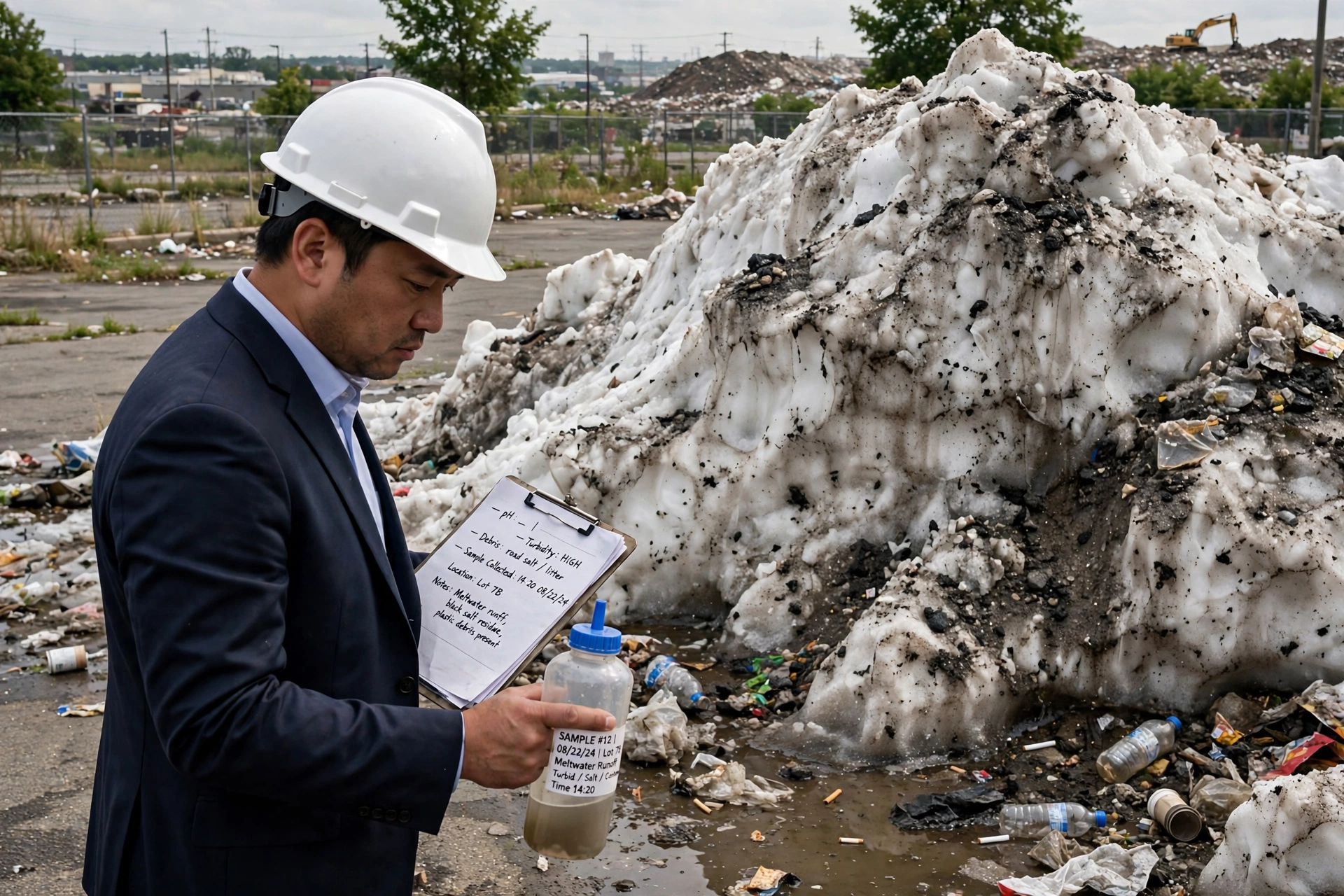
The material placed on the land is not snow. The Massachusetts Department of Environmental Protection, in its snow disposal guidance, states the composition plainly: collected snow is contaminated with road salt, sand, litter, and automotive pollutants such as oil.1 The pile sits on bare ground, unlined and uncovered, with no leachate collection system and no groundwater monitoring well. It has a defined boundary, a waste stream, a leachate, and a closure event, which is the melt. What it lacks is everything the law requires of a disposal unit, and what it possesses is a name that sounds like weather.
Consider what this facility is, in regulatory terms. It is a discrete area of land that receives discarded material resulting from community activities, placed there by a municipal operation, on a recurring schedule, in volumes measured in hundreds of thousands of tons. A permitted landfill with the same function would hold a composite liner, a leachate collection system, and a groundwater monitoring network. The snow pile holds none of these things, and there are, by the arithmetic in Section II, thousands of them at work in a single winter.
II. The Scale of Production
The throughput of a single unit is established. An inch of snow falling evenly on one acre of ground is equivalent to about 2,715 gallons of water, according to the United States Geological Survey, on the rule of thumb that ten inches of snow melt to one inch of water. An inch of rain on the same acre is 27,154 gallons.2 Apply the unit rate to a storm. In November 2022, a lake-effect storm dropped 77 inches of snow on Orchard Park, New York, in four days, according to the National Weather Service, which is 209,055 gallons of water for every acre it covered.3 In the winter of 2014-2015, Boston received 110.6 inches of snow, a seasonal record, which is about 300,000 gallons of water for every acre of the city.4
The disposal operation that follows is measured in trucks. Harvard University, faced with the same winter, opened a snow farm on 11 acres in Allston. For two and a half weeks the site ran around the clock, receiving up to 1,700 truckloads in a single day, until an estimated 300,000 tons of snow stood in piles with a 60-foot peak.5 Three hundred thousand tons of snow is about 72 million gallons of meltwater, waiting in a pile for spring.6 In Boston's Seaport District, a single pile reached 75 feet high, as tall as a seven-story building, and did not finish melting until July 14, 2015, five months after the last snow fell.7
The salt that makes the pile what it is arrives first. Road crews across the United States use more than 24 million tons of road salt to melt ice and snow each year, triple the volume used in 1975, according to the United States Geological Survey.8 Road salt is sodium chloride, and chloride is about 61 percent of its weight, so the annual application carries roughly 14.6 million tons of chloride onto the nation's roads.9 The plow then collects the salt, the sand, and everything the road has shed since the last storm, and delivers the mixture to the pile. The nation, for comparison, operates about 1,200 permitted municipal solid waste landfills, which together receive more than half of the 292 million tons of municipal solid waste generated each year.10 The permitted system takes in the household trash. The unpermitted system takes in the winter.
III. The Process
The treatment the pile performs is not a metaphor. It is a leachate, produced on the same schedule as every landfill's, and measured by the same authorities. Over the long winter, snow piles accumulate pollutants like road salt, sand, automotive oils, car exhaust, litter, and pet waste, according to the New England Interstate Water Pollution Control Commission. Oil and automobile fluids accumulate on roadways and are plowed into snow piles, and when the snow melts, those fluids make their way into the water, carrying concentrations of heavy metals harmful to human health, plants, and wildlife. According to the Environmental Protection Agency, one gallon of oil has the potential to contaminate up to one million gallons of freshwater.11
The leachate is not produced all at once. It is produced slowly, over months, as the pile melts from the outside in, which is the longest discharge event of any waste facility in the country. The Seaport pile stood from the winter into the middle of July, releasing its meltwater a little at a time, and the dirt and debris coating its surface absorbed the summer sun and insulated the snow beneath, slowing the melt further. As snow melts, the Massachusetts guidance states, road salt, sand, litter, and other pollutants are transported into surface water or through the soil, where they may eventually reach the groundwater.1 A permitted landfill collects its leachate in pipes and treats it. A snow pile releases its leachate to the soil and the storm drain, on a schedule set by the weather.
The pile also concentrates what the plow collected. As the Seaport pile melted, the city removed 276.17 tons of trash from it by July 7, including manhole covers, parking meters, and half-eaten yogurts, according to the city's own accounting.12 The trash is the visible fraction. The salt, the oil, and the heavy metals are the fraction that leaves with the meltwater, unweighed and unreported. No snow pile has ever filed a leachate report, because no snow pile has ever been asked to.
IV. The Discharge
The discharge is documented in the impairment lists. In Minnesota, 50 lakes and streams are classified as impaired by chloride, and another 75 water bodies are at high risk of impairment, according to the Minnesota Pollution Control Agency. Road salt is responsible for 42 percent of the chloride in the state's groundwater, lakes, and streams. Each winter, Minnesotans spread approximately 730 million pounds of salt on roadways and parking lots, 600 million pounds of it in the Twin Cities metropolitan area alone.13 The Twin Cities apply an estimated 365,000 tons of road salt to their roads each winter, and 78 percent of it is transported to groundwater or remains in local lakes and wetlands.14
The standard the discharge exceeds is not obscure. The Environmental Protection Agency recommends that long-term chloride exposure in freshwater streams remain under 230 milligrams per liter. A paper in the Proceedings of the National Academy of Sciences found that urban streams in the mid-Atlantic can contain five to ten times that amount.15 The exceedance does not end with the thaw. Chloride persists in the environment, and monitoring in New Hampshire found chloride levels in a brook receiving highway runoff during severe summer heat and drought at nearly ten times the levels recorded during wet winter months, which is the winter's salt still discharging in August. In nearby Mirror Lake, chloride levels have increased fourfold since Interstate 93 was built through the watershed, and more than 90 percent of the chloride polluting the state's waterways comes from road salt.16
The discharge is also classified. Nonpoint source pollution, which includes snowmelt runoff, is the leading cause of water pollution in the country, according to the Environmental Protection Agency.17 The leading cause of water pollution in the United States is, by the government's own classification, the meltwater of the unpermitted fleet.
V. The Standard
The standard the fleet evades is not obscure. The Resource Conservation and Recovery Act defines solid waste as any garbage, refuse, sludge from a waste treatment plant, water supply treatment plant, or air pollution control facility, and other discarded material, including solid, liquid, semisolid, or contained gaseous material resulting from industrial, commercial, mining, and agricultural operations, and from community activities.18 The Act defines an open dump as any facility or site where solid waste is disposed of which is not a sanitary landfill meeting the criteria promulgated under section 4004, and is not a facility for disposal of hazardous waste. Facilities failing to satisfy the criteria are considered open dumps, which are prohibited under section 4005 of the Act.19
The criteria the pile fails are written down. All municipal solid waste landfills must comply with the federal regulations in 40 CFR Part 258, Subtitle D of the Act, or equivalent state regulations. The standards include composite liner requirements, a flexible membrane overlaying two feet of compacted clay soil lining the bottom and sides of the landfill; leachate collection and removal systems, sitting on top of the composite liner, designed to maintain less than 30 centimeters of leachate over the liner; and groundwater monitoring requirements, testing wells to determine whether waste materials have escaped.20 About 1,200 permitted municipal solid waste landfills in the United States meet these standards. Zero snow piles do.
The closest thing to a standard for the pile is guidance, and the guidance reads like a confession. The Massachusetts Department of Environmental Protection instructs municipalities not to dump snow into any waterbody, including rivers, the ocean, reservoirs, ponds, or wetlands; not within a wellhead protection area or within 75 feet of a private well; not on high- and medium-yield aquifers; and not in sanitary landfills, because snow meltwater will create more contaminated leachate in landfills, posing a greater risk to groundwater. It recommends a silt fence on the downgradient side of the site, a 50-foot vegetated buffer between the disposal site and adjacent waterbodies, and debris cleared from the site and properly disposed of at the end of the snow season, no later than May 15.21 A silt fence and a 50-foot strip of grass are what the law asks of the pile. A composite liner, a leachate collection system, and a monitoring well network are what it asks of everything else. The Clean Water Act, for its part, makes it illegal to dispose of snow directly into the ocean or other surface waters, with temporary permits available from the state in a snow emergency, as Massachusetts issued in 2015.22
Apply the definition to the unit. The pile is a discrete area of land that receives discarded material resulting from community activities: the salt, the sand, the litter, and the oil that the community spread on its roads and the plow collected from them. It is not a sanitary landfill meeting the section 4004 criteria. It has no liner, no leachate collection, and no monitoring well. The definition fits the way a glove fits a hand, provided the hand is a snowbank.
VI. The Defense
The defense is noted. It concedes every number in this investigation and disputes only the prescription.
Its first exhibit is the definition. A solid waste is discarded material, and nobody discards a snowfall. The plow moves weather, and weather is not waste, however much salt the community mixed into it. Its second is the duration. A landfill is forever, and a snow pile is temporary. It melts, and the sun performs the closure care, free of charge, on a schedule no permit could improve. Its third is the classification. Meltwater is stormwater, regulated as nonpoint source pollution under municipal storm sewer permits, not solid waste under the waste act. The discharge is already inside the regulatory system, under a different chapter of the law, and the system has chosen guidance over permits for the pile itself.
Its fourth is the form. No permit application in the history of the program has had a line for design capacity in tons of snow, no state certifies snow pile operators, and no inspector has ever assigned a monitoring well to a snowbank. Its fifth is the operator. The largest piles in the country are built and maintained by the government itself, through municipal public works departments, which makes the state the operator of record for the largest unpermitted fleet in the nation, and the state does not permit itself.
The defense rests. It is overruled.
VII. The Prescription
The ledger is now complete, and it admits of only one reading.
Every snowbank in the United States should hold a Subtitle D permit, issued to the municipality as operator and the snow farm as the facility, with a composite liner beneath every pile, a leachate collection system maintaining less than 30 centimeters of meltwater over the liner, groundwater monitoring wells at the point of compliance, and operator certifications for the plow drivers who fill it. The Massachusetts guidance should be understood for what it is: the closure plan, already written, requiring debris cleared and properly disposed of by May 15, which is post-closure care by another name, performed without a permit, a liner, or a single monitoring well.
The Seaport pile is the test case. Seventy-five feet tall, standing for five months, yielding 276 tons of trash and an unmeasured volume of chloride, oil, and heavy metals to the soil and the harbor, it operated as an unpermitted open dump in the center of a major American city, in plain sight, under a name that sounds like agriculture. Until compliance is achieved, the fleet will continue to operate every winter, unpermitted, as it has since the first plow, collecting the salt and the sand and the litter from the roads, piling them on bare ground, and waiting for a form that does not exist.
Ergo.
Sources
- Collected snow is contaminated with road salt, sand, litter, and automotive pollutants such as oil; as snow melts, road salt, sand, litter, and other pollutants are transported into surface water or through the soil where they may eventually reach the groundwater. Massachusetts Department of Environmental Protection, Snow Disposal Guidance, December 2020. mass.gov ↑↑
- One inch of rain falling on one acre of ground is equal to about 27,154 gallons and weighs about 113 tons; an inch of snow falling evenly on one acre of ground is equivalent to about 2,715 gallons of water, based on the rule of thumb that 10 inches of snow equals one inch of water, varying with wet or powdery snow. U.S. Geological Survey, via ScienceIQ. scienceiq.com ↑
- A storm total of 77.0 inches was measured in Orchard Park, New York, in the lake-effect event of November 17-20, 2022; the National Weather Service investigated the report as a possible state 24-hour record and the State Climate Extremes Committee declined to certify the 24-hour figure, while the storm total stands as reported. dtnpf.com (Associated Press) ↑
- Boston received 110.6 inches of snow in the winter of 2014-2015, a seasonal record; the Seaport snow pile reached 75 feet and did not finish melting until July 14, 2015. knkx.org phys.org ↑
- Harvard opened an Allston snow farm on 11 acres; for two and a half weeks the site ran around the clock, receiving up to 1,700 truckloads in a single day, and an estimated 300,000 tons of snow stood in piles with a 60-foot peak. Harvard Magazine, May-June 2015. harvardmagazine.com ↑
- Calculation: 300,000 short tons of snow is 600,000,000 pounds; at 8.34 pounds per gallon of water, that is about 71.9 million gallons of meltwater. This is arithmetic from the published tonnage, not a separately measured volume. ↑
- The Seaport pile was once 75 feet high and finally melted on July 14, 2015, about five months after the last major blizzard of the season. knkx.org ↑
- Road crews across the United States use more than 24 million tons of road salt to melt ice and snow each year, triple the volume used in 1975, according to the U.S. Geological Survey. waterburyroundabout.org ↑
- Calculation: sodium chloride is 35.45 / 58.44, about 60.7 percent chloride by weight; 24 million tons of road salt therefore carries about 14.6 million tons of chloride. This is arithmetic from the published tonnage and the molecular weights, not a separately measured load. ↑
- In 1988 there were nearly 8,000 open municipal solid waste landfills in the United States; as of September 2024, according to EPA's Landfill Methane Outreach Program, that number had dropped to just over 1,200 open landfills. Over 292 million tons of municipal solid waste are generated annually in the United States, with more than half disposed of in landfills. epa.gov mdpi.com ↑
- Over the long winter, snow piles accumulate pollutants like road salt, sand, automotive oils, car exhaust, litter, and pet waste; according to the EPA, one gallon of oil has the potential to contaminate up to one million gallons of freshwater. New England Interstate Water Pollution Control Commission. neiwpcc.org ↑
- The removal of 276.17 tons of trash from the Seaport snow pile as of July 7, 2015, including manhole covers, parking meters, and half-eaten yogurts, according to the office of Boston Mayor Martin J. Walsh. phys.org ↑
- Fifty of Minnesota's lakes and streams are labeled as impaired because they have chloride levels too high for fish and other aquatic life, and an additional 75 water bodies are labeled high risk; the Minnesota Pollution Control Agency has determined that road salt is responsible for 42 percent of the chloride in groundwater, lakes, and streams; each winter, Minnesotans spread approximately 730 million pounds of salt on roadways and parking lots, 600 million pounds in the metro area alone. eastmetrowater.org ↑
- In the Twin Cities metro alone, an estimated 365,000 tons of road salt are applied to roads each winter, and 78 percent is transported to groundwater or remains in local lakes and wetlands. eastmetrowater.org ↑
- Freshwater streams typically contain less than 300 milligrams of chloride per liter, and the U.S. Environmental Protection Agency has recommended long-term chloride exposure fall under 230 milligrams per liter; a paper in the Proceedings of the National Academy of Sciences shows urban streams in the mid-Atlantic can contain five to ten times that amount. chesapeakebay.net ↑
- More than 90 percent of the chloride polluting New Hampshire waterways comes from road salt; chloride levels have increased fourfold in Mirror Lake since Interstate 93 was constructed through Woodstock; monitoring in Stoney Brook showed chloride levels during severe summer heat and drought in 2019, 2020, and 2022 nearly ten times the levels recorded during wet winter months. waterburyroundabout.org ↑
- Nonpoint source pollution, which includes snowmelt runoff, is the leading cause of water pollution in the country, according to the Environmental Protection Agency. New England Interstate Water Pollution Control Commission. neiwpcc.org ↑
- RCRA section 1004(27): the term solid waste means any garbage, refuse, sludge from a waste treatment plant, water supply treatment plant, or air pollution control facility and other discarded material, including solid, liquid, semisolid, or contained gaseous material resulting from industrial, commercial, mining, and agricultural operations, and from community activities. U.S. EPA training slides. epa.gov ↑
- RCRA section 4005(a): the term open dump means any facility or site where solid waste is disposed of which is not a sanitary landfill which meets the criteria promulgated under section 4004 and which is not a facility for disposal of hazardous waste. 40 CFR 257.1: facilities failing to satisfy any of the criteria in sections 257.1 through 257.4 are considered open dumps, which are prohibited under section 4005 of the Act. ecfr.gov ↑
- All municipal solid waste landfills must comply with 40 CFR Part 258, Subtitle D of RCRA, or equivalent state regulations. Federal standards include composite liners, a flexible membrane overlaying two feet of compacted clay soil; leachate collection and removal systems, designed to maintain less than 30 centimeters of leachate over the liner; and groundwater monitoring requirements. U.S. EPA. archive.epa.gov ↑
- Massachusetts snow disposal guidance: avoid dumping snow into any waterbody, including rivers, the ocean, reservoirs, ponds, or wetlands; avoid dumping snow within a wellhead protection area or within 75 feet of a private well; avoid dumping snow on high- and medium-yield aquifers; avoid dumping snow in sanitary landfills, since snow meltwater will create more contaminated leachate in landfills; place a silt fence on the downgradient side of the site; maintain a 50-foot vegetated buffer between the disposal site and adjacent waterbodies; clear debris from the site and properly dispose of it at the end of the snow season and no later than May 15. Massachusetts Department of Environmental Protection, Snow Disposal Guidance, December 2020. mass.gov ↑
- Per regulations established in the federal Clean Water Act, it is illegal to dispose of snow directly into the ocean or other surface waters; temporary permits can be issued by each state in a snow emergency, such as the one that occurred in Massachusetts during 2015. New England Interstate Water Pollution Control Commission. neiwpcc.org ↑