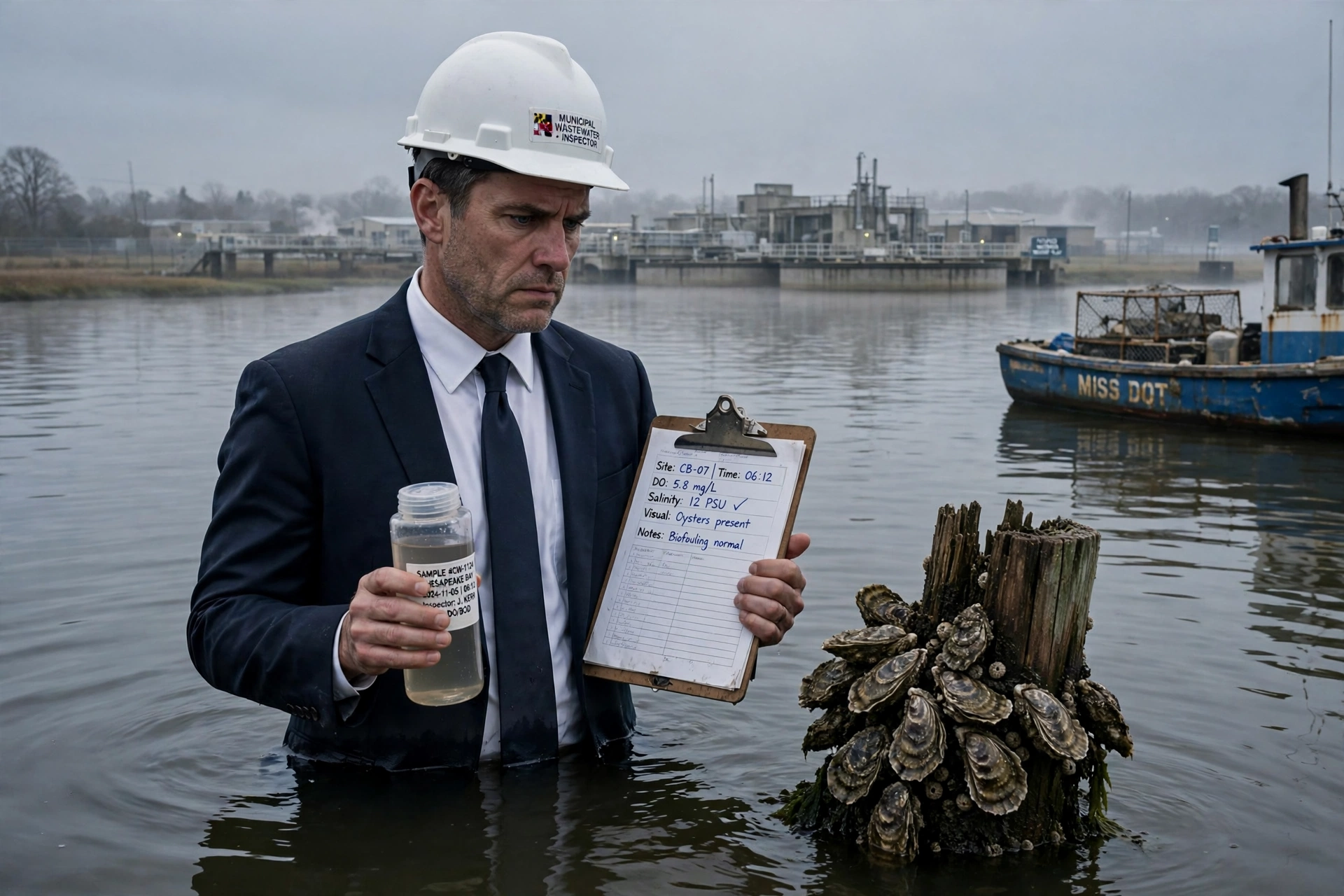
I. The Facility
An oyster is a water treatment plant that fits in the palm of a hand. It takes in raw water at one end of its shell, passes that water across its gills, removes the suspended solids, and discharges the remainder at the other end. It performs the four operations of every municipal treatment plant, intake, screening, biological treatment, and discharge, inside a shell the size of a fist, with no moving parts, no electricity, and no operator on duty.
The mechanism is not mysterious. Cilia on the gills pump water through the shell and trap algae, plankton, sediment, and other suspended particles in mucus. The oyster sorts what it catches. Nutritious particles are ingested and digested. Particles that are less nutritious, or that exceed the capacity of the gut, are rejected immediately as pseudofeces, bound in mucus and dropped to the sediment below. The remains of what is digested are voided within about a day as fecal pellets.1 The intake is continuous, the sorting is continuous, and the discharge is continuous, for as long as the oyster lives, which in the Chesapeake Bay is typically three to six years, and in captivity has been documented at decades.2
Consider what this facility is, in regulatory terms. It is a discrete unit that takes in water, treats it, and discharges it, at a fixed location, on a continuous schedule, with a measurable throughput. It has an intake, a treatment process, and an outfall. It has no permit file, no design flow on record, and no operator of record. A municipal plant with the same process train would hold an NPDES permit, employ a licensed operator, and file monthly discharge reports. The oyster holds none of these things, and there are, by the arithmetic in Section II, roughly a billion of them at work in a single estuary.
II. The Scale of Production
The throughput of a single unit is established. An adult oyster filters up to 50 gallons of water per day, according to the National Oceanic and Atmospheric Administration and the Chesapeake Bay Foundation. The figure is a maximum under good conditions, varying with size, temperature, salinity, and food concentration, and it is the figure the agencies themselves publish.3 At that rate, one oyster processes 18,250 gallons in a year.
Apply the unit rate to the fleet. The Chesapeake Bay once held enough oysters to filter its entire volume in three to six days, according to the estimate published by Newell in 1988 and repeated in the Virginia Institute of Marine Science primer. Lockwood and Mann, working from a fossil reef near Dutton, Virginia, calculated that the historic population could pass all of the bay's water through its gills in a single day. Today, the same task takes close to a year.4 Newell estimated that in the early nineteenth century, oysters filtered 80 percent of the shallow water volume of the bay per day in summertime; by 1988, that figure had fallen below 1 percent.5
The decline is documented in the harvest record. In the late 1800s, annual harvests from the bay peaked at an estimated 600 million to 1,200 million pounds. In 2024, wild commercial harvests were less than 5 percent of that peak.6 The population today stands at about 1 to 2 percent of its historic size, according to NOAA, and at less than 1 percent of its nineteenth-century size, according to the Maryland Department of Natural Resources. The causes are recorded and undisputed: overharvesting by dredge, pollution, habitat loss, and the parasitic diseases MSX and Dermo.7
Put the unit rate next to the fleet size, and the scale of the unpermitted operation becomes clear. Filtering the bay in about a year, at 50 gallons per oyster per day, requires on the order of one billion oysters at work.8 Filtering it in four days would have required roughly ninety billion. The nation, for comparison, operates more than 16,000 publicly owned treatment works, which together treat about 32 billion gallons of wastewater per day and serve about three quarters of the population.9 The historic oyster fleet processed a comparable volume with no permits at all, and the present fleet, reduced to a hundredth of its size, still processes billions of gallons a day without one.
III. The Process
The treatment the oyster performs is not a metaphor. It is measured, credited, and entered into the government's own pollution ledger. Restored oyster reefs remove about seven times as much nitrogen each day as unrestored sand or mud bottom, according to NOAA Fisheries. In Harris Creek, on Maryland's Eastern Shore, restored reefs remove nitrogen each year equivalent to roughly 20,000 bags of 10-10-10 garden fertilizer.10 In the Lynnhaven River, nitrogen removal by nitrification and denitrification at oyster reef sites ranged from 15 to 28 pounds per acre per month, against about 1 pound per acre per month for bare sediment.11
The credit is formal. In January 2018, the Environmental Protection Agency concluded that pollutants sequestered from the water column by in-water best management practices could legally be counted toward the Chesapeake Bay cleanup goals under the total maximum daily load. The Chesapeake Bay Program has approved oyster aquaculture and oyster reef restoration as best management practices, and Maryland and Virginia are implementing them.12 A facility whose pollutant removal is entered into the TMDL ledger is a treatment facility in every sense except the permit.
The process is also continuous in a way no municipal plant can match. A treatment plant shuts down for maintenance, loses power, and closes for upgrades. The oyster filters while it feeds, and it feeds whenever the tide brings water past its shell. It has no bypass, no overflow, and no shutdown. Its uptime is its lifetime, which is the longest operating record of any treatment unit in the country, and the one with the least documentation.
IV. The Discharge
Every treatment plant has an effluent, and the oyster is no exception. The particles it rejects become pseudofeces, bound in mucus and dropped to the sediment. The particles it digests become feces, voided within about a day as pelleted strings several millimeters long. Biodeposits sink up to 40 times faster than the loose particles they were made from, which is why they accumulate where loose sediment would not. Oyster biodeposits are 77 to 91 percent inorganic matter, 4 to 12 percent organic carbon, and about 1.0 gram of phosphorus per kilogram.13 None of it is sampled. None of it is reported. No oyster has ever filed a discharge monitoring report.
The discharge is not only solid. Oysters excrete dissolved ammonia back into the receiving water, and their feeding transfers nitrogen and phosphorus from the water column to the sediment, where microbes regenerate a portion of it to the water.5 The facility removes pollutants from the water and returns a fraction of them in a different form, at a different place, on a schedule no permit describes. A municipal plant that returned a fraction of its influent nitrogen to the receiving water in dissolved form would report it monthly, under an effluent limit, with a number. The oyster reports nothing.
The most concentrated waste stream is the one the facility stores in its own tissue. Oysters filter what the water carries, and they keep the bacteria. The Centers for Disease Control and Prevention estimates that vibriosis causes about 80,000 illnesses and about 100 deaths in the United States every year, most of them from eating raw or undercooked shellfish, particularly oysters. Vibrio vulnificus, the most dangerous species, is reported in 100 to 200 cases a year, and about one in five people who develop the infection die.14 The treatment plant concentrates its influent pathogens, stores them in its product, and serves the product raw, on the half shell, with lemon.
V. The Standard
The standard the fleet evades is not obscure. Section 402 of the Clean Water Act requires point source dischargers to control the pollutants they discharge to waters of the United States by obtaining a National Pollutant Discharge Elimination System permit. The Act prohibits the discharge of any pollutant from a point source into waters of the United States without one.15 A point source is any discernible, confined, and discrete conveyance, including any pipe, ditch, channel, tunnel, conduit, well, discrete fissure, container, rolling stock, concentrated animal feeding operation, vessel, or other floating craft from which pollutants are or may be discharged.16
The permitted fleet complies at a scale the oyster fleet dwarfs. More than 16,000 publicly owned treatment works hold NPDES permits, meet national secondary treatment standards, file discharge monitoring reports, and employ state-certified operators. Their permits carry effluent limits, monitoring schedules, and inspection rights. Their compliance records are public in EPA's ECHO database. Forty-seven states administer their own NPDES programs under EPA oversight.9 The system has permitted the nation's sewage for half a century, and it has permitted zero oysters.
Apply the definition to the unit. The oyster is discernible: it can be seen, counted, and harvested by the bushel. It is confined: it is cemented to a reef, a piling, or a shell, and it does not move. It is discrete: each shell is a separate unit with its own intake and its own outfall. It discharges pollutants, in the form of feces, pseudofeces, and dissolved ammonia, into waters of the United States, every day, at a rate of up to 50 gallons per unit. The definition fits the way a glove fits a hand, provided the hand is a bivalve.
VI. The Defense
The defense is noted. It concedes every number in this investigation and disputes only the prescription.
Its first exhibit is the definition. A point source is a conveyance, and an oyster is a living animal, not a pipe, a ditch, or a channel. Its second is the direction of the flow. The oyster removes pollutants from the water; the Act regulates the addition of pollutants to the water, and a facility whose effluent is cleaner than its influent is not a discharger in any ordinary sense. Its third is the discharge itself. Feces and pseudofeces are natural biological material, and the government's own cleanup program counts oyster filtration as a best management practice, which is the opposite of a violation.
Its fourth is the form. No permit application in the history of the program has had a line for design flow in gallons per bivalve, no state certifies oyster operators, and no inspector has ever assigned an outfall number to a shell. Its fifth is the operator. The largest reef projects in the country are funded and directed by the government itself, through NOAA, the Army Corps of Engineers, and the Chesapeake Bay Program, which makes the state the operator of record for the largest unpermitted fleet in the nation, and the state does not permit itself.17
The defense rests. It is overruled.
VII. The Prescription
The ledger is now complete, and it admits of only one reading.
Every oyster in waters of the United States should hold an NPDES permit, issued to the oyster as operator and the reef as the facility, with a design flow of 50 gallons per day, an outfall number stenciled on the shell, effluent limits on biodeposition, and monthly discharge monitoring reports filed by the reef. Oyster gardeners, the volunteers who grow oysters off their private docks under the Chesapeake Bay Foundation's program, should hold operator certifications for the units in their care. The Chesapeake Bay Foundation's goal of adding 10 billion new oysters to the bay by the end of 2025, of which about 6.7 billion had been planted by mid-2025, should be understood for what it is: the largest unpermitted treatment plant expansion in American history, proceeding at a rate of billions of units, with no permit application filed for any of them.18
Until compliance is achieved, the fleet will continue to operate around the clock, unpermitted, as it has since the first estuary, filtering up to 50 gallons a day per unit, discharging its biodeposits to the sediment, concentrating its pathogens in its tissue, and waiting for a form that does not exist.
Ergo.
Sources
- Captured particles are sorted, and the less nutritious ones or those in excess of gut capacity are immediately rejected as pseudofeces; nutritious particles are ingested and digested, and the remains are defecated within about 24 hours. Newell, R.I.E. et al., Influence of Eastern Oysters on Nitrogen and Phosphorus Regeneration in Chesapeake Bay, USA, 2005. academia.edu ↑
- The life span of a Bay oyster is probably around three to six years, but there are documented cases of oysters living for decades in captivity, growing all the while. virginialiving.com ↑
- An adult oyster can filter up to 50 gallons of water per day. Chesapeake Bay Foundation, Oyster Filtering Power; NOAA Restoration Center. cbf.org response.restoration.noaa.gov ↑
- The Chesapeake Bay's entire water column was filtered in three to six days by the historic oyster population (Newell, 1988); Lockwood and Mann calculated the historic population could pass all of the bay's water through its gills in one day, and that today the same task might take close to a year. daily.jstor.org army.mil ↑
- Newell (1988) estimated that eastern oyster populations in the early 19th century filtered 80 percent of the less than 9 meter water volume in Chesapeake Bay per day during summertime; by 1988 the decline in oysters had reduced this to less than 1 percent filtration of the shallows per day. Bivalve biodeposits transfer nitrogen and phosphorus from the water column to the sediments, where a portion is regenerated to the water column as excreta and via microbial decomposition. Newell, R.I.E. et al., 2005. academia.edu ↑↑
- In the late 1800s, annual harvests from the bay peaked at an estimated 600 million to 1,200 million pounds; in 2024, wild commercial harvests were less than 5 percent of that. daily.jstor.org ↑
- Only about 1 to 2 percent of the Chesapeake Bay's historic oyster population remains today (NOAA); the oyster population is estimated to be less than one percent of its size during the 19th century (Maryland Department of Natural Resources). Causes: overharvesting, pollution, disease, and habitat loss. response.restoration.noaa.gov army.mil ↑
- Calculation: the bay holds about 18 trillion gallons of water; at 50 gallons per oyster per day, filtering that volume in 365 days requires about 986 million oysters, and filtering it in 4 days requires about 90 billion. This is arithmetic from the published filtration rate and the published one-year and three-to-six-day figures, not a separately measured population count. ↑
- There are 16,024 publicly owned wastewater treatment facilities in operation, treating about 32,175 million gallons per day and serving about 72 percent of the population (EPA, 1996 Clean Watersheds Needs Survey); the 2022 survey counted 17,544 publicly owned treatment works. Forty-seven states plus one territory are authorized to administer their own NPDES programs. permanent.access.gpo.gov sdwis.epa.gov ↑↑
- Successful restored reefs are expected to remove about seven times as much nitrogen each day than unrestored sand or mud bottom areas can; in Harris Creek alone, restored reefs each year remove nitrogen equivalent to roughly 20,000 bags of 10-10-10 garden fertilizer. NOAA Fisheries, Oyster Reefs Provide Habitat and Filter Water, Findings Show, 2021. fisheries.noaa.gov ↑
- Nitrogen removal via nitrification and denitrification at oyster reef sites ranged from 15 to 28 pounds per acre per month, compared to bare sediment sites of about 1 pound per acre per month. Assessment of Oyster Reefs in Lynnhaven River as a Chesapeake Bay TMDL Best Management Practice. chesapeakebay.net ↑
- In January 2018, the U.S. EPA concluded that pollutants sequestered from the water column by in-water best management practices could legally be counted towards the TMDL pollutant reduction goals; oyster aquaculture and reef restoration practices were approved as best management practices by the Chesapeake Bay Program Partnership, with Maryland and Virginia working toward implementation. Reichert-Nguyen and Slacum, Oyster Recovery Partnership, 2019. chesapeakebay.net ↑
- Oyster feces are voided as pelleted strings several millimeters long; pseudofeces are less tightly bound in mucus; biodeposits have a sinking velocity up to 40 times that of non-aggregated particles. Oyster biodeposits contain 77 to 91 percent inorganic matter, 4 to 12 percent organic carbon, and about 1.0 gram per kilogram of phosphorus. Newell, R.I.E. et al., 2005; Haven and Morales-Alamo, Biodeposition as a Factor in Sedimentation of Fine Suspended Solids in Estuaries. academia.edu pubs.geoscienceworld.org ↑
- The CDC estimates that about 80,000 people get vibriosis, and about 100 people die from it, in the United States every year; most become infected by eating raw or undercooked shellfish, particularly oysters. About 100 to 200 cases of Vibrio vulnificus are reported each year, and about 1 in 5 people who develop the infection die. usatoday.com ↑
- Section 402 of the Clean Water Act requires point source dischargers to control the amount of pollutants discharged to waters of the United States through obtaining an NPDES permit. U.S. EPA, NPDES Permit Fact Sheet, Chinle Wastewater Treatment Plant, February 2026. epa.gov ↑
- Point source: any discernible, confined and discrete conveyance, including, but not limited to, any pipe, ditch, channel, tunnel, conduit, well, discrete fissure, container, rolling stock, concentrated animal feeding operation, landfill leachate collection system, vessel, or other floating craft from which pollutants are or may be discharged. Indiana Department of Environmental Management, Industrial Permit Overview, citing 327 IAC 5-1.5. in.gov ↑
- NOAA and its partners are working to restore oyster populations and habitat in 10 tributaries by the end of 2025, including 350 acres restored in Harris Creek on Maryland's Eastern Shore; the U.S. Army Corps of Engineers leads large-scale reef restoration in the bay. fisheries.noaa.gov army.mil ↑
- The Chesapeake Bay Foundation set a goal of adding 10 billion new oysters to the bay by the end of 2025; around 6.7 billion had been planted as of June 2025, many grown by volunteer oyster gardeners at their waterside homes. phys.org ↑