I. The Stack
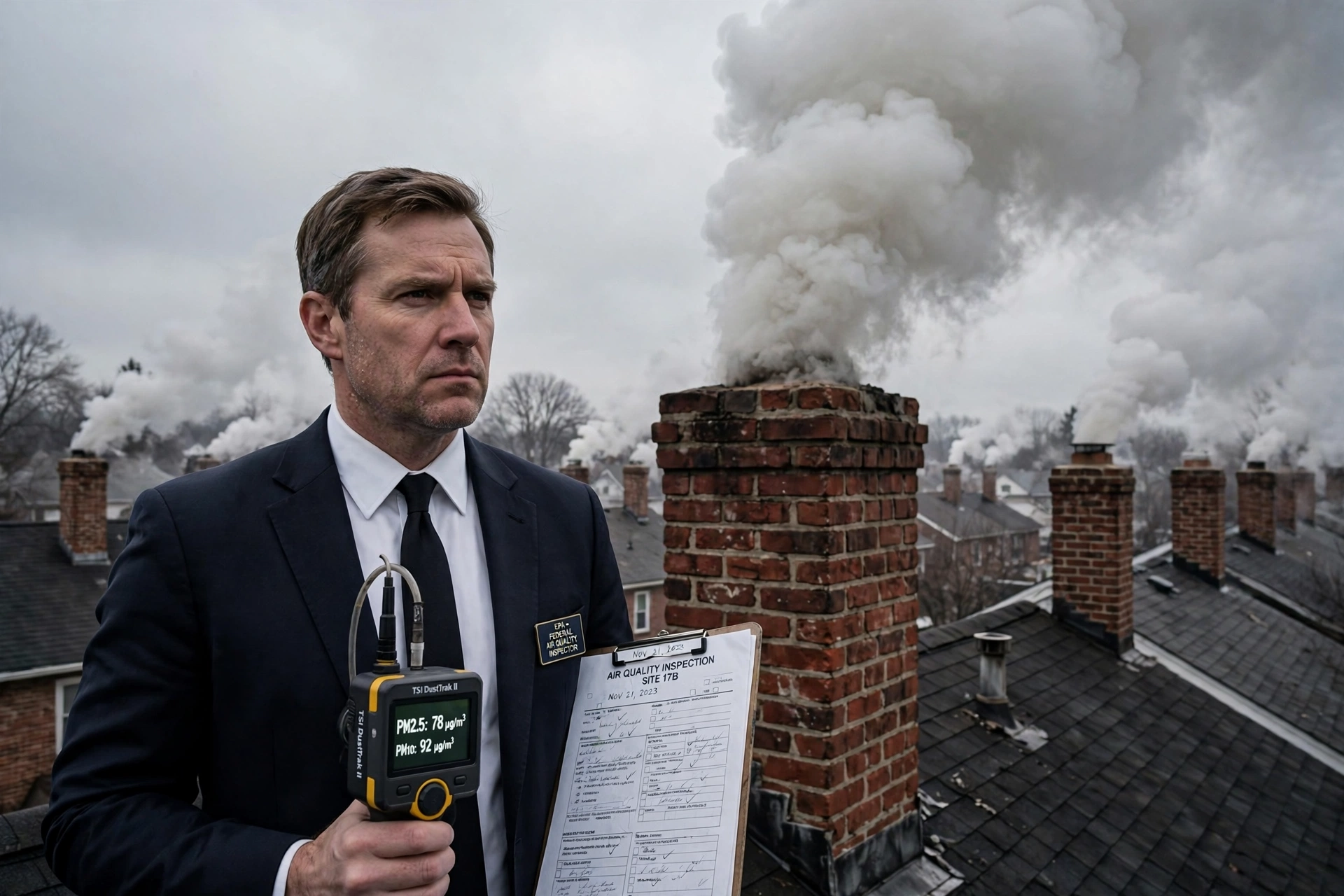
A chimney is, in the plainest engineering sense, a stack. It is a vertical conveyance, built of brick or masonry or steel, whose sole function is to carry the products of combustion out of a building and into the ambient air. It does not filter them. It does not treat them. It does not measure them. It conveys them, upward, at the height of the roofline, directly into the breathing zone of the neighborhood. Every regulated industrial source in the country has one of these, and the stack is where the inspector puts the probe.
What comes up the stack is not benign. Smoke from residential wood heaters contains fine particle pollution, known as PM2.5, along with carbon monoxide, volatile organic compounds, black carbon, and air toxics such as benzene. The fine particles can get deep into the lungs, harming the lungs, blood vessels, and heart, and the people most at risk are those with heart, vascular, or lung disease, older adults, and children.1 The Environmental Protection Agency's own wood heater database adds that residential wood combustion accounts nationally for 44 percent of total stationary and mobile emissions of polycyclic organic matter, compounds formed mainly from combustion, and for nearly 25 percent of all area source air toxics cancer risks.2
The device at the bottom of the stack is, by the government's own account, barely a heater at all. A typical vertical-back fireplace with an open front is at best ten percent efficient in converting wood to energy and delivering it to a room, and wood-burning fireplaces may actually remove more heat from a house than they produce, since the draft pulls heated room air up the flue and draws cold air in through gaps around windows and doors.3 Most traditional open fireplaces lose over 90 percent of the fire's heat out the chimney, and much of the heated air in the room goes with it. The fireplace is therefore a peculiar kind of source: it consumes fuel, produces smoke, and delivers almost none of the heat. It is a smokestack with a mantelpiece attached.
Consider what has occurred on any cold evening. A homeowner lights a fire for ambiance, not for heat, because the device cannot heat. The combustion is incomplete, as open combustion always is. The smoke rises through the stack and settles over the street. The neighbors breathe it. The homeowner, warmed only by radiant light on the front of the body while the back of the house grows colder, lights another log. The stack performs exactly as designed. Nothing about the operation is measured, reported, or permitted.
II. The Scale of Production
The tonnage behind the ambiance is staggering. Approximately 11 million American homes used wood or pellets for space heating in 2020, about 8.9 percent of all American homes, and that small share contributes up to 98 percent of fine particulate matter from residential heating from all fuel types. The Environmental Protection Agency estimates that residential wood heating emits approximately 485,000 tons per year of PM2.5 in the United States.4
The most recent accounting is worse than the older estimates. Wood is the primary heating fuel in just 2 percent of American homes, yet the 2023 release of the Environmental Protection Agency's National Emissions Inventory found that residential wood combustion contributes about 28 percent of total wintertime fine particulate matter emissions. Running those emissions through a high-resolution air quality model, researchers found that residential wood burning contributes 2.43 micrograms per cubic meter, or 21.9 percent, of winter population-weighted mean PM2.5 concentrations across the contiguous United States, associated with about 8,600 premature deaths annually, with a confidence interval of 6,500 to 9,600.5
Put the threshold next to the tonnage. A major stationary source, under the Clean Air Act, is a facility that directly emits, or has the potential to emit, one hundred tons per year or more of any air pollutant.6 The chimney fleet emits 485,000 tons of fine particles per year. That is 4,850 times the major source threshold, every year, from a source category whose individual units have never been inventoried, let alone permitted. A single refinery crossing the threshold by one ton would hold a Title V operating permit, file annual compliance certifications, and submit to inspection. The chimney fleet crosses it 4,850 times over and holds nothing.
III. The Law
The statute is not ambiguous about what counts. The Clean Air Act defines a stationary source as any building, structure, facility, or installation which emits or may emit any air pollutant.6 A house is a building. A chimney is a structure. It emits, visibly, every time it is used. The definition contains no exception for buildings people sleep in, no exception for structures built of brick, and no exception for emissions produced for ambiance rather than for industry. The words cover the chimney on their face.
The statute then sorts sources into two bins. A major source, for hazardous air pollutants, is a stationary source that emits or has the potential to emit, in the aggregate, 10 tons per year or more of any hazardous air pollutant, or 25 tons per year or more of any combination of hazardous air pollutants. An area source is any stationary source of hazardous air pollutants that is not a major source.7 Wood smoke carries benzene and polycyclic organic matter, both hazardous air pollutants, which is why the area source bin matters: the chimney is, at minimum, an area source, a regulated category with its own standards program, and the Act directs the Administrator to set standards for area sources and to pursue a strategy to substantially reduce the public health risks they pose.7
Against this record, the chimney's compliance file is empty. No chimney has ever applied for an operating permit. No homeowner has ever filed an emissions inventory for a fireplace. No stack test has ever been conducted on a residential flue. No opacity reading has ever been taken at a roofline, except where one California district has written its own rule, as Section V describes. The sector's defense, when pressed, is that nobody ever asked. The statute, it should be noted, does not require asking. It defines the source and sorts it. The paperwork was supposed to follow.
IV. The Exemption
The federal government has not ignored residential wood combustion. It has regulated it with remarkable energy, everywhere except at the fireplace.
Wood stoves and pellet stoves have been subject to New Source Performance Standards since 1988. On March 16, 2015, the Environmental Protection Agency published final emission standards for new residential wood heaters, including wood stoves, pellet stoves, hydronic heaters, and forced-air furnaces, the first revision since 1988, required by the Act's eight-year review cycle for such standards. The standards phase in over five years: Step 1 limits new woodstoves and pellet stoves to 4.5 grams of particulate matter per hour, and Step 2, effective May 15, 2020, tightens the limit to 2.0 grams per hour for stoves tested with crib wood, or 2.5 grams per hour for stoves tested with cordwood. New stoves must carry a permanent label certifying compliance.8910
The final rule does not apply to outdoor fireplaces, pizza ovens, barbecues, or chimineas, and it does not apply to new or existing heaters fueled solely by oil, gas, or coal. And it does not apply to indoor fireplaces at all. The agency did not include standards for indoor fireplaces in the regulation, because the agency determined that, quote, fireplaces are not effective heaters. The agency sought additional data and comments on the question, but the final rule continued to exempt fireplaces from emission standards, leaving them to a voluntary program that encourages manufacturers to make cleaner-burning fireplaces available.8
Read that exemption again, slowly, because it is the whole story. The appliance that heats least is regulated least. The wood stove, which converts most of its fuel to room heat, must meet 2.0 grams per hour and carry a certification label. The open fireplace, which converts at best ten percent of its fuel to room heat and vents the rest, including the heated air of the room itself, up the stack, must meet nothing and carry nothing. The worse the heater, the freer the stack. The regulation rewards inefficiency with immunity, and the immunity is total: the standards apply only to new wood heaters and will not affect wood heaters already in use in homes.9
V. The Local Precedent
One jurisdiction has refused to accept the exemption, and its record is instructive because it shows what enforcement looks like when someone actually tries it.
The Bay Area Air District created Spare the Air in 1991 to alert residents when air quality is forecast to be unhealthy. From November to February, the primary air pollutant is particulate matter, and during the cooler winter months more than one-third of particulate pollution comes from wood smoke. On some days, in certain areas, wood smoke can account for up to 90 percent of particulate pollution. When such conditions are expected, the district calls a Spare the Air Alert for fine particulate pollution, and during the alert the use of all wood-burning devices is illegal, both indoors and outdoors.11
The district passed its wood burning regulation in July 2008, making it illegal to burn wood, fire logs, pellets, or other solid fuels in fireplaces, wood stoves, outdoor fire pits, or other wood-burning devices when a Spare the Air Alert is in effect for fine particulate pollution. In 2019 the rule was amended to extend the ban to any day of the year when an alert is in effect, such as during a wildfire. The rule also places a year-round prohibition on excessive chimney smoke: smoke is in violation when it obscures objects viewed through it by more than 20 percent. And wood-burning devices are prohibited in new buildings constructed in the Bay Area.12
The enforcement record shows the mechanism working as designed. During the Winter Spare the Air season, which runs from November 1 through February 28, it is illegal to burn wood, manufactured fire logs, or any other solid fuel, both indoors and outdoors, for a full 24 hours when an alert is in effect. First-time violators have been given the option of taking a wood smoke awareness class, online or by mail, in lieu of paying a $100 ticket. The exemption for homes whose sole source of heat is a wood-burning device requires an Environmental Protection Agency certified or pellet-fueled device registered with the district. An open-hearth fireplace no longer qualifies for the exemption.13
The pattern is unmistakable. The one regulator that treats the chimney as what it is, a stack, has produced the only compliance regime in the country: a ban on bad-air days, an opacity limit on the smoke itself, a prohibition in new construction, and a registration requirement for the exemption. Everywhere else, the stack operates on the honor system, and the honor system has produced 485,000 tons a year.
VI. The Defense
The defense is noted. It concedes every number in this investigation and disputes only the prescription.
Its first exhibit is the inventory. The federal regulations define area sources as stationary and nonroad sources that are too small or too numerous to be individually included in a stationary source emissions inventory. There are millions of chimneys. Inventorying them individually would be absurd, and the regulation says so in its own definition.14 Its second is the calendar. The New Source Performance Standards apply to new heaters; they will not affect heaters already in use in homes, and a fireplace built in 1962 cannot retroactively violate a standard written in 2015.9 Its third is the heater. A fireplace is not a heater, the agency said so, and one cannot impose a heater standard on a thing that is not a heater.
Its fourth is the building. The house is the stationary source, not the chimney, and no one proposes permitting houses, because permitting houses would mean permitting kitchens, garages, and bathrooms, and the statute cannot mean that. Its fifth is the oldest defense in the book: nobody told us. The agency has never issued a permit application for a chimney, never held a stakeholder meeting with a flue, and never published a compliance guide for a mantelpiece.
The defense rests. It is overruled.
VII. The Prescription
The ledger is now complete, and it admits of only one reading.
Every chimney in the United States should be permitted as the stationary source it is, on a Title V operating permit, with the homeowner named as owner and the chimney designated as the emission unit. Each permit should carry an annual emissions inventory, an opacity limit no looser than the Bay Area's 20 percent rule, and a certification that the unit either meets the Step 2 limit of 2.0 grams per hour or burns nothing at all on days when the air district forecasts an exceedance. Stack testing should be conducted at the roofline, by the same inspectors who already enforce the Bay Area rule.
The agency should exercise the authority Congress granted it over area sources and set the fireplace standard it declined to set in 2015, on the ground the record now supplies: a device that is not an effective heater has no claim to an exemption written for heaters. Until compliance is achieved, the stacks will continue to operate all winter, unpermitted, as they have since the first hearth, venting 485,000 tons a year through structures that the statute defines, the inventory ignores, and the permit program has never seen.
Ergo.
Sources
- Smoke from residential wood heaters contains fine particle pollution (PM2.5), carbon monoxide, volatile organic compounds, black carbon, and air toxics such as benzene; fine particles can get deep into the lungs, harming the lungs, blood vessels, and heart; people with heart, vascular, or lung disease, older adults, and children are most at risk. 19january2017snapshot.epa.gov ↑
- Nationally, residential wood combustion accounts for 44 percent of total stationary and mobile emissions of polycyclic organic matter; RWC polycyclic organic matter accounts for nearly 25 percent of all area source air toxics cancer risks and 15 percent of noncancerous respiratory effects. cfpub.epa.gov ↑
- A typical vertical-back fireplace with an open front is at best ten percent efficient in converting wood to energy and delivering it to a room; wood-burning fireplaces may actually remove more heat from a house than they produce, pulling cold air in through gaps around windows and doors. energyguide.com ↑
- Approximately 11 million United States homes used wood or pellets for space heating in 2020, 8.9 percent of all American homes; that share contributes up to 98 percent of fine particulate matter from residential heating from all fuel types; the Environmental Protection Agency estimates residential wood heating emits approximately 485,000 tons per year of PM2.5. pmc.ncbi.nlm.nih.gov ↑
- Residential wood combustion is a primary heating fuel in just 2 percent of United States homes; the 2023 National Emissions Inventory found it contributes about 28 percent of total wintertime PM2.5 emissions; modeled, it contributes 2.43 micrograms per cubic meter (21.9 percent) of winter population-weighted mean PM2.5, associated with about 8,600 premature deaths annually (confidence interval 6,500 to 9,600). Shlipak et al., Science Advances 12(4), eadz0189 (2026). pmc.ncbi.nlm.nih.gov ↑
- 42 U.S.C. 7602(j): a major stationary source is a stationary facility or source of air pollutants which directly emits, or has the potential to emit, one hundred tons per year or more of any air pollutant; 7602(z): a stationary source is any building, structure, facility, or installation which emits or may emit any air pollutant. law.justia.com ↑↑
- 42 U.S.C. 7412(a): a major source emits or has the potential to emit, in the aggregate, 10 tons per year or more of any hazardous air pollutant or 25 tons per year or more of any combination; an area source is any stationary source of hazardous air pollutants that is not a major source; the Act directs a strategy to substantially reduce public health risks posed by area source releases. uscode.ecfr.io ↑↑
- On March 16, 2015, the Environmental Protection Agency published final emission standards for new residential wood heaters, including wood stoves, pellet stoves, hydronic heaters, and forced-air furnaces, the first revision since the 1988 wood stove standards; the final rule does not apply to outdoor fireplaces, pizza ovens, barbecues, or chimineas; indoor fireplaces were excluded because the agency determined that fireplaces are not effective heaters, and the final rule continued to exempt them. EveryCRSReport.com ↑↑
- The 2015 standards apply only to new wood heaters and will not affect wood heaters already in use in homes; Step 1 limits new woodstoves and pellet stoves to 4.5 grams per hour; Step 2, five years after the final rule, limits them to 2.0 grams per hour tested with crib wood or 2.5 grams per hour tested with cordwood. epa.gov ↑↑↑
- Step 2 deadline May 15, 2020: wood and pellet stoves and inserts certified at or below 2.0 grams per hour (crib wood) or 2.5 grams per hour (cordwood); the requirements do not apply to fireplaces. hpbapacific.org ↑
- Spare the Air was created in 1991 by the Bay Area Air District; from November to February the primary pollutant is particulate matter; during cooler winter months more than one-third of particulate pollution comes from wood smoke, and on some days in certain areas wood smoke can account for up to 90 percent; during an alert the use of all wood-burning devices is illegal, indoors and outdoors. sparetheair.org ↑
- The district passed its wood burning regulation in July 2008; in 2019 it was amended to extend the ban to any day of the year when a Spare the Air Alert is in effect; the rule places a year-round prohibition on excessive chimney smoke, in violation when it obscures objects viewed through it by more than 20 percent; wood-burning devices are prohibited in new buildings constructed in the Bay Area. sparetheair.org ↑
- Winter Spare the Air season runs November 1 through February 28; during an alert it is illegal to burn wood, manufactured fire logs, or any other solid fuel, indoors or outdoors, for a full 24 hours; first-time violators were given the option of a wood smoke awareness class in lieu of a $100 ticket; sole-source-of-heat exemptions require an EPA-certified or pellet-fueled device registered with the district, and an open-hearth fireplace no longer qualifies. Bay Area Air District news release, November 15, 2018. baaqmd.gov ↑
- 40 CFR 51.491: area sources means stationary and nonroad sources that are too small and/or too numerous to be individually included in a stationary source emissions inventory. law.cornell.edu ↑