I. The Mechanism
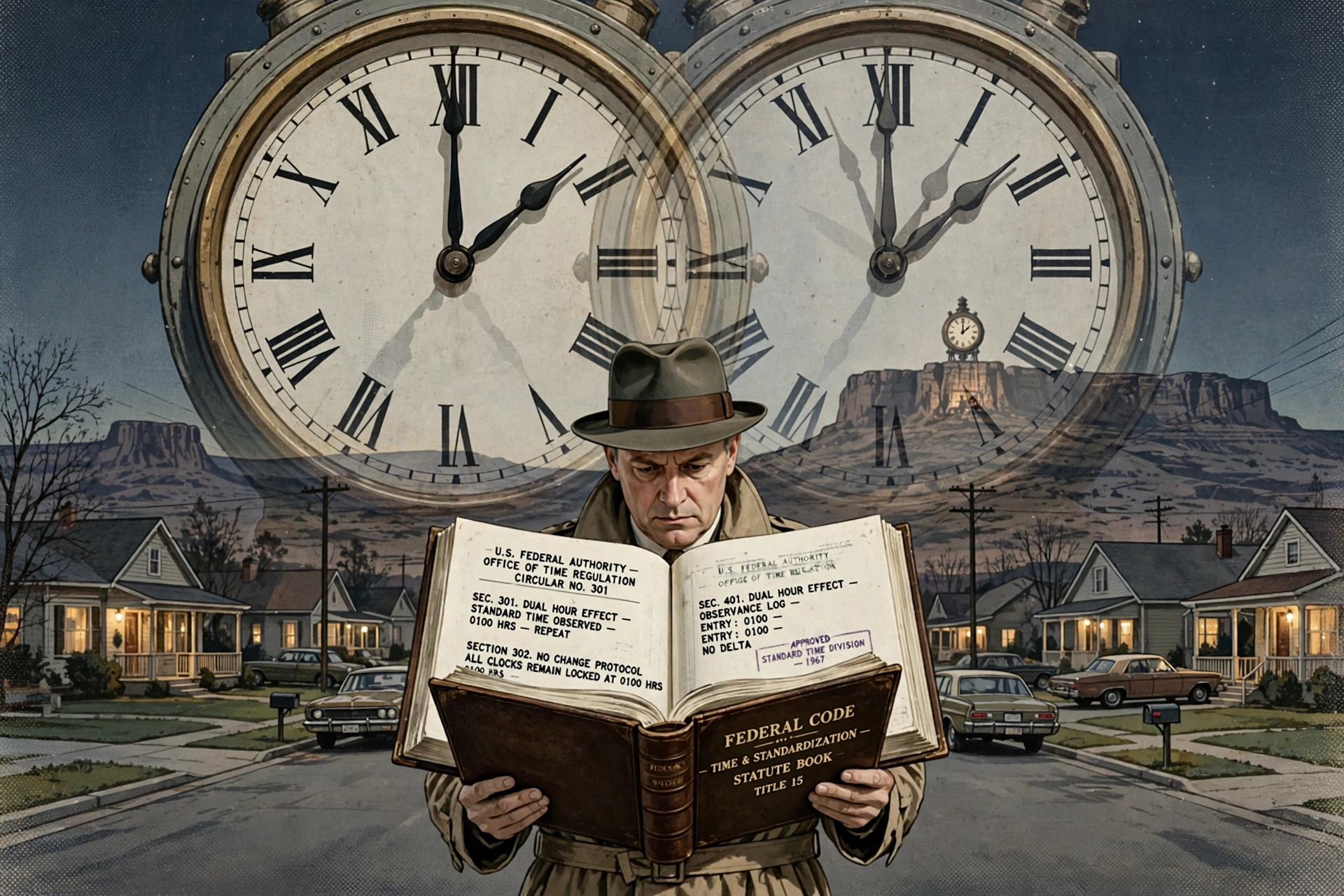
Daylight saving time ends at 2:00 AM local time on Sunday, November 1, 2026, according to the National Institute of Standards and Technology, the official timekeeper of the United States. At that moment, clocks are set back one hour to 1:00 AM.1 The effect is the one the mnemonic prescribes. Spring forward, fall back. In March, clocks moved ahead; in November, they move back. The hour between 1:00 and 2:00 AM happens twice.2
This is the earliest possible date on which the fall-back can occur. Daylight saving time ends on the first Sunday of November, and in 2026 the first Sunday of November is November 1.3 The current schedule, second Sunday in March to first Sunday in November, was established by the Energy Policy Act of 2005 and took effect in 2007.1 The Department of Transportation regulates daylight saving time and the time zones under federal law, and the Institute acts as the nation’s official timekeeper.4
The arithmetic of the night is not in dispute. November 1, 2026 will be a 25-hour day in every observing time zone. The day will contain one more hour than the day before it and one more hour than the day after it. The extra hour is not described, anywhere in federal law, as a created hour, a saved hour, or a duplicated hour. It is simply the hour that happens twice. No federal form exists to report it. No agency is tasked with counting it. No ledger carries it.
II. The Lineage
Congress first established daylight saving time in the Calder Act, also known as the Standard Time Act of 1918, which created the five continental standard time zones and set summer daylight saving to begin March 31, 1918.5 The law proved so unpopular that Congress repealed the daylight saving section in August 1919, overriding a veto from President Wilson, and daylight time became a local matter.5
It returned nationally for the second world war. Congress enacted year-round daylight saving in January 1942, a measure known as War Time, which lasted until the law terminating it took effect on September 30, 1945.5 From 1945 to 1966 there was no federal daylight saving observance at all, and states and localities chose their own dates, producing a patchwork in which neighboring jurisdictions kept different clocks.5
The Uniform Time Act of 1966, signed by President Lyndon B. Johnson in April 1966, standardized the beginning and end of daylight saving time, initially on the last Sunday in April and the last Sunday in October, with the changeover at 2:00 AM local time, while allowing local exemptions from observance.64
Year-round daylight saving was tried once more, briefly. President Nixon signed the Emergency Daylight Saving Time Energy Conservation Act, and year-round daylight saving began on January 6, 1974. Congress voted that October to return to standard time. A federal review at the time found statistically significant evidence of more deaths among school-age children in the mornings, according to the Congressional Research Service.7 The experiment ended after less than ten months.
III. The Ledger
When the Energy Policy Act of 2005 extended daylight saving by several weeks, Congress required the Department of Energy to measure the result. The October 2008 report to Congress found that the total electricity savings of the extended daylight saving time were about 1.3 terawatt-hours, corresponding to 0.5 percent per each day of extended daylight saving, or 0.03 percent of electricity consumption over the year, against total 2007 consumption of 3,900 terawatt-hours.8 The savings were put at $498 million in electricity and reduced oil usage of 2.9 million barrels.9
The measurement has been contested. A 2008 natural experiment in Indiana, where daylight saving was newly adopted statewide in 2006, found that residential electricity use rose roughly 1 percent under daylight saving, with researchers Matthew Kotchen and Laura Grant of the University of California, Santa Barbara reporting the strongest effect in late summer and early fall.10 The energy case, in the current literature, is roughly nil.
What the ledgers do not show is the hour itself. The Department of Energy has measured the electricity saved in the added weeks to three decimal places and to the millionth of a barrel. No department has measured the duplicated hour of November 1. There is no inventory of it, no unit price, no gross domestic product line. The hour is lived twice by the entire observing population and recorded nowhere. It is the most widely distributed asset the federal government has ever issued, and the only one for which it keeps no books.
IV. The Toll
The medical literature has counted what the hour costs in the spring, when it is taken away rather than given back. In a 2014 study published in the journal Open Heart, researchers led by Dr. Amneet Sandhu tallied 42,060 hospital admissions for heart attacks treated with artery-opening procedures in Michigan between January 2010 and September 2013. They found a 24 percent increase in heart attacks on the Monday after springing forward, and a 21 percent reduction on the Tuesday after falling back, with the total for the week unchanged, suggesting the change shifted the timing of heart attacks rather than creating new ones.11
The costs extend beyond the heart. A 2020 study of fatal car crashes from 1996 to 2017 found a 6 percent higher risk in the week after spring forward, concentrated in the morning.7 In Finland, hospital admissions for strokes rose 8 percent in the first two days after the spring change.7 Medical errors attributed to human mistakes rose 18.7 percent after the spring change, in a 2020 study.7 Workers sleep about 40 minutes less on the Monday after the spring change, per a 2009 study.7
The fall change is the gentler of the two. The literature finds the spring shift damaging and the fall shift comparatively benign. This is the asymmetry the law rests on: the hour it lends in November it collects in March, and the collection is the part that kills.
V. The Exemptions
Not all of the nation will duplicate the hour. Hawaii and most of Arizona do not observe daylight saving time, and neither do the territories of American Samoa, Guam, the Northern Mariana Islands, Puerto Rico, and the U.S. Virgin Islands.2 The Navajo Nation, whose land lies largely within Arizona, does observe daylight saving time, so a drive across northern Arizona can cross the fall-back line several times in a single afternoon.2
Arizona therefore functions as an unregulated temporal zone inside a regulated one. The state refused the hour when the Uniform Time Act offered it, and the federal government, which standardizes everything about the hour except its existence, has never compelled its acceptance. On November 1, most of Arizona will live the hour once, without duplication and without record, while the Navajo Nation inside it lives the hour twice, without duplication and without record.
The exemptions may not survive much longer. The Sunshine Protection Act, which would make daylight saving time permanent nationwide and eliminate the twice-yearly clock changes, passed the House in July 2026, but the legislation has stalled in the Senate, and no change has been enacted into law.12 Until the Senate acts, the duplication is scheduled.
VI. The Duplicated Hour
The duplicated hour is already being spent before it exists. Bars in Philadelphia, where closing time is 2:00 AM, receive an extra hour when the clocks fall back from 2:00 to 1:00, giving patrons an extra hour and bar owners an extra hour of revenue. In Delaware, where last call is 1:00 AM, the fall-back changes nothing.2 The same federal hour, repeated in every observing time zone, is worth an hour of liquor revenue in one state and nothing in the next, a discrepancy no regulator has addressed.
The payroll question is unresolved in the statute. A worker on the night shift between 1:00 and 2:00 AM on November 1 works an hour that occurs twice. The Uniform Time Act does not state which 1:00 to 2:00 AM the worker worked, or whether both occurred, or whether the second occurrence is a second hour. Employers answer the question by policy, not by law. The hour is paid, or not, according to the handbook.
The duplication has no custodian. The National Institute of Standards and Technology keeps the time. The Department of Transportation regulates the time zones. Neither counts the duplicated hour, because there is nothing to count: the hour is not an object that appears twice, but a label applied twice. And yet the bars will sell it twice, the workers will sleep through it twice, and the nation will live it twice. A thing lived twice by everyone and recorded by no one is either a bookkeeping error or the only honest entry in the books.
VII. The Defense
The defense will be stated, because the facts are real and the statutes are real, and an honest investigation states the mechanism that cuts against its conclusion.
First, nothing is created. The fall-back does not manufacture an hour; it relabels one. Standard time is the base, and daylight saving time is the displacement. The hour between 1:00 and 2:00 AM on November 1 occurs once in solar time and is merely named twice by legal time. The duplication is a change of labels, not a change of events.
Second, the ledger is consistent. The Department of Energy measured savings against the hours of daylight actually shifted, and its 0.5 percent figure describes the effect of the extended weeks, not of any single night. The hour of November 1 appears in no ledger because there is nothing to enter: an hour relabeled is an hour accounted.
Third, the exemption is the law. Arizona and Hawaii are not evading the hour; they are exempted from the observance by the same statute that imposes it. The Uniform Time Act permits the exemption, and the exempted jurisdictions comply with the law by not observing it.
The defense is noted. It concedes the mechanism and disputes only the name.
Whether the hour is duplicated or merely relabeled, the operative facts are identical: at 2:00 AM on November 1, in every observing time zone, clocks will read 1:00 AM again; the hour from 1:00 to 2:00 will be lived a second time; bars in one state will sell it and workers in another will sleep it; no form records it; no agency counts it; no statute names it. The defense calls it relabeling. The clock calls it 1:00 AM, twice. The distinction is semantic. The duplication is scheduled.
VIII. Conclusion
The record is complete. At 2:00 AM local time on November 1, 2026, the earliest possible fall-back date, clocks in the United States will return to 1:00 AM, and the hour between 1:00 and 2:00 AM will happen twice. The Calder Act of 1918 created the mechanism. Congress repealed it in 1919 over a presidential veto. War Time ran from 1942 to September 30, 1945. The Uniform Time Act of 1966 standardized the changeover at 2:00 AM local time. The Energy Policy Act of 2005 set the current dates. The Department of Energy counted 1.3 terawatt-hours and 0.5 percent per day. Indiana counted a 1 percent increase. Michigan counted 42,060 heart attacks, 24 percent more on the Monday after the spring change, 21 percent fewer on the Tuesday after the fall. The House passed a bill to end all of this in July 2026. The Senate has not acted.
Once a year, the United States duplicates one hour of legal time for its entire observing population, spends it, sleeps it, sells it, and records nothing. No form exists on which to report it. No agency is charged with counting it. The hour is lived twice and filed nowhere.
Ergo.
Sources
- People, “Daylight Saving Time Is This Weekend: Here’s What to Know,” October 30, 2026: daylight saving time ends on Sunday, Nov. 1, 2026, at 2:00 AM local time, according to the National Institute of Standards and Technology; at that moment clocks move backward one hour, returning to 1:00 AM; the current schedule, second Sunday in March to first Sunday in November, was established by the Energy Policy Act of 2005 and went into effect in 2007. people.com ↑ ↑
- Delaware Online, “Daylight saving time 2026 is ending. How to prepare for falling back,” October 30, 2026: at 2:00 AM local time Sunday, Nov. 1, clocks turn back one hour to 1:00 AM, meaning the hour between 1:00 and 2:00 AM happens twice; bars in Philadelphia have a closing time of 2:00 AM and the fall-back gives patrons and bar owners an extra hour, while in Delaware last call is 1:00 AM so falling back does not impact late-night celebrations; Hawaii and Arizona, with the exception of the Navajo Nation, do not observe daylight saving time, and neither do American Samoa, Guam, the Northern Mariana Islands, Puerto Rico, and the U.S. Virgin Islands. delawareonline.com ↑ ↑ ↑ ↑
- Democrat and Chronicle, “Daylight saving time 2026: When do clocks change?,” October 30, 2026: daylight saving time is scheduled to end on Sunday, Nov. 1, 2026; it is the earliest possible date that the annual time change can occur; daylight saving time will return on Sunday, March 14, 2027. democratandchronicle.com ↑
- Palm Beach Post, “Daylight saving ends today in Florida. But see fall back dates until 2036,” October 31, 2026: the U.S. Department of Transportation regulates daylight saving time and time zones; the National Institute of Standards and Technology acts as the official timekeeper for the United States; the fall-back and spring-forward dates are set for the next decade. palmbeachpost.com ↑ ↑
- Congressional Research Service, “Daylight Saving Time,” R45208, via EveryCRSReport: March 1918, Congress and the President enacted the Calder Act, also known as the Standard Time Act of 1918, which established daylight saving time in the United States as well as five standard time zones in the continental United States and Alaska; August 1919, Congress overrode a veto from President Wilson to repeal the daylight saving time section of the Calder Act; January 1942, Congress enacted year-round daylight saving time known as War Time, which lasted until a subsequent law ending War Time took effect September 30, 1945; after September 1945 the United States observed standard time without nationwide changes to time until enactment of the Uniform Time Act of 1966. everycrsreport.com ↑ ↑ ↑ ↑
- Napscience, “History and info: Daylight Saving Time, early adoption, U.S. law,” citing the Uniform Time Act of 1966 (15 U.S. Code Section 260a): the Act provided standardization in the dates of beginning and end of daylight saving time in the United States but allowed for local exemptions from its observance; the changeover occurs at 2:00 AM local time; signed by President Lyndon B. Johnson in April 1966. napscience.com ↑
- PinScene, “The case for ending the Daylight Savings clock change,” October 2026: year-round daylight saving time started January 6, 1974, during the energy crisis, and Congress voted that October to bring back standard time; a federal review at the time found statistically significant evidence of more deaths among school-age children in the mornings, according to the Congressional Research Service; fatal car crash risk rose 6 percent around the spring change, with the biggest jump in the morning, in a 2020 study of U.S. crashes from 1996 to 2017; in Finland, hospital admissions for strokes rose 8 percent in the first two days after the change; medical errors blamed on human mistakes rose 18.7 percent after the spring change, a 2020 study found; workers sleep about 40 minutes less on the Monday after the spring change, a 2009 study found. pinscene.com ↑ ↑ ↑ ↑ ↑
- U.S. Department of Energy, “Impact of Extended Daylight Saving Time on National Energy Consumption,” technical documentation for the report to Congress, October 2008: the total electricity savings of extended daylight saving time were about 1.3 terawatt-hours, corresponding to 0.5 percent per each day of extended daylight saving time, or 0.03 percent of electricity consumption over the year, against total 2007 electricity consumption of 3,900 terawatt-hours; Section 110 of the Energy Policy Act of 2005 amended the Uniform Time Act of 1966 to extend daylight saving in the spring and fall. energy.gov ↑
- Senate Select Committee on Energy Independence and Global Warming (archived), press release, March 5, 2009, reporting the Department of Energy’s October 2008 findings: the savings translate to $498 million in electricity savings and reduced oil usage of 2.9 million barrels of oil. markey.senate.gov ↑
- The Old Farmer’s Almanac, “How Much Daylight Are We Really Saving?,” 2026: a 2008 natural experiment in Indiana, where daylight saving was newly adopted statewide in 2006, found residential electricity use rose roughly 1 percent under daylight saving, with researchers Matthew Kotchen and Laura Grant, of the University of California, Santa Barbara, reporting the strongest effect in late summer and early fall; the 2008 Department of Energy study measured a 0.5 percent national electricity reduction during the four extended weeks of daylight saving added in 2007. farmersalmanac.com ↑
- Live Science, “Watch Out: Daylight Saving Time Causes Heart Attack Spike,” March 2015, reporting a 2014 study in the journal Open Heart: Dr. Hitinder Gurm and colleagues tallied more than 42,000 hospital admissions for heart attacks in Michigan from January 1, 2010 to September 15, 2013; the number of heart attacks increased 24 percent on the Monday following the start of daylight saving time; on the Tuesday following the end of daylight saving time in the autumn, heart attack numbers fell by 21 percent; on a weekly basis the totals stayed roughly the same, suggesting the change shifted timing rather than creating new heart attacks. livescience.com ↑
- USA Today, “Do clocks go back tonight? Everything to know for daylight saving time,” October 31, 2026: the Sunshine Protection Act, which would make daylight saving time permanent and eliminate the twice-yearly clock changes, passed the House in July but has since failed to clear the Senate; under current law, daylight saving time begins on the second Sunday in March and ends on the first Sunday in November; the Uniform Time Act of 1966 was enacted under President Lyndon B. Johnson’s administration and only Congress has the authority to change it. usatoday.com ↑