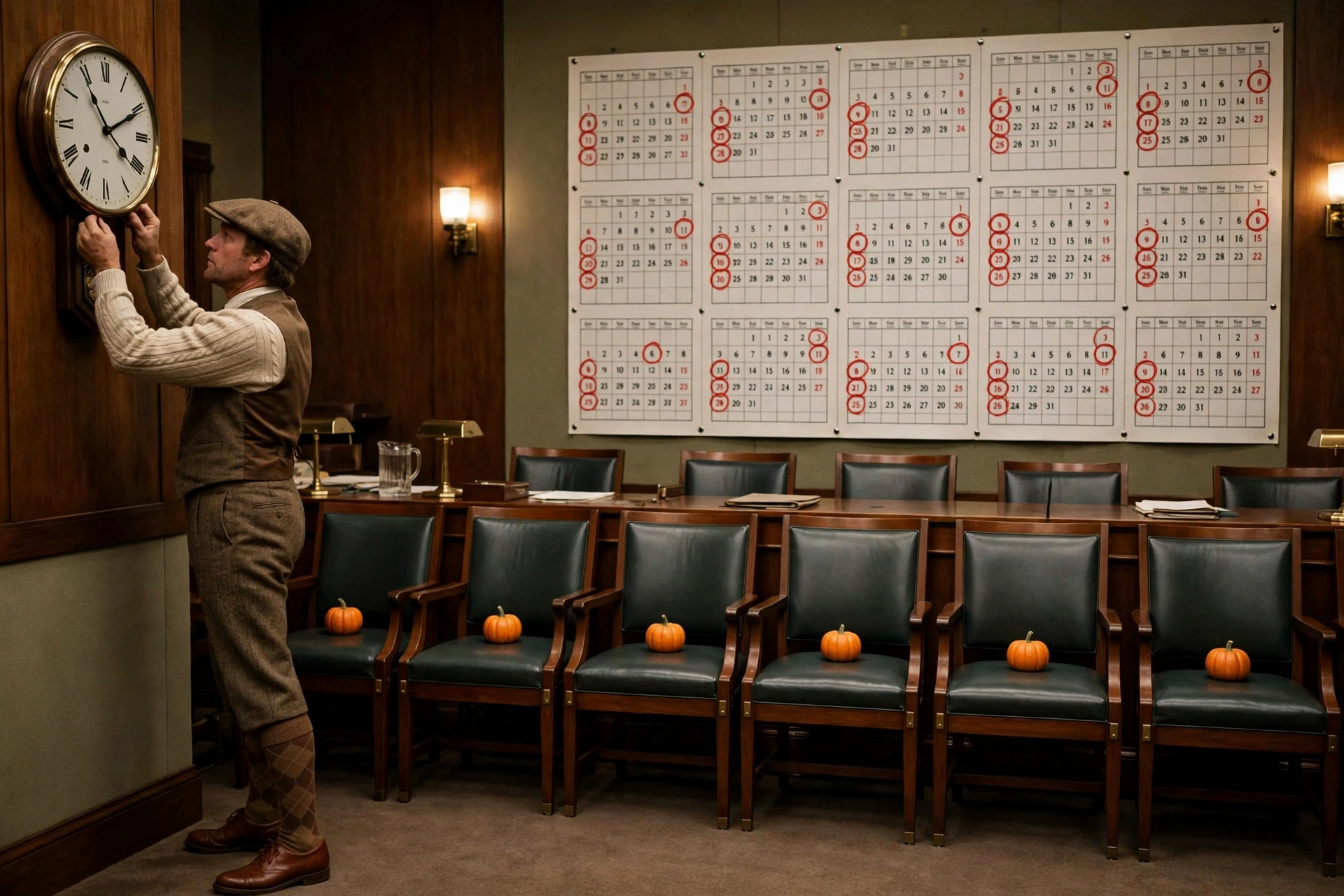
I. The Spring Ledger
On January 30, 2020, the journal Current Biology published “A Chronobiological Evaluation of the Acute Effects of Daylight Saving Time on Traffic Accident Risk,” by Josef Fritz, Trang VoPham, Kenneth P. Wright Jr., and Celine Vetter of the University of Colorado Boulder. The researchers analyzed 732,835 fatal motor-vehicle accidents recorded in the federal Fatality Analysis Reporting System from 1996 to 2017, across the contiguous United States, excluding Arizona and Indiana, where daylight saving was not consistently observed.1
Their finding: the spring transition to daylight saving time increases the risk of fatal traffic accidents by approximately six percent in the week after the change. The incidence rate ratio was 1.06, with a 95 percent confidence interval of 1.03 to 1.09. In absolute terms, the increase translated to an additional 5.7 fatal accidents per day from Monday to Friday after the spring transition, or more than 28 additional fatal accidents per year. Over the 22 years of data, the authors estimated that about 627 fatal accidents were associated with the spring shift.2
The increase begins immediately, on the Sunday the clocks spring forward, and the bulk of the additional fatal accidents occur in the morning. The effect is exacerbated in the western regions of time zones, where the spike exceeded eight percent. A subsequent correspondence in the same journal showed that after the Energy Policy Act of 2005 moved the spring transition from April to March, the morning increase rose from five to six percent to thirteen percent.3
Senior author Celine Vetter stated: “Our study provides additional, rigorous evidence that the switch to daylight saving time in spring leads to negative health and safety impacts. These effects on fatal traffic accidents are real, and these deaths can be prevented.”4 First author Josef Fritz described the mechanism as a “mini jetlag” caused by the one-hour loss, most severe in the first days after the transition and observable for up to two weeks.5
The fall transition produced a different pattern. After the clocks fall back, morning fatal accidents decline while evening accidents spike as darkness arrives sooner. The two effects balance, and there is no overall change in fatal accidents during the fall-back week.6
II. The Cardiac Ledger
In March 2014, the journal Open Heart published “Daylight savings time and myocardial infarction,” by Amneet Sandhu, Milan Seth, and Hitinder Gurm. The team analyzed 42,060 Michigan hospital admissions for acute myocardial infarction requiring percutaneous coronary intervention, drawn from the Blue Cross Blue Shield of Michigan Cardiovascular Consortium database between January 2010 and September 2013.7
On the Monday after the spring-forward transition, the daily heart-attack count rose 24 percent above the surrounding average, an expected increase of 7.8 heart attacks. On the Tuesday after the fall-back transition, when the clocks return to standard time and the population gains an hour of sleep, the count fell 21 percent, an expected decrease of 7.1 heart attacks. Across the full week following either transition, the total volume of heart attacks did not change significantly.8
The authors’ own conclusion was careful: the data suggest that daylight saving time may accelerate heart attacks that were already likely to occur among vulnerable patients, but does not impact overall incidence.9 A larger and more recent analysis reaches a flatter verdict. Rymer et al., in JAMA Network Open in September 2025, examined 168,870 patients across 1,124 hospitals from 2013 to 2022 and found no significant difference in heart-attack incidence or in-hospital outcomes around either clock change, the largest analysis of the question to date.27 The defense will call all of this its first and seventh exhibits. The defense is noted below.
A Finnish study of stroke, presented at the American Academy of Neurology’s 2016 annual meeting by Jori Ruuskanen of the University of Turku, compared 3,033 people hospitalized for ischemic stroke during the week after a daylight saving transition with 11,801 people hospitalized in the two weeks before or after. The overall rate of ischemic stroke was eight percent higher during the first two days after a transition. Adults over 65 were 20 percent more likely to have a stroke in that window; people with cancer were 25 percent more likely. Hospital deaths from stroke did not increase.10
Researchers at the Mayo Clinic reported in the Journal of General Internal Medicine that human errors increased 18.7 percent in the week after the spring transition, based on voluntarily reported patient-safety incidents from 2010 to 2017; the fall transition showed no statistically significant increase.11
III. The Occupational Ledger
In September 2009, the Journal of Applied Psychology published research by Christopher Barnes and David Wagner, then doctoral candidates in industrial and organizational psychology at Michigan State University. Using injury data from the Mine Safety and Health Administration covering 1983 to 2006, and sleep data from the Bureau of Labor Statistics’ American Time Use Survey covering more than 14,000 interviews, they measured what the spring transition costs American workers.12
On the Monday after the spring-forward, American workers slept an average of 40 minutes less than on other days. Workplace injuries increased 5.7 percent, and the injuries were more severe: 67.6 percent more workdays were lost to injuries than on comparable days. After the fall-back transition, the researchers found no significant increase in workplace accidents or sleep loss. The autumn change added an insignificant 12 minutes of sleep, not enough to register in the safety data.13
The authors wrote: “We therefore conclude that schedule changes, such as those involved in switches to and from Daylight Saving Time, place employees in clear and present danger.”14
IV. The Circadian Dissent
On August 27, 2020, the American Academy of Sleep Medicine issued a position statement, published in the Journal of Clinical Sleep Medicine as Rishi et al., “Daylight saving time: an American Academy of Sleep Medicine position statement” (2020;16(10):1781–1784). Its conclusion: “It is, therefore, the position of the American Academy of Sleep Medicine that these seasonal time changes should be abolished in favor of a fixed, national, year-round standard time.”15
The statement was endorsed by the Society for Research on Biological Rhythms, the National PTA, the National Safety Council, the World Sleep Society, and more than a dozen other organizations. Lead author M. Adeel Rishi stated: “Permanent, year-round standard time is the best choice to most closely match our circadian sleep-wake cycle. Daylight saving time results in more darkness in the morning and more light in the evening, disrupting the body’s natural rhythm.” A July 2020 AASM survey of more than 2,000 American adults found that 63 percent support eliminating seasonal time changes in favor of a fixed national time, while 11 percent oppose it.16
The scientists’ position is unambiguous: abolish the transitions, keep standard time. It is worth noting what the scientists did not propose. They did not propose keeping the transitions. They did not propose repeating the healthy one.
V. The First Lobbyist
The first proposal to reorganize human activity around daylight was not legislation. It was a joke.
On April 26, 1784, the Journal de Paris published “An Economical Project,” a letter from the 78-year-old Benjamin Franklin, then the American minister to France. Franklin had been waked at six in the morning by sunlight streaming through shutters his attendant had forgotten to close, and had begun calculating, in his words, “for the sheer love of economy.” Assuming 100,000 Parisian families burning half a pound of tallow and wax per hour for seven hours per night across the 183 nights between March 20 and September 20, he arrived at 64,050,000 pounds of candles at 30 sols per pound: 96,075,000 livres tournois. “An immense sum,” he concluded, “that the city of Paris might save every year.”17
To compel the reformation, Franklin proposed four regulations: a tax on every window fitted with shutters to keep out the sun; a limit of one pound of candles per week per family, enforced by guards posted in the shops of the wax and tallow chandlers; guards to stop all coaches in the streets after sunset; and, every morning at sunrise, all the bells in every church set ringing, with cannon fired in every street if the bells proved insufficient. “All the difficulty will be in the first two or three days,” he assured his readers.18
Congress read the letter, missed the joke, and kept the arithmetic.
VI. The Golf Caucus
The modern campaign began with a golfer. In 1905, the builder William Willett was riding his horse through Petts Wood at dawn and noticed how many blinds were still drawn. In 1907 he published a pamphlet, “The Waste of Daylight,” proposing that clocks be advanced 20 minutes at 2:00 AM on four consecutive Sundays in April and reversed the same way in September. His supporters included Winston Churchill and Arthur Conan Doyle. Parliament rejected the bill as too radical. Willett campaigned in Britain, Europe, and America until he died of influenza in 1915, at 58, one year before his scheme became law. He is commemorated in Petts Wood by a memorial sundial, set permanently to daylight saving time.19
Germany adopted the scheme first, on April 30, 1916, to conserve coal during the First World War. Britain followed in May. The United States adopted it in 1918.
The golf industry never forgot. When Congress considered extending daylight saving in 1986, the industry told the hearings that one additional month of daylight saving was worth $200 million in additional sales of golf clubs and greens fees. The barbecue industry estimated its own gain at $100 million in grills and charcoal briquettes. The extension passed, moving the start from the last Sunday in April to the first, and the American daylight saving season grew from six months to seven.20 The first and most persistent lobby for daylight saving, according to the historian Michael Downing, was the Chamber of Commerce, which understood that lighted department stores tempt shoppers.21
VII. The Candy Caucus
For 25 years, the candy makers wanted Halloween covered by daylight saving. Their reasoning was arithmetic of Franklin’s school: an extra hour of daylight for trick-or-treating means more houses visited and more candy collected. During the 1985 hearings on daylight saving, the industry placed candy pumpkins on the seat of every senator. “This is no kind of legend,” Downing told NPR in 2007. “This is the truth.”22
They did not get the extension in 1986. They got it in 2005. The Energy Policy Act of 2005 extended daylight saving from the second Sunday in March to the first Sunday in November, effective 2007. Halloween now falls within daylight saving time.23
The energy rationale that carried the bill did not survive contact with the data. The Department of Energy’s October 2008 report to Congress found that extended daylight saving saved about 1.3 terawatt-hours of electricity: 0.5 percent per day of the extension, or 0.03 percent of the nation’s 3,900 terawatt-hour annual consumption. In primary energy terms, the savings were 17 trillion Btu, roughly 0.02 percent of total American energy use.24 A study of Indiana by Matthew Kotchen and Laura Grant, published in the Review of Economics and Statistics, found that daylight saving increased residential electricity demand by about one percent, costing the state’s households $9 million per year in higher bills.25
The alibi collapsed. The schedule the lobbies wrote remained.
VIII. The Defense
The defense is noted. It concedes every number in this investigation and disputes only the prescription.
Its first exhibit is Sandhu’s own conclusion: the weekly totals did not change, and daylight saving “does not impact overall incidence” of heart attacks. The 21 percent Tuesday decline is a rebound, not a cure. Its second exhibit is Fritz: the fall-back week nets to zero, a morning decline canceled by an evening spike. Its third is the Finnish stroke study, whose eight percent increase applied to transitions in either direction. Its fourth is arithmetic: repeating the fall back twelve times per year would move the nation’s clocks back twelve hours annually, and within one year the country would be keeping time on the opposite side of the clock face. Its fifth is the scientists: the American Academy of Sleep Medicine demands permanent standard time, not repeated transitions. Its sixth is the legislature: on July 14, 2026, the House passed H.R. 139, the Sunshine Protection Act, 308 to 117, choosing permanent daylight saving time, the precise option the sleep scientists rejected. An almost identical bill passed the Senate by unanimous consent in March 2022 and died in the House; this time the order is reversed. The bill sits in the Senate Committee on Commerce, Science, and Transportation, where the Majority Leader has said there is “no clear path forward.”26
Its seventh is the largest cardiac study ever conducted. Rymer et al., JAMA Network Open, September 2025: 168,870 patients, 1,124 hospitals, no significant difference in heart-attack incidence or in-hospital outcomes around either transition.27 The centerpiece number of this investigation does not survive the largest sample anyone has assembled.
The defense rests. It is overruled.
IX. The Prescription
The ledger is now complete, and it admits of only one reading.
The spring-forward transition is the only one with a negative record on every metric the literature measures: six percent more fatal crashes, 24 percent more heart attacks on the following Monday, eight percent more strokes after transitions in either direction, 5.7 percent more workplace injuries, 67.6 percent more workdays lost, 40 minutes less sleep, 18.7 percent more human error. The fall-back is the only transition with a positive record on any metric: 21 percent fewer heart attacks on the following Tuesday, a decline in morning fatal crashes, no increase in workplace injuries, no measurable sleep loss.
The scientists propose abolishing both transitions in favor of permanent standard time, which would abolish the only transition with a positive medical record. The House proposes permanent daylight saving time, which would abolish the positive one and keep the negative one forever. Both remedies destroy the evidence. The correct remedy preserves it.
The spring-forward transition should be abolished. The fall-back transition should be repeated on the first Sunday of every month, twelve times per year. The scheduling should be entrusted to the golf, barbecue, and candy lobbies, the only parties in American history with a documented record of writing time law, with the Chamber of Commerce handling retail hours. The Department of Energy may continue counting the savings to three decimal places.
The hour the law takes in March, the law should return in April, May, June, July, August, September, October, November, December, January, and February.
Ergo.
Sources
- Josef Fritz, Trang VoPham, Kenneth P. Wright Jr., and Celine Vetter, “A Chronobiological Evaluation of the Acute Effects of Daylight Saving Time on Traffic Accident Risk,” Current Biology 30, no. 4 (February 24, 2020): 729–735. DOI: 10.1016/j.cub.2019.12.045. 732,835 fatal motor-vehicle accidents, Fatality Analysis Reporting System, 1996–2017. cell.com ↑
- Incidence rate ratio 1.06 (95% CI 1.03–1.09) for the five workdays after the spring transition; 5.7 additional fatal accidents per day Monday to Friday; more than 28 per year; about 627 over the 22-year study period. Fritz et al., Current Biology 2020. doi.org medicalxpress.com ↑
- Arizona and Indiana excluded for inconsistent observance; morning exacerbation; western time-zone regions above eight percent; post-2007 morning increase doubled to thirteen percent. news-medical.net arxiv.org ↑
- Celine Vetter: “Our study provides additional, rigorous evidence that the switch to daylight saving time in spring leads to negative health and safety impacts. These effects on fatal traffic accidents are real, and these deaths can be prevented.” news-medical.net ↑
- Josef Fritz on the “mini jetlag” of the one-hour loss: most severe in the first days after transition, observable up to two weeks. healthline.com ↑
- Fall-back pattern: decline in morning fatal accidents, spike in evening accidents as darkness arrives sooner, no overall change for the week. sleepreviewmag.com ↑
- Amneet Sandhu, Milan Seth, and Hitinder Gurm, “Daylight savings time and myocardial infarction,” Open Heart 1 (2014): e000019. DOI: 10.1136/openhrt-2013-000019. 42,060 Michigan admissions for acute myocardial infarction requiring percutaneous coronary intervention, January 2010 to September 2013. livescience.com ↑
- Monday after spring-forward: 24 percent increase in daily heart-attack count (expected 7.8 additional); Tuesday after fall-back: 21 percent decrease (expected 7.1 fewer); no significant change in weekly totals either direction. Sandhu A, Seth M, Gurm HS. Open Heart 2014;1:e000019. doi.org rxwiki.com ↑
- Sandhu A, Seth M, Gurm HS. Open Heart 2014;1:e000019: “Our data argue that DST could potentially accelerate events that were likely to occur in particularly vulnerable patients and does not impact overall incidence.” doi.org ↑
- Jori Ruuskanen et al., Finnish stroke data 2004–2013: 3,033 transition-week hospitalizations vs. 11,801 controls; eight percent higher ischemic stroke rate in the first two days after transitions in either direction; 20 percent higher for adults over 65; 25 percent higher for cancer patients. Presented at the American Academy of Neurology annual meeting, April 2016. newswise.com ↑
- Bhanu Prakash Kolla et al., “Increased Patient Safety-Related Incidents Following the Transition into Daylight Savings Time,” Journal of General Internal Medicine 36, no. 1 (January 2021): 51–54. DOI: 10.1007/s11606-020-06090-9. PMCID: PMC7859153. Human errors increased 18.7 percent in the week after the spring transition (statistically significant); the fall increase was not significant. Based on voluntarily reported incidents, Mayo Clinic, 2010–2017. pmc.ncbi.nlm.nih.gov ↑
- Christopher M. Barnes and David T. Wagner, “Changing to Daylight Saving Time Cuts Into Sleep and Increases Workplace Injuries,” Journal of Applied Psychology 94, no. 5 (September 2009): 1305–1317. Mine Safety and Health Administration injury data, 1983–2006; Bureau of Labor Statistics American Time Use Survey, 14,000+ interviews. ehstoday.com ↑
- Monday after spring-forward: 40 minutes less sleep, 5.7 percent more workplace injuries, 67.6 percent more workdays lost; no significant effect after the fall-back (12 extra minutes of sleep). shrm.org ↑
- Barnes and Wagner: “We therefore conclude that schedule changes, such as those involved in switches to and from Daylight Saving Time, place employees in clear and present danger.” ehstoday.com ↑
- Muhammad Adeel Rishi et al., “Daylight saving time: an American Academy of Sleep Medicine position statement,” Journal of Clinical Sleep Medicine 16, no. 10 (October 15, 2020): 1781–1784. PMID: 32844740. DOI: 10.5664/jcsm.8780. Position: seasonal time changes should be abolished in favor of a fixed, national, year-round standard time. pubmed.ncbi.nlm.nih.gov ↑
- Endorsed by the Society for Research on Biological Rhythms, the National PTA, the National Safety Council, the World Sleep Society, and others. Rishi: “Permanent, year-round standard time is the best choice to most closely match our circadian sleep-wake cycle.” AASM survey: 63 percent of 2,000+ adults support eliminating seasonal changes; 11 percent oppose. newswise.com ↑
- Benjamin Franklin, “An Economical Project,” Journal de Paris, April 26, 1784. 100,000 families × half-pound of tallow and wax per hour × 7 hours × 183 nights = 64,050,000 pounds at 30 sols per pound = 96,075,000 livres tournois. “An immense sum, that the city of Paris might save every year.” webexhibits.org ↑
- Franklin’s proposed regulations: a tax on windows fitted with shutters; no family supplied with more than one pound of candles per week, enforced by guards in the chandlers’ shops; guards to stop coaches after sunset; church bells rung at sunrise, cannon fired in every street if the bells proved insufficient. webexhibits.org ↑
- William Willett, “The Waste of Daylight” (1907): advance clocks 20 minutes at 2:00 AM on four consecutive April Sundays, reverse in September. Supporters included Winston Churchill and Arthur Conan Doyle. Willett died of influenza in 1915, aged 58. Memorial sundial in Petts Wood, set permanently to daylight saving time. Germany adopted daylight saving April 30, 1916; Britain followed in May. secretldn.com liquisearch.com ↑
- 1986 congressional hearings: the golf industry estimated one additional month of daylight saving at $200 million in golf clubs and greens fees; the barbecue industry estimated $100 million in grills and charcoal. The extension moved the start from the last Sunday in April to the first, growing the season from six months to seven. gatorsports.com ↑
- Michael Downing: the Chamber of Commerce was “the first and most persistent lobby for Daylight Saving in this country,” understanding that lighted department stores tempt shoppers. innovationtrail.org ↑
- Candy makers lobbied for 25 years to bring Halloween under daylight saving; during the 1985 hearings the industry placed candy pumpkins on the seat of every senator. “This is no kind of legend,” Downing told NPR in 2007. “This is the truth.” innovationtrail.org ↑
- Energy Policy Act of 2005: extended daylight saving from the second Sunday in March to the first Sunday in November, effective 2007. Halloween now falls within daylight saving time. gatorsports.com ↑
- U.S. Department of Energy, “Impact of Extended Daylight Saving Time on National Energy Consumption: Report to Congress,” October 2008. Extended daylight saving saved about 1.3 TWh: 0.5 percent per day of the extension, 0.03 percent of the nation’s 3,900 TWh annual consumption; 17 trillion Btu in primary energy, roughly 0.02 percent of total American energy use. DOI: 10.2172/949762. osti.gov ↑
- Matthew J. Kotchen and Laura E. Grant, “Does Daylight Saving Time Save Energy? Evidence from a Natural Experiment in Indiana,” Review of Economics and Statistics 93, no. 4 (2011): 1172–1185. Main finding: DST increases residential electricity demand by approximately one percent, costing Indiana households $9 million per year in higher bills. ideas.repec.org ↑
- H.R. 139, the Sunshine Protection Act of 2025, passed the House 308 to 117 on July 14, 2026, and was referred to the Senate Committee on Commerce, Science, and Transportation on July 15; no floor vote has been scheduled. An almost identical bill passed the Senate by unanimous consent in March 2022 and died in the House. northjersey.com masslegalresources.com ↑
- Jennifer A. Rymer et al., “Daylight Savings Time and Acute Myocardial Infarction,” JAMA Network Open 8, no. 9 (September 9, 2025): e2530442. DOI: 10.1001/jamanetworkopen.2025.30442. PMCID: PMC12421335. Cross-sectional study of 168,870 patients at 1,124 hospitals, 2013–2022, from the National Cardiovascular Data Registry Chest Pain-MI Registry. No significant differences in AMI incidence or in-hospital outcomes (including mortality and stroke) around either clock change. pmc.ncbi.nlm.nih.gov ↑