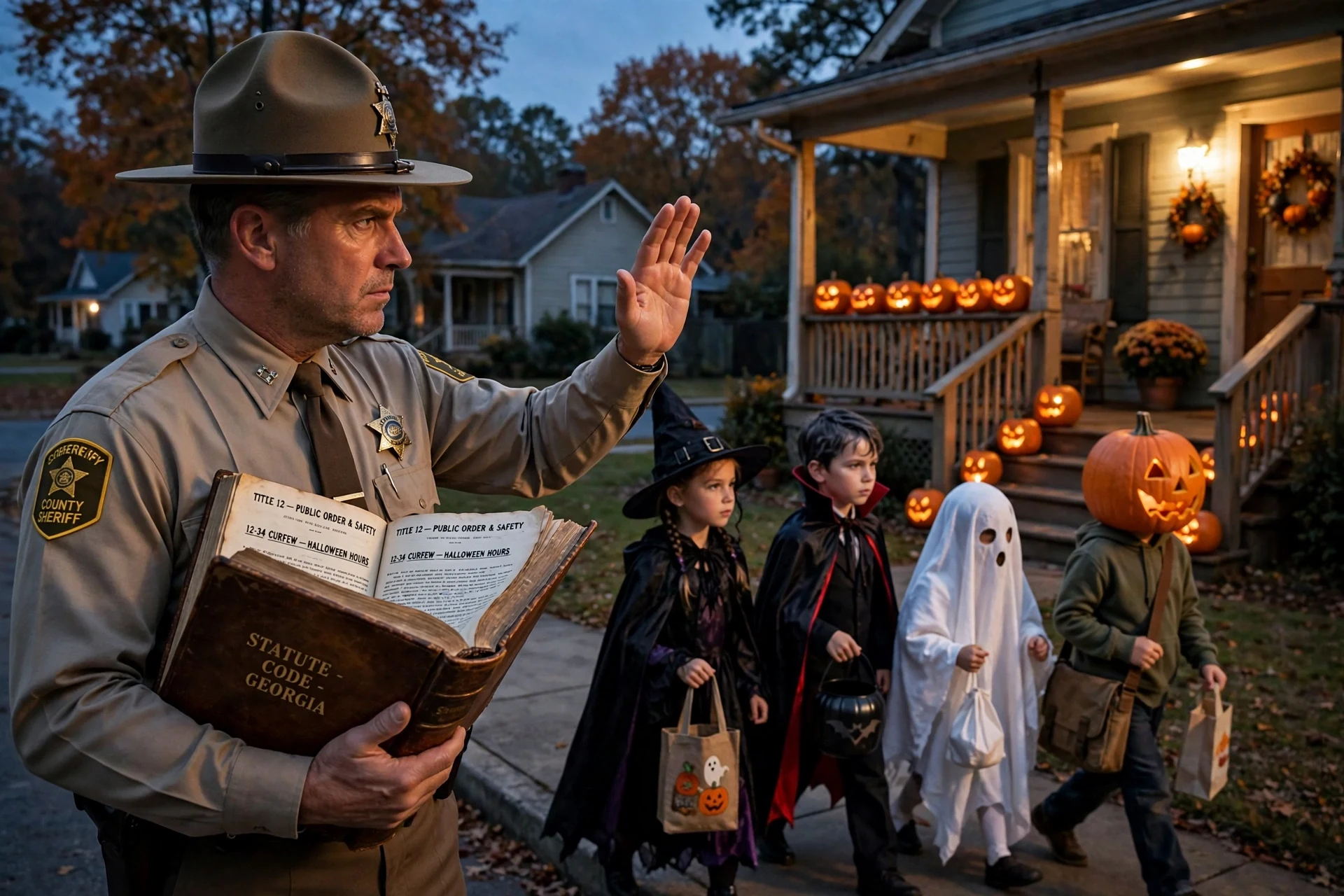
I. The Prohibition
The International Center for Not-for-Profit Law maintains a database of anti-mask laws in the United States, updated in September 2025. Its finding: while most states do not restrict mask wearing, 23 states and the District of Columbia have laws that limit face coverings in public spaces.1 The restrictions fall into three categories: general bans on masks, with exceptions; bans on masking with a certain intent; and bans on masking while committing a crime.1
The general bans are the oldest and the bluntest. Georgia’s is representative. Section 16-11-38 of the Official Code of Georgia Annotated provides that a person is guilty of a misdemeanor when he or she wears a mask, hood, or device by which any portion of his or her face is so hidden, concealed, or covered as to conceal his or her identity, is upon any public way or public property or upon the private property of another without the written permission of the owner, and intends to conceal his or her identity.2 Three elements. The mask. The place. The intent.
Alabama’s statute, dating to 1949, makes it an offense, punishable by up to 30 days in jail, for a person, being masked, to loiter, remain, or congregate in a public place.3 Florida’s laws, enacted in 1951, make it illegal for anyone over 16 to wear a mask or face covering in public outdoors, in public buildings, and on someone else’s private property.4 South Carolina provides that no person over 16 may wear a mask concealing the identity in public, subject to exceptions.5
II. The Lineage
The statutes were not written against Halloween. They were written against the Ku Klux Klan. The mid-20th century wave of mask bans, Georgia’s 1951 act among them, was enacted to strip the Klan of its uniform, often alongside bans on cross-burning, and Alabama’s 1949 law is described by the International Center for Not-for-Profit Law as enacted to help fight the Klan.36 The mask, in the legislature’s judgment, was the technology of intimidation: the concealed identity was the instrument, and the statute criminalized the instrument.
Georgia’s law survived constitutional challenge. In State v. Miller, 260 Ga. 669 (1990), the Georgia Supreme Court held that the statute passes constitutional muster, but it narrowed the path to conviction: the state must show that the mask-wearer intended to conceal identity and either intended to threaten, intimidate, or provoke the apprehension of violence, or acted with reckless disregard for the consequences, a heedless indifference to the rights and safety of others, with reasonable foresight that injury would probably result.7 The mask alone was not enough. The mask plus menace was the crime.
III. The Carve-Out
Then there is subsection (b). The statute that criminalizes the concealed face provides, in its own text, that without limiting the generality of subsection (a), no person shall be guilty of violating the section by wearing a traditional holiday costume on the occasion of the holiday.2 The exception is first in the list, ahead of trade and employment, ahead of theatrical productions and masquerade balls, ahead of gas masks in emergencies. The legislature that banned the mask wrote the costume into the ban.
The carve-out has been tended. In 2021, the Georgia legislature amended the statute to add a fifth exemption, for wearing a mask to comply with the guidance of a health care agency to prevent the spread of COVID-19 or other coronaviruses or influenza.8 During the pandemic, the Governor of Georgia signed an executive order suspending enforcement of the face-covering law during the emergency for wearers complying with health guidance.3 The statute has thus been suspended by executive order for disease and by its own text for holiday. The two suspensions differ in one respect: the executive order had an expiration. The holiday has a calendar.
IV. The Scale
The National Retail Federation’s annual survey, conducted by Prosper Insights and Analytics, projects that Americans will spend $13.5 billion on Halloween in 2026.9 Of that total, $4.4 billion will go to costumes, the single largest category, ahead of decorations at $4.3 billion and candy at $4.1 billion.9 The survey drew responses from 7,889 consumers between September 1 and 9, with a margin of error of plus or minus 1.1 percentage points.9
The participation figures describe the largest annual exercise of a statutory exception in American law. In the Federation’s 2025 survey, 51 percent of celebrants said they planned to dress in costume, 73 percent said they planned to celebrate at all, and 66 percent said they planned to hand out candy.10 Adults are expected to spend $2 billion on their own costumes this year; children $1.5 billion; pets $920 million, with pumpkins, hot dogs, and ghosts among the most popular choices for animals.9 Among adults, 5.6 million plan to dress as witches, 2.7 million as vampires, and 1.6 million each as pirates, cats, and Batman.10
Every one of them will stand on a public way, in a mask or device concealing the identity, intending to conceal the identity, and every one of them will satisfy the first element of the misdemeanor and the first exception to it, simultaneously, on the same night.
V. The Supply Chain
The suspension has a material infrastructure, and it is measured in two commodities. The first is candy. The National Confectioners Association reports that Americans purchase approximately 600 million pounds of candy for Halloween each year, and the Association’s 2026 seasonal report puts the Halloween confectionery season at $7.7 billion in 2025 sales, second only to the winter holidays at $7.9 billion, with the four major seasons accounting for 64 percent of all chocolate and candy sales.1112 Ninety-six percent of Halloween celebrants plan to buy sweets.9
The second is the pumpkin. The Department of Agriculture reports that American farmers produced approximately 1.47 billion pounds of pumpkins in 2025, on 68,100 acres, worth $259 million, or about 4.3 pounds for every American.1314 Illinois alone grew 532.8 million pounds, more than any other state, and the village of Morton, Illinois, which calls itself the Pumpkin Capital of the World, is home to the Nestle Libby’s plant that packs about 85 percent of the world’s canned pumpkin.1516
The pumpkin carries the night’s oldest technology. The jack-o’-lantern originated in the British Isles, where turnips, potatoes, or beets were hollowed and fitted with embers or candles, and the custom is tied to the Irish legend of Stingy Jack, who tricked the Devil, was denied both heaven and hell, and was given a burning coal to light his way, which he placed inside a hollowed turnip, becoming Jack of the Lantern.17 Irish immigrants brought the custom to North America, where pumpkins, native to the continent, were more abundant, larger, and easier to carve, and the turnip became the pumpkin.17 The suspension is therefore lit, as it has been for centuries, by an open flame inside a hollowed gourd.
VI. The Enforcement Record
The enforcement record of the mask code on October 31 is a null set. No trick-or-treater has been charged under Georgia’s anti-mask statute for wearing a costume. No officer has demanded that a witch produce proof that her costume is traditional. No municipality has published guidance on what makes a holiday costume traditional, or what occasion qualifies, or how the exception applies to the adult vampire at the office party on October 30. The exception is invoked by tens of millions of people and adjudicated by no one.
This is not how the statute treats its other exemptions. The trade exemption is bounded by employment. The theatrical exemption is bounded by the production. The health exemption was invoked by an executive order during a pandemic. Only the holiday exemption is bounded by nothing but the calendar, and only the holiday exemption is exercised, once a year, by a population larger than that of most states, without a single application, filing, or approval.
VII. The Defense
The defense will be stated, because the facts are real and the statutes are real, and an honest investigation states the law that cuts against its conclusion.
First, the exception is the law. The suspension is not a suspension. The legislature did not stand the code down for a night; it defined the offense to exclude the costume from the start. A witch on October 31 is not an unprosecuted violator. She is not a violator at all.
Second, intent. Georgia requires the intent to conceal identity, and the courts require more: the Miller standard demands intent to threaten or intimidate, or reckless disregard with foresight of injury.7 The child in the ghost costume intends to obtain candy, not to conceal identity from the state. The element fails on the facts before the exception is even reached.
Third, the statutes target intimidation. The Klan wore the hood to terrorize. The costume is the opposite of the harm: concealment in the service of festivity, announced in advance, performed at the doorsteps of willing participants. No legislature that wrote these laws intended to criminalize it, which is why every one of them wrote the exception.
The defense is noted. It concedes the mechanism and disputes only the name.
Whether the code is suspended or the offense is defined away, the operative facts are identical: on 364 days, the concealed face on the public way is a misdemeanor in Georgia and an offense in Alabama, Florida, and South Carolina; on the 365th, it is exercised by tens of millions, at a cost of $4.4 billion, fueled by 600 million pounds of candy and 1.47 billion pounds of pumpkins, under an exception that requires no application, no filing, and no approval, adjudicated by no officer and recorded by no agency. The defense calls it an exception. The calendar calls it October 31. The distinction is semantic. The suspension is scheduled.
VIII. Conclusion
The record is complete. Twenty-three states and the District of Columbia limit face coverings in public. Georgia’s statute criminalizes the concealed identity on the public way and exempts the traditional holiday costume in the same breath. The National Retail Federation counts $4.4 billion in costumes, 51 percent of celebrants in costume, $13.5 billion for the night. The Department of Agriculture counts 1.47 billion pounds of pumpkins. The Confectioners Association counts 600 million pounds of candy. The enforcement record on the night is empty. The application file for the exception does not exist, because the statute provides no form on which to apply.
Once a year, the American mask code stands down by its own text, and the largest masked population movement in the nation’s history proceeds through the streets without a single permit. No legislature voted the suspension this year. None had to. It was scheduled in 1951.
Ergo.
Sources
- International Center for Not-for-Profit Law, “Anti-Mask Laws in the United States,” updated September 2025: while most states do not restrict mask wearing, 23 states and Washington D.C. have laws that limit face coverings in public spaces; the restrictions fall into three categories, general bans with exceptions, bans on masking with a certain intent, and bans on masking while committing a crime. icnl.org ↑ ↑
- FindLaw, Georgia Code § 16-11-38, current as of March 28, 2024: a person is guilty of a misdemeanor when he or she wears a mask, hood, or device concealing the identity, is upon any public way or public property or upon the private property of another without written permission, and intends to conceal identity; subsection (b) provides that no person shall be guilty by wearing a traditional holiday costume on the occasion of the holiday, engaging in trade or a sporting activity, using a mask in a theatrical production including Mardi gras celebrations and masquerade balls, wearing a gas mask in drills or emergencies, or wearing a mask per health care guidance. codes.findlaw.com ↑ ↑
- International Center for Not-for-Profit Law, “U.S. Current Trend: Anti-Mask Laws, COVID-19, and the First Amendment,” updated September 2025: Alabama’s law, enacted to help fight the KKK, makes it an offense punishable by up to 30 days in jail for a masked person to loiter, remain, or congregate in a public place; Alabama’s Attorney General publicly announced non-enforcement during the COVID-19 pandemic; the Governor of Georgia signed an executive order suspending enforcement of the face-covering law during the emergency for wearers complying with health guidance. icnl.org ↑ ↑ ↑
- The Sick Times, “Mask bans and proposed bans by state” (published September 3, 2024, updated October 2024): Florida’s general mask bans, enacted in 1951, make it illegal for anyone over 16 to wear a mask or face covering in public outdoors, in public buildings, and on someone else’s private property. thesicktimes.org ↑
- World Population Review, “Anti-Mask Laws by State 2026”: South Carolina provides that no person over 16 may wear a mask concealing the identity in public, except for traditional holiday costumes, employment, theater productions, or gas masks for specific purposes. worldpopulationreview.com ↑
- The Sick Times, “Mask bans and proposed bans by state”: most U.S. mask bans were passed during the mid-20th century to address the Ku Klux Klan, often alongside bans on burning crosses. thesicktimes.org ↑
- Justia, Georgia Code § 16-11-38 (2020): State v. Miller, 260 Ga. 669, 398 S.E.2d 547 (1990), holds the statute passes constitutional muster; conviction requires that the state show the mask-wearer intended to conceal identity and either intended to threaten, intimidate, or provoke the apprehension of violence, or acted with reckless disregard, a heedless indifference to the rights and safety of others, with reasonable foresight that injury would probably result. law.justia.com ↑ ↑
- Georgia Senate Bill 235, as passed (2021), amending O.C.G.A. § 16-11-38: the enacted text provides that no person shall be guilty by wearing a traditional holiday costume on the occasion of the holiday, and adds the exemption for wearing a mask to comply with the guidance of a health care agency to prevent the spread of COVID-19 or other coronaviruses or influenza. gov.georgia.gov ↑
- Inside Radio, “Halloween Shoppers Pursue Value As Spending Stays Strong,” reporting the National Retail Federation’s 2026 annual consumer survey by Prosper Insights and Analytics: $13.5 billion total Halloween spending; $4.1 billion on candy with 96 percent of consumers planning to buy sweets; $4.4 billion on costumes; $4.3 billion on decorations; $115.14 average per person; children’s costumes $1.5 billion; adults $2 billion; pets about $920 million; survey of 7,889 consumers conducted September 1-9, margin of error plus or minus 1.1 percentage points. insideradio.com ↑ ↑ ↑ ↑ ↑
- Eyecare Business, “Halloween Spending Expected to Hit Record $13.1 Billion in 2025, Says NRF,” October 2, 2025: 73 percent of consumers planned to celebrate; top activities included handing out candy (66 percent), dressing in costume (51 percent), and decorating (51 percent); 5.6 million adults planned to dress as a witch, 2.7 million as a vampire, and 1.6 million each as a pirate, a cat, and Batman; children’s costume spending $1.4 billion. eyecarebusiness.com ↑ ↑
- Candy Artisans, “How Much Candy, By Weight, Is Sold in the U.S. During the Halloween Season?,” citing the National Confectioners Association: Americans purchase approximately 600 million pounds of candy for Halloween every year. candy-artisans.com ↑
- The Shelby Report, “Seasonal Occasions Drive 64 Percent of Chocolate, Candy Sales: NCA,” October 19, 2026, reporting the National Confectioners Association’s Getting to Know Seasonal Chocolate and Candy Consumers 2026 report: the winter holidays generated $7.9 billion in 2025 confectionery sales, followed by Halloween at $7.7 billion; the four major seasons account for 64 percent of annual chocolate and candy sales. theshelbyreport.com ↑
- WYLR, “‘Jack’ of All Trades: From field to front porch,” October 30, 2026, citing the USDA Economic Research Service: U.S. farmers produced approximately 1.47 billion pounds of pumpkins in 2025, with total crop value reaching $259 million. wylr.net ↑
- Illinois Policy Institute, “Illinois ranks No. 1 in pumpkin production nationwide,” October 27, 2026, citing the U.S. Department of Agriculture: Illinois farmers produced 532.8 million pounds of pumpkins in 2025, more than any other state, nearly 40 percent of the nation’s crop. illinoispolicy.org ↑
- Investigate Midwest, “Illinois grows the most pumpkins, but Pennsylvania farmers get the highest prices,” October 27, 2026: U.S. farmers harvested enough pumpkins to provide about 4.3 pounds per American in 2025; five states accounted for nearly three-quarters of production. investigatemidwest.org ↑
- Investigate Midwest, “Where do your pumpkins come from? Illinois keeps the crown,” October 2025: much of Illinois production centers on Morton, a village in Tazewell County that calls itself the Pumpkin Capital of the World, where about 85 percent of the world’s canned pumpkin is packed at the Nestle/Libby’s plant. investigatemidwest.org ↑
- Encyclopaedia Britannica, “jack-o’-lantern”: a hollowed-out pumpkin lantern displayed on Halloween, the custom originating in the British Isles where turnips or other vegetables were used; the Irish legend of Stingy Jack, who tricked the Devil and was denied both heaven and hell, placed the burning coal he was given inside a hollowed turnip and became Jack of the Lantern; Irish immigrants brought the custom to the United States, where pumpkins, native to North America, were more abundant, larger, and easier to carve. britannica.com ↑ ↑