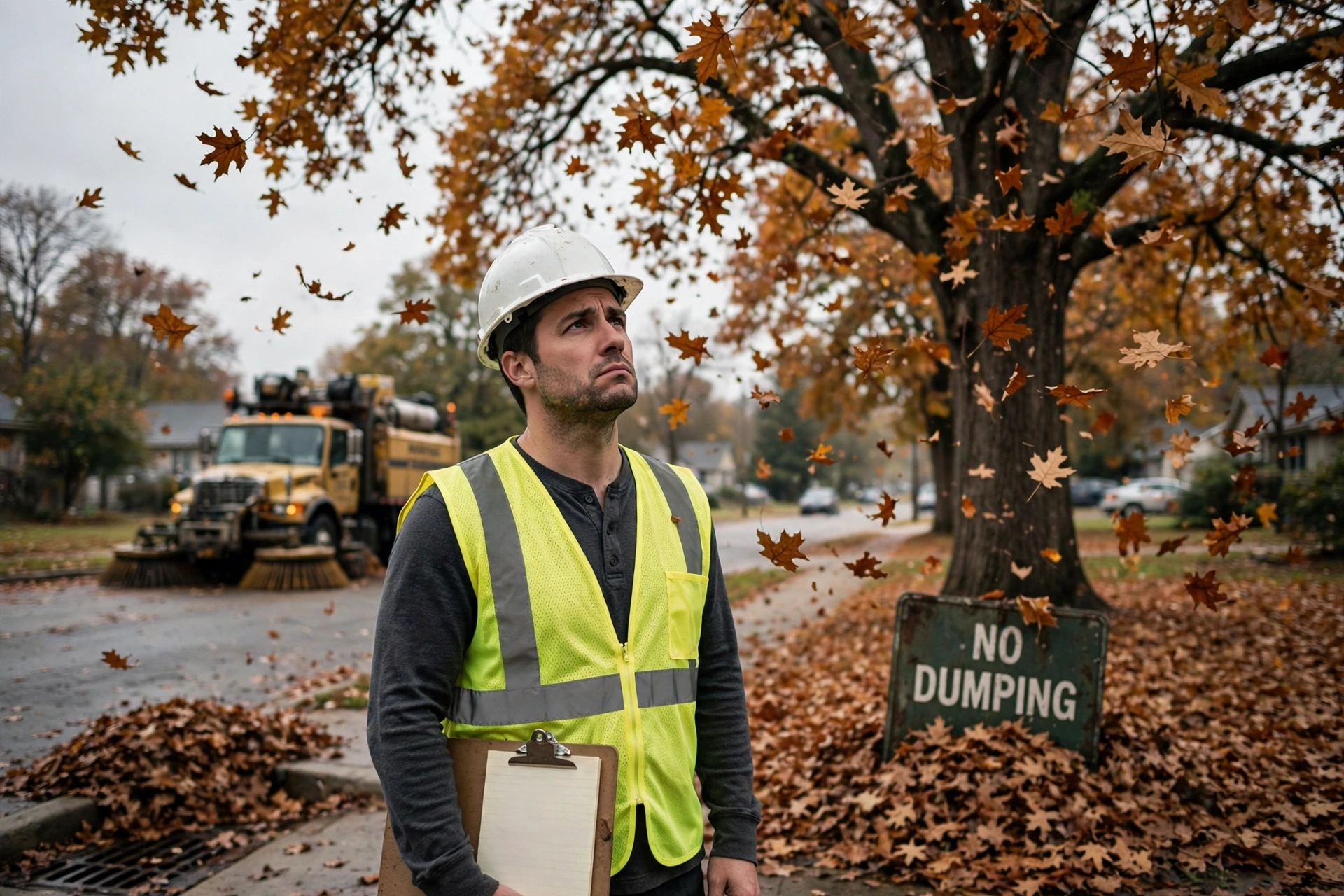
I. The Waste
The Environmental Protection Agency measures the generation, recycling, composting, combustion with energy recovery, and landfilling of yard trimming material in municipal solid waste, which the agency defines to include grass, leaves, and tree and brush trimmings from residential, institutional, and commercial sources.1 In 2018, the agency estimated generation at 35.4 million tons, or 12.1 percent of all municipal solid waste generated in the United States.1 Of that tonnage, an estimated 22.3 million tons were composted or mulched, a 63 percent composting rate; 2.6 million tons were combusted with energy recovery; and landfills received about 10.5 million tons, which comprised 7.2 percent of all municipal solid waste landfilled that year.1
The agency further notes that yard trimmings generation has declined since 1990, and attributes the decline in part to state legislation discouraging yard trimmings disposal in landfills, including source reduction measures such as backyard composting and leaving grass trimmings on the yard.2 The legislation did not reduce the generation of the material. It reduced the counting of the material. The leaves still fall; they are simply no longer weighed at the gate.
Consider the temporal concentration. The 35.4 million tons are not generated evenly across the year. The deciduous fraction, the leaves, is released in a single seasonal pulse across the autumn weeks, by generators that operate no balers, no compactors, no transfer stations, and no permitted disposal facilities of any kind. It is the largest seasonal generation event in the American waste stream, and it is conducted entirely by unpermitted operators.
II. The Ban
The Resource Conservation and Recovery Act, at Section 4005, prohibits the open dumping of solid waste.3 The prohibition is the centerpiece of Subtitle D, the non-hazardous solid waste program: every approved state solid waste management plan must prohibit new open dumps and require the closure or upgrade of every existing one, and any facility failing to meet the criteria in 40 CFR Parts 257 and 258 is, by definition, an open dump.4 The statute was enacted in 1976. The trees were not consulted.
The states have layered their own prohibitions on top. Twenty-four states ban or restrict yard waste disposal, according to industry data; twenty-six states require yard waste to be disposed of separately from the rest of household trash; and Wisconsin, Pennsylvania, and Iowa were the first to enact yard waste bans, in the early 1990s.56 In Iowa, it is illegal to put leaves in the garbage bin for landfill disposal, illegal to blow them into the street, and illegal to burn them in an open fire.7 The leaf, in Iowa, has no lawful destination that does not involve a compost pile.
The municipalities enforce the regime at the curb. In Fair Lawn, New Jersey, dumping or blowing leaves into the street is strictly prohibited, and violators face fines of up to $2,000; the borough’s Recycling Division announced the warning this week, as leaf cleanup gets into full swing across Bergen County.8 In Davenport, Iowa, raking leaves or blowing grass clippings into the street violates City Code Chapter 8.14.400, with a first fine of $100 and subsequent fines of up to $500.7 In Mansfield, Ohio, the city’s 2026 leaf program instructs residents not to place leaves in the streets, citing ordinance 911.06(b), because the practice causes flooding and stormwater problems.9 In Grand Rapids and Lansing, Michigan, it is illegal to rake, pile, or blow leaves or tree branches into city streets or storm drains, and under the state’s littering law, disposing of yard waste in a water body is a civil infraction punishable by fines of $800 to $5,000.10 In Fort Wayne, Indiana, the city’s annual leaf pickup mailers remind residents that throwing leaves in the trash is against city code and can result in a fine, that burning leaves is illegal under state law, and that leaf piles must be kept off the streets and on the curbs.11
The regime is comprehensive. It regulates the homeowner, the landscaper, the renter, and the passerby. It does not regulate the generator.
III. The Generators
The generators hold no waste-generator identification number. They file no manifests. They maintain no operating record, no contingency plan, no financial assurance for closure, and no permitted transfer station, treatment facility, or disposal unit. Every October they discharge the year’s production at the point of generation, directly onto sidewalks, streets, lawns, and storm drains, and then they stand there, unpermitted, while the humans manage the consequences.
The liability, meanwhile, attaches exclusively to the humans who touch the material after it falls. In Fair Lawn, landscapers must purchase a seasonal permit, $100 per truck, to drop leaves at the borough compost center; the hauler is permitted, the generator is not.8 In the District of Columbia, where gas-powered leaf blowers have been banned since January 1, 2022, the District tries to fine the landscaper who operates the blower, and if the landscaper cannot be identified but the complaint is valid, the property owner may be fined instead, up to $500 per offense.12 The enforcement chain runs from the municipality to the landscaper to the homeowner, and stops precisely one link short of the organism that produced the leaves.
The structural problem is definitional, as it always is. The Resource Conservation and Recovery Act addresses itself to persons who generate, transport, treat, store, or dispose of solid waste. The tree is not a person. The tree does not generate, in the sense the statute means; it sheds. It does not dispose, in the sense the statute means; it drops. The most prolific waste generators in the country operate entirely outside the vocabulary of the waste law, which is why fifty years of solid waste regulation has produced exactly zero permitted trees.
IV. The Water
The leaves do not stay where they fall. Rain and melting snow wash whatever is on streets and other paved surfaces down storm drains and into local waterways, and leaves, grass, and dirt contain phosphorus, which feeds the algae that turn lakes green.13 The U.S. Geological Survey’s findings on the subject are stark: fallen leaves in the street are the greatest source of phosphorus from urban stormwater, according to a 2016 study.14 USGS hydrologist Bill Selbig, evaluating the impact of leaf litter on nutrient levels in urban stormwater, found that 27 to 80 percent of a leaf’s initial phosphorus was leachable in the first 24 hours of soaking, which is to say that the pollution begins almost immediately, long before the leaf has visibly decomposed.15
In Madison, Wisconsin, USGS researchers paired catchments to test municipal leaf collection and street cleaning programs and confirmed that fall leaf litter can be a primary source of nutrients in stormwater, particularly phosphorus: where an active, thorough leaf removal and street cleaning program was in place, total and dissolved phosphorus loads fell by 84 and 83 percent, respectively, and total and dissolved nitrogen loads fell by 74 and 71 percent, compared with no program.16 The timing of removal matters, because of the highly leachable nature of leaves; significant reductions are achieved by removing leaf litter before a precipitation event.16 The municipality is, in effect, racing the rain to intercept the tree’s discharge before it reaches the water.
Here the regulatory inversion reaches its purest form. Municipalities hold stormwater discharge permits under the Clean Water Act’s municipal separate storm sewer system program, and the EPA’s own permit materials list decaying organic matter, such as leaf litter and grass clippings, among the phosphorus sources the permits must address.17 The city is the permittee for the tree’s waste. The city did not generate the waste, cannot bill the generator, cannot inspect the generator, and cannot require the generator to implement best management practices, because the generator is a tree. The permit covers the discharge; the discharge is leaves; the leaves are not the city’s. The city holds the paper, and the tree holds the canopy.
V. The Cleanup Economy
The municipalities have built an entire seasonal industry around waste they did not generate. Vacuum trucks, street sweepers, curbside bag programs, drop-off sites, and composting facilities mobilize every October to move the tonnage from where the generators put it to where the law allows it to be. The USGS found that weekly street cleaning with a regenerative-air street cleaner reduced phosphorus loads by 65 to 71 percent, regardless of the leaf collection method.18 The sweepers are the compliance mechanism for a generator that cannot be compelled.
The cleanup equipment, remarkably, is more regulated than the generator. In the District of Columbia, the Leaf Blower Regulation Amendment Act of 2018 took effect on January 1, 2022, prohibiting the sale and use of gasoline-powered leaf blowers, with fines of up to $500 per offense; any person who observes a gas-powered blower in use may file a signed complaint with photographic evidence within seven days.12 More than 170 jurisdictions in 31 states now regulate gas-powered leaf blowers, according to a D.C. Council report.19 The machine that moves the leaves is subject to a signed-complaint enforcement regime with photographic evidence standards. The organism that made the leaves is subject to nothing.
The economics of the material are equally perverse. Large-scale leaf composting reduces the original volume by 40 to 75 percent and the original weight by 50 percent; uncompacted yard waste runs 250 to 500 pounds per cubic yard, while landfilled yard waste compacts to 1,500 pounds per cubic yard.5 New York City’s residential composting mandate, in effect since April 2025, is the largest single organics program in the country.6 The cities spend millions collecting, hauling, and composting 35.4 million tons of material whose producers contribute nothing to the cost of management, hold no franchise agreement, and have never once been sent a bill.
VI. The Enforcement Void
The compliance rate is zero. No deciduous tree has ever obtained a solid waste facility permit. No oak has ever filed a manifest. No maple has ever submitted to an inspection, posted financial assurance, or responded to a notice of violation, because no notice of violation has ever been issued to a tree, because the enforcement apparatus has no form for a tree, and the form it would need does not exist.
The regime’s own concessions are instructive. In Fort Wayne, Indiana, environmental organizers remind residents that there is no ordinance or law requiring leaves to be removed at all; the city criminalizes putting leaves in the trash, criminalizes burning them, and criminalizes putting them in the street, but compels nothing.11 The law is a fence with no gate: the waste may not go here, may not go there, may not go anywhere the city has thought to prohibit, and must go somewhere the city provides, at the city’s expense, on the city’s schedule.
The record, taken as a whole, describes the largest unpermitted solid-waste disposal program in the United States. Its generators produce 35.4 million tons a year. They discharge the entire annual tonnage in a matter of weeks, directly onto public rights-of-way and into the storm sewer system, where the material becomes the greatest source of urban phosphorus pollution. The federal government banned the open dumping of solid waste fifty years ago. The states ban the landfilling of the material in two dozen jurisdictions. The municipalities fine the humans up to $2,000 for mishandling what the trees release for free.
The trees do not recognize the jurisdiction. They do not retain counsel. They do not experience regulatory anxiety. They leaf, they drop, they stand bare through the winter, and they leaf again in the spring, where the municipality has thoughtfully scheduled a vacuum truck. The permit application is not pending. It will not be filed. The inspector is still responsible for every generator in the jurisdiction, and the jurisdiction’s largest generators are in the ground.
Ergo.
Sources
- U.S. Environmental Protection Agency, “Yard Trimmings: Material-Specific Data.” Yard trimmings include grass, leaves, and tree and brush trimmings from residential, institutional and commercial sources. EPA estimated generation of yard trimmings in MSW at 35.4 million tons in 2018, 12.1 percent of MSW generation; 22.3 million tons composted or mulched (63 percent composting rate); 2.6 million tons combusted with energy recovery; landfills received about 10.5 million tons, 7.2 percent of all MSW landfilled. epa.gov ↑
- U.S. Environmental Protection Agency, “National Overview: Facts and Figures on Materials, Wastes and Recycling.” Yard trimmings comprised 35.4 million tons, or 12.1 percent of total generation, in 2018, compared to 35 million tons (16.8 percent) in 1990; the decline since 1990 is largely due to state legislation discouraging yard trimmings disposal in landfills, including source reduction measures such as backyard composting and leaving grass trimmings in the yard. epa.gov ↑
- 40 CFR § 256.26, “Requirement for schedules leading to compliance with the prohibition of open dumping”: “In implementing the section 4005(c) prohibition on open dumping, the State plan shall provide...” ecfr.gov ↑
- U.S. Nuclear Regulatory Commission summary of RCRA: the solid waste program under RCRA Subtitle D “encourages states to develop comprehensive plans to manage nonhazardous industrial solid waste and municipal solid waste, sets criteria for municipal solid waste landfills and other solid waste disposal facilities, and prohibits the open dumping of solid waste.” nrc.gov ↑
- Waste360, “Yard Waste: MSW Facts.” 24 states ban or restrict yard waste disposal. Large-scale leaf composting results in the loss of 40% to 75% of the original volume and 50% of the original weight of the leaves. Uncompacted yard waste density: 250-500 pounds per cubic yard; landfilled: 1,500 pounds per cubic yard. waste360.com ↑
- LawnStarter, “Best States for Waste Management in 2026.” Wisconsin, Pennsylvania, and Iowa were the first states to enact yard waste bans in the early 90s; 26 states currently require yard waste to be disposed of separately from the rest of household trash; New York City’s citywide residential composting mandate, in effect since April 2025, is the largest single organics program in the country. cmmonline.com ↑
- 103 WJOD, “It’s Illegal To Blow Your Leaves Onto The Street In Iowa.” It is illegal to put leaves in the garbage bin for landfill disposal; raking leaves and blowing grass clippings into the street in Davenport violates City Code Chapter 8.14.400, with a first fine of $100 and subsequent fines up to $500; open burning of leaves is also illegal. 103wjod.com ↑
- WMTR AM, “Fair Lawn Offers Three Legal Ways To Get Rid of Yard Waste, With Fines of Up to $2,000 for Violations,” October 22, 2026. Dumping or blowing leaves into the street is illegal and can cost up to $2,000 in fines, per the Fair Lawn Recycling Division; landscapers need a borough permit, $100 per truck per season, to drop leaves at the compost center. wmtram.com ↑
- City of Mansfield, Ohio, “2026 Leaf Pickup Program,” October 2026. “Please, when raking your leaves to the curb, do not place them in the streets. This causes flooding, other storm water related issues, and is a violation of city ordinance #911.06(b).” mansfieldohio.gov ↑
- WGRD, “Michigan Law Prohibits Leaves in Trash, But What About the Street.” In Grand Rapids and Lansing it is illegal to rake, pile, or blow leaves or tree branches into city streets or storm drains; under Michigan’s littering law, disposing of yard waste in a water body is a civil infraction punishable by fines of $800 to $5,000. wgrd.com ↑
- 96.3XKE / Adams Radio, “EcoFest says you can leave the leaves,” October 22, 2026. The City of Fort Wayne mailed annual leaf pickup notices: no leaves in the trash (against city code, fines possible), no burning leaves (illegal in Indiana), keep leaf piles off streets and on curbs; EcoFest notes there is no ordinance or law requiring leaves to be removed. 963xke.com ↑
- District of Columbia Department of Licensing and Consumer Protection, “Leaf Blower Regulations.” The Leaf Blower Regulation Amendment Act of 2018 took effect January 1, 2022, prohibiting the sale and use of gasoline-powered leaf blowers in the District; violations subject to fines of up to $500 per offense; complaints must be signed and filed within seven days. The District tries to fine the landscaper; if the landscaper is not identified but the complaint is valid, the property owner may be fined. dlcp.dc.gov ↑
- Adopt-a-Drain (MS4 program materials), “Prevent Runoff Pollution.” “Rain and melting snow wash anything that’s on streets and other paved surfaces down storm drains and into local waterways... Leaves, grass, and dirt contain phosphorus, which feeds the algae that turn lakes green. Keep them off streets and sidewalks.” ms4.adopt-a-drain.org ↑
- Illinois Extension, “Stormwater Practices.” “The greatest source of phosphorus from urban stormwater is fallen leaves in the street... according to a 2016 U.S. Geological Survey study. When it rains, phosphorus from the nutrient-rich leaves goes directly into storm drains and waterways.” extension.illinois.edu ↑
- MSW Management, “Fall Foliage Fouls Stormwater Runoff” (2018), on USGS hydrologist Bill Selbig’s study: “27 to 80 percent of initial phosphorus was leachable in the first 24 [hours] of soaking.” mswmag.com ↑
- South Dakota State University Extension, “Urban Stormwater Systems and Leaf Litter,” on the USGS Upper Midwest Water Science Center Madison study: with an active, thorough leaf removal and street cleaning program, total and dissolved phosphorus loads were reduced by 84 and 83 percent, respectively, and total and dissolved nitrogen loads by 74 and 71 percent, compared to no leaf removal and street cleaning; the timing of leaf removal is important because of the highly leachable nature of leaves, with significant reductions achieved by removal prior to a precipitation event. extension.sdstate.edu ↑
- U.S. EPA, Fact Sheet Attachment 1: Charles River Basin Nutrient (Phosphorus) TMDLs, 2014 Draft Massachusetts Small MS4 General Permit. Phosphorus sources in the urban landscape include “decaying organic matter (such as leaf litter and grass clippings)”; impervious surfaces collect and transport the loads to surface waters. epa.gov ↑
- U.S. Geological Survey, “Reducing leaf litter contributions of phosphorus and nitrogen to urban stormwater through municipal leaf collection and street cleaning practices.” Catchments receiving weekly street cleaning by a regenerative-air street cleaner had the highest reduction in phosphorus load, 65 to 71 percent for total phosphorus and 57 to 70 percent for dissolved phosphorus. usgs.gov ↑
- DCist, “D.C. Council Strikes Death Blow To Gas-Powered Leaf Blowers” (2018). The Leaf Blower Regulation Amendment Act passed the D.C. Council; per a D.C. Council report, D.C. would join more than 170 jurisdictions in 31 states that regulate gas-powered leaf blowers. dcist.com ↑