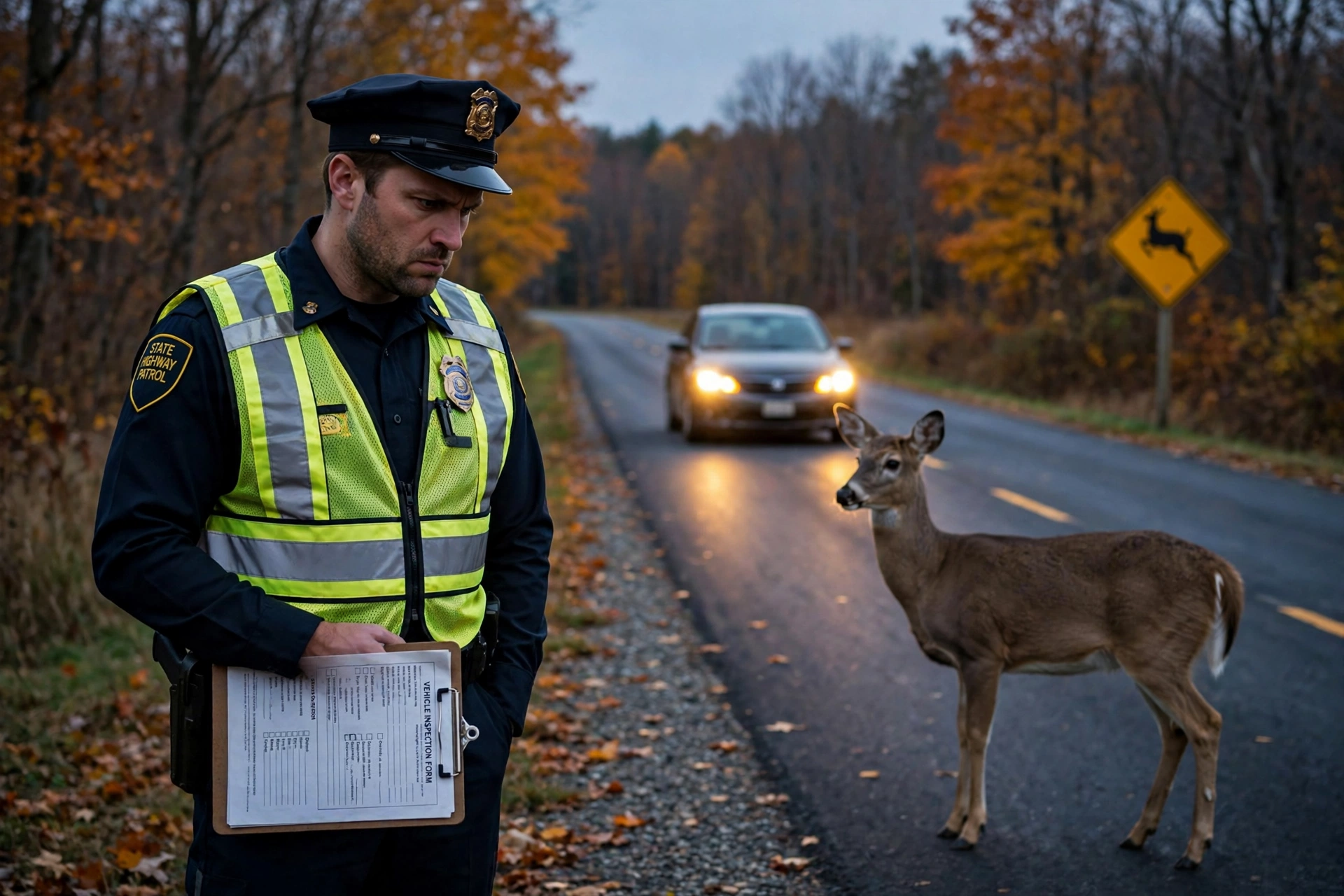
I. The Fleet
The fleet is the most successful large mammal in North America, and its size is not a matter of dispute. The National Deer Association, surveying state and provincial wildlife agencies across the continent, reports roughly thirty to thirty-five million white-tailed deer on the landscape in North America today. Its survey returned an estimate of a little more than twenty-five million from the agencies that responded, and it notes that not every state or province responded, including states with abundant deer populations. Texas alone holds more than five million white-tailed deer. Pennsylvania hunters harvested nearly half a million deer in 2024. The population has increased by about five million over the last two decades.1
The size of the fleet is more remarkable for where it started. From a nadir of approximately three hundred thousand to five hundred thousand individuals in the early nineteen hundreds, after decades of unregulated market hunting, the white-tailed deer recovered to its present abundance under state game management, hunting license revenue, and habitat restoration. The recovery is routinely described as one of the great wildlife conservation stories in American history. It is also, as a matter of arithmetic, the assembly of a fleet of thirty million self-propelled units, each capable of highway operation, under no registration regime of any kind.2
The specifications of the individual unit are documented with the same precision a motor vehicle manufacturer would supply for a new model. White-tailed deer are primarily nocturnal or crepuscular, browsing mainly at dawn and dusk. They sprint at up to thirty miles per hour and leap as high as ten feet and as far as thirty feet in a single bound. They move between feeding areas and bedding cover on a reliable schedule, along the transitions between forest and field, which is to say along the edges of the roads that run between forest and field. A unit capable of thirty miles per hour exceeds the posted speed limit of every twenty-five-mile-per-hour residential street it crosses, and it does so on four legs, at night, without a speedometer.3
The fleet operates in formation. Deer travel in groups and walk single file, so that where one deer crosses, another is commonly right behind it. State safety guidance repeats the warning as a matter of routine: if you see one deer, slow down, because more are following. The convoy does not file a manifest. It does not travel with a lead vehicle. It travels in single file through the dark, and the second unit in the column is, by the accounts of every state agency that issues the warning, usually the one the driver never sees.4
II. The Season
The fleet's operating season is now open, and the insurers have published the schedule. State Farm's national animal-collision ranking for 2025-26, based on data collected between July 1, 2025, and June 30, 2026, estimates approximately 1.6 million animal-vehicle insurance claims across the nation. The national likelihood of an animal collision stands at one in one hundred forty-five licensed drivers, improved from one in one hundred thirty-nine the year before. West Virginia drivers face the highest likelihood, at one in forty-six, followed by Montana at one in fifty-four, Wisconsin at one in sixty-two, Pennsylvania at one in sixty-four, and Michigan at one in sixty-eight. Deer are the most frequently struck animal.5
The claims are not distributed evenly across the calendar. Autumn, including the months of October, November, and December, accounts for an estimated six hundred fifty thousand incidents, or forty-one percent of all animal collision claims in the year. November is the worst month, followed by October and then December. The reason is the rut, the autumn breeding season, during which deer become more active, less wary of roads, and more mobile. In New Jersey, peak mating season typically runs from mid to late October into mid-December. The Pennsylvania Game Commission reports that young bucks can travel several dozen miles looking for new territory during the rut. The fleet's busiest quarter is the quarter in which its units are most distracted, most mobile, and most likely to be on the highway.6
The prior year establishes that the current season is not an anomaly. Between July 1, 2024, and June 30, 2025, there were about one point seven million animal-collision claims, of which deer accounted for more than one point one million, at national odds of one in one hundred thirty-nine, with West Virginia again first at one in forty. The fleet's annual output of collisions has run at or above one point six million claims for consecutive measurement periods. At the current rate, the author's calculation puts the daily average at roughly four thousand four hundred collisions a day across the year, rising to roughly seven thousand a day during the autumn quarter. These are the author's calculations from the insurers' published totals, applied to calendar days, and they are labeled as such.7
Michigan supplies the ground-level record, because Michigan counts its crashes the way other states count their rainfall. The Michigan State Police reported more than fifty-eight thousand deer-vehicle crashes in 2024 across rural, suburban, and city roads, about eighty percent of them on two-lane roads. In 2025, the state recorded sixty thousand nine hundred seven crashes involving animals, more than thirty-one thousand of them on dark, unlighted roads, and about sixteen thousand during daylight hours. Most Michigan crashes happen between eight and nine in the morning and between six and nine in the evening, which is to say at dawn and at dusk, which is to say when the fleet is operating.8
III. The Toll
The claims data counts bent metal. The fatality data counts something else, and the two sets of numbers must not be confused, because they measure different things and they peak in different seasons. The Insurance Institute for Highway Safety reports that two hundred ten people died in 2024 in motor vehicle crashes involving collisions with animals, up from eighty-nine in 1975. In sixty-three percent of those fatal crashes, the collision with the animal was itself the most harmful event, rather than a secondary rollover, a collision with another vehicle, or a collision with a fixed object. The remaining deaths came from rollovers at twelve percent, collisions with vehicles in transport at eight percent, and collisions with fixed objects at eight percent.9
The geography of the deaths differs from the geography of the claims. West Virginia leads the claims ranking, but Texas has recorded the most animal-collision deaths of any state over the past decade, with one hundred ninety-seven deaths between 2015 and 2024, followed by Pennsylvania at one hundred twenty-seven and Michigan at one hundred nineteen. The difference reflects population and driving exposure rather than individual risk. The deaths also peak in a different season than the claims: in 2024, the highest number of animal-collision deaths occurred from July through September, not in the October through December window that leads the claims data. This investigation reports both peaks, because a publication that reported only the autumn peak would be selecting the season that fits its thesis, and the thesis does not need the help.10
At two hundred ten deaths in a year, the author's calculation puts the average at one death roughly every forty-two hours. The calculation is the author's, from the Institute's published annual total, and it is labeled as such. The figure is not the largest annual death toll on American highways by any measure. It is the death toll attributable to collisions with animals, most of them deer, in a system in which one party to every collision is registered, licensed, insured, and lighted, and the other party is none of those things.11
IV. The Definition
The California Vehicle Code defines its terms before it imposes its duties, and the first definition is the one on which this investigation rests. Section 415, subdivision (a), provides that a motor vehicle is a vehicle that is self-propelled. The definition contains no requirement of an engine, a chassis, a manufacturer, or a model year. It requires self-propulsion. A white-tailed deer is self-propelled. It propels itself at thirty miles per hour, over ten-foot obstacles, across thirty-foot gaps, and onto highways, under its own power, without assistance, towing, or external motive force of any kind.12
Section 670 supplies the definition beneath the definition. A vehicle is a device by which any person or property may be propelled, moved, or drawn upon a highway, excepting a device moved exclusively by human power or used exclusively upon stationary rails or tracks. The deer is not moved exclusively by human power. No human power moves it at all. It is not used exclusively upon stationary rails or tracks. It is used upon highways, at dawn and dusk, in the autumn, in groups, in single file, at thirty miles per hour. The two definitions together describe a self-propelled device operating on a highway. The word device will return in Section IX, where it belongs, and where it will be dealt with honestly.13
The duties that follow from the definitions are stated in the same code, in the same plain terms. Section 4000, subdivision (a), paragraph (1), provides that a person shall not drive, move, or leave standing upon a highway, or in an offstreet public parking facility, any motor vehicle, trailer, semitrailer, pole or pipe dolly, or logging dolly, unless it is registered and the appropriate fees have been paid. The prohibition covers driving, moving, and standing. A deer on a highway is standing, or moving, or both in succession, and it is doing so without registration and without the payment of any fee. No deer has ever paid a registration fee. No deer has ever displayed a plate. No deer has ever carried a registration card.14
The registration system presumes an owner, an address, and a vehicle identification number, and it issues a plate that links the three. The deer has none of the three in any form the Department of Motor Vehicles would recognize. It has a range, not an address. It has a herd, not an owner. It has antlers, in season, not a number. The system that registers every vehicle in America has never registered one deer, because no deer has ever presented itself for registration, and no department has ever asked it to.15
V. The Paperwork Void
Consider the complete documentary record of a single deer on a single highway on a single November evening. There is no title, because no state has titled a deer. There is no registration, because no state has registered a deer. There is no certificate of ownership, because no person owns a deer in the sense the Vehicle Code means by owner, which is a person having all the incidents of ownership, including the legal title. The deer is wildlife, held in trust by the state and managed through hunting seasons, and the state's paperwork for deer authorizes the taking of deer under hunting licenses. It does not authorize the operation of deer on highways. The harvest figures prove the licensing system exists: Pennsylvania hunters harvested nearly half a million deer in 2024. No harvest figure, in any state, in any year, has ever been accompanied by a registration figure, because there is none.16
The same void covers the entire fleet. Thirty to thirty-five million white-tailed deer operate across North America, and the documentary record of their highway operation consists of insurance claims filed by the other party, police crash reports filed about the other party, and fatality statistics compiled from the other party's crashes. The deer contributes no document to any of these files. It contributes the collision. The file is complete in every respect except the one the file is about: the identity, registration, and insurance of the unit that entered the highway.17
The asymmetry with the registered fleet makes the point concrete. A licensed driver operates a manufactured vehicle that carries a plate on its rear, a registration card in its glove compartment, a title in a drawer at home, and a vehicle identification number stamped into its frame. The vehicle can be identified after it is stolen, wrecked, or sold. The deer cannot be identified after it is struck, because it was never identified before it was struck. It carries no plate, no card, no title, and no number. Its service life is measured in years, not hours, and its highway career is measured in crossings, not miles, and at the end of neither period does any database hold a record of it.18
VI. The Lights
The headlamp rule is the one that governs the fleet's operating hours, and it is precise about equipment. Section 24400 provides that a motor vehicle, other than a motorcycle, shall be equipped with at least two headlamps, with at least one on each side of the front of the vehicle, located at a height of not more than fifty-four inches nor less than twenty-two inches, and shall be operated during darkness, or inclement weather, or both, with at least two lighted headlamps. Two lamps, one on each side of the front, lighted, during darkness. The rule states the number, the placement, the height, and the condition.19
The fleet operates during darkness without any of it. White-tailed deer are primarily nocturnal or crepuscular, browsing mainly at dawn and dusk, and the crash record confirms the hours: in Michigan, most crashes happen between eight and nine in the morning and between six and nine in the evening, and more than thirty-one thousand of the state's 2025 animal crashes happened on dark, unlighted roads. The deer enters the highway in the dark, in the hours the headlamp rule governs, carrying no lamp of any kind. Its eyes return light. They do not produce it. The shine in a driver's headlights is reflected light, borrowed from the vehicle the deer is about to meet, and it is not a headlamp in any sense the statute recognizes, because it is not a lamp, it is not lighted, and it is not under the deer's control.20
The placement is wrong as well as the equipment. The statute requires one lamp on each side of the front of the vehicle. A deer's eyes sit on the sides of its head, facing sideways, which is the arrangement evolution produced for detecting predators across a wide field of view, not the arrangement the Vehicle Code prescribes for illuminating a roadway. A deer approaching a highway head-on presents the driver with the narrowest possible profile and no forward light at all. A deer crossing presents a flank. In neither attitude does it present two lighted lamps, one on each side of its front, at a height between twenty-two and fifty-four inches, because it presents no lamps, and its front is a nose.21
VII. The License and the Insurance
The license rule is stated in a single sentence. Section 12500, subdivision (a), provides that a person may not drive a motor vehicle upon a highway, unless the person then holds a valid driver's license issued under this code, except those persons who are expressly exempted under this code. The exemption list does not include deer. No deer has ever held a valid driver's license issued under the code of any state. No deer has ever passed a written examination, a vision screening, or a behind-the-wheel test. No deer has ever been photographed for a license card, because no department has ever issued a deer a card.22
The insurance rule is stated with equal plainness. Drivers must carry proof of insurance at all times, and California law requires drivers to maintain financial responsibility, with minimum liability coverage prescribed by statute. Driving without insurance is itself an infraction, carrying fines of one hundred to two hundred dollars for a first offense and two hundred to five hundred dollars for a repeat offense within three years. No deer has ever carried proof of insurance. No deer has ever maintained financial responsibility. No deer has ever paid a fine for driving without insurance, because no deer has ever been cited for it, and no deer has ever been stopped.23
The consequence of the insurance void falls entirely on the registered party. State Farm advises drivers that comprehensive coverage typically covers repairs for collisions with animals after the driver's deductible. The deductible is paid by the driver. The premium is paid by the driver. The claim is filed by the driver. The deer pays nothing, because the deer carries no policy, and the system that pays for the damage is the system that insures the vehicle that was damaged, not the unit that caused the damage. In one point six million claims a year, the insured party is, without exception, the party that was not the deer.24
VIII. The Scene of the Accident
The duties after a collision are the most specific duties in the code, and they are the duties the fleet violates most completely. Section 20002 provides that a driver involved in an accident that results only in property damage must immediately stop at the scene, provide the owner or person in control of the damaged property with the driver's name and current residence address and vehicle registration number, and, if the owner is not present, leave a conspicuous written notice on the damaged property and notify the police without unnecessary delay. Failure to comply is a misdemeanor, carrying up to six months in a county jail, a fine of up to one thousand dollars, and two points on the driver's record.25
The deer stops for nothing. In every collision in which the deer survives, it leaves the scene, without stopping, without providing a name, without providing an address, without providing a registration number it does not have, and without leaving a conspicuous written notice on the damaged vehicle. It leaves no note because it carries no paper, and it notifies no police department because it has no telephone, and it does not wait for the owner of the damaged property because the owner is standing in the road watching it leave. Minnesota's safety guidance describes what the deer does instead of stopping: deer stop in the middle of a lane, cross and then quickly re-cross, and sometimes move toward an approaching vehicle rather than away from it. The guidance does not list leaving a note among the observed behaviors.26
The arithmetic of the violation, if violation it were, is precise. At one thousand dollars per misdemeanor failure to stop, one point six million collisions a year represent one point six billion dollars in potential fines, before penalty assessments, before restitution, before the two points per offense that would suspend any driver's license several hundred thousand times over. These are the author's calculations from the statute's published penalty and the insurers' published claim totals, applied to the full claim count, and they are labeled as such. The figures are hypothetical. The principle, as always in this publication, is not.27
IX. The Definitional Escape Hatch
A careful reader will have noticed the difficulties, and there are five of them. First, the definition of vehicle requires a device, and a deer is not a device. Section 670 defines a vehicle as a device by which any person or property may be propelled, moved, or drawn upon a highway. A deer is an animal, not a device, and no court has held that an animal is a device within the meaning of the Vehicle Code. The self-propulsion definition in Section 415 applies to vehicles, and a deer becomes a vehicle only if it first qualifies as a device, which it does not.28
Second, the duties of registration, licensing, insurance, and stopping all fall on persons. Section 4000 prohibits a person from driving an unregistered motor vehicle. Section 12500 prohibits a person from driving without a license. The code defines person to include a natural person, a firm, a copartnership, an association, a limited liability company, or a corporation. A deer is none of these. It is not a natural person, and it is not a firm. The duties run to persons, and the deer is not a person in any sense the code recognizes.29
Third, the hit-and-run statute requires knowledge and willfulness. A conviction under Section 20002 requires proof that the defendant knew an accident occurred and willfully failed to stop or provide information. A deer that flees a collision is fleeing a predator response, not willfully evading a statutory duty it cannot comprehend. This investigation cannot show that any deer knew it had been involved in an accident within the meaning of the statute, and it does not claim to. It claims only that no deer stopped, which is true in the same way that no deer filed a claim.
Fourth, the insurers' claim counts cover collisions with all animals, not deer alone. State Farm's ranking is based on comprehensive and collision claims involving animals of every species, including dogs, raccoons, cattle, coyotes, cats, turkeys, hogs, and bears, and its state-by-state likelihood is calculated from licensed-driver data. Deer are the most frequently struck animal, and in the prior measurement year they accounted for more than one point one million of one point seven million claims, but the current year's total of one point six million is an all-animals figure, not a deer-only figure. This investigation does not claim otherwise. It claims that the fleet is the largest contributor to the total, which the prior year's species breakdown supports.30
Fifth, the fatality data counts animal strikes generally, not deer strikes specifically, and its seasonal peak differs from the claims peak. The Institute's two hundred ten deaths in 2024 are deaths in crashes whose first harmful event was a collision with an animal of any species, and the highest number of those deaths occurred from July through September, not in the autumn quarter. The claims peak and the deaths peak measure different things, and a reader who conflates them will conclude that autumn is the deadliest season for animal collisions, which the fatality data does not support. This investigation reports both peaks, in Section III, for exactly that reason.
This investigation declines to use the hatch. The facts are what the facts are. The definition says what the definition says. The fleet does what the fleet does, every autumn, at dawn and dusk, at thirty miles per hour, in single file, with no registration, no insurance, no headlamps, and no license. The hatch is there for anyone who wants it. The highway is not using it.
X. Conclusion
The evidence assembled in these pages requires no interpretive leap. The definition establishes that a motor vehicle is a vehicle that is self-propelled. The registration rule establishes that no person shall drive, move, or leave standing upon a highway any motor vehicle unless it is registered and the appropriate fees have been paid. The license rule establishes that no person may drive a motor vehicle upon a highway unless the person holds a valid driver's license. The insurance rule establishes that drivers must carry proof of financial responsibility at all times. The headlamp rule establishes that a motor vehicle operated during darkness shall carry at least two lighted headlamps, one on each side of the front of the vehicle.
The same body of law establishes that none of this reaches the deer.
If the deer of a single continent were a single fleet, it would operate thirty to thirty-five million units, run them at thirty miles per hour across ten-foot obstacles and thirty-foot gaps, move them most actively at dawn and dusk during the autumn rut, collide with insured vehicles approximately one point six million times a year at a rate of roughly four thousand four hundred a day, concentrate six hundred fifty thousand of those collisions into the autumn quarter, kill two hundred ten people a year in the crashes that follow, carry no registration, no proof of insurance, no headlamps, and no license for any unit in the fleet, and leave the scene of every survivable collision without stopping, without a name, and without a note. The state would require it to register its units. The state would require its operators to be licensed. The state would require it to carry insurance. The headlamp rule would require two lighted lamps during darkness. Instead the fleet is made of deer, and the law requires of deer exactly what it requires of any other animal, which is nothing, until it steps onto a highway, at which point it requires nothing still, but faster.
The regulatory framework that governs motor vehicles can be summarized in four propositions. The vehicle must be registered. The driver must be licensed. The operation must be insured. The lights must be shown at night. The largest unregistered, uninsured, unlighted, and unlicensed fleet on American highways is not built, not bought, and not titled. It is grown, it is managed by the states that decline to register it, and it crosses the highway at dusk, in single file, at thirty miles per hour, while the insured party brakes. Every collision in the autumn quarter is a collision with a unit that holds no registration, no insurance, no headlamps, and no license. The data exists in claim files and crash reports. It contributes to no vehicle database and activates no enforcement action.
The standard protects the point of operation. The registration system protects the identity of the vehicle. Nothing protects the two-lane road at dusk in November, the stretch in which the claims peak, in the dark, in the rut, with a second deer following the first in single file through the headlights.
The state built a registration apparatus. It pointed it at the people who build vehicles. It wrote no provision for the vehicles that grow.
Ergo.
Sources
- National Deer Association, "How Many White-Tailed Deer Are There in North America?": recent estimates indicate roughly 30 to 35 million white-tailed deer in North America; a survey of state and provincial wildlife agencies returned an estimate of a little more than 25 million, with not every state or province responding; Texas holds over 5 million whitetails; Pennsylvania hunters harvested nearly half a million deer in 2024; populations have increased by about 5 million over the last two decades. deerassociation.com ↑
- White-tailed deer population history: from a nadir of approximately 300,000 to 500,000 individuals in the early 1900s, modern wildlife management rebuilt populations to current levels; Texas estimated at 5.5 million deer; Upper Midwest states support 1.2 to 1.8 million deer each. findyourunit.com ↑
- National Geographic, "White-Tailed Deer": white-tailed deer are primarily nocturnal or crepuscular, browsing mainly at dawn and dusk; they sprint up to 30 miles per hour and leap as high as 10 feet and as far as 30 feet in a single bound. nationalgeographic.com ↑
- Pennsylvania Game Commission guidance, via October 2026 collision-season reporting: deer often travel in groups and walk single file, so another deer could be right behind the first; if you see one deer, slow down and watch for more. pinscene.com ↑
- State Farm national animal-collision ranking for 2025-26, data July 1, 2025, to June 30, 2026, reported September 2026: an estimated 1.6 million animal-vehicle insurance claims nationwide; national likelihood 1 in 145, improved from 1 in 139 the prior year; West Virginia 1 in 46, Montana 1 in 54, Wisconsin 1 in 62, Pennsylvania 1 in 64, Michigan 1 in 68; deer the most frequently struck animal; collisions most likely in fall. lansingstatejournal.com ↑
- State Farm: autumn months October, November, and December account for an estimated 650,000 incidents, or 41% of all animal collision claims; November the worst month, followed by October and December; fall the season deer are more active heading into the rut; New Jersey peak mating season mid to late October into mid-December; young bucks can travel several dozen miles looking for new territory. repairerdrivennews.com pinscene.com ↑
- State Farm prior-year data, July 1, 2024, to June 30, 2025: about 1.7 million animal-collision claims, deer more than 1.1 million of them; national odds 1 in 139; West Virginia 1 in 40; Pennsylvania approximately 147,000 estimated industry claims. Author's calculations: 1,600,000 divided by 365 is 4,384 per day; 650,000 divided by 92 autumn days is 7,065 per day. worlddeer.org ↑
- Michigan State Police: more than 58,000 deer-vehicle crashes in 2024 across rural, suburban, and city roads, about 80% on two-lane roads; 60,907 crashes involving animals in 2025, more than 31,000 on dark, unlighted roads, about 16,000 during daylight hours; most Michigan crashes between 8 and 9 a.m. and between 6 and 9 p.m. lansingstatejournal.com pinscene.com ↑
- Insurance Institute for Highway Safety, Fatality Statistics, Collisions with Fixed Objects and Animals: 210 motor vehicle crash deaths in collisions with animals in 2024, up from 89 in 1975; collision with an animal the most harmful event in 133 deaths (63%), rollover in 26 (12%), collision with a vehicle in transport in 16 (8%), collision with a fixed object in 16 (8%). iihs.org ↑
- Animal-collision deaths by state over ten years: Texas 197 deaths 2015-2024, Pennsylvania 127, Michigan 119, Wisconsin 117, Ohio 73; in 2024 the highest number of animal-collision deaths occurred July through September, not October through December. worlddeer.org pinscene.com ↑
- Author's calculation from footnote 9: 210 deaths per year is one death every 41.7 hours (365 days times 24 hours divided by 210). ↑
- California Vehicle Code section 415, subdivision (a): "A 'motor vehicle' is a vehicle that is self-propelled." lawserver.com ↑
- California Vehicle Code section 670: "A 'vehicle' is a device by which any person or property may be propelled, moved, or drawn upon a highway, excepting a device moved exclusively by human power or used exclusively upon stationary rails or tracks." law.justia.com ↑
- California Vehicle Code section 4000, subdivision (a), paragraph (1): "A person shall not drive, move, or leave standing upon a highway, or in an offstreet public parking facility, any motor vehicle, trailer, semitrailer, pole or pipe dolly, or logging dolly, unless it is registered and the appropriate fees have been paid." california.public.law ↑
- Author's application of footnotes 12, 13, and 14: the registration system presumes an owner, an address, and a vehicle identification number; no deer has ever presented itself for registration. ↑
- Author's application of footnote 1: Pennsylvania hunters harvested nearly half a million deer in 2024 under state hunting seasons; no harvest figure in any state has ever been accompanied by a registration figure. The Vehicle Code's definition of owner as a person having all the incidents of ownership, including legal title, appears in section 460, summarized in the terms accompanying section 415. deerassociation.com lawserver.com ↑
- Author's summary: the documentary record of deer highway operation in insurance claims, police crash reports, and fatality statistics, as cited in footnotes 5 through 10, contains no registration, title, or insurance document for any deer. ↑
- Author's application of footnotes 12, 13, and 14 to the registered fleet: a manufactured vehicle carries a plate, a registration card, a title, and a vehicle identification number; a deer carries none of these. ↑
- California Vehicle Code section 24400: a motor vehicle, other than a motorcycle, shall be equipped with at least two headlamps, with at least one on each side of the front of the vehicle, located at a height of not more than 54 inches nor less than 22 inches, and shall be operated during darkness, or inclement weather, or both, with at least two lighted headlamps. leginfo.legislature.ca.gov ↑
- Author's application of footnotes 3, 8, and 19: deer are most active at dawn and dusk; most Michigan crashes occur at dawn and dusk and on dark, unlighted roads; a deer's eyes return light but produce none. ↑
- Author's application of footnotes 3 and 19: the statute requires one lamp on each side of the front of the vehicle; a deer's eyes sit on the sides of its head, facing sideways. ↑
- California Vehicle Code section 12500, subdivision (a): "A person may not drive a motor vehicle upon a highway, unless the person then holds a valid driver's license issued under this code, except those persons who are expressly exempted under this code." california.public.law ↑
- California Vehicle Code section 16028: drivers must carry proof of insurance at all times; section 16056 prescribes minimum liability coverage; section 16029 makes driving without insurance an infraction carrying fines of $100 to $200 for a first offense and $200 to $500 for a repeat offense within three years. vazirilaw.com legalclarity.org ↑
- State Farm: "Comprehensive coverage typically covers repairs for collisions with animals after your deductible." repairerdrivennews.com ↑
- California Vehicle Code section 20002: a driver involved in an accident resulting only in property damage must immediately stop, provide name, current residence address, and vehicle registration number, and, if the owner is not present, leave a conspicuous written notice and notify police without unnecessary delay; failure to comply is a misdemeanor carrying up to six months in county jail, a fine up to $1,000, and two points on the driving record. esfandilawfirm.com ↑
- Minnesota Department of Public Safety guidance, via October 2026 collision reporting: deer stop in the middle of a lane, cross and then quickly re-cross, and sometimes move toward an approaching vehicle rather than away from it. vehq.com ↑
- Author's calculations from footnotes 5 and 25: $1,000 multiplied by 1,600,000 claims is $1,600,000,000 in potential fines; two points per offense applied to 1,600,000 offenses is 3,200,000 points. Fleet sizes and offense counts are hypothetical applications of published figures. ↑
- Author's application of footnote 13: Section 670 defines a vehicle as a device; a deer is an animal, not a device; no court has held that an animal is a device within the meaning of the Vehicle Code. ↑
- California Vehicle Code section 470, as summarized in the terms accompanying section 415: "Person" includes a natural person, firm, copartnership, association, limited liability company, or corporation. lawserver.com ↑
- State Farm methodology, via October 2026 reporting: the analysis is based on comprehensive and collision claims involving animals in all 50 states and the District of Columbia, including dogs, raccoons, cattle, coyotes, cats, turkeys, hogs, bears, and other species; state likelihood calculated from licensed-driver data; deer the most frequently struck animal. lansingstatejournal.com glassbytes.com ↑