I. The Protective System
The Occupational Safety and Health Administration's excavation standard, at 29 CFR Part 1926, Subpart P, is among the most categorical rules in the construction code. Section 1926.652(a)(1) provides that each employee in an excavation shall be protected from cave-ins by an adequate protective system designed in accordance with the sloping, benching, shoring, or shielding options of the section, except when the excavation is made entirely in stable rock or when the excavation is less than five feet in depth and examination of the ground by a competent person provides no indication of a potential cave-in. The exception is narrow, and it is the only one. There is no third path.1
The protective system must have the capacity to resist without failure all loads that are intended or could reasonably be expected to be applied or transmitted to the system, under 29 CFR 1926.652(a)(2). Where the employer chooses sloping, the default option at 1926.652(b)(1)(i) requires excavation at an angle not steeper than one and one-half horizontal to one vertical, which is 34 degrees measured from the horizontal, unless the employer uses one of the other options. A vertical wall is not a slope. A vertical wall is the condition the slope exists to prevent.2
The reason for the categorical rule is stated by the agency in plain terms. Excavation and trenching are among the most hazardous construction operations, cave-ins pose the greatest risk, and cave-ins are much more likely than other excavation accidents to result in worker fatalities. One cubic yard of soil can weigh as much as a car. The agency's own releases repeat the comparison because the weight is the point: a small collapse is a fatal collapse.3
The death toll is what moved the rule from guidance to enforcement. The Department of Labor reported that worker deaths in trench collapses fell from 39 in 2022 to 15 in 2023 and 12 in calendar year 2024, following intensive outreach, state plan work, and aggressive enforcement under a zero tolerance policy for unprotected trenches, including immediate inspections and referrals for criminal prosecution where warranted. By July 28, 2025, the agency was warning again: 11 trench-related fatalities had already been reported that year, after a series of collapses in the Midwest. The rule saves lives when it is followed. The rule is followed only where an inspector can reach.4
II. The Specific Requirements
Subpart P does not stop at the protective system. Section 1926.651(c)(2) provides that a stairway, ladder, ramp, or other safe means of egress shall be located in trench excavations that are four feet or more in depth so as to require no more than 25 feet of lateral travel for employees. The threshold for egress is a foot lower than the threshold for cave-in protection, because a worker who cannot get out of a trench does not need a cave-in to be in danger.5
Section 1926.651(j)(2) requires excavated material and equipment to be kept at least two feet from the edge of the excavation, so that loose soil cannot fall back into the trench onto the worker below. Section 1926.651(k)(1) requires daily inspections of excavations, the adjacent areas, and protective systems by a competent person for evidence of a situation that could result in possible cave-ins, indications of failure of protective systems, hazardous atmospheres, or other hazardous conditions, conducted prior to the start of work and as needed throughout the shift, and also after every rainstorm or other hazard-increasing occurrence. The rainstorm clause matters. Rain changes the ground. The standard knows it.6
Where the competent person finds evidence of such a situation, 1926.651(k)(2) requires exposed employees to be removed from the hazardous area until the necessary precautions have been taken to ensure their safety. The sequence is mandatory and in order: inspect, find, remove, correct, return. No step may be skipped. No step may be performed by the excavation itself.
III. The Definitions
Subpart P defines its terms at 29 CFR 1926.650(b), and the definitions do the enforcement work. An excavation is any man-made cut, cavity, trench, or depression in an earth surface, formed by earth removal. A trench is a narrow excavation, in relation to its length, in which the depth is greater than the width and the width at the bottom does not exceed 15 feet. A cave-in is the separation of a mass of soil or rock material from the side of an excavation, or the loss of soil from under a trench shield or support system, and its sudden movement into the excavation, either by falling or sliding, in sufficient quantity so that it could entrap, bury, or otherwise injure and immobilize a person.7
A competent person is one who is capable of identifying existing and predictable hazards in the surroundings, or working conditions which are unsanitary, hazardous, or dangerous to employees, and who has authorization to take prompt corrective measures to eliminate them. The definition has two elements, and both are required: capability and authorization. A bystander who can see the hazard but cannot stop the work is not a competent person. A supervisor who can stop the work but cannot see the hazard is not one either.8
The scope provision at 1926.650(a) states that the subpart applies to all open excavations made in the earth's surface, and that excavations are defined to include trenches. The agency has confirmed in interpretation letters that the definition of excavation carries no minimum length, because the danger of a cave-in in an excavation five feet or more in depth does not significantly vary based on its length. A short trench kills as thoroughly as a long one. Depth, not distance, is the measure.9
IV. The Target
The material being excavated is the hazard. Soil is not light because it is familiar. A cubic yard of it weighs as much as a car, and wet soil weighs more, which is why the inspection duty attaches after every rainstorm. The trench fatality figures in Section I are not abstractions. They are the reason the five-foot line exists, the reason the two-foot spoil rule exists, and the reason the daily inspection exists. Every clause of Subpart P is a response to a body recovered from a trench that had none of these protections.
The agency's enforcement posture confirms the stakes. The zero tolerance policy for unprotected trenches brings immediate inspections and referrals for criminal prosecution where warranted. The Department of Labor counts the dead by year, 39, then 15, then 12, and reports the decline as the product of enforcement. The implication is unambiguous: where the standard reaches, fewer workers die. Where it does not reach, the count is not kept.
V. The Operator
The common earthworm, Lumbricus terrestris, called the nightcrawler in the United States, is a large worm, usually four to eight inches or more, growing to 14 inches and living up to six years in the wild. It is indigenous to Europe and now abundant in North America. It belongs to a group known as deep burrowers. Kansas State University's extension service describes the group precisely: the deep burrowers build large, vertical, permanent burrows that may reach as deep as five or six feet.10
Other authorities put the depth higher. National Geographic reports that nightcrawlers are capable of digging down as deep as 6.5 feet. The University of California's agriculture division reports that nightcrawlers are vertical burrowers capable of digging down as deep as eight feet in moist soil. Every cited depth exceeds the five-foot protective-system threshold. The most conservative figure in the literature already triggers the rule. The higher figures exceed it by three feet.11
The burrow is vertical. That is not a detail. A vertical shaft stands at 90 degrees from the horizontal. The default sloping option permits 34 degrees. The worm's excavation exceeds the maximum allowable steepness by 56 degrees, with no bench, no step, and no horizontal level anywhere in its length. It is deeper than it is wide, and its width at the bottom is far below 15 feet, so by geometry alone it satisfies the definition of a trench. It satisfies every dimensional element of the regulated thing, in the most unprotected configuration the regulation contemplates.
The worm also violates the spoil rule at the surface. Nightcrawlers leave small cone-shaped piles of castings, called middens, in the middle of a lawn or orchard, consisting of worm castings mixed with plant residues. Kansas State notes that these bumps are randomly spaced rather than in a run, like moles, and that the middens may be used for protection and food reserves. The spoil is deposited at the mouth of the excavation, not two feet back from the edge. The distance required by 1926.651(j)(2) is two feet. The distance observed is zero.12
National Geographic reports that an earthworm can eat up to one third of its body weight in a day, consuming soil and extracting nutrients from decomposing organic matter as it burrows. The eating is the excavating. The worm does not operate a machine that removes earth. It removes earth by passing it through its body, and it deposits the removed earth on the surface as castings. The excavation advances at the speed of digestion, which is to say continuously, including at night, when the worm emerges to feed above ground and the reason for its common name is on display.13
VI. The Scale
Charles Darwin spent the last decades of his life weighing worm castings. His final book, The Formation of Vegetable Mould, through the Action of Worms, published in 1881, reported measurements taken by collecting, drying, and weighing the castings over a given space of ground. The contemporary reviews summarized the result: in many parts of England, worms bring about ten tons of soil per acre to the surface annually, and two of Darwin's calculations gave much larger amounts, namely 16.1 and 18.12 tons per acre. A summary in Popular Science Monthly put the measured range at 7.56 to 15.12 tons per acre in one year, a volume sufficient to spread a layer of soil from one to more than two inches thick over the whole surface in ten years.14
The New York Public Library, summarizing the same work, notes that Darwin concluded it may be doubted whether any other animals played so important a part in the history of the world as these lowly organized creatures, and that the worm book sold more copies than his earlier books. The man who rewrote the history of life ended his career weighing worm excrement, and the public bought it. The public was right. The numbers justified the attention.15
A contemporary review of Darwin's book added the workforce figure: if it is correct that in an ordinary acre of ground 53,767 worms may exist, the cumulative power of the agricultural army is easy to conceive, and if ten tons of dry earth is annually brought to the surface of each acre in some parts of England, the debt is easy to conceive as well. The review's arithmetic is the investigation's arithmetic. At ten tons per acre per year, a single acre moves 100 tons per decade. A 100-acre field moves 1,000 tons per year. No licensed excavation contractor in the county moves earth at that rate with a workforce that fits in a bucket.16
The burial record proves the rate independently of the weighings. At Abinger in Surrey, the remains of an ancient Roman villa were found in 1877 beneath 11 to 16 inches of mould over a tessellated floor, and 13 to 15 inches over the broken summit of a wall, laid down in large part by the action of worms. Coins, gold ornaments, and stone implements dropped on the surface will infallibly be buried by worm castings in a few years, according to the same summary, and thus safely preserved until the land is turned up. The worms do not merely move soil. They bury history under it, at a measurable rate, in the open, where anyone with a scale and a quadrat could have cited them.17
VII. The Competent Person Void
No competent person inspects a worm burrow. No inspection occurs prior to the start of work, because the work never starts in any sense the standard recognizes; it continues, season after season, from the same permanent burrow. No inspection occurs as needed throughout the shift, because there is no shift. No inspection occurs after every rainstorm, although the rainstorm is precisely when the hazard increases and precisely when the worm is most active, emerging onto wet ground to feed and cast.
The inspection duty and the worm's schedule are perfectly, inversely aligned. The standard demands reinspection when rain makes the ground heavier and more likely to collapse. Rain is what brings the worm to the surface. The competent person is required to be present at the moment the ground is most dangerous. The worm is present at the moment the ground is most dangerous. The competent person is absent. The worm is not a competent person. It cannot identify existing and predictable hazards in the surroundings, and it has no authorization to take prompt corrective measures to eliminate them. It has no authorization to take any measure. It has setae.
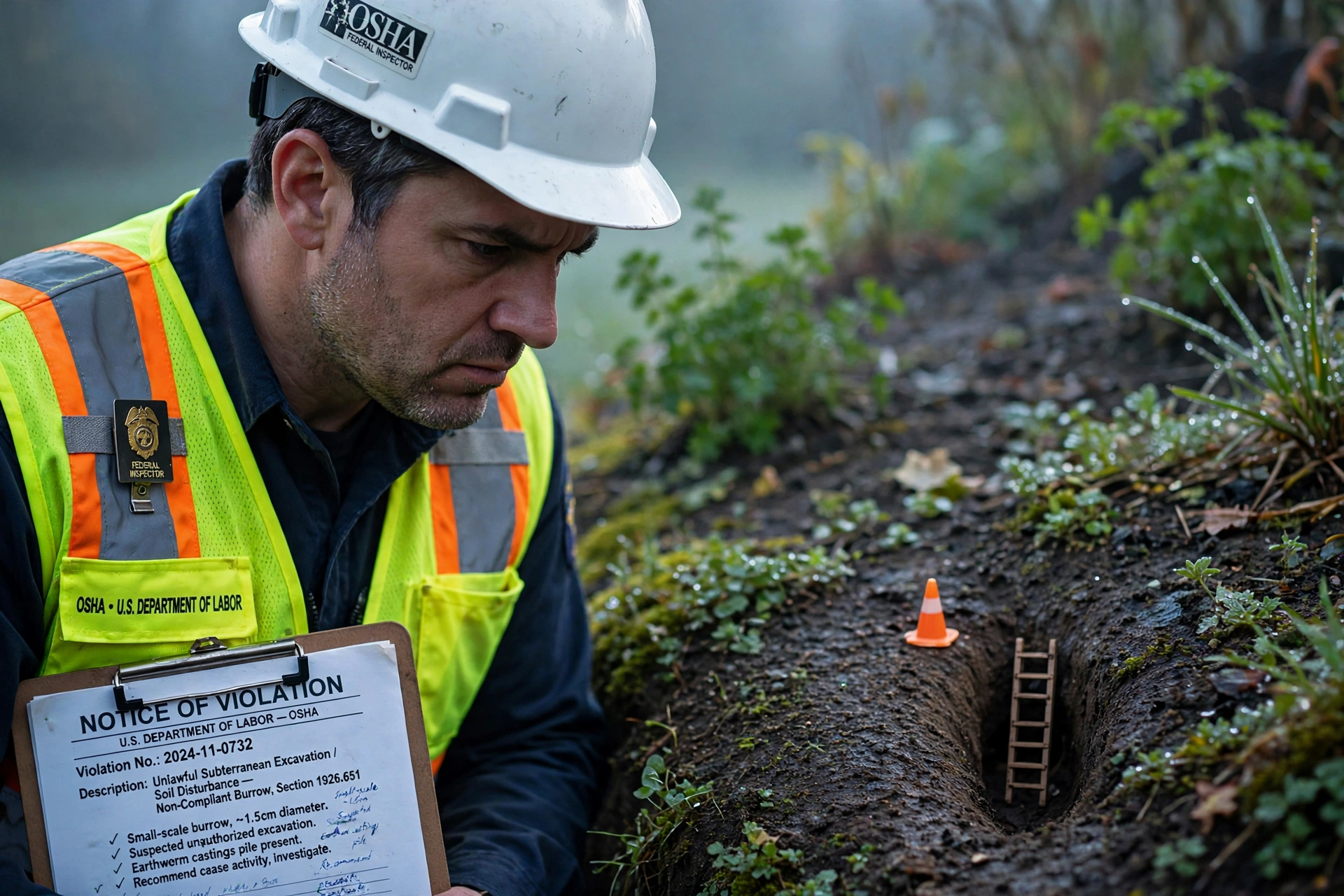
The egress duty fails in the same manner. A burrow four feet or more in depth requires a stairway, ladder, ramp, or other safe means of egress within 25 feet of lateral travel. The burrow is five to six feet deep, and it contains no stairway, no ladder, and no ramp. The worm exits by climbing the wall of its own excavation, using bristles, which is not a means of egress within the meaning of 1926.651(c)(2) in the same way that a trench wall is not a ladder. The only ladder in the vicinity is the one in the photograph accompanying this investigation, and it was placed there by the photographer.
VIII. The Asymmetry
Consider two excavation operations working the same county on the same wet October morning.
On one side of the field, a licensed contractor opens a trench for a utility line. A competent person classifies the soil, examines the ground, and inspects the excavation before work begins. The walls are sloped at one and one-half horizontal to one vertical, or shored with hydraulic supports, or shielded with a trench box. Spoil is kept two feet back. A ladder stands within 25 feet of every worker. The competent person reinspects after the rain. The paperwork is complete. The trench is six feet deep.
On the other side of the field, 53,767 workers per acre open permanent vertical shafts five to six feet deep, with walls at 90 degrees, spoil piled at the edge, no ladder, no shoring, no shielding, no sloping, no benching, no inspection before work, during work, or after rain, and a combined annual output of ten tons of excavated earth per acre. The contractor's trench will be backfilled by Friday. The worms' trenches will still be there in June, and in June of the year after that, and they will have moved another ten tons per acre in the meantime.
The regulatory burden falls entirely on the operation that moves less earth. The operation that moves more, several orders of magnitude more, bears none of it. The standard does not distinguish between a ton of earth removed by a backhoe and a ton removed by digestion. The enforcement regime does, but only because the enforcement regime can find the backhoe.
IX. The Definitional Escape Hatch
A careful reader will have noticed the difficulty. The standard defines an excavation as a man-made cut, cavity, trench, or depression in an earth surface, formed by earth removal. A worm burrow is a cut, a cavity, a trench, and a depression, formed by earth removal, but it is not man-made. It is worm-made. The first word of the definition excludes the entire operation, however completely the remaining words describe it.
The scope provision compounds the exclusion. Subpart P applies to employers engaged in construction work, and to employees exposed to the hazards of open excavations. A worm is not an employer. A worm is not an employee. A worm has no employer, draws no wage, and is exposed to the hazard of its own excavation only in the sense that it lives in it. No court has held that a worm is an employee. No court has held that digestion is earth removal within the meaning of 1926.650(b), whatever the plain-text reading of a cavity formed by earth removal might suggest to a reader in a generous mood.
The agency has never proposed to inspect a burrow, has never issued a citation to a lawn, and has never required a worm to demonstrate capability and authorization as a competent person. The definitional escape hatch is wide, well-lit, and clearly marked. It is marked with the word man-made.
This investigation declines to use it. The facts are what the facts are. The standard says what the standard says. The worms do what the worms do, every year, at ten tons per acre, in shafts deeper than the protective-system threshold, with spoil at the edge and no ladder in sight. The hatch is there for anyone who wants it. The soil is not using it.
X. Conclusion
The evidence assembled in these pages requires no interpretive leap. Section 1926.652 establishes that work in an excavation five feet or deeper is an activity of sufficient danger to warrant a mandatory protective system, with only two exceptions. Section 1926.651 establishes egress at four feet, spoil at two feet, and inspection every day and after every rainstorm. The definitions establish that a trench is deeper than it is wide and narrower than 15 feet at the bottom, and that a competent person must be both capable and authorized.
The same body of law establishes that none of this reaches the lawn.
If the worms of a single acre were a single excavation firm, it would employ 53,767 workers, operate permanent trenches five to six feet deep across the entire site, move ten tons of earth per year, maintain spoil piles at the edge of every excavation, provide no egress, conduct no inspections, and hold no competent person on staff. OSHA would require it to slope, shore, or shield. OSHA would require it to inspect. OSHA would require it to remove its workers from the hazard until precautions were taken. Instead the 53,767 workers are distributed across the topsoil, and OSHA requires nothing.
The regulatory framework that governs excavation can be summarized in four propositions. The activity is dangerous. The worker must be protected. The protection must be inspected. The largest excavation in the country is performed by animals that cannot read the standard. Every ton of soil brought to the surface of an acre is earth removed without a protective system, without egress, without a spoil setback, and without inspection. The data exists in 53,767 digestive tracts per acre. It contributes to no database and activates no enforcement action.
The standard protects the point of excavation. The inspection protects the integrity of the system. Nothing protects the ten tons per acre of unprotected excavation between the frost line and the surface, the zone in which the vast majority of the worms' earth removal actually occurs.
OSHA built a protective apparatus. It pointed it at the people who dig. It wrote no provision for the animals that eat their way down.
Ergo.
Sources
- 29 CFR 1926.652(a)(1): each employee in an excavation shall be protected from cave-ins by an adequate protective system, except when excavations are made entirely in stable rock or are less than five feet in depth and examination by a competent person provides no indication of a potential cave-in. osha.gov ↑
- 29 CFR 1926.652(a)(2) and (b)(1)(i): protective systems shall resist without failure all loads reasonably expected; sloping at an angle not steeper than one and one-half horizontal to one vertical (34 degrees). osha.gov ↑
- OSHA: excavation and trenching are among the most hazardous construction operations; cave-ins pose the greatest risk and are much more likely than other excavation accidents to result in fatalities; one cubic yard of soil can weigh as much as a car. osha.gov ↑
- Department of Labor: worker deaths in trench collapses declined from 39 in 2022 to 15 in 2023 and 12 in calendar year 2024, following outreach and aggressive enforcement under a zero tolerance policy for unprotected trenches. OSHA, July 28, 2025: 11 trench-related fatalities already reported in 2025. dol.gov osha.gov ↑
- 29 CFR 1926.651(c)(2): a stairway, ladder, ramp, or other safe means of egress shall be located in trench excavations four feet or more in depth so as to require no more than 25 feet of lateral travel for employees. law.cornell.edu ↑
- 29 CFR 1926.651(j)(2): excavated material and equipment kept at least two feet from the edge; 1926.651(k)(1): daily inspections by a competent person prior to the start of work, as needed throughout the shift, and after every rainstorm or other hazard-increasing occurrence; (k)(2): exposed employees removed until precautions are taken. law.cornell.edu ↑
- 29 CFR 1926.650(b): excavation means any man-made cut, cavity, trench, or depression in an earth surface, formed by earth removal; trench means a narrow excavation deeper than it is wide with width at the bottom not exceeding 15 feet; cave-in means separation of a mass of soil or rock from the side of an excavation and its sudden movement in sufficient quantity to entrap, bury, injure, or immobilize a person. intrans.iastate.edu ↑
- 29 CFR 1926.650(b): competent person means one who is capable of identifying existing and predictable hazards in the surroundings, or working conditions which are unsanitary, hazardous, or dangerous to employees, and who has authorization to take prompt corrective measures to eliminate them. intrans.iastate.edu ↑
- 29 CFR 1926.650(a): the subpart applies to all open excavations made in the earth's surface, including trenches. OSHA interpretation: the definition of excavation carries no minimum length, because cave-in danger at five feet or more does not significantly vary with length. osha.gov ↑
- Kansas State University Extension: nightcrawlers are large worms, usually four to eight inches or more, belonging to the deep burrowers, which build large, vertical, permanent burrows that may reach as deep as five or six feet; middens are mixtures of plant residues and castings. hnr.k-state.edu ↑
- National Geographic: nightcrawlers capable of digging down as deep as 6.5 feet; up to 14 inches long; lifespan up to six years. University of California Agriculture and Natural Resources: nightcrawlers are vertical burrowers capable of digging down as deep as eight feet in moist soil. nationalgeographic.com ucanr.edu ↑
- University of California Agriculture and Natural Resources: nightcrawlers may leave small cone-shaped piles of dirt called middens, consisting of worm castings rich in nutrients and organic matter. Kansas State Extension: middens are mixtures of plant residues and castings, used for protection and food reserves. ucanr.edu hnr.k-state.edu ↑
- National Geographic: nightcrawlers burrow during the day and feed above ground at night; as they burrow they consume soil, extracting nutrients from decomposing organic matter; an earthworm can eat up to one third of its body weight in a day. nationalgeographic.com ↑
- Contemporary review of Darwin's The Formation of Vegetable Mould (1881): by collecting, drying, and weighing castings, Darwin found about ten tons of soil per acre brought to the surface annually in many parts of England, with two calculations giving 16.1 and 18.12 tons per acre. Popular Science Monthly summary: measured range 7.56 to 15.12 tons per acre in one year, sufficient for a layer one to more than two inches thick in ten years. darwin-online.org.uk en.wikisource.org ↑
- New York Public Library: Darwin concluded it may be doubted whether any other animals played so important a part in the history of the world as these lowly organized creatures; the worm book sold more copies than his earlier books. nypl.org ↑
- Contemporary review: if in an ordinary acre of ground 53,767 worms may exist, and ten tons of dry earth is annually brought to the surface of each acre in some parts of England, the cumulative power is easy to conceive. Author's calculation: ten tons per acre per year is 100 tons per acre per decade and 1,000 tons per year for a 100-acre field. darwin-online.org.uk ↑
- Popular Science Monthly summary: at Abinger, Surrey, the remains of a Roman villa found in 1877 lay under mould 11 to 16 inches thick over a tessellated floor and 13 to 15 inches thick over the broken summit of a wall; coins and ornaments dropped on the surface will infallibly be buried by worm castings in a few years. en.wikisource.org ↑