I. The Registration Requirement
Section 305 of the Public Health Security and Bioterrorism Preparedness and Response Act of 2002 required the owners, operators, and agents in charge of domestic and foreign facilities that manufacture, process, pack, or hold food for human or animal consumption in the United States to register those facilities with the Food and Drug Administration by December 12, 2003. The implementing rule, published at 68 Federal Register 58894 and codified at 21 CFR Part 1, Subpart H, created the registry. The stated purpose was to give the agency reliable information about the origin and distribution of food and feed products, so that it could detect and respond quickly to actual or potential threats to the food supply.1
Section 102 of the FDA Food Safety Modernization Act, enacted January 4, 2011, amended Section 415 of the Federal Food, Drug, and Cosmetic Act, codified at 21 U.S.C. § 350d. The amendment required every registered facility to renew its registration between October 1 and December 31 of each even-numbered year, gave the agency authority to suspend registrations, and required each registrant to obtain a Unique Facility Identifier.2
The regulation at 21 CFR 1.225 states the obligation plainly. The owner, operator, or agent in charge of a domestic or foreign facility that manufactures, processes, packs, or holds food for consumption in the United States must register the facility before beginning such activities. A domestic facility must be registered whether or not its food enters interstate commerce.3 The regulation at 21 CFR 1.227 defines “facility” as any establishment, structure, or structures under one ownership at one general physical location, or a mobile facility traveling to multiple locations, that manufactures, processes, packs, or holds food for consumption in the United States.4
Registration is accomplished on Form FDA 3537, filed electronically through the agency’s Field Updates and Registration Logging System, or by mail or fax for those granted a waiver, obtainable by calling 1-800-216-7331 or writing to the Center for Food Safety and Applied Nutrition in College Park, Maryland.5 The agency expected approximately 420,000 domestic and foreign facilities to register under the 2002 law. By December 2009, a total of 392,217 facilities had registered, of which 157,395 were domestic.6
Failure to register is a prohibited act under Section 301 of the Act, 21 U.S.C. § 331(dd).7 The criminal penalties are set out at 21 U.S.C. § 333: up to one year of imprisonment, a fine of up to $1,000, or both, rising to up to three years and $10,000 where the violation is committed with intent to defraud or mislead.8 The statute draws no distinction between facilities that forgot to file and facilities that never learned to write.
II. The Manufacturing Process
The sugar maple, Acer saccharum, spends the winter as a warehouse. Starch accumulated during the growing season sits in the roots and trunk, inert. In late winter, as the tree shakes off dormancy, it converts that stored starch to sucrose. Sugar content follows an arc through the season: around one percent as the tree wakes, rising to roughly two and a half percent at the height of the season when starch-to-sugar conversion is most efficient, then falling again as reserves deplete.9
The motive force is meteorological. When nighttime temperatures drop below freezing and daytime temperatures rise to around forty degrees Fahrenheit or higher, pressure changes within the trunk drive sap upward from the roots. The sugaring season runs from late February to late April, four to six weeks of freeze-thaw cycles, and a season with more cycles can boost sap flow by twenty to thirty percent.10 Researchers at the University of Vermont’s Proctor Maple Research Center have spent decades quantifying exactly these relationships.11
The raw material is almost entirely water. Maple sap is roughly ninety-eight percent water and two percent sugar. Sugar maples average two to three percent sugar; red maples, also tapped, average one and a half to two percent.12 C. H. Jones’s “Rule of 86,” derived from considerable calculation at the Vermont Agricultural Experiment Station, holds that dividing eighty-six by the sap’s sugar percentage yields the gallons of sap required to produce one gallon of syrup. At two percent, the rule gives forty-three gallons. The industry rounds to forty to one.13
The finishing specification is exacting. Sap must be boiled to approximately 219 degrees Fahrenheit, seven degrees above the boiling point of water, until it reaches a density of sixty-six to sixty-seven degrees Brix, the legal standard for pure maple syrup. Evaporating forty gallons of sap into one gallon of syrup requires at least 60,000 BTUs of energy. Along the way, caramelization and Maillard reactions shape the flavor, color, and clarity that define the finished product.14
Every step of the chemistry that creates the sugar was performed by the tree. The boiling only removes water.
III. The Scale of the Enterprise
The United States Department of Agriculture’s National Agricultural Statistics Service reported that Vermont produced 3.108 million gallons of maple syrup in 2024 from 8.4 million taps, at a yield of 0.37 gallons per tap, with a production value of $95 million. Vermont has led the nation in the number of maple taps every year since 1916, outproduced only in 1918 and 1926.15 Nationally, American sugarmakers produced 5.86 million gallons in 2024 from 17.1 million taps. New York contributed 846,000 gallons; Maine contributed 701,000.16 Canada, led by Quebec, produces roughly eighty percent of the world’s supply.17
At forty gallons of sap per gallon of syrup, Vermont’s 2024 crop required the trees to manufacture approximately 124 million gallons of sap. The national crop required approximately 234 million gallons. Every gallon of it was synthesized, pressurized, and delivered by unregistered facilities operating on a four-to-six-week seasonal schedule, after which the entire manufacturing workforce went dormant until the following February.
The finished product moves in interstate commerce by the millions of gallons. The raw material never leaves the county. The manufacturing, however, is complete before a single drop reaches a human hand.
IV. What the Trees Actually Do
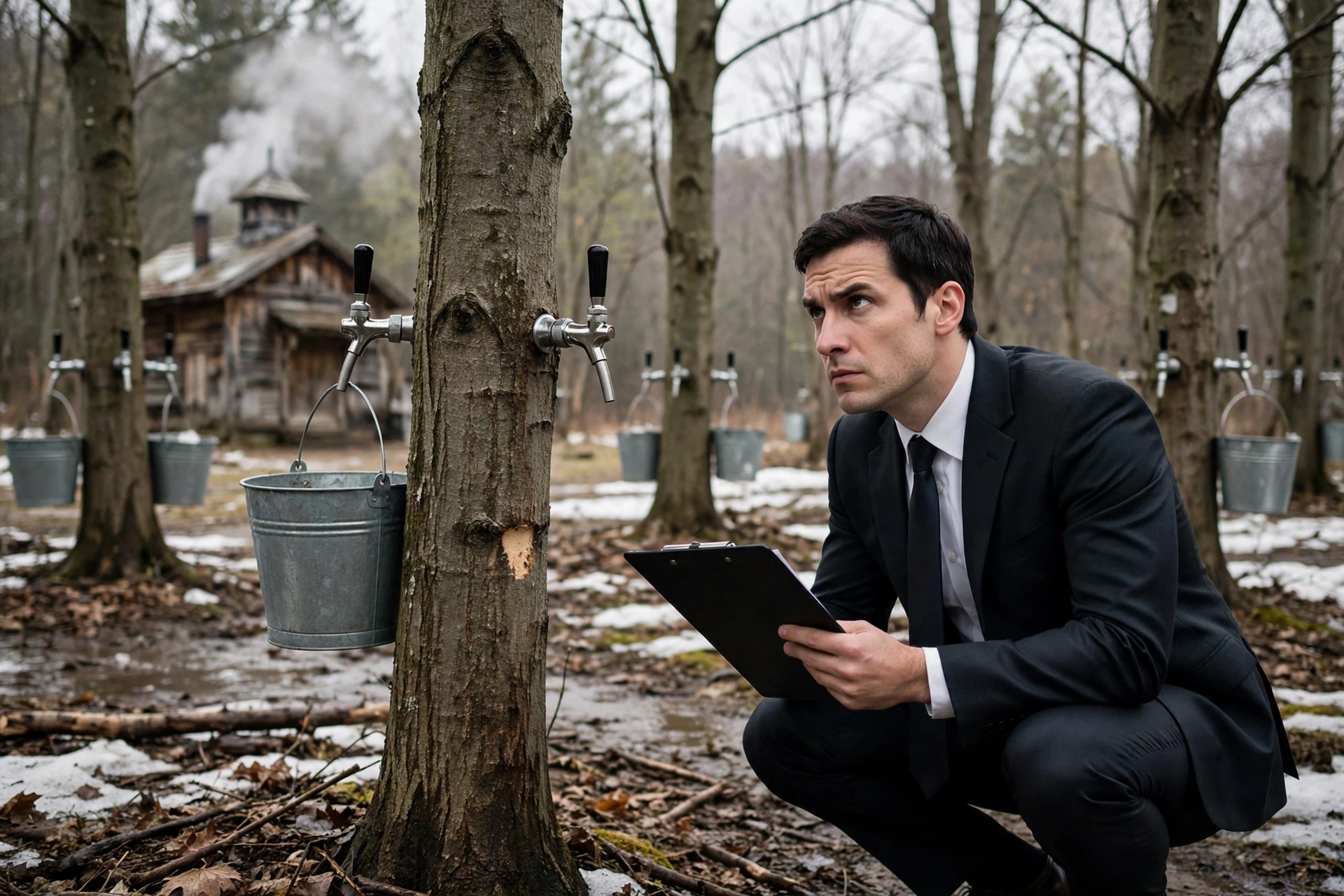
The Food and Drug Administration has addressed the maple question directly. In its guidance on the registration rule, the agency was asked: are maple syrup producers “farms” and therefore exempt from registering? The agency’s answer, published as Question B.1.15, draws the line with unusual precision. The activities of maple syrup producers customarily consist of two types: gathering sap from sugar maple trees and concentrating the sap through the application of heat to make syrup. Gathering sap is “harvesting,” which is included in the definition of “farm.” The farm is therefore exempt from registration. Concentrating sugar maple sap by heating, however, is a form of “manufacturing/processing.” A facility that concentrates sugar maple sap is performing a manufacturing activity and is required to register, unless all of the concentrated sap is consumed on the farm.18
The agency’s line-drawing contains a blind spot the size of a forest. It classifies the human’s evaporation of water as manufacturing, while treating the tree’s synthesis of sucrose from starch as mere agriculture. But the manufacturing that matters, the step that converts water and carbon dioxide into a food product, is performed entirely by the tree. The human operator does not manufacture sugar. The human operator removes water from sugar the tree already manufactured, then sells the result.
Under the agency’s own framework, the roles are reversed. The tree is the manufacturer. The sugarhouse is a dehydration contractor. The contractor may or may not have filed Form FDA 3537. The manufacturer unquestionably has not.
The agency requires manufacturers to maintain a written food safety plan. No maple tree has ever maintained one.
V. The Exemptions That Do Not Cover Trees
The regulations provide several exemptions from registration, and it is worth examining each in turn, because none of them covers a tree.
The farm exemption, at 21 CFR 1.227, covers harvesting. The agency has ruled that the trees’ contribution goes beyond harvesting into manufacturing. The exemption therefore fails at the first step, by the agency’s own analysis.
The private residence exemption, at 21 CFR 1.227(b)(2), provides that a private residence is not a “facility” and need not register. A residence must meet customary expectations for a private home. A sugarhouse built in a detached garage that can still practically be used as a garage may qualify; a dedicated sugar manufacturing building does not.19 A maple tree is not a private residence under any reading of the regulation. It has no garage.
The retail food establishment exemption does not apply, because the trees sell nothing at retail. The qualified-facility provisions at 21 CFR 117.5, which give very small businesses modified requirements instead of full preventive controls, still require registration and the filing of a qualified facility attestation. The trees have filed no attestation.20
Foreign facilities that manufacture food for consumption in the United States must designate a United States agent. Canadian maple trees ship the overwhelming majority of the world’s syrup into American commerce. No Canadian maple tree has ever designated a United States agent. Since the 2011 amendments, every registrant must also obtain a Unique Facility Identifier, a DUNS number issued by Dun & Bradstreet. No maple tree holds a DUNS number.21
Every exemption has been considered. Every exemption fails. The trees are simply unregistered.
VI. Current Good Manufacturing Practice
Registration is only the threshold obligation. Facilities that manufacture food are subject to current good manufacturing practice and the hazard analysis and risk-based preventive controls of 21 CFR Part 117. A covered facility must conduct a hazard analysis, implement preventive controls, maintain a written food safety plan, designate a Preventive Controls Qualified Individual, establish a supply-chain program, verify its controls, take corrective actions, and keep records.22
No maple tree has ever appointed a Preventive Controls Qualified Individual. No hazard analysis has ever been conducted for a sugarbush. The trees hold their raw material at ambient spring temperatures in an open vascular system, despite the industry’s own acknowledgment that sap spoils quickly if not kept cold and that microbial control determines syrup quality. There are no sanitation controls. There is no environmental monitoring. There is no written recall plan.
Late in the season, trees produce what the industry calls “buddy” sap, yielding syrup with off flavors that cannot be sold as table grade. This is, in regulatory terms, a recurring process deviation with a known seasonal cause. No corrective action has ever been documented. No preventive control has ever been validated. The deviation recurs every April, on schedule, in every sugarbush in North America.
VII. The Inspection Void
Section 704 of the Act, 21 U.S.C. § 374, authorizes the Food and Drug Administration to inspect facilities.23 When an inspection reveals objectionable conditions, the investigator issues a Form FDA 483, a notice of inspectional observations. No Form FDA 483 has ever been issued to a maple tree. No investigator has ever walked a sugarbush with a 21 CFR Part 117 checklist. The trees’ manufacturing lines, which is to say their trunks, have never been examined for compliance with current good manufacturing practice.
The agency maintains a model untitled letter for unregistered facilities. It reads, in relevant part: “The Food and Drug Administration has determined that your facility is subject to the registration requirement in § 415 of the Federal Food, Drug, and Cosmetic Act and our implementing regulation at 21 CFR Part 1, Subpart H. Our records indicate that, to date, this facility has not been registered with FDA. We request that the owner, operator, or agent in charge of this facility register the facility with FDA within 30 working days.”24
No such letter has ever been sent to a maple tree. The trees have fixed locations, which would ordinarily assist service, but they have no mailing address and no owner, operator, or agent in charge distinct from themselves. Refusal of inspection is itself a basis for enforcement action. The trees cannot refuse inspection. They also cannot consent to it. The regulatory framework assumes a counterparty with hands.
VIII. The Adulteration Paradox
While the agency has never pursued the unregistered manufacturers, it has been asked repeatedly to pursue the products that lie about them. In 2016, more than thirty members of Congress, joined by eleven maple producers’ associations, urged the Food and Drug Administration to investigate products that claim to contain maple syrup but do not, alleging widespread and intentional misrepresentation. The industry named names, including a national oatmeal brand whose “maple” product contained no trace of maple syrup.2526
The agency declined. In a letter to the Vermont Maple Sugar Makers Association, the Food Labeling and Standards Staff explained that under FDA regulations, the term “maple” is not synonymous with “maple syrup,” and that enforcement would require evidence of consumer perception plus a change in the regulations. The industry press called it, accurately, a drop-dead letter.27
Two years later, the agency turned its attention to the genuine article. In a 2018 draft guidance, the agency proposed that pure maple syrup and pure honey, as single-ingredient products, would have to declare “added sugars” on the Nutrition Facts label, and worried openly that consumers would misread the declaration as evidence that the pure product had been adulterated with corn syrup. The proposed solution was a typographic obelisk, “‡,” directing consumers to contextual language explaining that the added sugars in pure maple syrup were not, in fact, added.28
The posture is difficult to reconcile. The agency will not act against products that use the word maple to sell corn syrup, on the ground that consumers do not necessarily perceive the word to promise maple. It will contemplate requiring pure maple syrup to carry a symbol explaining that its sugars are not adulterants, on the ground that consumers might perceive adulteration that is not there. And it has never required the actual manufacturers of the maple sugar to register, inspect, or document anything at all.
IX. The Arithmetic of Non-Registration
The registry, for all its gaps, is substantial. As of January 2021, a total of 182,147 food facilities were registered worldwide.29 The Department of Health and Human Services’ Office of Inspector General found in 2009 that forty-eight percent of surveyed firms had failed to provide accurate registration information and that seven percent had failed to register or cancel as required, leaving the agency missing critical information it would need to locate those facilities in an emergency.30
The maple trees have never submitted inaccurate information. They have submitted no information. Against 17.1 million American taps in 2024, the number of tree registrations on file is zero. The compliance rate is not low. It is undefined.
The biennial renewal window runs from October 1 to December 31 of every even-numbered year.31 The 2026 renewal window opened three weeks ago. Every registered food facility in America is currently required to confirm or update its registration. The trees have not renewed. They did not register in the first instance, so there is nothing to renew, which the regulation does not list as an excuse.
The penalties for failure to register reach up to one year of imprisonment and a $1,000 fine, or up to three years and $10,000 where the violation is committed with intent to defraud or mislead. The trees’ intent is unknowable. The statute has never required knowability from a corporation, and a corporation is, like a tree, an entity that cannot hold a pen but can be held liable.
X. Conclusion
Section 415 requires registration before manufacturing begins. The regulation defines the covered activity to include manufacturing. The agency’s own guidance classifies the concentration of maple sap as manufacturing. The sugar maple performs the manufacturing, converting starch to sucrose and pressurizing forty gallons of sap for every gallon of syrup, at a national scale of 5.86 million gallons a year. No tree has registered. No tree maintains a food safety plan. No tree has been inspected. The prohibited act is complete, the penalties are specified, and the renewal window now open will close on December 31 with the registry still showing zero trees.
There is, as in every investigation, an escape hatch, and honesty requires stating it. No court has held that a maple tree is a facility. The regulation defines a facility as an establishment or structure, and it places the duty to register on an owner, operator, or agent in charge, a formulation that assumes a registrant capable of filling out a form. The farm definition covers the humans’ harvesting. A tree is not an establishment. A tree is not a structure. A tree cannot designate a United States agent, obtain a DUNS number, or respond to an untitled letter within thirty working days. The conclusion is wrong for the oldest reason in regulatory law: the statute regulates persons, and a maple tree, despite manufacturing millions of gallons of food a year, is not one.
It is also, by every factual measure in this investigation, the largest unregistered food manufacturing operation in American history. The trees manufactured approximately 234 million gallons of raw material last year without filing a single form. The agency that requires a ten-page registration from every sandwich shop in America has never asked a sugarbush for its name.
The trees will begin manufacturing again in February. Registration opens long before that. The forms are available by calling 1-800-216-7331.
Ergo.
Sources
- Public Health Security and Bioterrorism Preparedness and Response Act of 2002, Pub. L. 107-188, § 305; Registration of Food Facilities, 68 Fed. Reg. 58894 (Oct. 10, 2003), codified at 21 CFR Part 1, Subpart H. webarchive.library.unt.edu ↑
- FDA Food Safety Modernization Act, Pub. L. 111-353, § 102 (Jan. 4, 2011), amending 21 U.S.C. § 350d (biennial renewal, suspension authority, Unique Facility Identifier). khlaw.com ↑
- 21 CFR 1.225 (who must register; registration required before beginning operations; domestic facilities must register whether or not food enters interstate commerce). customsmobile.com ↑
- 21 CFR 1.227 (defining “facility” as any establishment, structure, or structures under one ownership at one general physical location that manufactures, processes, packs, or holds food). extension.umd.edu ↑
- 21 CFR 1.231 (Form FDA 3537; electronic filing; mail/fax via 1-800-216-7331 or 301-575-0156). customsmobile.com ↑
- FDA expected approximately 420,000 facilities to register; 392,217 had registered as of December 2009, including 157,395 domestic facilities. homelandsecuritynewswire.com ↑
- 21 U.S.C. § 331(dd) (failure to register a facility as required by § 415 is a prohibited act). ctmaple.org ↑
- 21 U.S.C. § 333(a) (criminal penalties: up to one year imprisonment and/or $1,000 fine; up to three years and/or $10,000 with intent to defraud or mislead). law.cornell.edu ↑
- Starch-to-sucrose conversion; sugar content arc from ~1% to ~2.5% and back; Jones’s “Rule of 86.” northernwoodlands.org ↑
- Freeze-thaw cycles (nights below freezing, days around 40°F or higher); season late February to late April; flow boosted 20–30% by additional cycles. moe.stuy.edu ↑
- University of Vermont Proctor Maple Research Center; 4–6 week season; 10–12 inch diameter trees. champlainorchards.com ↑
- Sap approximately 98% water and 2% sugar; sugar maple 2–3%, red maple 1.5–2%. champlainorchards.com ↑
- Jones’s Rule of 86: 86 divided by sugar percentage equals gallons of sap per gallon of syrup; industry 40:1 benchmark. northernwoodlands.org ↑
- Finished at 219°F (7°F above boiling); 66–67° Brix; at least 60,000 BTUs per gallon; caramelization and Maillard reactions. champlainorchards.com ↑
- Vermont 2024: 3.108 million gallons, 8.4 million taps, 0.37 gallons per tap, $95 million value; national tap leader since 1916 except 1918 and 1926 (USDA NASS). agriculture.vermont.gov ↑
- United States 2024: 5.86 million gallons from 17.1 million taps (USDA NASS). morningagclips.com ↑
- New York 846,000 gallons; Maine 701,000 gallons (2024). farmprogress.com ↑
- Canada produces roughly 80% of the world’s maple syrup. thefern.org ↑
- FDA Q&A B.1.15: gathering sap is “harvesting” (farm, exempt); concentrating sap by heating is “manufacturing/processing” requiring registration. sustainableagriculture.net ↑
- 21 CFR 1.227(b)(2): a private residence is not a “facility”; detached buildings retaining customary residential use may qualify; dedicated manufacturing buildings must register. mapletrader.com ↑
- 21 CFR 117.5 (qualified facilities: modified requirements, attestation still required); 21 CFR 1.227 (foreign facilities must designate a U.S. agent); Unique Facility Identifier (DUNS) required of every registrant. fdaregistrationassistance.com ↑
- 21 CFR Part 117 (hazard analysis, risk-based preventive controls, written food safety plan, Preventive Controls Qualified Individual, supply-chain program, verification, corrective actions, records). fdaregistrationassistance.com ↑
- 21 U.S.C. § 374 (FDA inspection authority under § 704 of the Act). law.cornell.edu ↑
- FDA model untitled letter for unregistered facilities (§ 415; 21 CFR Part 1, Subpart H; 30 working days to register). webarchive.library.unt.edu ↑
- 2016 congressional letter to FDA Commissioner Califf urging action against mislabeled “maple” products; 11 producers’ associations alleging widespread misrepresentation. king.senate.gov ↑
- Industry allegations against “maple” products containing no maple syrup; Canadian requirement that maple products consist entirely of maple sap. thefern.org ↑
- FDA Food Labeling and Standards Staff response to the Vermont Maple Sugar Makers Association: “maple” is not synonymous with “maple syrup”; no enforcement action. themaplenews.com ↑
- FDA 2018 draft guidance on declaration of added sugars on pure maple syrup and honey; Docket No. FDA-2018-D-0075; “‡” symbol proposal. fda.gov ↑
- 182,147 food facilities registered worldwide as of January 2021. foodsafetynews.com ↑
- HHS Office of Inspector General (2009): 48% of surveyed firms provided inaccurate registration information; 7% failed to register or cancel. homelandsecuritynewswire.com ↑
- Biennial registration renewal: October 1 through December 31 of each even-numbered year (21 CFR 1.230). fdaregistrationassistance.com ↑