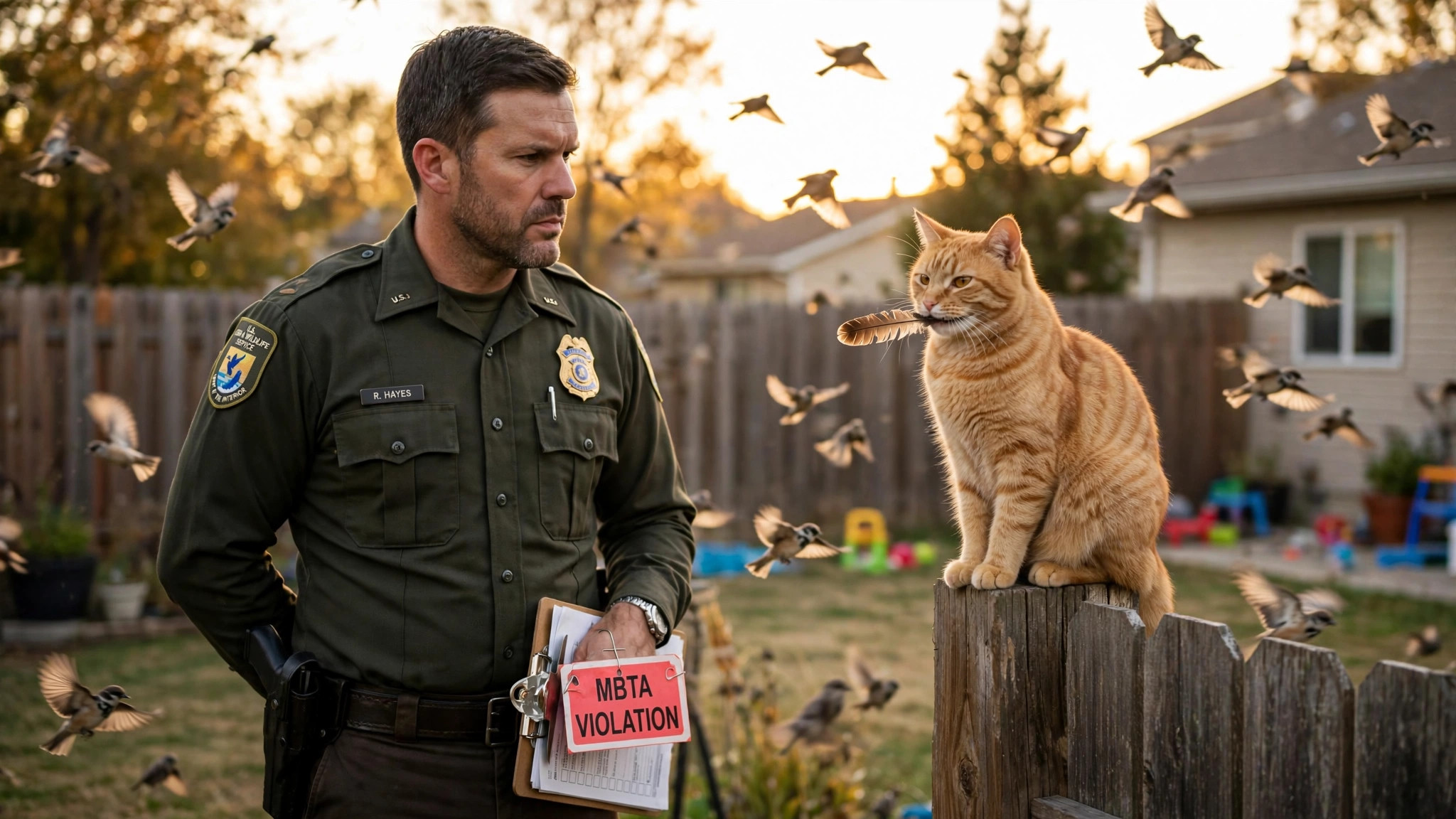
I. The Statute
The Migratory Bird Treaty Act of 1918, codified at 16 U.S.C. §§ 703–712, was enacted to fulfill the United States’ obligations under the 1916 Convention between the United States and Great Britain, acting for Canada, for the protection of migratory birds. Three further treaties followed: with Mexico in 1936, with Japan in 1972, and with the Soviet Union in 1976. The statute is, by the measure of its own text, one of the most uncompromising prohibitions in American conservation law.1
The operative provision is Section 703(a). It provides, in relevant part:
“Unless and except as permitted by regulations made as hereinafter provided in this subchapter, it shall be unlawful at any time, by any means or in any manner, to pursue, hunt, take, capture, kill, attempt to take, capture, or kill, possess, offer for sale, sell, offer to barter, barter, offer to purchase, purchase, deliver for shipment, ship, export, import, cause to be shipped, exported, or imported, deliver for transportation, transport or cause to be transported, carry or cause to be carried, or receive for shipment, transportation, carriage, or export, any migratory bird, any part, nest, or egg of any such bird, or any product, whether or not manufactured, which consists, or is composed in whole or part, of any such bird or any part, nest, or egg thereof.”2
The phrasing repays attention. “At any time” admits no closed season. “By any means or in any manner” admits no exempt technique. “Attempt to take, capture, or kill” reaches conduct that fails: the crouch in the grass, the stalk along the fence line, the pounce that misses. The statute does not require success. It requires only the attempt, and it criminalizes the attempt at the same grade as the completed act.
The birds protected are enumerated at 50 CFR § 10.13. The Fish and Wildlife Service revised the list in 2023, adding sixteen species and removing three, bringing the total number of protected species to 1,106.3 A further proposed revision, open for public comment through November 30, 2026, would bring the total to 1,131. The Service’s own guidance notes that birds are protected “whether or not ecologically migratory,” meaning a year-round resident robin in a suburban backyard carries the same federal protection as an Arctic tern that flies from pole to pole.4
II. The Standard of Liability
The Migratory Bird Treaty Act is a strict liability statute. This is not an inference. It is the holding of the federal courts.
In United States v. FMC Corp., 572 F.2d 902 (2d Cir. 1978), the Second Circuit affirmed the criminal conviction of a pesticide manufacturer whose wastewater pond had killed ninety-two migratory birds. The company argued that the killings were unintentional and that the statute should require intent. The district court instructed the jury that “the Government does not have to prove that the defendant intended to kill the birds” and that the jury could convict “even if you find that the killing of the birds was accidental or unintentional.” The Second Circuit affirmed, holding that the statute “dispenses with the conventional requirement for criminal conduct; namely, awareness of wrongdoing and the specific intent to violate the law.”5
The rule has been restated across the circuits. The Third Circuit held that “scienter is not an element of criminal liability under the Act’s misdemeanor provisions.”6 The Eighth Circuit agreed that “it is not necessary to prove that a defendant violated the Migratory Bird Treaty Act with specific intent or guilty knowledge.”7 The Tenth Circuit likewise treated the taking of protected birds as a strict liability crime.8 Goodwill, good intention, and remedial measures taken to prevent the killing are, under the law, not a defense.
The penalties are set at 16 U.S.C. § 707(a): a misdemeanor punishable by a fine of not more than $500, imprisonment of not more than six months, or both, for each violation. Under the modern federal fine schedule, the per-count fine for a Class A misdemeanor reaches $15,000 per bird.9 Each bird is a separate count. There is no volume discount.
III. The Take
In 2013, the journal Nature Communications published a systematic quantitative synthesis of wildlife mortality caused by domestic cats in the United States. The authors were Scott R. Loss of the Smithsonian Conservation Biology Institute’s Migratory Bird Center, Tom Will of the Fish and Wildlife Service’s Division of Migratory Birds, and Peter P. Marra, also of the Smithsonian. Their paper, published January 29, 2013, as Nature Communications 4:1396, reviewed the available predation studies and modeled national totals. Their finding: free-ranging domestic cats kill an estimated 1.3 to 4.0 billion birds and 6.3 to 22.3 billion mammals annually in the contiguous United States.10
The paper’s conclusions were stated without qualification. Unowned cats, as opposed to owned pets, cause the majority of the mortality. Free-ranging cats “are likely the single greatest source of anthropogenic mortality for US birds and mammals,” exceeding in their toll every other direct human-caused source, including collisions with buildings, windows, vehicles, communication towers, and wind turbines, as well as pesticides, oil spills, and electrocution.11
At the midpoint of the estimated range, 2.65 billion birds per year, the take proceeds at a rate of approximately 7.3 million birds per day, or roughly five thousand birds every minute, day and night, without pause for weekends, holidays, or inclement weather. The lower bound of the estimate, 1.3 billion birds, is itself larger than the entire breeding bird population of many continents. The upper bound, 4.0 billion, approaches the scale of the commercial poultry industry’s annual slaughter, except that the poultry industry holds permits and the cats do not.
The mortality is not indiscriminate in the sense the statute cares about. The statute does not care about sense at all. It cares about species, and the cats’ take includes species the federal government has separately determined to warrant extraordinary protection. The authors of Cat Wars, Marra among them, report that domestic cats have been implicated in the decline and extinction of some 175 species worldwide, a figure that exceeds the confirmed bird extinctions attributable to the pesticide DDT, which the federal government banned in 1972.12 The federal government banned a chemical for doing, at national scale, less than what the nation’s cats do every spring.
IV. The Operators
The take is not the work of a single enterprise. It is the work of a distributed population of operators numbering in the tens of millions, the largest unpermitted take workforce ever assembled under a single federal statute.
The American Pet Products Association’s 2026 Cat Report, built on the Association’s 2025 National Pet Owners Survey, found that 53 million American households owned at least one cat in 2025, representing 39 percent of all American households. The figure was up 5 percent from 49 million in 2024, which was itself up 23 percent from 40 million in 2023, the fastest growth rate on record. The Association has taken to calling the period “the year of the cat.”13 Independent compilations place the total pet cat population at approximately 74 million animals.14 Estimates of the unowned population, the feral and semi-feral cats that live entirely outdoors, range from 30 million to 100 million.15
The Loss synthesis found that the unowned population causes the majority of the bird mortality. This is the enforcement-relevant detail. The owned cat that slips through the pet door at dusk is, in the statute’s terms, an operator whose owner is identifiable, whose address is known, and whose conduct could in principle be supervised. The unowned cat is an operator with no registered agent, no fixed address, and no owner to name in an indictment. The majority of the take is committed by defendants the government cannot find, and the minority is committed by defendants the government has chosen not to look for.
There is a further irony that the statute, being indifferent to human motive, does not recognize. Millions of American households maintain bird feeders, purchase birdseed, and hang nesting boxes, and also maintain outdoor cats. The feeder concentrates the protected resource. The cat harvests it. The household subsidizes both sides of the taking. The Fish and Wildlife Service, which administers the statute, has no mechanism for addressing the household that feeds the victim to the violator.
V. The Permits That Do Not Exist
The statute’s prohibition is not absolute. Section 703(a) opens with the words “unless and except as permitted by regulations made as hereinafter provided in this subchapter,” and Section 704(a) directs the Secretary of the Interior to adopt regulations permitting the taking, possession, and transportation of migratory birds under defined conditions. The Fish and Wildlife Service administers the permit program under 50 CFR Part 21. The program covers research, education, rehabilitation, propagation, falconry, Native American religious use, depredation control, and related activities.16
There is no permit for cats. There is no application form for cats. There is no regulatory category into which a cat, or a cat’s owner acting on the cat’s behalf, could plausibly fit. A falconry permit authorizes a human to hunt with a raptor; it does not authorize a felid to hunt without one. A depredation permit authorizes the taking of birds that damage property; the cat’s taking damages nothing but the birds. The permit program is comprehensive, detailed, and decades old, and in all that time no provision has been made for the nation’s most prolific takers of migratory birds.
The government once offered the regulated community a different kind of relief. On December 22, 2017, the Interior Department’s Solicitor issued Opinion M-37050, holding that the Migratory Bird Treaty Act does not prohibit “incidental take,” the unintentional killing of birds in the course of otherwise lawful activity, such as operating a wind turbine or maintaining an oil pit. The opinion was vacated by the United States District Court for the Southern District of New York in August 2020, in Natural Resources Defense Council v. U.S. Department of the Interior, and was subsequently revoked and replaced by Opinion M-37065, restoring the broader reading.17
The episode is instructive for what it does not cover. Even at the high-water mark of the narrow reading, the relief extended only to take that was incidental: the byproduct of some other lawful activity, unintended and undesired. A cat crouched in the ornamental grass beneath a bird feeder, tail twitching, hindquarters oscillating, is not engaged in incidental take. The taking is the activity. There is no other lawful activity of which the dead warbler is the byproduct. The one interpretive lifeline the federal government ever threw to the regulated community would not have saved the cats, because the cats are not incidentally killing birds. They are killing birds on purpose, which under the statute is worse, and they are doing it without a permit, which under the statute is the whole offense.
VI. The Enforcement Void
The Fish and Wildlife Service has never issued a migratory bird take permit to a cat. The Service has never brought a Migratory Bird Treaty Act enforcement action against a cat. No published federal prosecution under the Act has ever named a domestic cat as the instrumentality of the take, though the courts have named pesticide ponds, oil pits, power lines, and communication towers. The statute reaches “by any means or in any manner,” and the courts have held that remedial measures are no defense, yet the one means that accounts for the single greatest share of anthropogenic bird mortality in the United States has never once appeared in a charging instrument.
The conservation community has responded with the instruments available to it. The American Bird Conservancy maintains a “Cats Indoors” campaign urging owners to keep cats inside, a voluntary compliance program with no penalty for noncompliance, no inspection authority, and no reporting requirement. It is, in regulatory terms, a suggestion. The cats have not complied. Compliance cannot be measured, because there is no registry of outdoor cats against which to measure it.
The contrast with the statute’s treatment of other takers is stark. A wind energy developer whose turbines kill eagles must obtain an eagle take permit under 50 CFR Part 22, file reports, and implement conservation measures, or face prosecution. An oil company whose pit kills ducks faces strict liability under FMC Corp. A homeowner whose cat kills a yellow warbler on the patio faces nothing, though the statute draws no distinction between the turbine, the pit, and the patio. The warbler is equally dead in all three cases. Only two of the three deaths are investigated.
VII. The Arithmetic
The penalty provision, 16 U.S.C. § 707(a), makes each violation a misdemeanor punishable by a fine of not more than $500, imprisonment of not more than six months, or both. Each bird is a separate violation. The arithmetic that follows is the statute’s own.
At the lower bound of the Loss estimate, 1.3 billion birds per year, the aggregate maximum fine exposure for one year of the nation’s unpermitted take is $650 billion, at $500 per bird. At the upper bound, 4.0 billion birds, the exposure is $2 trillion per year. Under the modern federal fine schedule, at $15,000 per count for a Class A misdemeanor, the lower-bound exposure rises to $19.5 trillion, a sum exceeding the gross domestic product of every nation on earth except the United States and China. The custodial exposure, at six months per bird served consecutively, exceeds the remaining lifespan of the sun.
These figures assume that every taking could be charged, which it cannot be, because the takers cannot be identified, served, or brought before a magistrate. The figures assume that every taking is detected, which it is not, because most takings occur in backyards, alleys, and woodlots, far from any wildlife officer. The figures assume a prosecutorial apparatus scaled to the offense, which does not exist, because the offense is scaled to approximately one hundred million defendants.
It is worth pausing on the denominator. The Fish and Wildlife Service’s Office of Law Enforcement, the body charged with enforcing the Migratory Bird Treaty Act, employs a few hundred special agents nationwide. They are responsible for enforcing the statute against every wind farm, oil field, power line, pesticide applicator, and market hunter in the country, and additionally, in principle, against every cat. The ratio of agents to feline defendants is approximately one to three hundred thousand. If every special agent in the Service did nothing but investigate cats, full-time, for the rest of their careers, each agent would need to clear roughly eight hundred feline cases per workday to keep pace with a single year’s take.
VIII. Conclusion
The elements are not in dispute. The statute prohibits the taking of migratory birds by any means or in any manner without a permit. The courts have held that the prohibition is strict: intent is not an element, accident is not a defense, and remedial measures do not excuse. The protected list covers 1,106 species, including birds that never migrate. Peer-reviewed science, co-authored by the enforcing agency’s own ornithologists, establishes that domestic cats take between 1.3 and 4.0 billion birds per year, the largest documented source of direct human-caused bird mortality in the nation. No permit exists for this take. No permit has ever been issued for this take. No enforcement action has ever addressed this take.
The statute says “at any time.” The cats hunt at dawn and dusk, the crepuscular hours when birds are most active and least wary, and they hunt through the night as well. The statute says “by any means or in any manner.” The cats hunt by stalk, by ambush, by pounce, and by the patient motionless waiting that precedes all three. The statute says “attempt to take, capture, or kill.” The cat that misses the sparrow has still committed the attempt, and the sparrow that escapes has still been pursued.
There are between one hundred and one hundred seventy million cats in the United States, depending on whose estimate of the unowned population one credits. Every one of them is, in the eyes of the Migratory Bird Treaty Act, an unpermitted taker operating in the open, in every county in the country, in numbers the enforcing agency cannot count, committing violations the statute cannot excuse, at a pace the courts cannot process, under a law that has been on the books for one hundred and eight years.
The largest criminal enterprise in the history of American wildlife law has no headquarters, no bank accounts, no organizational chart, and no legal counsel. It has whiskers. It knocks objects off tables. It sleeps sixteen hours a day and spends the remaining eight in violation of 16 U.S.C. § 703(a).
Ergo.
Sources
- Migratory Bird Treaty Act of 1918, 16 U.S.C. §§ 703–712, implementing the Convention between the United States and Great Britain (for Canada) for the Protection of Migratory Birds, Aug. 16, 1916, 39 Stat. 1702; the Convention with Mexico, Feb. 7, 1936; the Convention with Japan, Mar. 4, 1972; and the Convention with the U.S.S.R., Nov. 19, 1976. uscode.house.gov ↑
- 16 U.S.C. § 703(a). law.cornell.edu ↑
- 88 Fed. Reg. 49310 (July 31, 2023) (FR Doc. 2023-15551), revising the List of Birds Protected by the Migratory Bird Treaty Act; net increase of 13 species (16 added, 3 removed), bringing the total to 1,106. A 2026 proposed rule would add 32 species and remove 7, bringing the total to 1,131, with comments due November 30, 2026. govinfo.gov ↑
- U.S. Fish and Wildlife Service, Migratory Bird Permits guidance: birds are protected “whether or not ecologically migratory” (50 CFR § 10.12); the protected list is maintained at 50 CFR § 10.13. fws.gov ↑
- United States v. FMC Corp., 572 F.2d 902 (2d Cir. 1978). law.justia.com ↑
- United States v. Engler, 806 F.2d 425, 431 (3d Cir. 1986). ↑
- United States v. Manning, 787 F.2d 431, 435 n.4 (8th Cir. 1986). ↑
- United States v. Corrow, 119 F.3d 796, 805 (10th Cir. 1997). ↑
- 16 U.S.C. § 707(a) (misdemeanor: fine of not more than $500 or imprisonment of not more than six months, or both); modern per-count fine characterization under the federal fine schedule, 18 U.S.C. § 3571, discussed in Congressional Research Service, “The Migratory Bird Treaty Act (MBTA): Selected Legal Issues” (R44694). law.cornell.edu ↑
- Scott R. Loss, Tom Will & Peter P. Marra, “The impact of free-ranging domestic cats on wildlife of the United States,” Nature Communications 4:1396 (Jan. 29, 2013), doi:10.1038/ncomms2380. abcbirds.org (PDF) ↑
- Id. at 1 (abstract): “We estimate that free-ranging domestic cats kill 1.3–4.0 billion birds and 6.3–22.3 billion mammals annually. Un-owned cats, as opposed to owned pets, cause the majority of this mortality.” ↑
- Peter P. Marra & Chris Santella, Cat Wars: The Devastating Consequences of a Cuddly Killer (2016), as discussed in the Los Angeles Review of Books (“implicated in the decline and extinction of some 175 different species”). lareviewofbooks.org ↑
- American Pet Products Association, 2026 Cat Report: Strategic Insights from the 2025 National Pet Owners Survey (released Sept. 14, 2026): 53 million U.S. households owned a cat in 2025 (39% of households), up 5% from 49 million in 2024, up 23% from 40 million in 2023. petfoodindustry.com ↑
- World Population Review (via World Animal Foundation, 2026): approximately 74 million pet cats in the United States. worldanimalfoundation.org ↑
- Estimates of the unowned/feral cat population range from 30–40 million (Federation of Humane Organizations of West Virginia, 2026 compilation) to 60–100 million (World Animal Foundation, 2026). fohowv.org ↑
- U.S. Fish and Wildlife Service, 724 FW 2, Migratory Bird Permits: regulated activities include “research, education, rehabilitation, propagation, falconry-related activities, Native American religious use, and depredation” under 50 CFR Part 21. fws.gov ↑
- Solicitor’s Opinion M-37050, “The Migratory Bird Treaty Act Does Not Prohibit Incidental Take” (Dec. 22, 2017); vacated by Natural Resources Defense Council v. U.S. Dep’t of the Interior, No. 18-cv-4596 (S.D.N.Y. Aug. 11, 2020); revoked and replaced by Solicitor’s Opinion M-37065 (2021). regulations.justia.com ↑