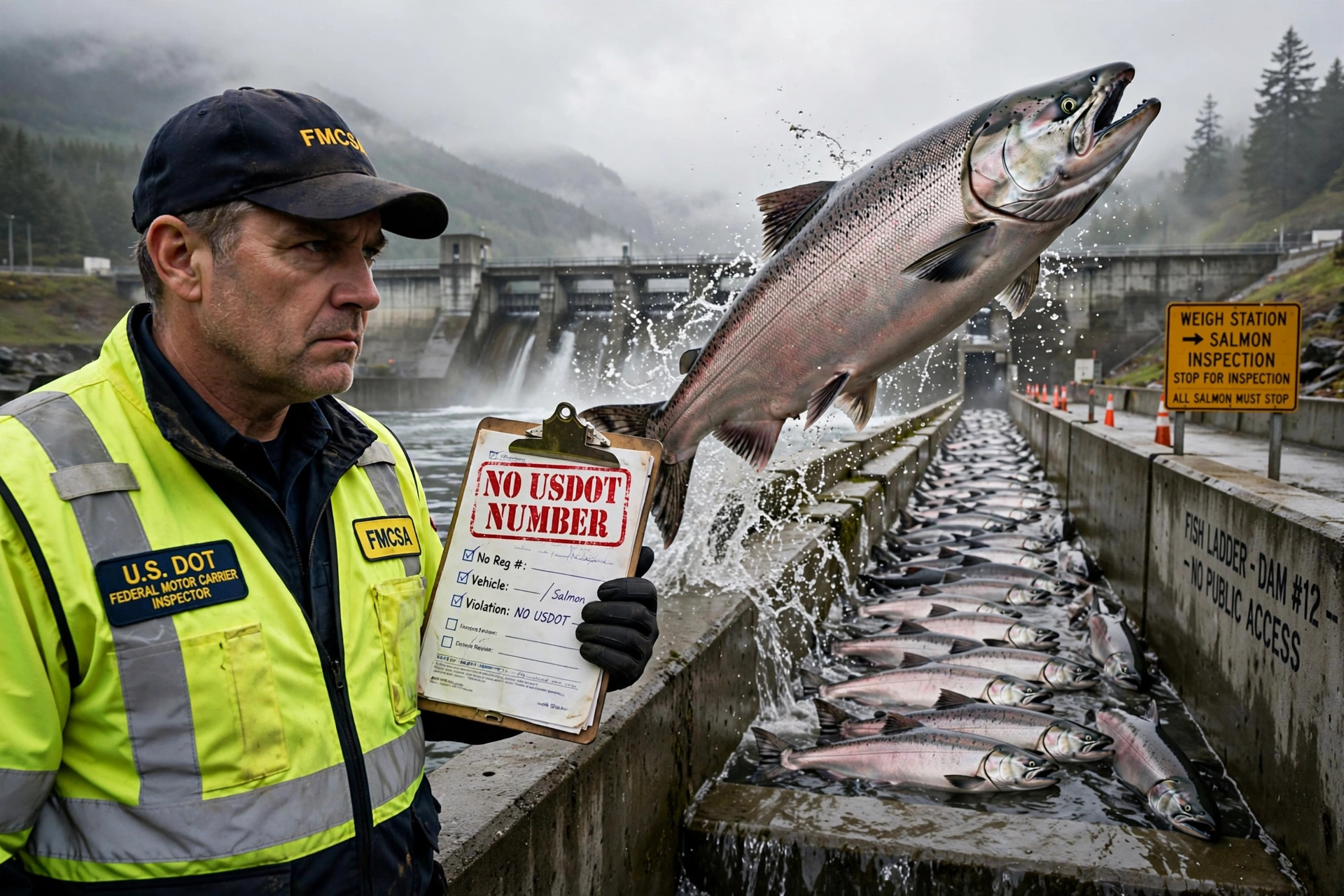
I. The Registration Requirement
Under 49 U.S.C. § 13902, a motor carrier subject to federal jurisdiction may not operate in interstate commerce unless it has registered with the Federal Motor Carrier Safety Administration.1 The FMCSA has stated the rule plainly: an unregistered carrier’s vehicle discovered in operation will be placed out of service, and the carrier may be subject to additional penalties.2 Before beginning interstate operations, a carrier must register with FMCSA and receive a USDOT number; for-hire carriers must additionally obtain operating authority.3
The statute defines a motor carrier as a person providing motor vehicle transportation for compensation.4 The financial responsibility requirements are not trivial. Under 49 CFR § 387.9, carriers of non-hazardous property must maintain minimum liability coverage of $750,000 for vehicles over 10,001 pounds gross vehicle weight rating, and $300,000 for lighter vehicles, with proof filed on Form BMC-91.5 For-hire interstate carriers must also carry the MCS-90 endorsement. The regulatory scheme assumes that anything moving property across state lines can be identified, insured, and, if necessary, ordered out of service.
The scheme did not contemplate the salmon.
II. The Carrier
Pacific salmon of the genus Oncorhynchus, chinook, coho, chum, pink, and sockeye, share a single general life cycle. Young salmon emerge from gravel in streams or lakes in spring, migrate to the ocean, live at sea between one and four years, and return to their natal streams to spawn and die. The young fish weigh less than one gram to about 20 grams when they leave freshwater. They return weighing two to ten kilograms or more.6
This life cycle is, from a transportation perspective, a freight operation with an unusual business model. The carrier loads its cargo at the point of origin, the ocean, in the form of body mass accumulated over years of feeding. It then transports that cargo hundreds of miles inland, upstream, against the current, and delivers it by dying. There is no return trip. There is no backhaul. The delivery is terminal in every sense.
The salmon is the only freight carrier in which the vessel and the cargo are the same object. The hull is the shipment. When the carrier arrives, it unloads itself.
III. The Cargo
A 2024 study published in Nature combined whole-fish nutrient estimates with four decades of Pacific salmon return data, 1976 through 2015, to quantify the continental-scale freight. The median annual post-harvest return of approximately 119 million Pacific salmon transported a summed total of 14,000 metric tons of nutrients and compounds per year from the eastern Pacific Ocean to freshwaters spanning western Alaska to northern California.7 The U.S. Geological Survey summarized the finding: salmon transported tonnes of nutrients and kilograms of contaminants to freshwaters annually, with nutrient delivery increasing 30 percent over the study period.8
The cargo manifest, such as it is, breaks down as follows: 9,000 metric tons of nitrogen per year, with a 95 percent credible interval of 8,100 to 9,900 tons; 1,100 metric tons of phosphorus; 2,300 metric tons of DHA; and 1,600 metric tons of EPA.9 An adult male chum salmon on the spawning grounds contains an average of 130 grams of nitrogen, 20 grams of phosphorus, and more than 20,000 kilojoules of energy in the form of protein and fat. A single 250-meter reach of stream in southeastern Alaska received more than 80 kilograms of nitrogen and 11 kilograms of phosphorus in the form of chum salmon tissue in just over a month.10
The consignees are not human. Isotopic analyses indicate that trees and shrubs near spawning streams derive approximately 22 to 24 percent of their foliar nitrogen from spawning salmon, and Sitka spruce near salmon streams show significantly increased growth rates as a consequence of the subsidy.11 In western Washington, salmonberry foliage adjacent to salmon spawning reaches carried significantly higher levels of total nitrogen and phosphorus than foliage at comparable sites without salmon.12 On California’s Mokelumne River, native riparian vegetation and cultivated wine grapes adjacent to spawning sites received 18 to 25 percent of their foliar nitrogen from marine sources.13
The forests of the Pacific Northwest are, in measurable part, built from undeclared imports delivered by unregistered carriers. The wine grapes of the Mokelumne are fertilized by freight that cleared no customs, filed no manifest, and paid no tariff.
IV. The Route
The Snake River sockeye travels the longest distance, climbs the highest elevation, and runs the farthest south of any North American sockeye population: approximately 900 miles from the Pacific Ocean, ascending more than 6,500 feet in elevation, to spawn in Redfish Lake in Idaho’s Sawtooth Valley.14 The Idaho Department of Fish and Game confirms the figure: roughly 900 miles and 6,500 feet of elevation gain.15 The route crosses three states, Washington, Oregon, and Idaho, and passes eight federal dams between the Sawtooth Valley and the Pacific.16
This is interstate transportation by any geographic measure. The cargo originates outside any state, in the Pacific Ocean, and is delivered across state lines to Idaho. The carrier transits Washington and Oregon en route. Under the federal motor carrier framework, a single state-line crossing with property aboard triggers the registration requirement. The sockeye crosses two state lines, climbs a mile vertically, and navigates eight dams, and has never once displayed a USDOT number.
The U.S. Army Corps of Engineers has counted fish at Bonneville Dam since 1938, producing the longest continuous record of an unlicensed carrier’s operations in federal history.17 In a recent season, more than 700,000 adult sockeye climbed the dam’s fish ladders, the first time that figure had been reached since counting began, with over 10,000 fish passing daily.18 The Corps maintains daily counts. It has never once placed a fish out of service.
V. The Documentation Void
Federal law governs bills of lading at 49 U.S.C. §§ 80101 through 80116.19 A bill of lading is the contract of carriage: it identifies the shipper, the carrier, the consignee, the goods, and the terms of transport. It is the foundational document of American freight law, and it exists so that when cargo is lost, damaged, or delayed, someone can be held to account.
No salmon has ever issued a bill of lading.
Consider what the document would require. The shipper of record would be the Pacific Ocean, which is not a legal person, holds no Employer Identification Number, and has never designated an agent for service of process. The consignee would be a riparian forest, which cannot sign for delivery. The goods would be described as 130 grams of nitrogen and 20 grams of phosphorus per unit, except that the units are the carriers, and the carriers are consumed in transit by bears, which are also not parties to the contract.
The insurance gap is equally total. No salmon carries $750,000 in liability coverage. No salmon has filed a BMC-91. No salmon bears the MCS-90 endorsement. A carrier operating a 10,001-pound vehicle without proof of financial responsibility faces an out-of-service order. A ten-pound fish carrying 130 grams of nitrogen faces nothing, because the regulatory apparatus has no form for a fish.
VI. The Cargo-Loss Problem
The Carmack Amendment, 49 U.S.C. § 14706, makes carriers liable to the shipper for loss of or damage to cargo in interstate transport.20 It is the mechanism by which the freight system prices risk: lose the cargo, pay the claim.
Salmon freight suffers extraordinary in-transit loss, and no claim has ever been paid. At Bonneville Dam alone, California sea lions consumed an estimated 2,218 spring chinook from the 2024 run of 79,241 fish, a loss rate of 2.8 percent at a single point on the route.21 This is cargo theft on an industrial scale, committed in the tailrace of a federal dam, in full view of federal biologists, and the consignee forests have no recourse. There is no claims department. There is no arbitration. The sea lion is not a party to the bill of lading, because there is no bill of lading.
Bears compound the losses further upstream, intercepting shipments at the final delivery point and redistributing the cargo across the forest floor without authorization. From the consignee’s perspective, this unauthorized redistribution is, ironically, the delivery mechanism. The forest receives its nitrogen precisely because the cargo was stolen. The freight system works only through its continuous failure.
VII. The Historical Scale
When Lewis and Clark visited Idaho in 1805, the Columbia and Snake river basins were home to the world’s greatest salmon and steelhead populations. An estimated 16 million adult salmon returned annually from the Pacific Ocean to their ancestral spawning beds in the Pacific Northwest.22 In the 1880s, observers reported the lakes and streams of the Stanley Basin teeming with red-backed sockeye, with returns estimated between 25,000 and 35,000 fish at Redfish Lake alone.23
At 16 million carriers per year, each hauling its body weight in marine cargo 900 miles inland, the pre-settlement salmon run was the largest freight operation on the North American continent. No railroad, no steamship line, no trucking fleet has ever matched its tonnage. It operated for millennia without a single USDOT number, without a single filed tariff, without a single out-of-service order.
The Snake River sockeye was listed as endangered under the federal Endangered Species Act in November 1991, the first Idaho salmon to receive the designation.24 By 1992, a single male, nicknamed Lonesome Larry, completed the 900-mile journey alone.25 One carrier. One shipment. Nine hundred miles. No paperwork.
VIII. Conclusion
The federal motor carrier framework requires registration, operating authority, USDOT numbers, bills of lading, minimum insurance, and financial responsibility filings for the interstate transportation of property. The Pacific salmon transports 14,000 metric tons of property across state lines every year, through three states, past eight federal dams, up 6,500 feet of elevation, and has complied with none of it. The cargo-loss rate to piracy exceeds 2 percent at a single checkpoint. The consignees, being trees, have never filed a complaint.
The defense, such as it is, rests on a single phrase in 49 U.S.C. § 13102. The statute defines a motor carrier as a person providing motor vehicle transportation for compensation. A salmon is not a motor vehicle. A salmon is not compensated. No court has ever held otherwise, and no court is likely to. This is the entire defense, and it is airtight. It is also the only defense. Every other element of the federal freight regime, the registration, the documentation, the insurance, the liability for lost cargo, describes with precision what the salmon does and what the salmon has never done.
The largest unlicensed freight network in the Pacific Northwest is made of fish. It has operated continuously since before the statute existed, before the states existed, before the concept of a bill of lading existed. The compliance gap is not measured in violations. It is measured in tons, 14,000 of them, every year, delivered on time, COD: cash on death.
Ergo.
Sources
- 49 U.S.C. § 13902, Registration of motor carriers. law.cornell.edu ↑
- Federal Motor Carrier Safety Administration, “Registration Enforcement,” interim final rule. fmcsa.dot.gov ↑
- 49 CFR § 385.301, What is a motor carrier required to do before beginning interstate operations. codes.findlaw.com ↑
- 49 U.S.C. § 13102, Definitions. law.cornell.edu ↑
- 49 CFR § 387.9, Financial responsibility, minimum levels. law.cornell.edu ↑
- J.M. Helfield and R.J. Naiman, “The Fish and the Forest,” Scientific American. Pacific salmon life cycle: young fish of less than one gram to 20 grams return at two to ten kilograms or more. scientificamerican.com ↑
- C.T. Stricker et al., “Continental-scale nutrient and contaminant delivery by Pacific salmon,” Nature, 2024. Median annual post-harvest return of approximately 119 million Pacific salmon; summed estimate of 14,000 t yr−1. nature.com ↑
- U.S. Geological Survey, “Continental-scale nutrient and contaminant delivery by Pacific salmon,” publication summary. usgs.gov ↑
- Stricker et al., op. cit. 9,000 t (8,100 to 9,900 t) of N; 1,100 t (950 to 1,500 t) of P; 2,300 t of DHA; 1,600 t of EPA per year. nature.com ↑
- Helfield and Naiman, op. cit. Adult male chum salmon: 130 g nitrogen, 20 g phosphorus, 20,000+ kJ energy; 250-meter reach received 80 kg N and 11 kg P in just over a month. scientificamerican.com ↑
- Helfield and Naiman, op. cit. Trees and shrubs near spawning streams derive approximately 22–24% of foliar nitrogen from spawning salmon. scientificamerican.com ↑
- R.E. Bilby et al., “Salmon decay and nutrient contributions to riparian forest soils.” Salmonberry foliage adjacent to salmon reaches carried significantly higher total N and P. researchgate.net ↑
- A.M. Merz et al., “Salmon, wildlife, and wine: marine-derived nutrients in human-dominated ecosystems of central California,” Canadian Journal of Fisheries and Aquatic Sciences, 2006. Riparian vegetation and wine grapes received 18–25% of foliar N from marine sources. ncbi.nlm.nih.gov ↑
- FISHBIO, “Hope for Snake River Sockeye.” Snake River sockeye travel approximately 900 miles and ascend more than 6,500 feet; longest distance and highest elevation of any North American sockeye population. fishbio.com ↑
- Idaho Department of Fish and Game, “MK Nature Center in Boise welcomes five Upper Columbia River sockeye salmon.” Snake River sockeye migrate roughly 900 miles and 6,500 feet in elevation to Redfish Lake. idfg.idaho.gov ↑
- Rocky Barker, Idaho Statesman, via bluefish.org. Eight dams between the Sawtooth Valley and the Pacific. bluefish.org ↑
- U.S. Army Corps of Engineers, via bluefish.org. Fish counted at Bonneville Dam since it began operating in 1938. bluefish.org ↑
- K.C. Mehaffey, “Sockeye Numbers Break Record at Bonneville Dam as River Temps Rise.” First season exceeding 700,000 adult sockeye since counting began in 1938. newsdata.com ↑
- 49 U.S.C. §§ 80101–80116, Bills of lading. law.cornell.edu ↑
- 49 U.S.C. § 14706, Liability of carriers under receipts and bills of lading (Carmack Amendment). law.cornell.edu ↑
- Oregon Department of Fish and Wildlife, “2024 Evaluation of pinniped predation on adult salmonids and other fish in the Bonneville Dam tailrace.” 2024: 79,241 spring chinook passage; 2,218 consumed; 2.8%. digitalcollections.library.oregon.gov ↑
- Idaho Outdoor Journal, “The Legend of Lonesome Larry.” An estimated 16 million adult salmon returned annually to the Columbia and Snake basins when Lewis and Clark visited in 1805. cutthroatpress.com ↑
- Idaho Outdoor Journal, op. cit. Stanley Basin returns estimated between 25,000 and 35,000 sockeye in the 1880s. cutthroatpress.com ↑
- Western Institute for Study of the Environment, “News From the Salmon Front.” Redfish Lake sockeye listed as endangered under the ESA in November 1991, the first Idaho salmon listed. westinstenv.org ↑
- Idaho Outdoor Journal, op. cit. In 1992 a single male, “Lonesome Larry,” completed the 900-mile journey to Redfish Lake. cutthroatpress.com ↑